
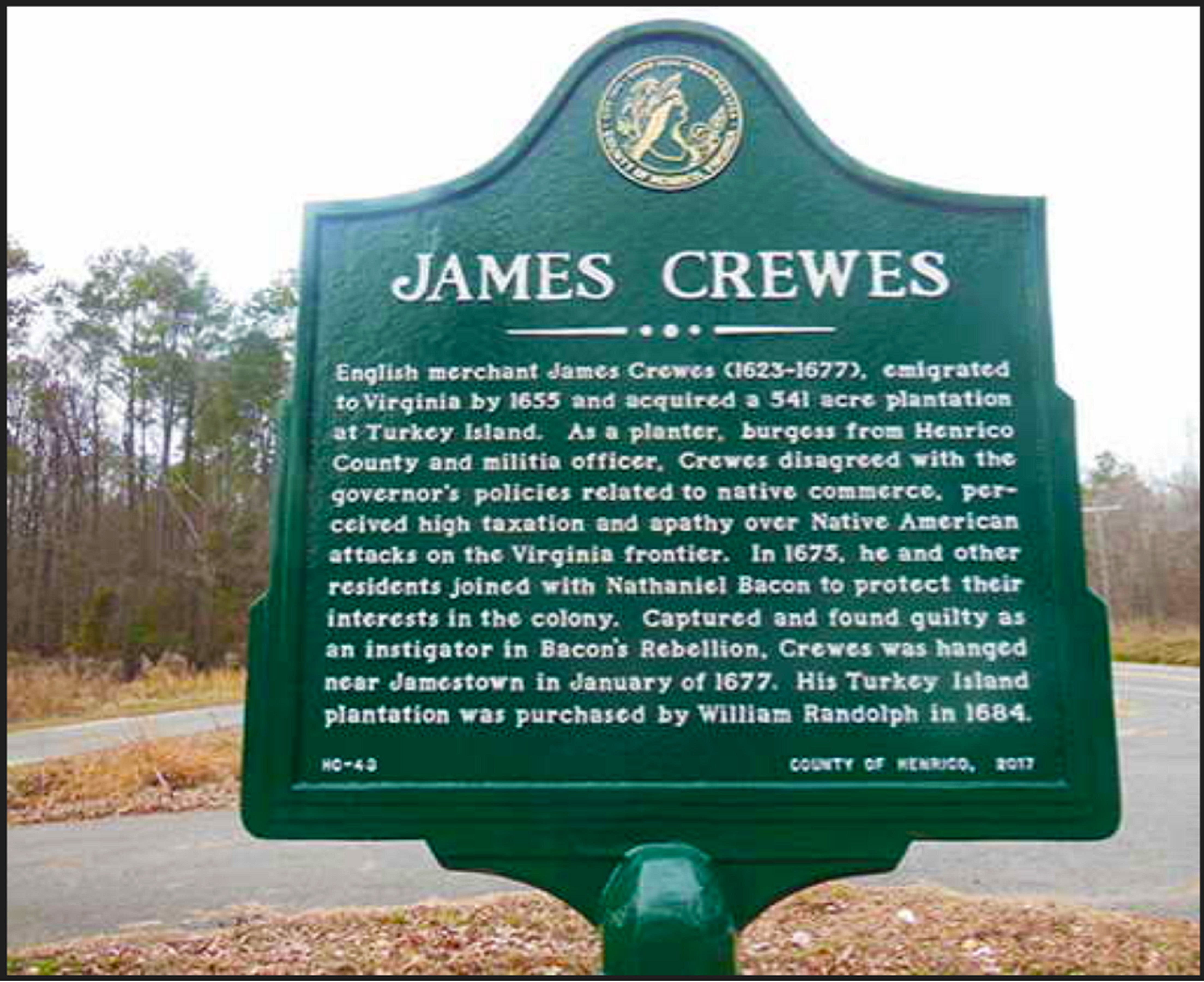
Read the words on the historical marker shown above.
For many years now, I’ve written about the way history is transmitted in the USA.
Whether we are talking about public-facing “commemoration” and “interpretation”, or the history taught in the classrooms of our children, most people in the USA treat history as a list of dates and matching “facts”.
As someone who writes about US history, I am often at pains to make clear that history is a discipline, not a science.
Anyone writing about American history is faced with a daunting mountain of historical documents and records.
Court records. Legislative records. Letters and professional correspondence. Diplomatic correspondence. Drawings, paintings, and photographs. Goods receipts and business accounts. Wills and inventories. Censuses and marriage bonds, banns, and certificates. Family Bibles, religious texts, and prepared sermons. Contemporary news reports and journalism. Poetry and literature. Biographies, autobiographies, and hagiographies. Obituaries and death notices. Weather reports. Pamphlets, posters, placards, and propaganda produced by citizens, foreigners, and politicians. Property conveyancing papers. Tribal enrolment documents. Pension and land bounty records. Music and voice recordings. Physicians’ research, reports, and autopsy results. Flyers and bills for shows, plays, and other entertainments. Military reports to commanders. Ships’ manifests. Banking and loan records. Gravestone inscriptions and epitaphs. History books written by others.
You get the point.
And this isn’t even including accompanying or supporting archaeological, agricultural, architectural, engineering, manufacturing, scientific, and genetic evidence.
So when an historian - or even a writer of popular history - decides to tell a story, there is a LOT of sifting involved.
Example. Writing a single accurate paragraph asserting that large swathes of the American population were deeply affected psychologically by “the night the stars fell” in 1833 might require hours or even days of background reading.
This particularly impressive Leonid meteor shower might be written as a straight astronomical event in history.
Or it could be placed within a wider context involving American scientific progress, or held up as a mirror to America’s enduring tendency to view unusual events through a religious lens.
“The Night the Stars Fell” can be employed as an exemplar, jumping-off point, or metaphor for other historical narratives.
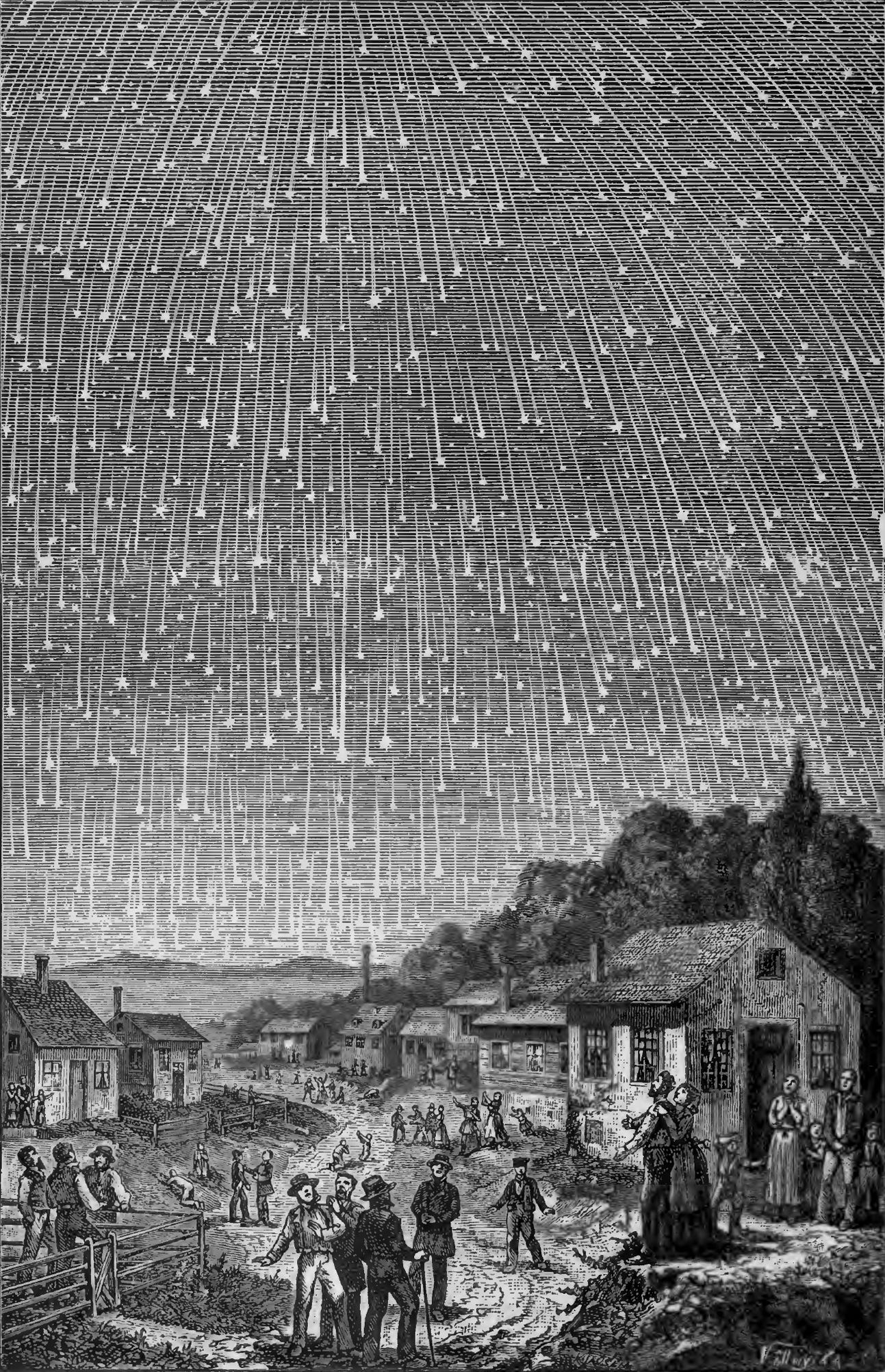
What we choose to say about that mid-November night nearly 200 years ago - and perhaps even more important - what we choose NOT to say, will completely alter the nature, meaning, and significance of the story being told.
This is what humans do.
They repeat stories.
And when they repeat stories, they almost always repeat every story in a way which aligns with their own worldview, stripping-out bits here, adding an embellishment or emphasis there.
A simple historical marker on the side of a road in central Virginia is a perfect illustration of how history in America is truncated, chopped, amended, abridged, curated, and even falsified before being funnelled into the service of the “American Exceptionalism” story.
*****
Henrico County, Virginia started off as a settler-colonialist “Citie” in 1611, and was named for Henry Frederick, Prince of Wales, the son of Anne of Denmark and King James the VI and I of Scotland and England, respectively.
To place this event in context, this is the same year that William Shakespeare wrote “The Tempest”, and just eight years after the death of Elizabeth I.
“Henrico” is a corruption of the earlier Latin rendering of “Henry”, i.e., “Henricus”.
The “Citie of Henricus” was destroyed during the great Powhatan uprising of 1622, but the name lived-on with the establishment of Henrico Shire in 1634.
Henrico is one of the oldest counties in Virginia, and thus one of the oldest in the entire USA.
The simplest way to understand the geography of the region where Jamestown, the Citie of Henricus, and other early colonies were planted, is to picture a vast estuary (Chesapeake Bay) running south to north from its inlet on the Atlantic Ocean, with a huge number of creeks and rivers on both its eastern and western sides. The Chesapeake is in fact the largest estuary in the entire USA - around 193 miles long, and varying between 3 and 25 miles in width.
Today, this bay divides sections of the states of Virginia and Maryland.
Back in the time of Shakespeare, almost every attempt at settlement by the English was begun on the banks of the rivers opening into Chesapeake Bay, or on islands situated in those rivers.
It is impossible to stress strongly enough the fact that such early settlements and “plantations” in Virginia were not a case of “impoverished Europeans escaping political or religious persecution back home”.
Settlements in Virginia were a get-rich-quick scheme for upper-class English elites from London, operating as a trading company under charter from the king.
King James hoped to use such colonies for generating the wealth which would place his kingdoms in England, Scotland, and Ireland on a more equal footing with rivals such as Spain, whose monarchs had already been extracting resources and riches from the Americas for over a century.
The first colonizers to arrive in Virginia were speculators, pure and simple, and they certainly had no intention of stooping to agricultural or manual labor.
Their sole purpose was to get an immediate return on the investments made by various shareholders in Virginia and England.
Any European commoners present in Virginia had been brought over as indentured servants or craftspeople in the service of the shareholding elites.
Early attempts to extract marketable commodities from North American resources - through viticulture, silk-making, glass-blowing, tar and pitch making, carpentry, and salt-making met with only limited success (or outright failure).
Only the development of a tobacco-growing industry, and the eventual replacement of indentured servants with outright slavery, would eventually see a turnaround in fortunes for The Virginia Company of London.
It is worth pointing-out that during the first 20 years of colonization in Virginia and Maryland, shareholders, military men, craftspeople, indentured servants, spies, and war captives arrived there from over a dozen countries other than England - Ireland, France, Germany, Poland, Wales, Switzerland, The Netherlands, Wallonia (Belgium), Italy, Austria, the Ottoman Empire, Spain, Portugal, Scotland, Armenia, and likely Sweden and Finland.
Within another twenty or thirty years, the ethnic mix around the Chesapeake Bay would include Sephardic Jews, like Jacob Lumbrozo.
Later, more Jewish families would relocate from colonies in South America and the Caribbean to Anglo colonies up and down the coast from South Carolina to Rhode Island and New York, bringing their African and Indigenous “servants” with them (and oftentimes, their mixed-ethnic families, as well). This is why we can find free men of color like “Shadrach Jones” being manumitted by his father Simon? Bar Jonas in Charles County, Maryland during the 1700s.
By the end of the 1600s, we can even document the presence of Romani people in Virginia, where a “Gypsy woman” testified before a magistrate that she could not be tried under Christian law, as she was “noe Christian”.
Needless to say, by 1620 the first people from Africa had also arrived in Virginia, much against their will.
It is extremely important to understand that, for the first 50 years of the Virginia colony, Africans and African-Americans were treated in much the same way as European indentured servants, being allowed to serve out a fixed period of labor before gaining their freedom.
African and European indentured servants co-mingled socially and sexually, and liaisons with members of the local Indigenous communities were also common.
This means that for many decades, long before Virginia began to develop and enshrine in law a race-based caste system for slavery, there existed a substantial population of free persons of color.
This early presence of a nominally free, mixed-ethnic underclass, would have a bearing on later events in Virginia, as we will learn shortly...
*****
Tobacco is a labor-intensive crop, and events like the Great Fire of London in 1666 created a great demand for craftspeople, builders, and laborers at home in England.
Better wages in England made indentured servitude in Virginia a far less tempting prospect for the English underclasses.
Unwilling to see their line of income go up in smoke, the wealthy elites of Virginia began to come up with “justifications” for enslaving some indentured servants for life.
You see where this is going...
Tobacco is also a hungry crop, sucking nutrients rapidly from the soil in which it is grown.
In Virginia Colony, this meant that tobacco plantation owners, and increasing numbers of indentured servants who had completed their terms of service, were actively on the lookout for new land to cultivate - land invariably found farther upriver, deeper inside Indian country.
The English had always used violence and duplicity in their dealings with the various Indigenous tribes and nations of Virginia.
Anyone watching Palestine today would recognize the exact same depressing algebra of occupation.
Colonizer steals more land (leading to reprisals from the rightful occupier), and the colonizer responds with multiplied force, claiming that this disproportionate ferocity and brutality is “justified”.
By 1675, The Virginia Company had been dissolved, and the monarchy had assumed direct control of its overseas colony in Virginia.
England had seen a king executed, fought two civil wars, lived through a temporary Puritan and republican takeover of the reins of government, witnessed the restoration of its monarchy, and later watched its capitol city burn down.
The restored King Charles II rewarded those who had remained loyal to the monarchy during the Cromwellian interregnum, and one of his favorites, William Berkeley, was once more given the governorship of Virginia Colony in 1660, a post he had already held (during the English Civil War back in the 1640s).
Berkeley’s second term would end in disaster in 1677.
*****
It is beyond the scope of this article to go into the finer details. What matters, is that a new dynamic was taking shape in Virginia.
Remember the free mixed-ethnic underclass population which was beginning to grow on the outer edges of English forts and settlements?
These people were beginning to push inland in search of more land, bringing them into ever greater conflict with Indigenous peoples, including those tribes who had gone to great lengths to remain on friendly trading terms with English leaders like Berkeley.
Meanwhile, an erstwhile friend of Governor Berkeley named Nathaniel Bacon had arrived in Virginia with his own ambitions.
Bacon, like Berkeley, came from a wealthy, aristocratic background, and was educated at Cambridge, well-connected, and well-travelled. Related to Francis Bacon, who had been Lord Chancellor of England back in the 1620s, Nathaniel Bacon was also a vile man who had attempted to cheat someone out of their inheritance. It was this scandal which saw nepo-baby Bacon shipped off into golden exile by his father to Virginia, with a cool start-up fund of £1,800 (English pounds, worth about a half a million dollars today).
Neither Berkeley nor Bacon had any regard for people below their own social class, and neither had any love for Indians.
Whereas Berkeley preferred to play political chess, using “manageable” tribes to act as a buffer against hostile tribes (while enriching himself through trade monopolies), Bacon saw a faster path to riches for himself and his circle of supporters.
“...ruin and extirpate all Indians in General.”
James Crewes, the man commemorated on the marker at the top of this piece, was another member of the wealthier planter and merchant classes in Virginia, holding both African and Indigenous slaves.
Crewes was an avid supporter of Bacon’s genocidal approach to the ethnic-cleansing of Virginia.
Both Bacon and Crewes recognized that the free mixed-ethnic underclass population could also be mobilized in support of total war against all Indians - after all, it was these people, former indentured servants on the very edge of English settlement, clearing timber for small farms, and outright squatting on already-cleared Indian farmland, who bore the brunt of Indian reprisals.
Add to this the arbitrary way in which Governor Berkeley ran the colony as a fiefdom, throw in some unpopular taxes, cronyism, and a recent collapse in tobacco market prices, and you need only a spark to set-off the fire of insurrection.
In 1676 and 1677, Nathaniel Bacon, James Crewes, and others gathered a small army of this mixed-ethnic crew, which included both free and enslaved men (and women), and led them on a campaign of slaughter against the Indians, making no differentiation between warrior or woman, and taking scores of slaves. The Doeg, Occoneechee, Susquehannock, and Pamunkey were treated with equal treachery, even though the majority of these had lived peacably alongside the English for decades, with some even supplying food and fighting men to assist the English at times.
Many of these friends of the English were forced to flee for their lives with their children into the depths of the nearby Dragon Swamp.
Berkeley denounced his former friend Bacon as a rebel, launching counter-insurgency expeditions against him and his followers.
Bacon even managed to seize control of the government itself for a short time, eventually burning Jamestown itself to the ground.
The rebellion began to fizzle-out after Bacon died suddenly of dysentery in late October, 1676.
Berkeley would get some measure of revenge, overseeing the hanging of a couple of dozen insurrectionists, including James Crewes.
Interestingly, the only party to have expressed empathy for the suffering of the Indians, was the committee who reported on the rebellion directly to King Charles II...
*****
Over the decades and centuries since these events, many historians and commentators have tried to shoehorn Bacon’s Rebellion into a sort of “prequel” role, leading to the War for Independence.
This writer can find no serious reading of these events which would make Nathaniel Bacon a “proto-patriot” or hero.
Bacon was an opportunist who leveraged underclass grievances to further his own ambitions.
It is noteworthy that both Bacon and Berkeley were willing to offer manumission as an enticement to get indentured servants and the enslaved to follow them during this conflict. A modern corollary to this would be the offering of free medical care and third level education funding to US armed forces recruits from disadvantaged backgrounds.
Bacon cared not one jot for his underclass followers, a situation recognizable to many Vietnam and Iraq War veterans, and indeed many of the service people onboard the USS Lincoln near the Persian Gulf today.
This pattern and dynamic was present throughout the frontier years of “Manifest Destiny”, all across America, and through various wars, including the War for Independence.
Offer the underclasses enticements (land bounties, etc.) to do the dirty work, before the wealthy swoop in to reap the rewards. Think kids from West Virginia trailer parks sent to Iraq 20 years ago, while the men behind companies like Halliburton, Blackwater, and Lockheed Martin laughed all the way to the bank (whose governing board were also laughing en masse).
And when the wars are over, when the free land runs out, when crop prices stagnate or tumble, when recessions, depressions, and other crises come (as they always will), many among the underclasses can be trained to believe they are still the social equals of those who send them to war and consign them to a life living paycheck to paycheck, dreading the day a medical emergency finds them.
And with few Indians left in their midst to focus their ire upon today, they can be trained instead to turn their hatred upon “the gays”, “the Libs”, Black and Latino people, or indeed, one another.
Having read this far, look over the words on Virginia’s “historical marker” again, paying less attention to what is actually said, and more attention to the things left unsaid:
“English merchant James Crewes (1623-1677), emigrated to Virginia by 1655 and acquired a 541 acre plantation at Turkey Island. As a planter, burgess from Henrico County and militia officer, Crewes disagreed with the governor’s policies related to native commerce, perceived high taxation and apathy over Native American attacks on the Virginia frontier. In 1675, he and other residents joined with Nathaniel Bacon to protect their interests in the colony. Captured and found guilty as an instigator in Bacon’s Rebellion, Crewes was hanged near Jamestown in January of 1677. His Turkey Island plantation was purchased by William Randolph in 1684.”
Ethnic cleansing becomes “acquired a plantation”. Choosing a policy other than outright genocide becomes government “apathy over Native American attacks on the Virginia frontier”. Launching a full-blown violent insurrection was a way to express disagreement with “...policies related to...perceived high taxation”. Waging war for the freedom to take over and squat on the land of friendly Indians was done merely “to protect their interests in the colony”.
The story could be more truthfully told by saying “Some ruthless, bigoted rich guys (who wanted to get even richer) raised an insurrectionist army by telling a mob that killing would make them better off”.
No one on the colonizing side comes out of this story as “the good guys”.
Not Berkeley.
Not Bacon.
Not even the mixed-ethnic frontierspeople.
The worst consequence of Bacon’s Rebellion? Other than the destruction of various Indigenous communities?
The fact that white, black, and brown people had been willing to rise up against the colonial administration, TOGETHER, led to the introduction of harsher “race laws”, in order to more clearly separate “white” from “black” in America’s emerging racial caste system.
Consider the title of this lovely piece of legislation from 1705:
“An act declaring the Negro, Mulatto, and Indian slaves within this dominion, to be real estate”
This law was expressly intended to force mixed-ethnic people further to one side of the white/black binary caste divide, and superseded this earlier attempt from 1661:
“An Act to to Discourage English Running Away with Negroes”
Divide and rule...
*****
Postscript
As recently as 2020, 50% of Henrico County respondents self-reported their “ethnicity” as “white alone”.
Around 29% of Henrico County respondents self-reported their “ethnicity” as “black alone”.
Almost 10% self-report as “Asian alone”, while around 7% say they are “Hispanic or Latino”.
The remaining 4% is comprised of people who identify as “multiracial”, “Native American”, or simply “other”.
How people self-identify, i.e., “white alone” or “Black alone” SAYS VERY LITTLE ABOUT THEIR ACTUAL ANCESTRY.
What it does say, is something about how people wish to present themselves, about how they wish to be perceived.
The average African-American carries 25% European DNA.
Let’s just leave that fact to stew for a while, while readers ponder the horrifying historical reasons for it.
At least 1 in 20 Americans self-identifying as “white” have some Black ancestry.
Numbers would be higher, except for the late wave of preferential treatment given to “white” immigrants during the late 19th and early 20th century, leading to many communities of German, Scandinavian, Polish, Italian, and Eastern European Jewish people in northern states having never gone through the early colonial interethnic mixing process.
The number of Americans self-identifying as “white” who have some Black ancestry rises to 1 in 10 in places like South Carolina and Louisiana, and will be an order of magnitude higher among “Old Mix Americans”, people descended from pre-War of Independence populations of the Carolinas and Chesapeake Bay area.
Consider the map below, which shows the population of “free persons of color” in 1790, in and around the rivers where Bacon’s Rebellion took place. Many of these folks would have literally been the great-grandchildren of the mixed-ethnic frontierspeople who had rallied to Bacon and Crewe’s flag.
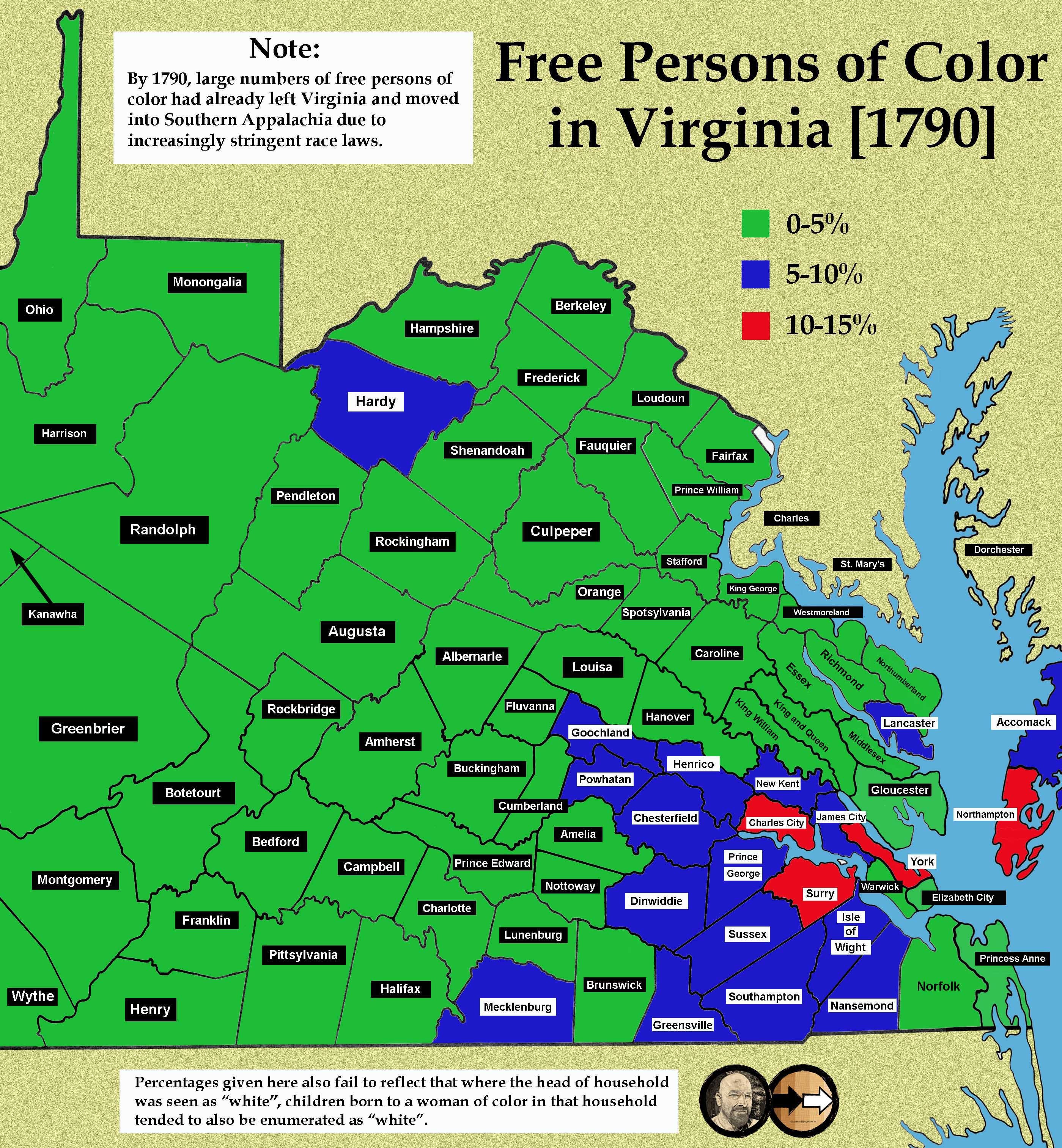
Between Bacon’s Rebellion and the American War for Independence, Virginia introduced some of the strictest and most punitive “race laws” in North America, as we have already learned.
Many free persons of color voted with their feet, and headed west, into the mountains of Southern Appalachia, where many of their descendants still live, to this day, self-identifying as “white” or simply “American”.
You won’t find their story on any roadside historical marker...
I think we all know why.
Comments
Nothing yet. Say the first thing.
Sign in to join the conversation.