
America has some unusual surnames, some of which have mostly died-out in their original home countries.
Sometimes I might spend nearly a week trying to get to the original source of a specific surname - recently I went back to the surname “Cornett”.
The Cornett surname is attached to Appalachia and frontier-era America as certainly as bubble-gum to the underside of a roadside diner table.
The fact is, no one really knows the deep origins of these Cornett folks. The name itself can be found in France, Belgium, and many other places, including Scotland, where it arrived during the Middle Ages along with Norman (French Viking) warlords.
The first American Cornetts appear in the historical record in 1700s colonial Virginia, almost never with any documentary trail back to the Old World.
Later bearers of this surname carry Y DNA (male ancestor) markers from many different lands and wellsprings - a state of affairs only too common in a country where so many families of different ethnic backgrounds carry surnames “borrowed” from the Anglo cultural ascendancy.
Many years of research into the social/ethnic history of Appalachia have led this writer down paths which have induced a full range of reactions - from outright horror to utter admiration.
So when I first read of a “bad” man named Samuel Cornett who was “married” to a certain Polly Davidson (around the turn of the 1700s and 1800s in Letcher County, Kentucky) my mind was open. If there are two sides to every story, then every Appalachian story has at least three sides.
Many of these early non-Indigenous settlers and colonizers of Southern Appalachia are named in various records as slaveholders. This is a story rarely told - the sheer number of people piling into mountainous Indian lands with a few slaves in tow.
The received wisdom of most Americans is that slavery was a “Deep South thing”.
That slavery was only for big cotton plantations.
Large southern plantation owners were certainly the individuals most likely to hold the largest numbers of slaves, and this fact has led many apologists for “The Rebel Cause” to assert that slavery never really took root in mountain country, or that slaveholding was confined to wealthy elites.
This assertion is wrong.
While the mountains of southern Appalachia had far fewer LARGE slaveholders than the Deep South, slavery was still widespread.
Not every person of color associated with a farm, business, or household was enslaved.
When we examine wills and census documents from the period between the War for Independence and say, 1840, we often find households with some members enumerated as “white”, while others might be enumerated under categories such as “all other free” or “free persons of color”, or perhaps “all other persons except Indians not taxed”.
Years of studying thousands upon thousands of such documents has made it obvious that many heads of household were extremely fluid in how they reported the status of household members - this occurred for a myriad of reasons, with “racial status” and free or enslaved status affecting everything from property rights to tax burdens.
The issue of exactly who was truly enslaved, and who was a family member, consort, or concubine (being portrayed as being enslaved), is somewhat complicated by the fact that Virginia and the Carolinas were among the earliest states to move legislation against their “free colored” populations.
By the time of the American Revolution, Virginia and the Carolinas had seen nearly 200 years of inter-ethnic mixing between non-enslaved African-Americans, Atlantic Creole “Portuguese”, mixed-ethnic Caribbean peoples, Lenape, Shawnee, Catawba, Saponi, Pamunkey, and other Indigenous peoples, Brazilians, Jewish adventurers and merchants, and Romani peoples from Germany (Sinti), France (Manouche), Spain (Gitanos), and the British Isles (Romanichal).
Not to mention peoples from the Dutch East Indies, Madagascar, India, or the Barbary Coast of North Africa...
So. When we look at a man like Samuel Cornett in 1820s Eastern Kentucky, listed as a slaveholder and head of a household including people of color, we need to take the existence of these Old Mix Americans into account.
Oftentimes the “slaves” enumerated as the “property” of a household were actually part of mixed-ethnic frontier families, and only enumerated as “slaves” because inter-ethnic marriage had been made illegal under various pieces of repressive legislation.
And yes, sometimes the people of color were the children born to women suffering under a shocking imbalance of power, whether they were “free” concubines, or held as virtual sex slaves…
*****
Samuel Cornett might have been “brown” or “white” himself. Of single ethnicity or multi-ethnic.
Samuel Cornett would not have been the first to blur the lines between outright slavery, forced concubinage, and common-law marriage.
These are all things which this writer tends to bear in mind when reading accounts of lives on the American frontier.
And after weighing all of the evidence to hand, Cornett does indeed seem to have been the holder of at least four or five outright slaves.
Again, merely being a slaveholder does not automatically mean the enslaver was “white”, nor does it automatically mean that the enslaved were of wholly, or even partial African ancestry (the widespread enslavement of American Indians is shockingly forgotten by most).
As a writer, I have often been loathe to address the issue of “brown slaveholders”, because white supremacists and racists tend to latch onto such facts, as if the existence of a small percentage of non-white slaveholders somehow calls the evil of 300 years of race and caste-based chattel slavery into question.
Even worse, modern white supremacists and racists seize onto this fact as if it somehow excuses their own racism today.
A feeling for nuance is rare among such people…
Leaving all of that aside, what really caught my eye was the family lore telling how Samuel Cornett’s wife/consort Polly Davidson contracted “consumption” - tuberculosis - and spent her last couple of years kept in a “pen”.
Needless to say, this seemed like one of the most horrifying pieces of historical detail one might stumble across.
For years I kept a special file on this particular Samuel Cornett, his name under an ugly dark cloud in my imagination.
The slaveholder who locked his sick wife in a “pen”.
But this man is why every single tid-bit of random knowledge from life’s rich tapestry is worth learning.
You see, Southern Appalachia is home to its own culture, with its own words and ways and food and building traditions.
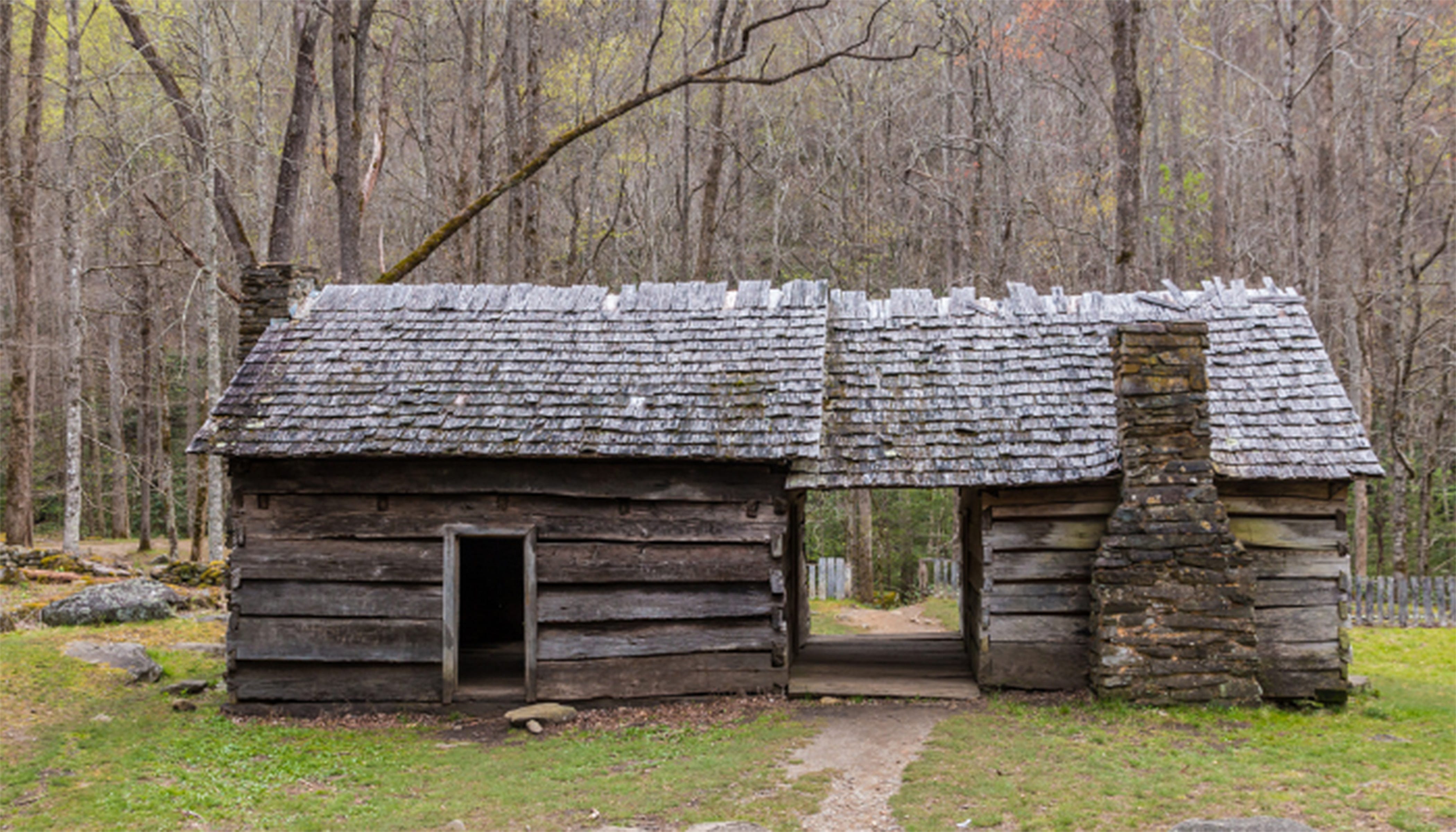
Southern Appalachian innovation created the “dog-trot cabin” - two small cabins separated by a narrow gap, but covered by a single roof.
An ingenious way to manage temperature in an age before central heating and air conditioning...
Two compartmentalised cabins are easier to heat quickly in winter.
Two compartmentalised cabins with a narrow gap encourage the “Venturi Effect” in summer heat, in which any wind passing through the gap is cooled, helping to cool both cabins, while affording the perfect covered, shady, and cool place to sit out-of-doors.
A pleasant place for man and dog alike...
But most important to this story, the two separate rooms of a “dog-trot cabin” were known as...”pens”.
So simple historical documents can be read in at least two utterly different ways, depending on the level of knowledge we possess, and the lens through which we choose to view the past.
In one, we have a brutal slaveholder who kept his suffering wife/concubine locked away in a shed.
In the other, we have a multi-ethnic family trying to survive, and a woman with tuberculosis living in the cabin beside her family, in an effort to halt further spread of sickness to her children.
Maybe before deciding how to view things, we should consider a couple of final details.
*****
It is said that shortly after Polly Davidson’s death, Samuel Cornett went fully insane...
Family folklore tends to have little good to say about Samuel.
He is said to have abandoned one wife (and children) back in Virginia.
Without diaries or letters, we are unlikely to ever know why. He may have been an abject, worthless family man. His first wife may have been screwing around.
Men and women in early Appalachia often parted ways on grounds of adultery - which was committed by men AND women. The records are myriad.
We do know that many of the people casting aspersions on his character and mental capacity were people with an interest in his property.
We know that some of these people - including members of the family he left 30 years previously - sought to disenfranchise Polly Davidson’s children, calling them “illegitimate”.
We know that Samuel Cornett pushed back against this, describing these “illegitimate” children in affectionate terms.
Other folklore tells of a woman (concubine?) enslaved by or living with Samuel Cornett. She is said to have killed another young enslaved boy with an iron for harming her young baby.
Samuel Cornett, apparently enraged by her damage to his “property”, is said to have made the girl walk barefoot for miles to present herself to the local judge, where she faced a count of murder.
Apparently the judge declined to convict upon hearing her evidence.
So was Samuel Cornett a cruel, vicious disgrace of a man?
Or was he being vilified by a former family and community scandalized by his “taking-up” with an Indian or African-American woman?
All of the above?
We just don’t know.
But a few things we do know.
Keeping a wife in a “pen” in the early 1800s did not mean what it means today.
And the trauma visited upon generations of human beings by the actions of other human beings travels down the decades and centuries.
The self-loathing and societal dysfunction caused by people - usually women and people of color - being treated as “less than” forges a long, hard steel chain of pain, suffering, and trouble, until something - or someone - breaks that chain.
Comments
Nothing yet. Say the first thing.
Sign in to join the conversation.