
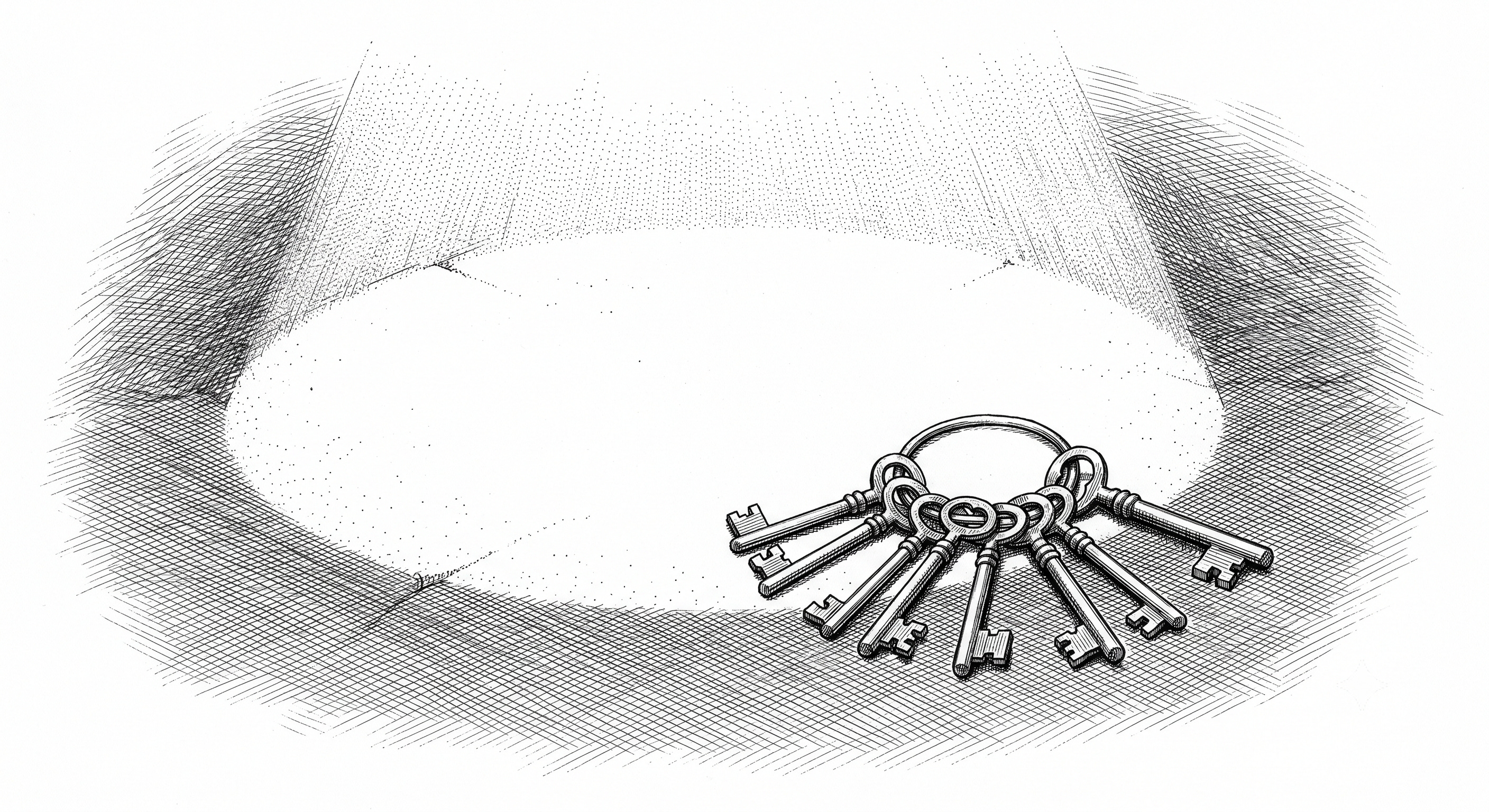
A man is on his hands and knees under a streetlight when a police officer stops to help. “What are you looking for?” the police officer asks. “My keys,” replies the man. The police officer joins the search. After a while, he asks the obvious question: “Are you sure you dropped them here?” “No,” the man says. “I dropped them over in the park.” “Then why are you looking here?” asks the exasperated police officer. The man replies, “Because this is where the light is.”
It’s an old and familiar joke.1 We repeat it as a story of a fool. It isn’t. It’s a story about facilitation methods.
Every method for gathering pre-meeting intelligence is a streetlight. It illuminates one kind of thing and leaves the rest in the dark. The man under the lamp isn’t stupid. He’s doing what all of us do the moment we select a method: searching where the method illuminates.
A streetlight will show you your keys on the pavement. It can’t show you keys in the park grass or in your pocket or that you never had keys at all. The light has a domain, let’s call it the domain of the findable, and outside of that domain, using the light reports nothing, which is easy to mistake for proof that there is nothing to see.
It seems to be human nature to formulate our questions so that their answers fall within the reach of the methods we already know and trust.2 Abraham Kaplan formalized this propensity as “the principle of the drunkard’s search.”3
I think about this constantly when a group is preparing for a consequential decision, and someone asks how to find out what people actually think before the room convenes. I can think of three methods — three “lights” — that finish the sentence “What I’m missing is…” differently: a survey, an in-person interview, and Reflect & Engage, which combines elements of the others.
A survey assumes you already know the right questions, and that what you’re missing is the distribution of answers. An interview assumes you’re missing depth, context, nuance, and the thing a person only says when someone draws it out.4 Reflect & Engage assumes groups often can’t see their own blind spots due to time pressure, status dynamics, and the urge to reach consensus.
One method isn’t inherently superior to the others. Their relative usefulness (and cost) is a function of what you’re trying to see and the size of the group.
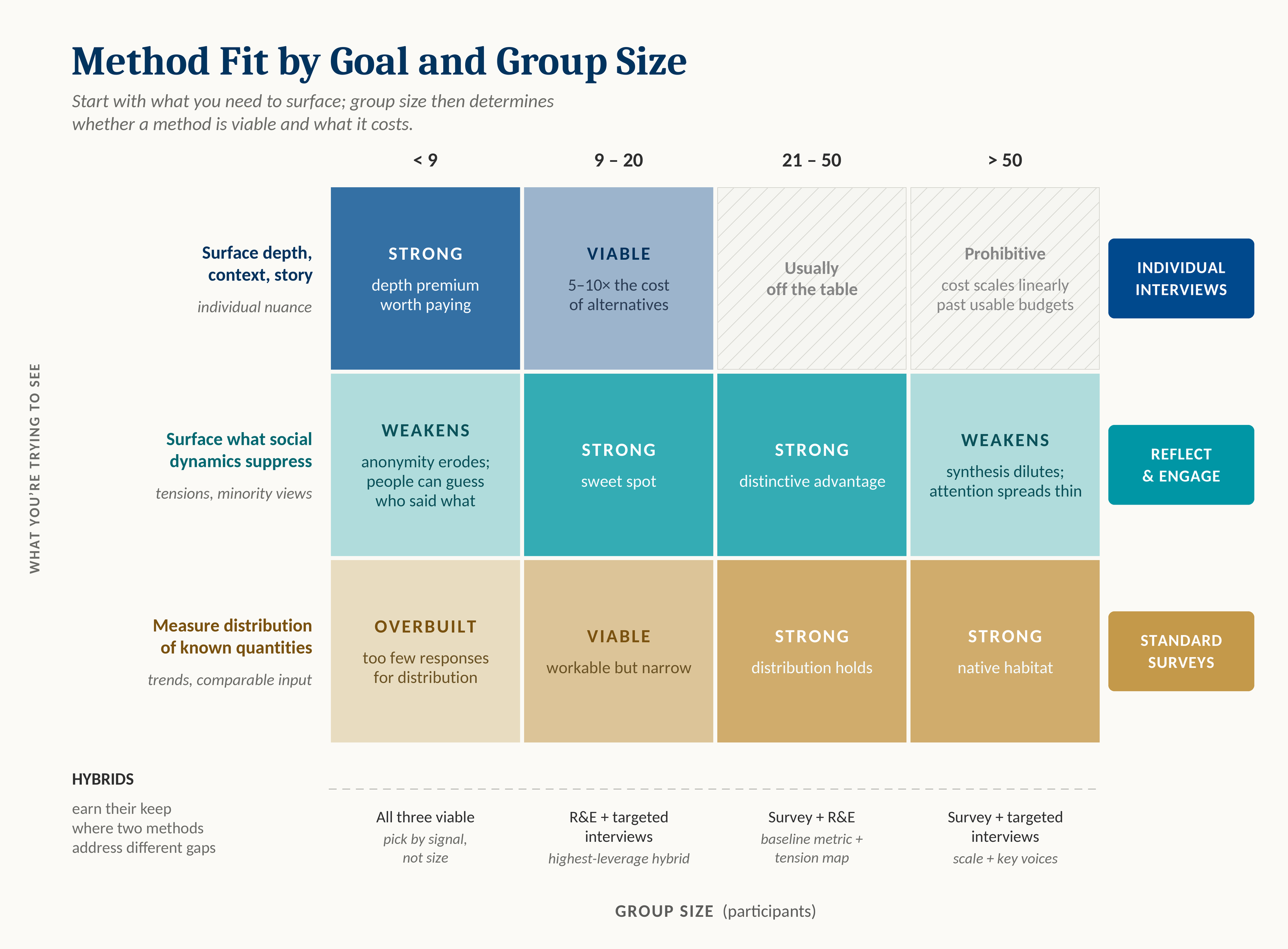
Each method illuminates certain information and has blind spots:
Surveys yield quantitative distributions and trends, but are blind to the question no one thought to ask.
Individual interviews return stories, nuance, depth, and help build a trusted relationship with the interviewer. However, the interviewer’s presence skews what is divulged.
Reflect & Engage returns a “map” of tensions, minority perspectives, and untested assumptions. Sometimes, though, it might shine light on empty pavement.
Notice what the grid takes for granted: that you already know which row you’re in. It settles everything downstream of that choice — which method, for which size of group — yet the choice itself, naming what you’re trying to see, is made in the dark.
We typically choose the light in which we’re most comfortable standing. We use the method that we already know and trust. That implies that we know what we’re missing: trends, depth, or points of divergence.5
The uncomfortable truth is that choosing a different method doesn’t escape the problem; it only moves it. The choice is still made in the dark, and I don’t have a clear resolution to the dilemma. So the question worth asking before the meeting was never which method is best. It was the one the man under the lamp couldn’t bring himself to ask: “Are you sure this is where you lost your keys?”
The tale of the missing ring appears in Classic Tales of Mulla Nasreddin, retold by Houman Farzad and translated from the Persian by Diane L. Wilcox (Mazda Publishers, Costa Mesa, California, 1989), page 26. The Nasreddin tales go back centuries.
Kaplan, Abraham. The Conduct of Inquiry: Methodology for Behavioral Science. San Francisco: Chandler Publishing Company, 1964.
Of course, we can choose to use more than one method, which broadens the scope of illumination.
No posts
Comments
Nothing yet. Say the first thing.
Sign in to join the conversation.