
The Johari Window is a framework developed in 1955 by Joseph Luft and Harry Ingham, two psychologists at UCLA.1 It was originally conceived from research on group dynamics, and its central purpose is to enhance self-awareness of personality and behavioral traits to improve interpersonal communication within a team.
The original model maps what you know about yourself against what others know about you, expressed as a “window” consisting of four quadrants.2 The Arena holds what is mutually known. The Façade holds what you know but conceal. The Blind Spot holds what others perceive about you that you can’t see about yourself. The Unknown holds what no one on the team has yet discovered.
I’m interested in what happens when you change the unit of analysis from personality traits to decision-relevant knowledge.3
Redefining the Window
Consider all the information relevant to a group decision, including facts, intuitions, doubts, and patterns. It can be sorted into the quadrants of a slightly revised version of the Johari Window:
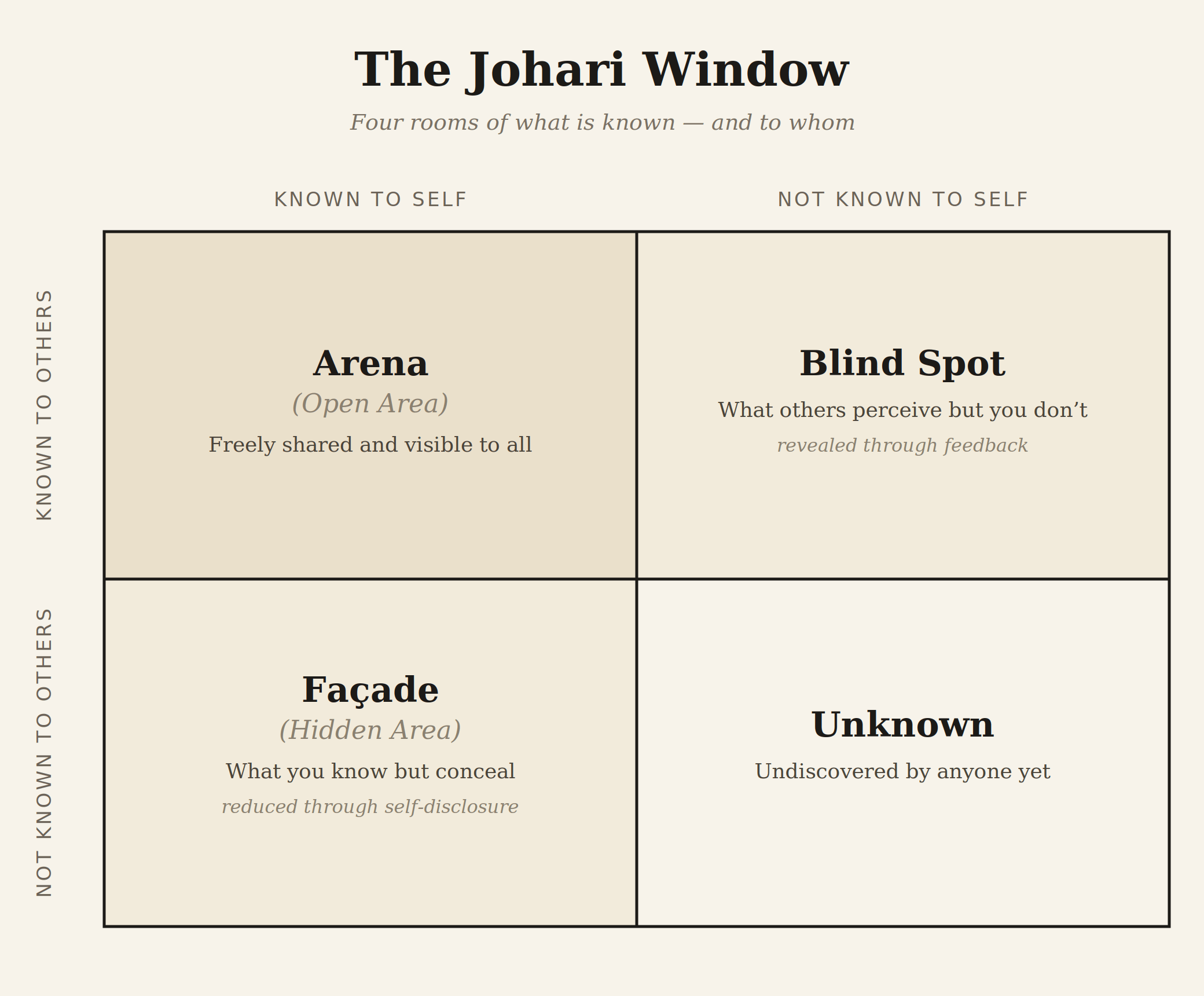
The Arena is what’s genuinely on the table for the team's consideration. These are the facts and interpretations the group holds in common and can reason about together.
The Façade is what individual members know but haven’t revealed. This might include the engineer’s doubt about the timeline, the salesperson’s sense of a customer’s real reservation, and the misgiving that never found a safe moment to share. This is where hidden profiles live, the unique knowledge that research has shown groups systematically fail to discuss.4 The contents of this quadrant shrink through self-disclosure.
The Blind Spot is what the team sees that the individual can’t. The contents of this quadrant shrink only when feedback is sought and heard.5
The Unknown is what nobody on the team knows yet. No amount of disclosure or feedback touches it; only probing the world does.
The window doesn’t tell a group what to do. It tells the group where its knowledge is, and, more uncomfortably, where it isn’t.
The Bonus Is Paid in the Arena
Scott Page’s argument for the diversity bonus is, fundamentally, an argument about repertoire. Groups whose members can access diverse mental models, heuristics, and categories can outperform homogeneous groups — even those consisting of higher-ability individuals — on complex problems.6 But the bonus is a potential, not an automatic property of the team. The bonus is realized only when the differing perspectives interact in a shared view.
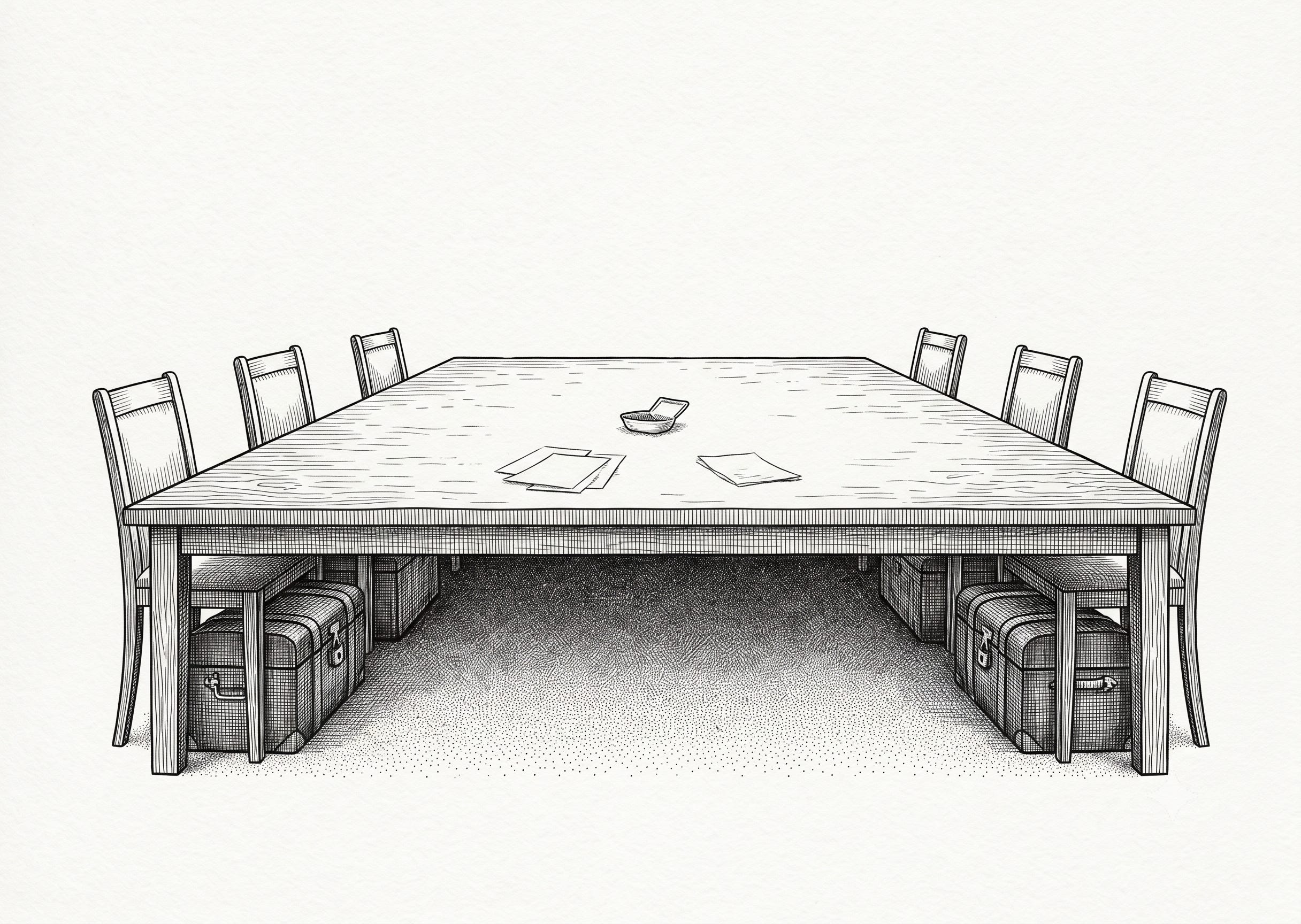
The Johari Window is a visual representation of that requirement. Cognitive diversity that sits in the Façade is like inventory in a locked warehouse. The group recruited it, paid for it, and gave it a seat at the table, but it contributes nothing to shared understanding. The hidden-profile experiments show the default with depressing consistency. Groups gravitate toward rehashing what everyone already knows. The Arena is filled with redundancy, while the Façade often carries the new information that matters.
A team’s effective intelligence, then, is not bound by what its members know but by the size of its Arena. The question isn’t, “Do we have diverse perspectives?” It’s, “What moves knowledge from the Façade into the Arena?”
The Courage Tax
Luft’s prescription for moving information from the Façade to the Arena was self-disclosure. It sounds frictionless. It’s not.
Disclosure inside an organization is an attributed act performed in front of an audience that can impact your future. Surfacing a doubt about the strategy means attaching your name to dissent, in real time, with the sponsor present. I’ve argued before that courage is a tax on honesty.7 Every revelation that crosses from the Façade into the Arena incurs a toll. Innocuous facts cross cheaply. The observations that would most change the shared picture — the ones implicating the sponsor’s pet assumption, or the group’s last decision — are taxed at the highest rate. Consequently, the Arena fills with what’s cheap to say.
The standard remedy is psychological safety: lower the tax rate by changing the culture.8 I think Amy Edmondson is right about the destination, but cultural change is slow and fragile, and it resets with every reorganization and every new boss. Telling a group to “be more open” is telling it to pay the tax voluntarily. Some people will. The pattern of who won’t is exactly what makes the loss invisible.
Subsidizing Disclosure
The Johari Window is a fair way to visualize what Reflect & Engage attempts to do. Before the meeting, participants respond to carefully framed reflection questions asynchronously and anonymously. Next, AI-supported synthesis provides the facilitator with situational awareness — particularly of dissenting views — that they can use to guide the discussion. The intent is to move Façade contents into the Arena without the act of disclosure being attributed, thus reducing reliance on individual courage.
I want to be careful here, though. The Reflect & Engage process design subsidizes the crossing from Façade to Arena, but it doesn’t eliminate the cost. It relocates it. Anonymity has its own price. A witness draws out what you almost know, and removing the witness helps you say only what you can already articulate.9 Asynchronous reflection is less effective at eliciting the inchoate kind of knowledge that only emerges when someone pushes back in conversation.
Observing Isn’t Orienting; Orienting Isn’t Deciding; Deciding Isn’t Acting
Further caution is warranted, lest we become overconfident. Increasing the contents of the Arena improves the group’s information position. That’s all.
You can lead a group to information, but you can’t make it think.10 A richer shared picture still has to be interpreted. Orienting is where shared information either becomes shared sense-making or doesn’t.11 Groups are perfectly capable of observing a well-stocked Arena and then reasoning their way to the conclusion they’d already reached. Better orientation, in turn, doesn’t guarantee better decisions. The decision step has its own pathologies of framing, timing, and authority. Furthermore, better decisions don’t execute themselves. The gap between deciding well and acting effectively has buried more strategies than ignorance ever did.
Each arrow in that chain — observation to orientation, orientation to decision, decision to action — is its own failure point, and enlarging the Arena addresses only the input to the first one. I think that input is the binding constraint more often than groups admit, which is why I keep working on it. However, I hold that out as a judgment about where leverage is often found, not as a law about where it always is.
What the Johari Window offers isn’t a guarantee. It’s a useful representation of what we collectively know, what we’re individually withholding, what others could tell us, and (the largest room) what nobody yet knows. Acknowledging our ignorance seems like a useful step toward effective orientation and decision-making.
Luft, J., & Ingham, H. (1955). The Johari Window, a Graphic Model of Interpersonal Awareness. Proceedings of the Western Training Laboratory in Group Development, University of California, Los Angeles, Extension Office. “Johari” is a portmanteau of the authors’ first names.
The classic exercise asks participants to select a handful of adjectives from a standardized list (e.g., confident, caring, introverted) that they feel describe them. Others in the group do the same for that person. The overlap between self-selection and peer selection populates the Arena; traits peers chose, but the individual did not, constitute the Blind Spot; traits only the individual chose form the Façade; traits no one chose fall into the Unknown.
I’m far from the only person to adapt the Johari Window in this way. For a recent example, see: Amy Jo Richardson, David B. Knight & Walter C. Lee (24 Feb 2026). How Organizational Partnerships Spark Information Sharing in a Quest for Sustainable, Institutional Change. Community College Journal of Research and Practice. In an earlier, related framing, Secretary of Defense Donald Rumsfeld said the following in a February 2002 news briefing: "Reports that say that something hasn't happened are always interesting to me, because as we know, there are known knowns; there are things we know we know. We also know there are known unknowns; that is, to say, we know there are some things we do not know. But there are also unknown unknowns — the ones we don't know we don't know."
Garold Stasser and William Titus (1985). Pooling of unshared information in group decision making. Journal of Personality and Social Psychology 48, no. 6. Their hidden-profile studies found that groups disproportionately discuss information all members already hold, leaving uniquely held information (often the decisive kind) unspoken. I explored this pattern in “When Cognitive Diversity Stays Silent.”
Admittedly, this is an awkward mapping. However, it’s not central to the theme of this essay, so I’m going to skip over this awkwardness for the time being.
Scott E. Page (2017). The Diversity Bonus: How Great Teams Pay Off in the Knowledge Economy. Princeton University Press.
Amy C. Edmondson (2018). The Fearless Organization. Wiley. My quarrel isn’t with psychological safety as a goal; it’s with relying on culture alone as the mechanism, given how slowly it accrues and how quickly it can erode.
“The Cost of Removing the Witness.” The design tension between anonymity and elicitation isn’t settled in my mind.
Dennis, A. R. (1996). Information Exchange and Use in Group Decision Making: You Can Lead a Group to Information, but You Can't Make It Think. MIS Quarterly, 433. Access to more complete information is a necessary but insufficient condition for effective orientation and good decision-making.
In “Navigating Turbulent Seas,” I sketched why orientation in John Boyd’s OODA loop — observe, orient, decide, act — is the constraint that interests me.
Comments
Nothing yet. Say the first thing.
Sign in to join the conversation.