
You’ve been getting the morning sun.
Out on the step before the phone, 10 minutes, face to the sky — because a thread said it lowers your cortisol and that’s what’s been wrecking you.
You’ve been doing a good thing for the exact wrong reason.
What you’ll learn in this post:
→ Why “lower your cortisol” is the wrong goal for the morning entirely
→ Which two of the seven have real trials — and what those trials actually measured
→ The walk that changed a measured brain region — and the detail that makes it work
→ Read time: 8 min
If you do one thing today, do number three — the walk. It’s the only item here with a brain scan behind it, and almost everyone does it wrong.
A mum in the community told me she’d been standing in her garden at 6:15 every morning, phone left inside, “detoxing her cortisol” before the kids woke. She said it felt virtuous and nothing changed and she couldn’t work out what she was doing wrong.
This is experience, not evidence. One person. No measurements.
the goal itself is upside down
Here’s the claim running through every one of these threads: cortisol is the enemy, and the job of your morning is to get it down.
Morning cortisol is not the enemy. It’s the thing that gets you out of bed.
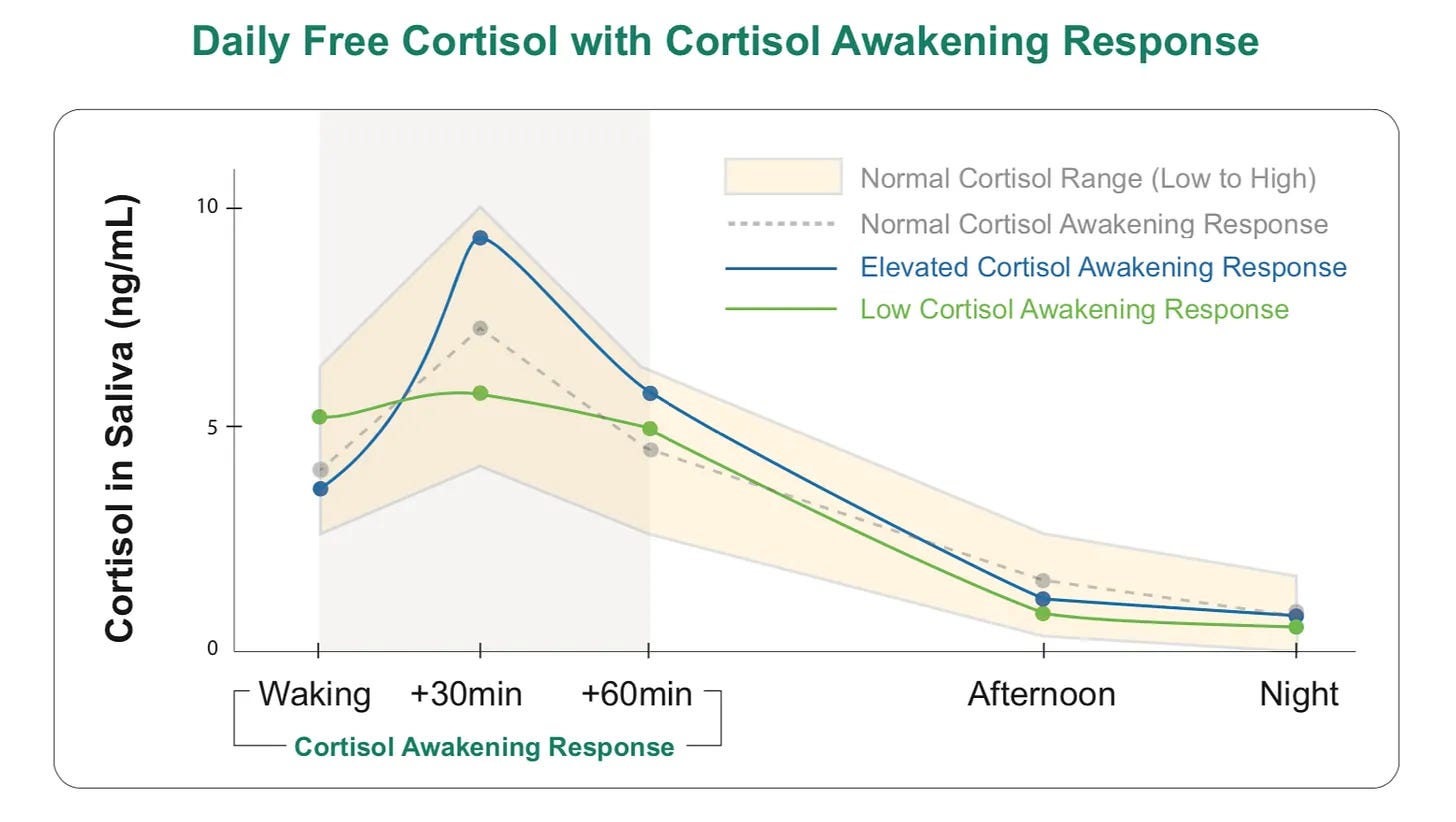
There’s a specific, well-studied event called the cortisol awakening response — a sharp rise in cortisol over the first 30 to 45 minutes after you wake. It’s supposed to happen. A flat one is associated with burnout and exhaustion, not calm.
And morning light doesn’t lower it. It sharpens it. When researchers moved healthy men from dim to bright light in the early morning, cortisol jumped more than 50% almost immediately (Leproult, 2001 — https://academic.oup.com/jcem/article/86/1/151/2841140). Later work found bright and blue-enriched morning light raises the awakening response compared to dim light (Petrowski, 2019 — https://www.sciencedirect.com/science/article/abs/pii/S0306453018306565).
So the tip is right and the reason is backwards. Get the morning light. Not because it drains your cortisol — because it delivers a clean, sharp morning spike, which is exactly what lets the hormone fall properly by night. You want a mountain in the morning so you can have a valley at 10pm. The thread sold you a tool for flattening the mountain.
I spent a good while writing “get morning light to lower cortisol” into my own notes before I checked it. I had it in a draft. Then I read Leproult and realised I’d have been telling thousands of people to chase a number their body is working hard, and correctly, to raise.
Before we go further: if your mornings are the flat, can’t-move, nothing-left kind — not wired, just empty — then a low cortisol awakening response might be your issue, and “calm your cortisol” is the wrong advice for you entirely. That’s a GP conversation, not a garden one. This post is for the wired mornings.
THE TWO WITH REAL EVIDENCE
→ The physiological sigh. Keep it. Correct the claim.
Two quick inhales through the nose, one long exhale through the mouth. The thread says it’s the fastest way out of sympathetic activation.
108 people, randomised, five minutes a day for a month: this exact pattern beat mindfulness meditation on mood and lowered breathing rate (Balban, 2023 — https://www.sciencedirect.com/science/article/pii/S2666379122004748).
The catch: in that same trial there was no significant change in heart-rate variability — the standard readout for the “sympathetic to parasympathetic” shift the thread promises. It works on how you feel. The autonomic switch it’s sold on didn’t show up in the numbers. Do it anyway. Just know what
it was measured to do.
→ The phone-free rest. Keep it. This one’s almost right.
“Scrolling is not rest” is the one line in the thread with real backing. Rumination — the loop of repetitive self-focused thought — is a measured risk factor, and stimulation feeds it. Which brings us to the walk, where the actual evidence lives.
That leaves five tips, one of which has a Stanford brain scan behind it and is being described in a way that throws away the part that matters. One is doing genuine work for a reason nobody explains. And two are pleasant rituals with no evidence at all — which is fine, as long as you know that’s what they are.
Here’s all seven, graded, and the one move I’d build a morning around.
The full stress-reset protocol is inside — including the exact sequence and the one move most parents skip.
Reply with the number — which of the seven were you already doing? 1 to 7.
And if you were doing the morning light one: tell me why you thought you were doing it. Lower cortisol, or something else?
I ask because that answer tells me more about where you’re stuck than any symptom would. Send it and I’ll tell you the one thing on your list worth keeping and the one you can drop tonight.
Most of what I know about this came from replies like yours, not from the papers.
Bilateral tapping is used inside EMDR, a real trauma therapy. Tapping on its own, for cortisol, in a stressed parent, has no standalone trial I can find. The rhythm may be soothing. That’s not nothing. It’s also not evidence. Use it if it helps; don’t expect it to move a hormone.
Raises the morning cortisol response, doesn’t lower it, and that’s the point (Leproult, 2001; Petrowski, 2019, above). Get outside before the phone. You’re building a sharp morning peak so the curve can fall at night. Bonus: morning light anchors your body clock, which is what actually improves the following night’s sleep.
The thread says “not treadmill, not podcast, a real walk” and calls it “neural switching.” Close. Here’s what was actually measured.
Stanford researchers sent people on a 90-minute walk in either a natural setting or a busy urban one. The nature-walk group came back with lower self-reported rumination and reduced activity in the subgenual prefrontal cortex — a brain region tied to the repetitive negative thinking that drives low mood. The urban walkers got no such change (Bratman, 2015 — https://www.pnas.org/doi/10.1073/pnas.1510459112).
Comments
Nothing yet. Say the first thing.
Sign in to join the conversation.