
You did the open-loop dump.
Pen and paper, 90 seconds, every unfinished thing on the list — the dentist, the school form, the thing you said you’d send on Thursday. You even did the 4-8 breathing after.
You were awake at 3:07 anyway.

→ The three items on the list that hold up — and what each one was actually tested to do
→ Why the “cortisol is destroying you” framing is doing more damage than the wake-up
→ The one thing measured against arousals from sleep — the thing you’re actually complaining about
→ Read time: 8 min
If you do one thing from today, do the fibre. It’s the least glamorous item here and it’s the only one measured against the specific thing you have.
THE PROBLEM: the frame is the fault
The list opens by telling you high cortisol shaves five years off your life, tanks your testosterone, locks belly fat onto you, and literally shrinks your brain.
The five years came from nowhere. There is no study. Nobody ran a cohort, measured cortisol, and counted the years. The number was chosen because it sounds like something.
The brain-shrinking claim is different, and that’s what makes it dangerous. There is a paper. Around 2,000 Framingham participants, average age 48, one early-morning blood draw and an MRI. Higher serum cortisol tracked with lower brain volume and worse memory (Echouffo-Tcheugui, 2018 — https://www.neurology.org/doi/10.1212/WNL.0000000000006549).
One blood draw. One morning. Cross-sectional. When readers wrote in to point out that the arrow could run the other way — that brain changes could be raising cortisol rather than the reverse — the authors published a response agreeing the inverse direction may also be considered.
I quoted that study. I wrote “stress shrinks your brain” in a post, with a link, and I felt clever doing it.
Then someone replied with the author response and I went back and read the methods, which I had not done. One blood draw, at one moment, on one morning, with no follow-up. I’d turned a correlation into a threat and used it to frighten exhausted people into reading further.
Before we go on: this post assumes your 3am wake-up is not a cortisol disorder. If you’ve been diagnosed with Cushing’s, Addison’s, or adrenal insufficiency, none of the below is aimed at you and your endocrinologist’s plan beats anything on the internet, including mine.
For everyone else — you don’t have a cortisol emergency. You have a wake-up, and a list of eight things, and no way to tell which ones are real.
So let’s sort them.
THE TWO THAT SURVIVE (AND WHAT THEY ACTUALLY DO)
→ The 9pm paper dump. Keep it. Halve the promise.
Fifty-seven adults, wired for polysomnography in a sleep lab, randomly assigned to spend five minutes writing either a to-do list for the next few days or a journal about tasks they’d finished. The to-do list group fell asleep faster. And the more specific the list, the faster they went under (Scullin, 2018 — https://pmc.ncbi.nlm.nih.gov/articles/PMC5758411/).
Writing it down → the unfinished task stops being something your brain has to hold → sleep pressure wins.
Real study. Gold-standard measurement. Small, young, one night.
Here’s the part the thread doesn’t mention: it measured falling asleep. Sleep onset latency. Nobody has shown a to-do list stops you waking at 3. You’ve been given a sleep-onset tool and sold it as a 3am tool.
→ The long exhale. Keep it. Bin the mechanism.
The thread says long exhales recruit the vagus nerve — the brake on cortisol.
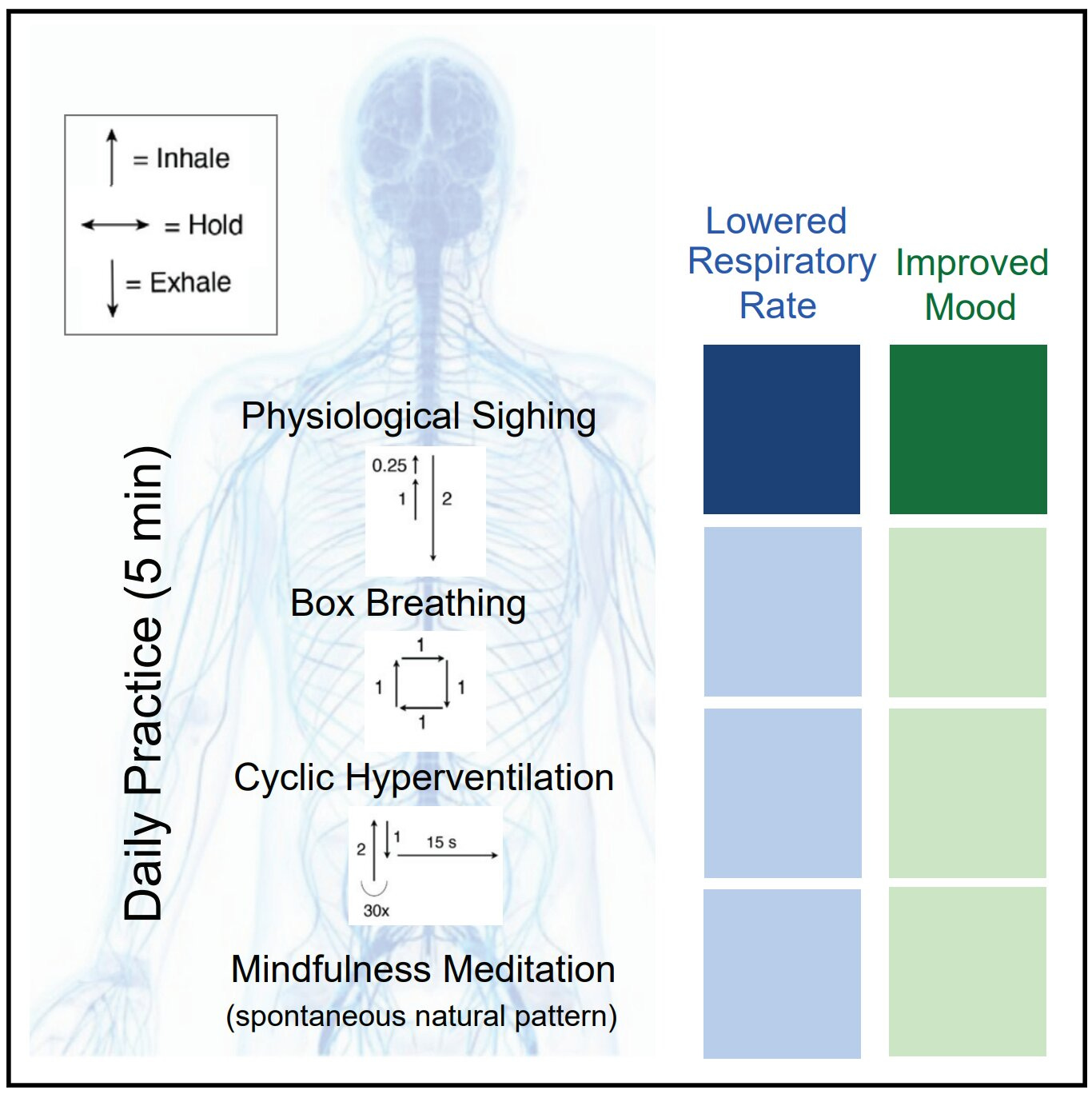
108 people, randomised, five minutes a day for a month: exhale-focused breathing (the double inhale, long exhale) beat mindfulness meditation on mood and lowered respiratory rate (Balban, 2023 — https://www.sciencedirect.com/science/article/pii/S2666379122004748).
And in that same trial, there was no significant change in heart-rate variability or resting heart rate. In any group.
HRV is the standard proxy for vagal tone. The best trial of this exact practice looked for the vagal signature and didn’t find it. The study didn’t measure cortisol. It didn’t measure sleep at all.
So do the breathing. It works — on mood, in 108 people, over 28 days. Just not for the reason you were given, and not on the thing you were promised.
That leaves six. One of them is the only item on the list that matches an actual first-line clinical treatment — and it’s buried at number seven. One of them is quietly costing you sleep every night you obey it.
And the single strongest food finding in this entire argument isn’t on the list at all, because it’s about your lunch.
The full sleep + nutrition protocol is inside — including the exact meal timing that works around your kids’ bedtime.
When you wake at 3, are you wired — heart going, brain sprinting — or are you just awake, flat, staring at the ceiling?
Those are two completely different problems with two completely different fixes, and almost every list online treats them as one thing.
Comments
Nothing yet. Say the first thing.
Sign in to join the conversation.