
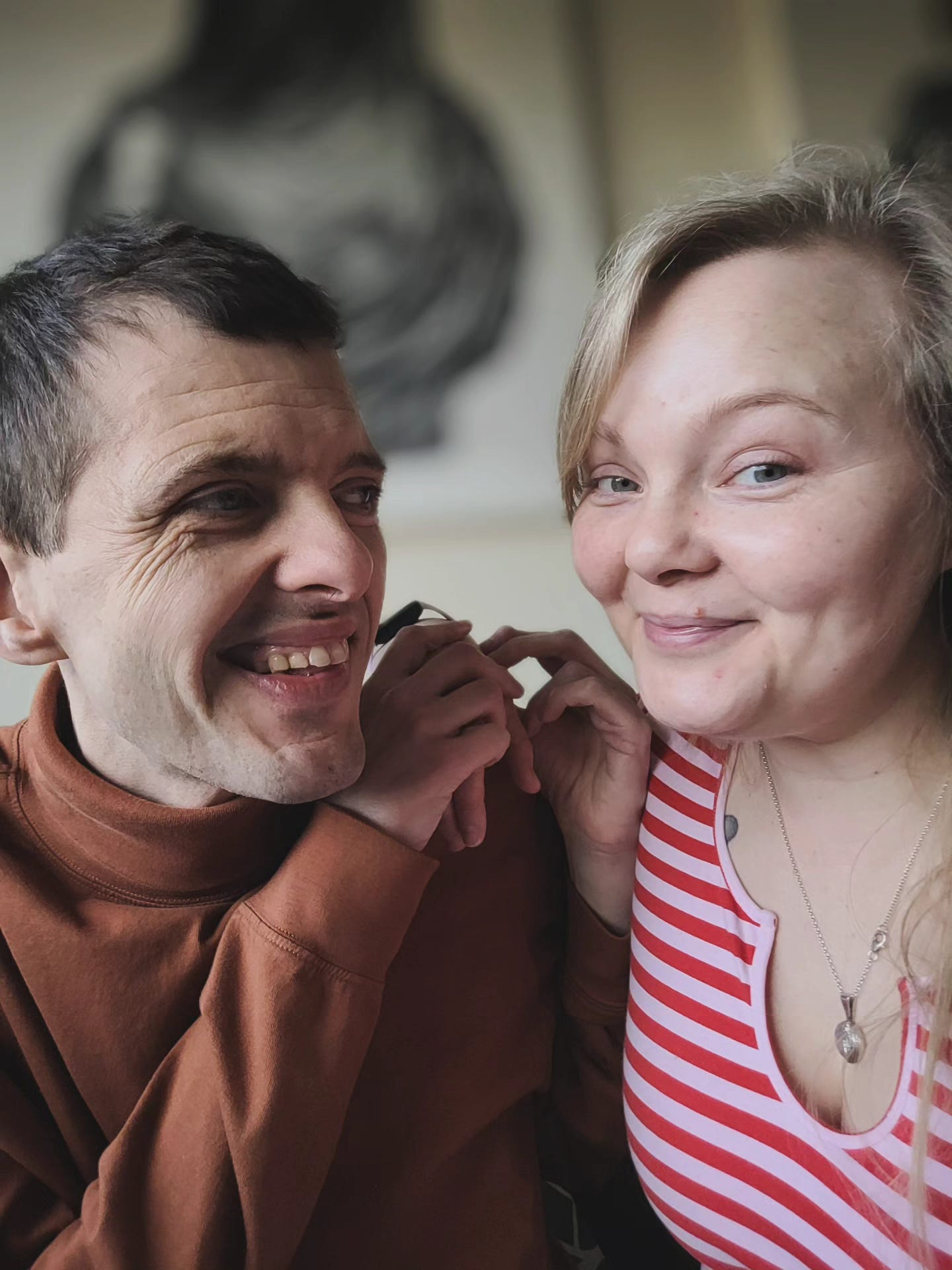
In some ways, autism is wildly different for the both of us, and in other ways we couldn’t be more alike. Comparing the two of us, you realise just how unique the experience of being autistic can be, even between siblings, but also see how there are shared characteristics that connect us in invisible ways. This is the same on a much wider scale within the autistic community as a whole. You may understand how being autistic impacts one person, but that doesn’t mean you understand how it impacts all of us. So much of the autistic experience happens internally and invisibly to the rest of the world. Finding the right words to fully capture the constant challenges and immense fullness of my experience doesn’t seem to get much easier, even as time goes on. However, I have been taken aback by just how much I have learned about myself while spending more time with my brother.
Matthew is non-verbal with learning disabilities and requires 24/7 support. He is extremely sensory seeking, constantly rubbing his hands across the environment around him and twiddling with his clothes so much that he wears holes in the collars. He finds it almost impossible to stay still, and even when he’s relaxing on the sofa he will be bobbing his head or moving his body. He is very hypermobile and can contort himself in all sorts of positions. Matthew also makes a lot of noises, some of which seem to help him express his feelings - such as singing tunes when he’s happy, or a deep and loud roaring when he’s upset. He also grinds his teeth so hard that they squeak. This is exactly as you imagine it sounds, and is so bad that the left side of his teeth are actually ground down about half the length of the other side. Lots of these behaviours you might call stereotypically autistic, but he also likes to invade peoples personal spaces and either smell your hair (a sensory seeking activity), or peer into your face, lock eye contact and have a deep look into your soul. The intensity of the soul-peering still takes me by surprise, moreso because it doesn’t hold the same kind of pain that can attach itself toeye contact with others. [On an aside, I have spent much of my life teaching myself to exercise the muscle involved in eye contact and fully understand it can be important in showing neurotypical people that you’re listening to them - I try to do it as much as possible in conversation, but there are more and more times I realise how intentional I have to be with it.] I have often wondered why my brothers eye contact feels different, and the closest explanation I can find is that it holds absolutely no judgement. It is exactly how I imagine it might feel to be looked into by God. In another life, my brother would roll his eyes at this comment and tell me that he is no closer to God than any of us, but once you’ve experienced his ability to connect to your soul through eye contact, you’ll know exactly what I mean. There is a purity within it, and a feeling of being unconditionally accepted and seen for who you are in a way that no-one else manages.
In contrast, I am able to communicate pretty well, if I do say so myself. I have managed to exist in the world reasonably normally for quite a long time, and as a result was only diagnosed late into my 30’s. I am what many would identify as high functioning, which, quite frankly, is a label I very much dislike. It suggests that things are easy, but it’s more that the difficulties are more invisible to others, but that doesn’t make them any less real or impactful. I have over 30 years of masking hardened in layers covering my identity, which include the avoidance of too much movement and anything that might make me look odd or weird. I communicate well because I have spent so much time and energy learning how to do so. I learned very early on the importance of being able to articulate my experience and find words to hold the confusing and painful life I found myself existing within, even if those words were only ever shown to the pages of my diary.
As time goes on, I begin to realise how similar my brother and I really are. I have tightly wound myself in order to protect the soft, vulnerable pieces of me. My brother does not feel the same fear of judgement or the threat of being ostracised, something that I am both jealous of and deeply grateful that he never has to experience. As I open up the layers of masking to see what is beneath, I discover a innate urge to move my body almost constantly. I still struggle to let go of my own judgement of this, and feel very self conscious around other people, but when I’m alone, or with my brother, I am moving. Matthew offers me permission to mirror his movements, to give me a place to begin. I bounce my head to the unseen rhythm that guides his own, and he smiles when he sees me joining. I rarely speak when we are together, finding that so much more can be said without words. As a result, my nervous system relaxes. I no longer have to play the part of myself, I can just be.
I am still finding my way through this journey after I received my diagnosis in 2023. I started in a place of reading lots and collecting pieces of others’ autistic experiences in order to understand my own. I am now entering a new landscape, where I am seeing and meeting myself properly for the first time. It has taken me this long to begin to feel more comfortable with the actual embodied reality of being autistic, which feels weird to say, because obviously I have always been autistic and do have an actual diagnosis, but it has felt like an alien part of me that I haven’t always felt very comfortable to be with, let alone allow others to see.
When I talk about playing the part of myself up until this point, it can sound like my entire life has been a lie. In some ways, this is true, but not in a malicious way to trick other people, more in a self-preservation way to trick myself into believing I was the same as other people, so that I could actually exist in the world without drawing too much attention to the bits that weren’t anything like everyone else. I mirrored others and adopted the likes and dislikes of those around me. I was someone who didn’t make decisions, and would instead prefer others to choose - which, in my mind, would mean the decision would be right. It wasn’t that I didn’t trust myself, it was that I wasn’t enough of a Self to actually attach trust or distrust to. For those that aren’t neurodiverse, this might not make a whole lot of sense, but I was very very young when my unconscious buried my true self somewhere deep inside. It was hidden so deeply within me so early on in my life, that I was never aware that I had been replaced with a ‘more acceptable’ copy. My brain protected me by forming a new identity based upon the world I lived in and how I perceived others. Most, if not all, people act a little different depending on who they’re around, but for those of us who mask, this can be on the extreme end of things. The problem was that I kept getting things wrong, because I was trying to play a role which I was only given half the script for, and it was also in a completely different language. That’s when I really began to suffer. You cannot thrive like this, and over time it becomes less and less compatible with life.
My diagnosis came after almost two decades of depression and anxiety. It wasn’t picked up after a breakdown in my early 20’s, and so I carried on muddling through until I started to develop symptoms of an autoimmune condition.
There are many things that can impact the characteristics and nuances of being autistic and cause deterioration of skills and a lowered capacity to manage life. My health deteriorating was one of these things, and actually brought my neurodivergence into the open for the very first time. If I had not become unwell, I might still be unaware of this huge part of my identity. Maybe it wouldn’t matter because I’d still be able to muddle through, but perhaps there is an inevitability in muddling through and the resulting impact on physical health. There is such a lot of evidence now showing that the stress of constantly being in a dysregulated state can cause long term health conditions, particularly autoimmune ones. I began to really struggle with certain life skills and daily tasks that I had never really thought about before - suddenly I had to spend immense amounts of energy and focus guiding myself through how to make a phone call, drive a car, have a conversation. It was much more than just fatigue and brain fog, though that was obviously making things a lot worse. I now realise that coping long-term with pain and fatigue every single day, lowered my capacity to mask and manage the constant barrage of internal and external input that I thought everyone experienced. The flood gates had opened and it would be impossible to close them again.
As I continue to age and walk further along this path of discovery, I uncover more and more of myself. I have had to come to terms with certain things no longer being comfortable for me and the impact can be far-reaching and difficult to process. I am increasingly overwhelmed by sensory stimuli. Things that I didn’t used to think about at all have now become painful, like my brain is trying to escape through my skull. I find sounds one of the most difficult things to manage nowadays. Bustling, busy places have become something I tend to avoid almost completely. I read someone’s experience the other day talking about how they can’t taste food when there are too many people talking, and I understand that completely. It is like every single voice has climbed inside my head and is jumping around screaming. I lose myself in it, in the worst possible way. In those moments I have to consciously use all my energy to remind myself of how to function and that I’m actually a person with their own identity. It’s like it splits my being into pieces and nothing makes sense anymore. Upsettingly, this can happen at home, in my safe space, as well, especially when my capacity is particularly low. A noise latches on to my focus and begins to tear away pieces of me. The curse of being autistic is never being able to escape from the constant bombardment of sensory input and never really being able to control when things become too much to handle.
I constantly experience everything all at once.
This is both a curse and a gift. I can’t escape from it but in many ways, I don’t think I’d want to either. I experience the world in full colour. I see every leaf and blade of grass, each stone and ant and snail. I see the way the breeze moves through the leaves on the trees and hear each layer of sound laid out like written music on paper. I notice how the sunlight plays upon water and the beauty hidden within a patch of weeds. I see it all. I notice when something seems out of place (like a bat in the middle of the day on someone’s drive when I’m out for a dog walk). I notice the unspoken and unseen, both in the world around me and in the people I come across. All of these things are a gift. Moments to cherish and hold close. Moments to connect on a deeper, slower, more meaningful level to this life I find myself living through.
The truth is, there is much in this world that confuses me and causes me pain. I worry a lot, especially about my future. I know that not everyone can understand my experience of the world, even after I weave so many words together to try and show them. I am tired of having to explain myself, but constantly feel the need to apologise for who I am becoming, because it is not always as easy to be around, or as palatable. I know that there is a very real possibility that I will lose more skills as I age, particularly when I enter the menopause. I don’t know what this will look like, or what it will mean. Sometimes that scares me.
I also hold deep reverence for the person who was hidden for so long, and who is now stepping/falling/tumbling out of me. I am proud of myself for continuing to uncover the layers and of being so open to meeting myself in this way. I know in my heart that I deserve to embrace my authentic self, because I will not survive otherwise. Life is beautiful and painful and awe-inspiring and ridiculous and so much more than I can ever put in to words. I do my best to let it all float through me, observing with wonder and curiosity this strange and stupendous life.
My brother continues to teach me so much about this life and of myself. He invites me to let go of the thinking and embrace more of the being. He asks only that I listen, stay open, and keep returning to who I have always been, underneath it all. That is who he sees when he looks into my soul.
The need for routine and sameness:
My Sacred Scholarship Paper exploring Autism and the Flow State:
Autism & The Flow State: A Path to Freedom & Self Worth with NeuroSomatic Flow™
·
January 21, 2025
Before you get stuck into this paper, I wanted to write a few words at the start. I have been itching to share this with you all ever since I finished it in November. It’s the first time I’ve written an essay since my Counselling diploma, which was a fair few years ago now. But this is by far the first time I’ve really been allowed to share my story and…
My journey after diagnosis through my blog posts:
Hello Autistic Me.
·
June 20, 2023
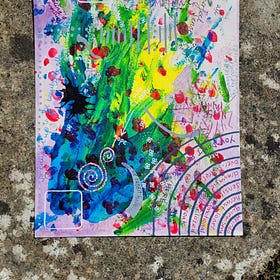
As someone who has arguably slipped, tumbled and freely jumped headfirst into the proverbial over-sharing hole in the past, it’s come as a great surprise to me that I’ve kept this to myself for so long. It’s something that I’ve only really begun to explore within the safety of my journals in the last 6 months or so, and I’ve mentioned it to very few peo…
Autistic Me, 10 months later
·
April 26, 2024
April is Autism Acceptance Month, and I have been meaning to write this for the last 26 days, but it's been hard to know where to start.
·
July 22, 2025
The two year anniversary of my official autism diagnosis passed by without me realising, yet I think about being autistic every single day.
A poem about unmasking and the porousness of feeling everything:
A poem about being spread too thinly, but also of being an ‘other’:
No posts
Comments
Nothing yet. Say the first thing.
Sign in to join the conversation.