
Welcome to Issue #51 of Becoming Berkshire!
I originally wrote a couple of paragraphs about Hochschild-Kohn back in Issue #8, but since it was the first investment Munger and Buffett had made together, I figured I’d dive a bit deeper and give it the attention it deserves. So please excuse me if this does not fit the chronological order of the Berkshire timeline as we go back in time to 1966.
During the first half we, and two 10% partners, purchased all of the stock of Hochschild, Kohn & Co., a privately owned Baltimore department store. This is the first time in the history of the Partnership that an entire business has been purchased by negotiation, although we have, from time to time, negotiated purchase of specific important blocks of marketable securities. However, no new principles are involved. The quantitative and qualitative aspects of the business are evaluated and weighed against price, both on an absolute basis and relative to other investment opportunities. HK (learn to call it that - I didn't find out how to pronounce it until the deal was concluded) stacks up fine in all respects.”1
At this point, Buffett was on a generational run, just not the kind you might expect. The world’s greatest investor had just taken control of a textile company that was shedding mills by the month, largely because of a petty grudge with the family that ran it. He then followed that monumental mistake by purchasing a struggling Baltimore department store. You can’t make this stuff up!
Hochschild-Kohn, or as Buffett puts it (“HK”), was, at one point, the largest department store in Baltimore.
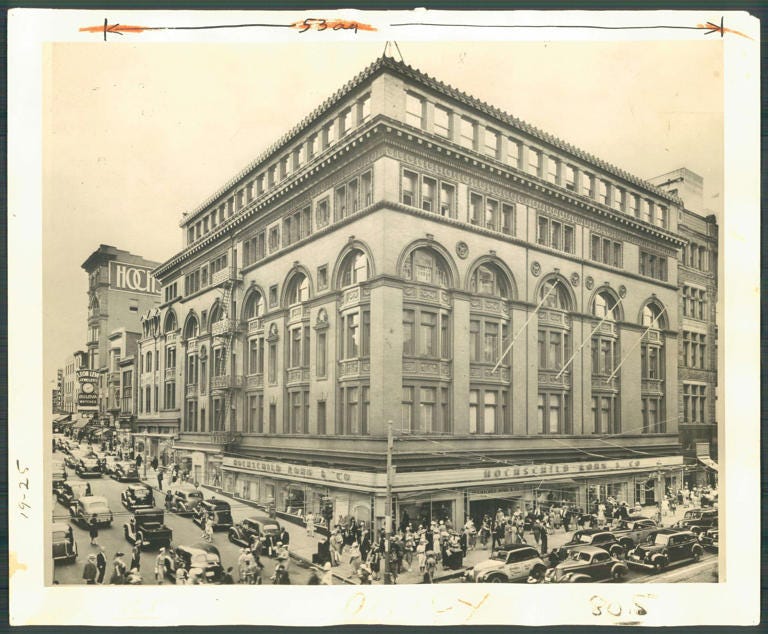
The company was founded in 1897 by Max Hochschild and brothers Benno and Louis B. Kohn. They opened their first store at Howard and Lexington Streets in downtown Baltimore.
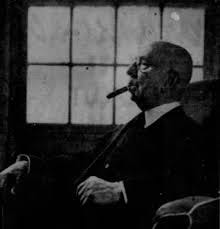
In 1912, the partners purchased another building at 208 North Howard Street, and by the time Hochschild-Kohn incorporated in 1922, it had become Baltimore’s largest department store.
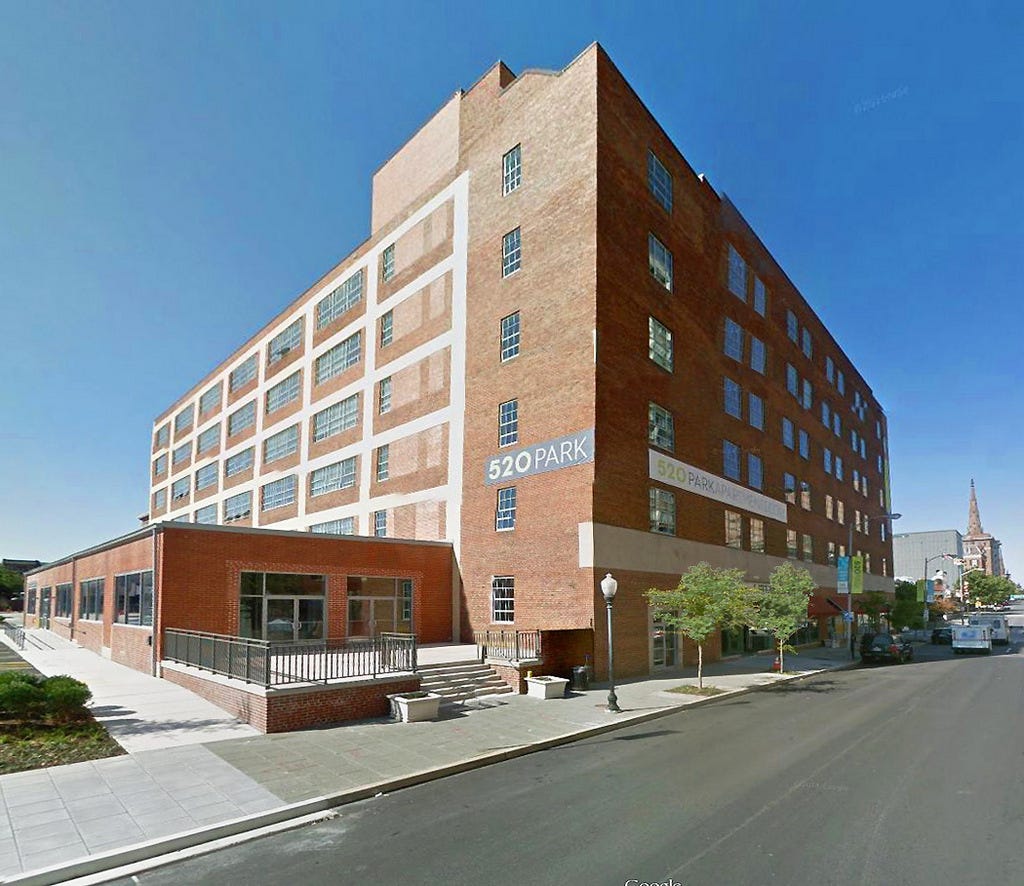
Far after incorporating, the company was still run as a family business. In 1923, Hochschild-Kohn purchased most of the block surrounded by Howard, Franklin, Park, and Center Streets, with plans to build a much larger store.
Unfortunately, HK had financial woes, hit with the retirement of its president, Max Hochschild, followed by the Great Depression. I could only imagine how a retailer survived the depression. My mother worked at Nordstrom during the Great Financial Crisis, and our family barely got by.
During the worst year of the Depression, Hochschild-Kohn’s sales were down nearly 50% from 1930. On a percentage basis, its sales fell more than the combined decline suffered by Baltimore’s other department stores.
On top of stagnant sales, there was strife within the family. Benno Kohn died in 1929. Walter Kohn retired in 1935 after clashing with Irving Kohn. After Irving died in 1945, Martin B. Kohn became president, with Louis Kohn II and Walter Sondheim Jr. serving as vice presidents. Ah, what a treat I must be to work with your family.
Under Martin Kohn, Hochschild-Kohn began following its customers out of downtown Baltimore and into the surrounding neighborhoods.
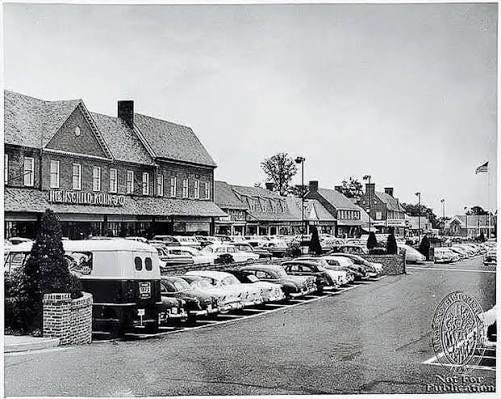
In 1947, the company opened its first branch outside downtown at Edmondson Village, west of the city’s central business district. The shopping center was promoted at the time as a uniquely designed suburban development built around a growing, middle-class rowhouse community.
A year later, Hochschild-Kohn opened another branch in the Govans neighborhood at Belvedere Avenue and York Road.
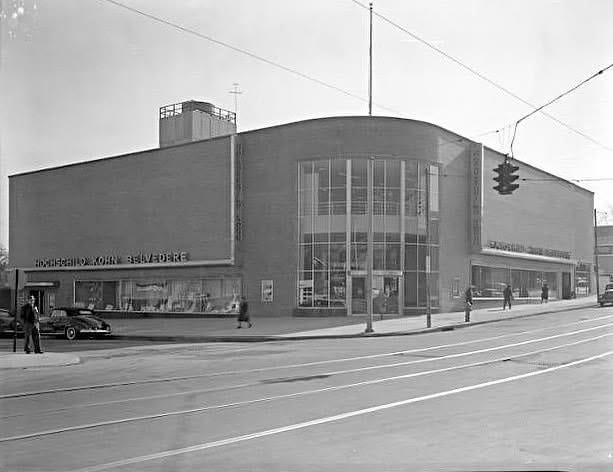
Although the Edmondson Village and Belvedere stores were still technically within Baltimore’s city limits, both were located far from the company’s original downtown store. Hochschild-Kohn was already beginning to recognize that the future of retail was moving away from downtown.
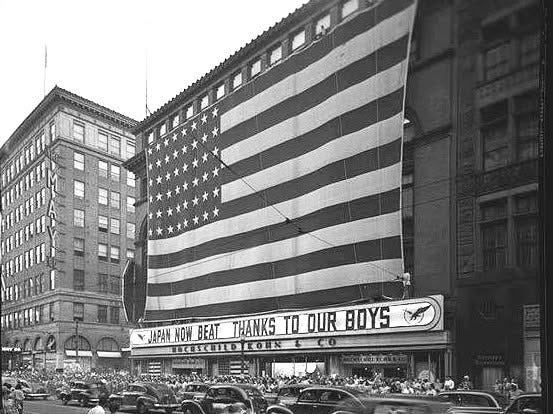
At the same time, the company continued investing in its original downtown location, adding more space to the Howard and Lexington Street store in 1959 and 1960.
This was the challenge facing many department stores at the time. Customers were moving away from downtown areas and into the suburbs, so the stores had to follow them. But opening suburban locations did not make the cost of operating the old downtown store disappear.
This was part of a major shift in the American retail landscape. After World War II, the economy boomed, the Baby Boom took off, and millions of middle-class families left crowded cities for newly constructed suburbs, aided by government-backed mortgages, inexpensive land, and an abundance of new homes.
As the population spread out, traditional downtown shopping districts became less convenient. Going downtown could also be a pain, ah, some things never change. Parking was limited and expensive, while shoppers who took streetcars had to lug their purchases home or have them delivered.
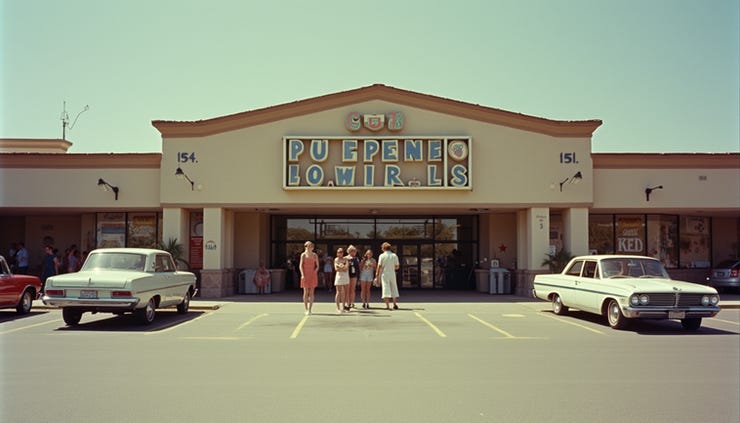
At the same time, car ownership soared. By 1960, nearly 80% of American households owned at least one car, giving families the freedom to shop farther from downtown. Suburban shopping centers offered exactly what they wanted: stores closer to home, wide-open spaces, plenty of parking, and eventually several retailers under one roof.
This ultimately set the stage for the modern shopping mall, which essentially recreated the downtown shopping experience in the suburbs, only with easier access, ample parking, and protection from the weather.
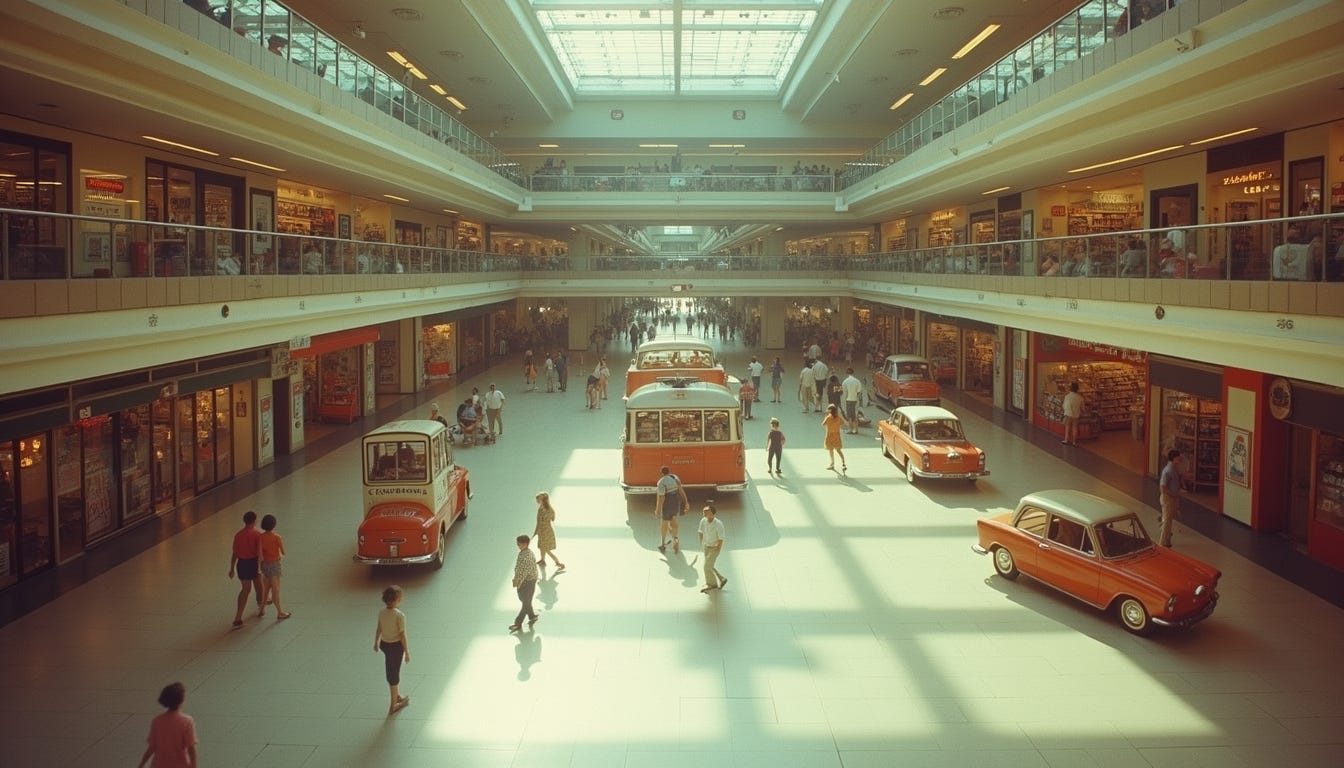
“Downtown seemed to change overnight. By the late 1950s buildings were being knocked down to make way for parking lots, and shopping centers and hotels were being developed along the highway outside of town.“By the early 1960s, people exchanged boasts about how long it had been since they had been downtown,” Bryson writes. “They had found a new kind of happiness at the malls.”"2
Hochschild-Kohn initially benefited from its location along the streetcar route. But as streetcars disappeared and more people purchased cars, the company lost some of that competitive advantage.
In modern terms, this was the equivalent of Buffett buying Circuit City just as the e-commerce boom was beginning to rage.
HK now had to maintain its large downtown operation while also spending money on new stores. At the same time, it was competing against shopping centers, changing consumer habits, and retailers designed specifically for customers who traveled by car.
The company’s surviving records show just how complicated the business had become. Shout out to the Maryland Center for History and Culture.
HK had detailed policies covering merchandising, advertising, banking, employee discounts, markdowns, customer service, deliveries, alterations, theft prevention, and even what employees were allowed to wear during different seasons.
In 1960, Hochschild-Kohn integrated the tearoom in its downtown store, reportedly becoming the first department-store tearoom in Baltimore to do so.
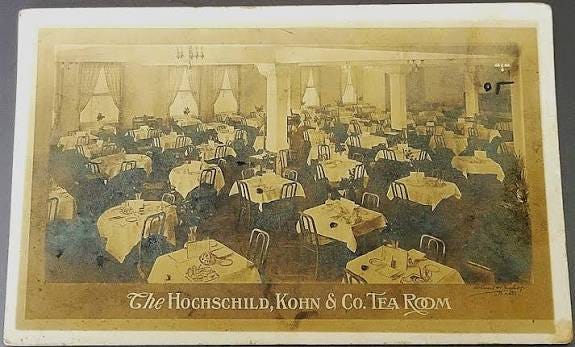
Some customers responded with angry letters. But letters supporting the decision outnumbered those opposing it by nearly ten to one. The decision also appears to have been financially successful.
By the early 1960s, management was spending more and more time trying to improve efficiency and control costs. A 1961 study examined the growth potential of the furniture business. A 1964 report looked at sales, payroll expenses, staffing levels, and possible cost reductions. Other reports studied the company’s workrooms and branch stores.
The question was whether an old, family-run department store could change quickly enough to keep up with an industry that was moving in an entirely different direction.
That direction was the move away from downtown to suburban shopping centers, and the rise of independent regional department stores and larger chains with greater purchasing power. Stores like Hutlzer, Hudson’s, Famous-Barr, Rich’s, and Hecht’s, to name a few.
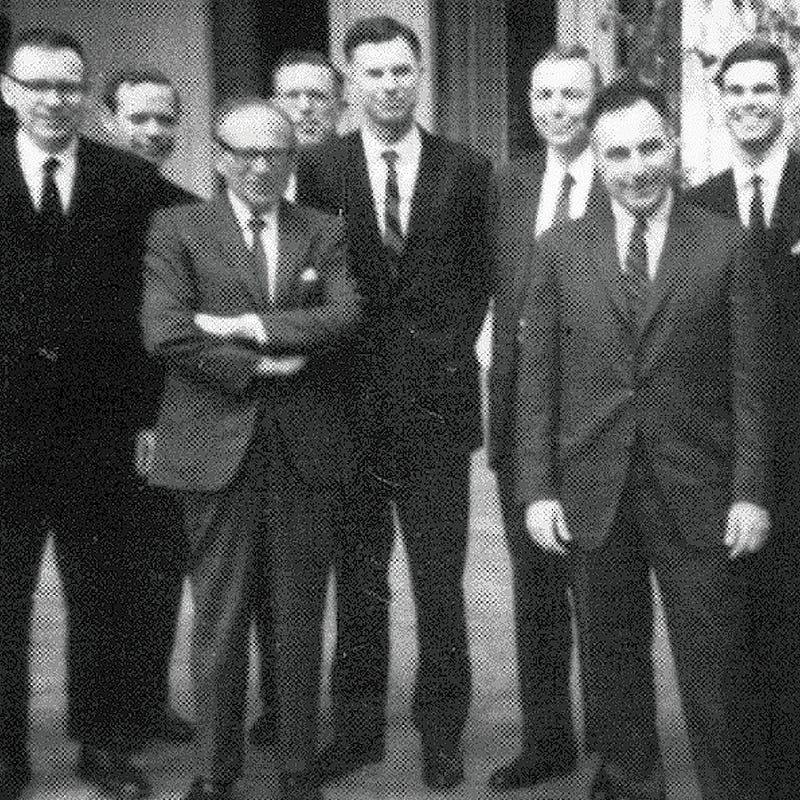
Then came along the famous trio of Warren Buffett, Charlie Munger, and Sandy Gottesman in 1966.
Hochschild-Kohn still had a respected name, the assets still had value, and the company had been around for 70 years at this point. And most importantly, the business was selling far below its underlying assets.
Unfortunately, the company was cheap for a reason; Buffett later called this a “second-class department store at a third-class price.
Alice Schroeder gives a wonderful account of how the investment came to be in her book The Snowball: Warren Buffett and the Business of Life:
In January 1966, Gottesman brought Buffett an idea: Hochschild-Kohn, a venerable department store headquartered in downtown Baltimore. Buffett and Munger flew into Baltimore, and they liked the Kohn family immediately. Louis Kohn, who had a financial background, was going to run the business for them … Buffett and Munger looked at the balance sheet and made a $12 million bid on the spot.
On January 30, 1966, Buffett, Munger, and David “Sandy” Gottesman formed a holding company, Diversified Retailing Company, Inc. (“DRC”), to “acquire diversified business, especially in the retail field.” The Partnership owned 80% of DRC. Gottesman and Munger each took 10%. Buffett and Munger then went to Maryland National Bank and asked for a loan to make the purchase.
Buffett had never borrowed any significant money to buy a company. But they figured the margin of safety reduced their risk, and interest rates were cheap at the time.
I find it fascinating that Buffett borrowed $6 million to help finance the acquisition, likely because so much of his capital was already tied up in the partnership and his growing investment in Berkshire Hathaway.
And the kicker? Buffett and Munger sold Hochschild-Kohn just three years later, in December 1969.
It did not take long for Buffett and Munger to realize that retail was simply too difficult. Hochschild-Kohn’s competitive position was being attacked from every direction: customers were leaving downtown Baltimore, streetcars had disappeared, car ownership was soaring, suburban malls were growing, and larger competitors enjoyed greater scale. They had purchased an established retailer just as the retail landscape was shifting beneath its feet.
After five years of declining sales, the Edmondson Village store closed in early 1974. The Belvedere location was renovated in 1976 and converted into a smaller store focused primarily on contemporary fashions.
The company continued experimenting with smaller neighborhood stores. In 1977, it opened locations at Reisterstown Road Plaza and North Plaza after both shopping centers had been enclosed and converted into malls. Another small fashion store opened at Kenilworth Bazaar in Towson in 1978.
But shrinking the stores did not solve the company’s larger problem.
The strategy gave Hochschild-Kohn a presence in more neighborhoods, but the smaller locations could not attract the same volume of customers as a full department store. They also struggled to compete with the larger department stores anchoring Baltimore’s newer regional malls.
The Belvedere store closed in early 1984. The Eastpoint, Harundale, Reisterstown Road Plaza, and Security Square locations followed later that year. The Harundale and Security Square stores were sold to Hutzler’s, another Baltimore department-store chain.
Only the smaller Kenilworth Bazaar and North Plaza locations remained. Both closed in 1986, finally bringing the Hochschild-Kohn story to an end nearly ninety years after the company opened its first store in downtown Baltimore.
Hochschild-Kohn had followed its customers from downtown Baltimore to the early suburban shopping centers and eventually into the regional malls. But at nearly every stage, the company was forced to support an older retail model while trying to catch up with the next one.
That is what makes Hochschild-Kohn more interesting than simply calling it one of Buffett and Munger’s early mistakes. They did not buy an obviously worthless business. They bought a respected Baltimore institution with valuable assets, a recognizable name, and a loyal customer base.
The problem was that by 1966, the retail industry was changing faster than Hochschild-Kohn could.
Buffett revisited Hochschild, Kohn & Co. in his 1989 Berkshire Hathaway Shareholder Letter:
To quote Robert Benchley, “Having a dog teaches a boy fidelity, perseverance, and to turn around three times before lying down.” Such are the shortcomings of experience. Nevertheless, it’s a good idea to review past mistakes before committing new ones. So let’s take a quick look at the last 25 years.
My first mistake, of course, was in buying control of Berkshire. Though I knew its business – textile manufacturing – to be unpromising, I was enticed to buy because the price looked cheap. Stock purchases of that kind had proved reasonably rewarding in my early years, though by the time Berkshire came along in 1965 I was becoming aware that the strategy was not ideal.
If you buy a stock at a sufficiently low price, there will usually be some hiccup in the fortunes of the business that gives you a chance to unload at a decent profit, even though the long-term performance of the business may be terrible. I call this the “cigar butt” approach to investing. A cigar butt found on the street that has only one puff left in it may not offer much of a smoke, but the “bargain purchase” will make that puff all profit. Unless you are a liquidator, that kind of approach to buying businesses is foolish.
First, the original “bargain” price probably will not turn out to be such a steal after all. In a difficult business, no sooner is one problem solved than another surfaces – never is there just one cockroach in the kitchen.
Second, any initial advantage you secure will be quickly eroded by the low return that the business earns. For example, if you buy a business for $8 million that can be sold or liquidated for $10 million and promptly take either course, you can realize a high return. But the investment will disappoint if the business is sold for $10 million in ten years and in the interim has annually earned and distributed only a few percent on cost. Time is the friend of the wonderful business, the enemy of the mediocre.
You might think this principle is obvious, but I had to learn it the hard way – in fact, I had to learn it several times over. Shortly after purchasing Berkshire, I acquired a Baltimore department store, Hochschild Kohn, buying through a company called Diversified Retailing that later merged with Berkshire. I bought at a substantial discount from book value; the people were first-class, and the deal included some extras – unrecorded real estate values and a significant LIFO inventory cushion. How could I miss? So-o-o – three years later I was lucky to sell the business for about what I had paid. After ending our corporate marriage to Hochschild Kohn, I had memories like those of the husband in the country song, “My Wife Ran Away With My Best Friend, and I Still Miss Him a Lot.”
“We thought we were buying a second-class department store at a third-class price”- Buffett.
“Buying Hochschild-Kohn was like the story of a man who buys a yacht; the two happy days are the day he buys it and the day he sells it” - Munger.
Buffett had lowered his standards to justify the investment, given the environment of few investment opportunities. Buffett attributed this to “(1) a somewhat changed market environment, (2) our increased size, and (3) substantially more competition.”
Comments
Nothing yet. Say the first thing.
Sign in to join the conversation.