

Today, I want to talk about the value of providing constructive feedback and a framework that has helped me maintain a 100% on a management satisfaction survey from my team this year.
Let’s dig in.
Why is feedback important?
My old department manager used to say, “Feedback is a gift.” In every all-hands, he would encourage us to give him feedback, which created a culture where people felt safe to help each other grow. That’s the purpose of feedback. This process can help you and your peers improve when done correctly and with the right intentions.
But giving feedback is a skill. You have to be intentional about improving and practicing to get better at it.
How I failed at giving feedback
When I started managing a team, I was anxious about giving feedback. I read about how important this was for managers, and it felt like a lot of responsibility. As most of my team were more senior than me, I also worried that I didn’t have enough experience to coach them.
When I had to give feedback, I’d either waited too long, avoided it altogether, or passively shared what they could’ve done better, which wasn’t fair to my team.
I had expectations, but I wasn’t giving them an opportunity to meet them because I was too concerned about appearing arrogant or condescending.
So I experimented. One of the things I tried was including a feedback section in our 1:1 agenda. I hoped it would force me to think about feedback to share with my team. However, all it did was increase my anxiety.
I kept reading and experimenting and eventually found a framework that worked for me — and removed the feedback section from the 1:1 agenda.
What eventually worked for me?
One of the most popular frameworks for giving feedback is Situation-Behavior-Impact (SBI) by the Center for Creative Leadership.
They advocate sharing what you observed with the person and clarifying the impact. In addition, they also encourage you to ask about the person’s intent if you need clarification. This approach sets the tone for a conversation.
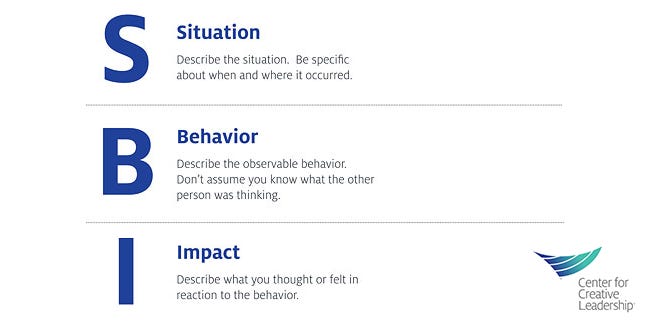
Here’s how it could work in practice:
Let’s say Juan is working on a task. The task is a new backlog item that the product owner (PO) added after the last Sprint Review. Juan wrote the code but forgot to pull the latest changes before committing his code and ran into a merge conflict.
Using the SBI framework, you could say something like Hi Juan, I heard that there was a merge conflict related to your recent commit for the new feature, highlighting a missed pull of the latest changes. Pulling changes before committing helps maintain the team’s workflow and avoid these conflicts. So, in the future, please pull before making changes and ask for help if you have questions. (Tailor this example to match your style and the context).
The mindset shift that empowered me to give feedback
But having a good framework is only part of the battle. If you are anxious about giving feedback, view it from your team’s perspective.
According to Oak Engage, 65% of employees said they wanted more feedback. Your team wants to know how they can improve and is counting on you to help them. They may assume you don’t care if you don’t share feedback. Don’t let that happen.
Take the following steps to decide if feedback is necessary:
Determine if the behavior requires a discussion. If they made a simple mistake, you might let it slide, but if they make that mistake again, it’s time to share some feedback.
What or how would you want them to improve? Your feedback will only be constructive if you know how they could improve. Otherwise, spend time reflecting on the event, or don’t share.
What could you do to prevent this from happening again? As their manager, is there something you forgot or didn’t do that could’ve helped them? i.e., set clear expectations or provide training.
In summary
I learned the benefit of sharing constructive feedback in a recent meeting. I was discussing a project with a team member. They made a choice that impacted our relationship with a vendor. I asked them to bring any significant decisions to the team’s attention so that we can align and avoid any surprises next time.
They told me that I’m one of the few managers that give constructive feedback. Don’t lose that.
Their feedback made my day because a year ago, having to give feedback made my heart race. I wanted to avoid it, but now I see it as a tool to help my team.
However, it can still be challenging. Sometimes, I need time to get my thoughts together or finish a more urgent task before having a difficult conversation about someone’s performance. Take the time you need to prepare and share with your team so they can improve.
Giving constructive feedback will create a culture of helping each other get better — including you.
Thanks for reading Becoming a Leader! Subscribe for free to receive new posts and support my work.
Comments
Nothing yet. Say the first thing.
Sign in to join the conversation.