
I want to tell you about the month I stopped healing the way I was supposed to, and started healing the way that actually worked.
It’s been a big year and TBH I wrote this podcast episode back in March but a house move, a kid meltdown, a burnout and an autoimmune flare later - it’s June and we’re getting it done.
Back in Feburary/ March - I noticed something in myself. Not a meltdown. Not burnout. Not crisis. Just, starting to struggle. The subtle kind. The kind you only catch because you’ve spent years learning to read yourself.
I was waking up braced. Jaw tight. Shoulders up around my ears. Thoughts looping before my feet hit the floor. I was being pulled into my phone in a way that was quietly leeching the energy out of my real life, momentarily soothed by the scroll, and significantly worse afterwards.
Like a lot of people I know, I’d fallen into an Epstein-files spiral.
Here’s the thing about a story like that. If you’re a woman, if you’re autistic, if you’ve survived sexual violence, if you have ever gone looking for justice and been handed ambiguity instead of an answer, you don’t consume that kind of story as information.
Your nervous system consumes it. It’s not imagining. It’s bracing. And if you’re wired for fairness, if justice lives in your body and not just your brain, it hits harder again, because when you watch power get protected, your body doesn’t stay in the present. It flicks backwards. Into memory. Into sensation. Into recognition.
Trauma brains don’t just hunt for resolution. They hunt for relief. They want a different ending. And when they don’t get one, the body stays braced.
There’s real research behind this, by the way… exposure to unresolved injustice pushes the brain into pattern-seeking mode. It wants coherence. It wants an ending. It wants something that makes the world feel stable again.
But there was no ending on offer. Just more information, more speculation, more powerful men protected by the same systems that always protect them.
As we’ve established - I’m autistic, so when my sense of control wobbles, I hyper-focus. It feels productive. Intelligent. Like agency. Sometimes it’s just an activated nervous system wearing a high-functioning mask.
So that was me. Reading, scrolling, scanning, listening to podcasts at 2am, trying to outthink something that does not have a clean solution.
In the middle of all that vigilance, one of our TLG community members mentioned a show called Heated Rivalry. She said it was her safe show at the moment. So I thought - what’s the worst that could happen.
Within fifteen minutes, my shoulders dropped. Within one episode, my chest relaxed. Within two, I was completely, what-day-is-it gone, for two rival hockey players who meet at eighteen, collide in locker rooms and hotel corridors, pretend it’s temporary, and slowly, stubbornly turn secret hookups and stolen glances into a decade of devotion neither of them can outrun.
Here’s the part I refuse to pathologise: it wasn’t just regulation. It was joy.
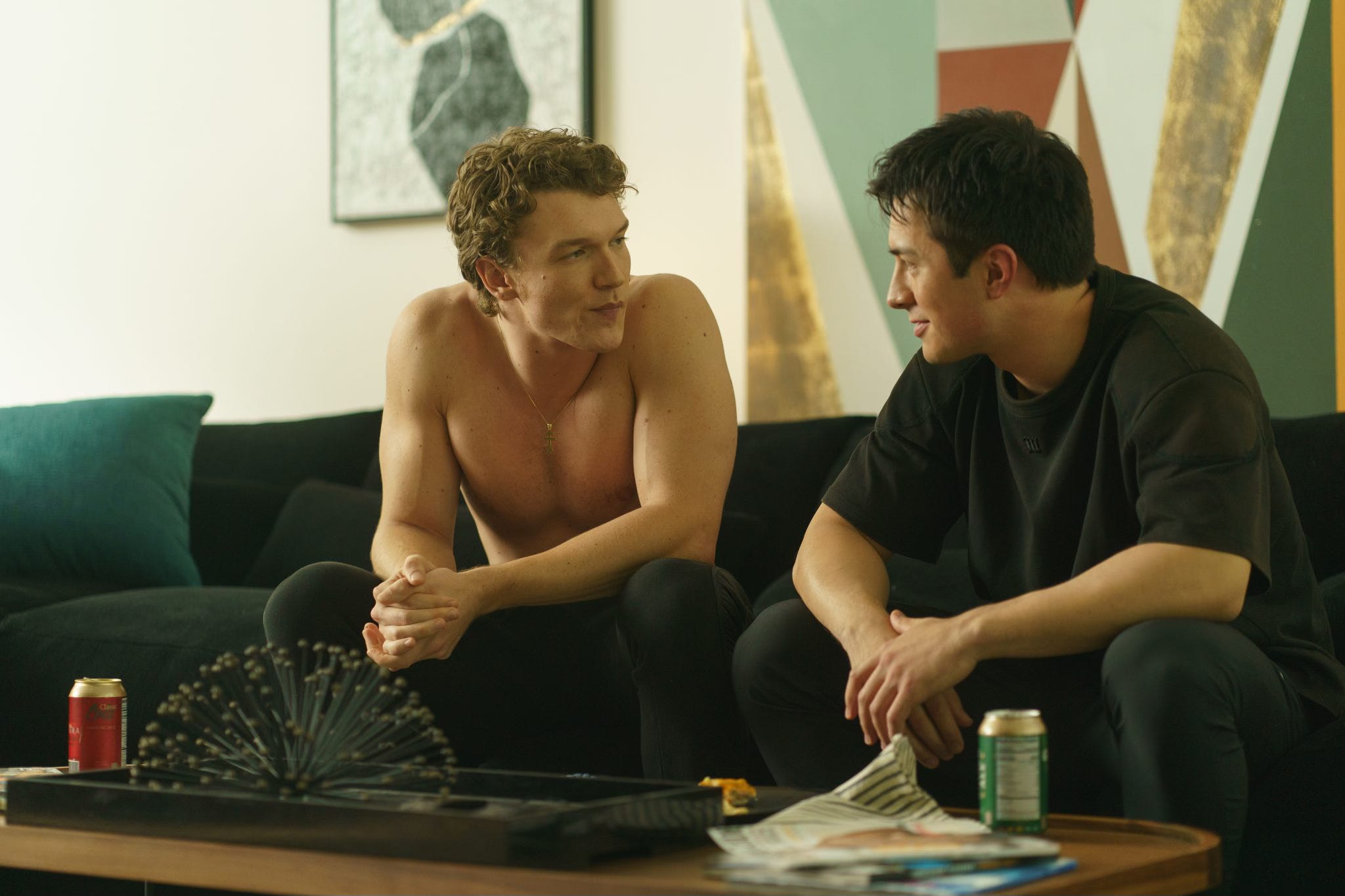
Heated Rivalry is the television adaptation of Rachel Reid’s novel, part of a series called Game Changers. (The next instalment is literally titled The Long Game, which, given the name of my podcast and my program, feels cosmically arranged.) Two elite NHL players, drafted the same year, lifelong rivals on opposing teams, constant proximity, very different personalities, and a pull neither of them can argue their way out of.
Canada’s Shane Hollander. Russia’s Ilya Rozanov.
The casting is genius. They cast relative unknowns, Connor Storrie as Ilya, Hudson Williams as Shane, and that’s the whole trick. Cast recognisable actors and you drag their old roles in with them; the audience never fully forgets who they’ve seen them be before. Cast unknowns and you just… believe them.
Connor’s Ilya is magnetic chaos. Playful, theatrical, disarming, with a softness leaking through the bravado that catches you off guard the moment the grin drops. He delivers pages of Russian dialogue in a language he didn’t grow up speaking… the payoff being one of the most gut-twisting romantic speeches I’ve ever watched, performed with such fluency that native speakers on set reportedly assumed he had heritage.
All of it in service of a character whose chaos is armour for devotion.
Hudson’s Shane is embodied restraint. Controlled, media-trained, meticulous, emotion folded tight behind discipline. And what he does with that containment is just as remarkable, because stillness is harder than spectacle. He builds Shane out of micro-shifts, the jaw tightening instead of speaking, the pause before answering, the way the whole body braces before vulnerability. It reads autistic-coded in the most grounded, unannounced way, and Rachel Reid has confirmed Shane is written as autistic. It’s never a lesson, never a limitation, never a plot device. It’s just part of his architecture. A man whose wiring informs him but does not define the boundaries of his love.
And then you see them off-screen - best friends, teasing, completely at ease in each other’s space, turning up to the Vanity Fair Oscars after-party in incidentally matching sheer blouses.
Soft, styled, playful, a little camp, completely unbothered. In a world still insisting that men like Andrew Tate are what women secretly want, here are two men inhabiting their power instead of performing it, and women are losing their minds.
Not because it’s shocking. Because it’s safe.
Let me explain something about autistic brains and the things they love.
Neurotypical attention is broad and shallow. It samples and moves on. Autistic attention is narrow and deep. We don’t sample, we move in and that capacity gets pathologised constantly: we’re told we’re obsessive, that we fixate, that our interests are “too intense.” Here’s what I want to say to anyone who’s heard that, including the version of me that used to believe it. The intensity is not the problem. The intensity is the gift.
When an autistic brain locks onto a subject, the reward circuitry lights up in a way that is genuinely regulating. We’re not just enjoying the thing - we’re using the thing to organise our internal world. Which is why hyperfixation, when it works with us, looks like joy, energy, clarity, six tabs open and a Google Doc titled “Why Ilya’s Russian Speech Made Me Cry.”
It only turns sour when the brain has nothing better to settle on and the fixation becomes the only available regulator. That’s what the Epstein spiral was: a hyperfixation in distress, scanning a story with no resolution for a pattern that didn’t exist, manufacturing vigilance and calling it research. No reward. Just bracing.
Heated Rivalry is the same neural mechanism with a completely different fuel source. It has structure. It has emotional resolution, scene by scene. It rewards the pattern-recognition my brain is already running. It gives back what I put in. That’s the entire difference between a hyperfixation that drains you and one that feeds you — and we don’t talk about that distinction nearly enough.
A safe show is one you’ve usually already seen. You know the beats, the lines, the ending. There’s no threat in it. The world is mapped, so your brain can rest inside it without spending energy on prediction.
For most autistic and ADHD brains, and a lot of trauma brains, predictability is fuel and unpredictability is tax. The world is loud, social interaction is processing-heavy, and most of our energy goes on forecasting what’s coming next. A safe show switches that forecasting off. You’re not watching to find out what happens; you’re watching to experience what you already know is coming. The relief is almost physical. That’s not laziness or regression. That’s your executive function recharging.
Heated Rivalry isn’t technically a safe show for me yet - I’ve only watched it twice (I say “only”; twice in a week). But it behaves like one, because the emotional shape of every scene is so reliable in the best possible way. Every lingering glance lands somewhere tender. Every conflict is about logistics, never about whether love is real. Nobody weaponises emotion against anybody else. So my brain has filed it as a predictable safe space disguised as new content, which is exactly why so many people are on their sixth, seventh, eighth rewatch. They’re not watching for plot. They’re dosing themselves with a nervous-system state that’s hard to find anywhere else in the week.
There’s a particular flavour of pain that comes with being a woman watching most heterosexual romance, and you may not have language for it. I didn’t, for a long time. It’s the comparison engine - the constant, low-grade reading of yourself against the female lead.
Am I that thin?
Am I that hot?
Would I be looked at like that, wanted like that, chosen like that?
And underneath it, the older, uglier question women have been trained into for centuries: am I enough?
That engine runs in the background of almost every het romance I’ve ever watched, even ones I love. It’s tax. It stops the watching from being fully nourishing, because part of my brain is always quietly assessing whether I would be loveable in the world the story is calling romantic.
Take the female lead out, and the engine goes quiet. I’m not comparing my body to theirs. I’m not running my desirability against theirs. I’m just watching two people fall in love, getting tenderness, longing, devotion, choice, heat and intimacy without a single ounce of “would I be enough” underneath. I cannot tell you how much processing power that frees up.
There’s more in it, too, because the story doesn’t centre a woman, it never quietly positions a woman as the stakes. There’s no girl he might lose, no girl who’ll be hurt if he chooses badly, no woman whose emotional regulation is the price of the men’s growth. The women in the show are full characters with their own lives - but they’re not the prize, the punishment, or the moral compass either man has to perform virtue around. Both leads have to do their own emotional labour. For each other. And for a brain that has spent its whole adult life being asked to do that work for other people, that’s the deepest possible exhale.
This show pulls off something much harder than it looks: two layers of representation, queer and neurodivergent, handled without lecture, without trauma porn, and without using anyone’s identity as the engine of the plot.
Shane is autistic, but the show never says so. No disclosure scene, no diagnosis montage, no “ohhh, that’s why he’s like that.” He’s just built that way: the structure, the routines, the discomfort with eye contact in the wrong context and the laser precision of it in the right one, the way overwhelm shows up in the body before it reaches the mouth, the way intimacy with one specific person makes all the social performance go quiet. If you’re autistic, you watch him and think: yeah, that’s a guy I recognise. If you’re not, you just see a hot, complicated, deeply feeling man. That’s what good representation is, wiring as texture, not as the point.
The queer story works the same way. So much queer storytelling is built around suffering, coming-out trauma, loss, rejection, violence and even the gentler stuff often uses queerness itself as the source of conflict. Here, the conflict is the career: two men whose jobs make them visible to millions, whose love would end one or both of those careers if it were known. The tension is logistical and external, not “is this love okay.” Both men know early that what they feel is real. The only question is how to live inside it.
That’s a profoundly different psychological space. When a queer love story is architected around grief, your nervous system braces for grief, because the genre has trained it to. When it’s architected around devotion and logistics, your nervous system can rest because the question isn’t will love survive, it’s how do we make this work. For any brain conditioned to expect danger in intimacy survivor, queer, autistic, or all three at once, that distinction is enormous. You’re not waiting for the bad thing. You’re watching two people choose each other, over and over, and work out the practical mechanics of a life that lets them keep choosing. That’s the bit my system can’t stop replaying.
The sex scenes are a huge part of the conversation around this show, and the way they’re shot is part of why it works. They’re charged and explicit, but they’re not aggressive. The tension is romantic. The secrecy is about survival, not dominance.
That distinction is everything. So much sex on screen, straight, queer, doesn’t matter, builds eroticism out of threat: power imbalance, risk, the faint question of whether someone’s about to get hurt.
Heated Rivalry builds it out of recognition. What makes the scenes hot isn’t power or peril; it’s two people seeing each other and being seen back. The only risk is external, what if we get caught? Never internal. The bodies are aligned with each other, not braced against each other.
Which brings me to co-regulation: the process by which one nervous system soothes another through proximity. We do it with babies, with pets, with the people we love. Calm bodies regulate our bodies. This isn’t woo; it’s well-established physiology. And what we don’t talk about enough is that you can co-regulate vicariously. Your mirror-neuron system runs whether you ask it to or not, if the bodies you’re watching are tense, you tense; if they’re tender, you soften. A well-shot intimate scene between two people who are clearly safe with each other can genuinely lower your heart rate.
Not just titillate. Calm.
That’s what this show is doing for a lot of us, and it’s why the rewatches keep happening. It’s not escapism. It’s medicine. It just happens to arrive in the shape of two impossibly attractive Canadian hockey players in a hotel room.
I went into this wanting to talk about a show. What I actually want to talk about is what it taught me about how healing works.
I’d spent weeks in vigilance, doing all the things you’re “supposed” to do - reading, researching, trying to understand and integrate and be useful, trying to outthink an unsolvable horror because that’s what my brain does when it can’t find safety in the world. None of it worked. Not because the work was wrong, but because the form was wrong. My system didn’t need more information. It needed a different state.
And what flipped the state wasn’t therapy, or breathwork, or journaling, or a long walk. It was a show about two fictional hockey players who chose each other for ten years.
This is where a lot of wellness culture quietly fails people.
We’re told healing should look like discipline - cold plunges, ten-minute meditations, an immaculate morning routine. Those things help, and I do plenty of them, but sometimes, especially for survivor brains and autistic brains and any brain that’s spent too long scanning, healing isn’t a discipline. It’s a re-pattern. And the thing that re-patterns you is whatever your specific system finds genuinely, all-the-way-in regulating. For some people that’s a fantasy series, or a garden, or a band’s entire discography, or a video-game world where every variable behaves and every reward is earned. For me, this month, it’s been a queer hockey romance.
So if you take one thing from this: don’t let the world tell you the shape of your healing has to look respectable. Don’t let anyone, including the part of you that’s internalised every voice that ever called you “too much,” police the form your nervous-system repair arrives in. If the thing that drops your shoulders and gives you back your own joy is a cult-fandom hockey romance, you take it with both hands, you let it work, and you stop apologising for it.
And if you’re me, you write three thousand words about it and call it medicine.
See you at the cottage
Bec x
I’ve also made a full podcast episode going even deeper into all of this — link below. And if you’re currently being saved by a piece of media you’d never have predicted, I want to hear what it is in the comments!
Listen here
Comments
Nothing yet. Say the first thing.
Sign in to join the conversation.