
Bisous, Zoo Bisous! Welcome to Tuesday Zoosday! This is the second installment in the feature’s first series, Animal Alphabet Soup! Each week we’ll cover an animal starting with each letter of the (English) Alphabet! Enjoy!
You can keep tabs on the Alphabet Soup series here.
—Ranger Beau
In high school journalism class, each of our staff was given the opportunity (some might have called it a chore) to do a full page spread in the newspaper. I worked as our sports correspondent, so my full page spread was Weird College Mascots. I started by writing all the weird mascots I could think of off the top of my head (shout out to Dad’s obsession with March Madness, the genesis of my interest in such trivia). One of the more mundane names I wrote was “bearcat.” Not a particularly interesting name to me; it looked like someone simply jammed “bear” and “cat” together. But I paused: is there such thing as a bearcat?
Wikipedia was still a pretty new thing in those days, and while most teachers admitted it was a good starting point for an overview on a topic, it was never to be used as a source. So, I went down to the school library to use our encyclopedia software, venerable old Microsoft Encarta. When I looked up “bearcat” I was given the entry on binturongs.
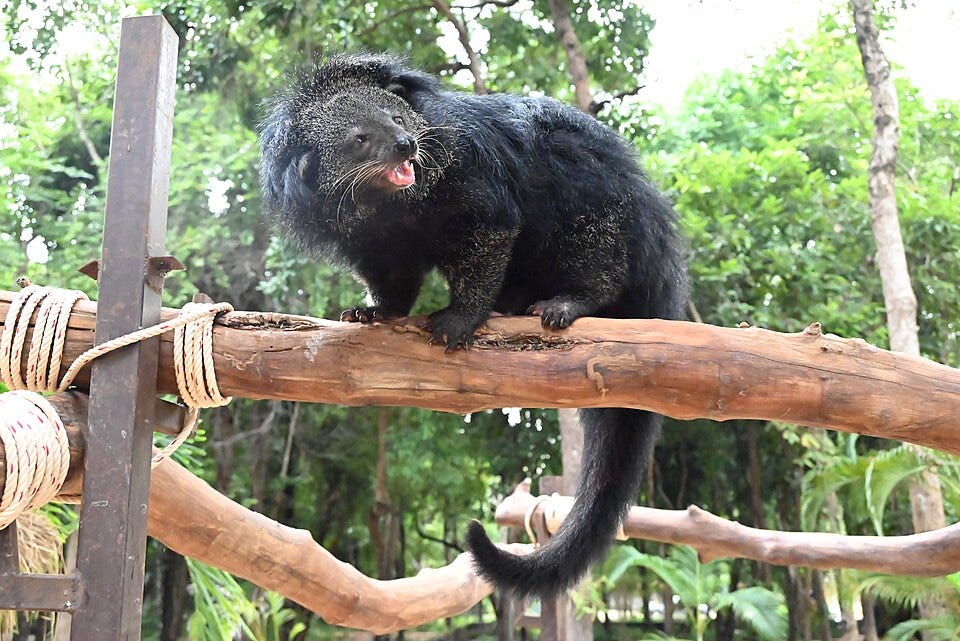
To me, the binturong looks like neither a bear nor a cat; but are so called because they have the “face of a cat” and the “body of a bear.” I think it looks more like a wolverine crossed with a raccoon.
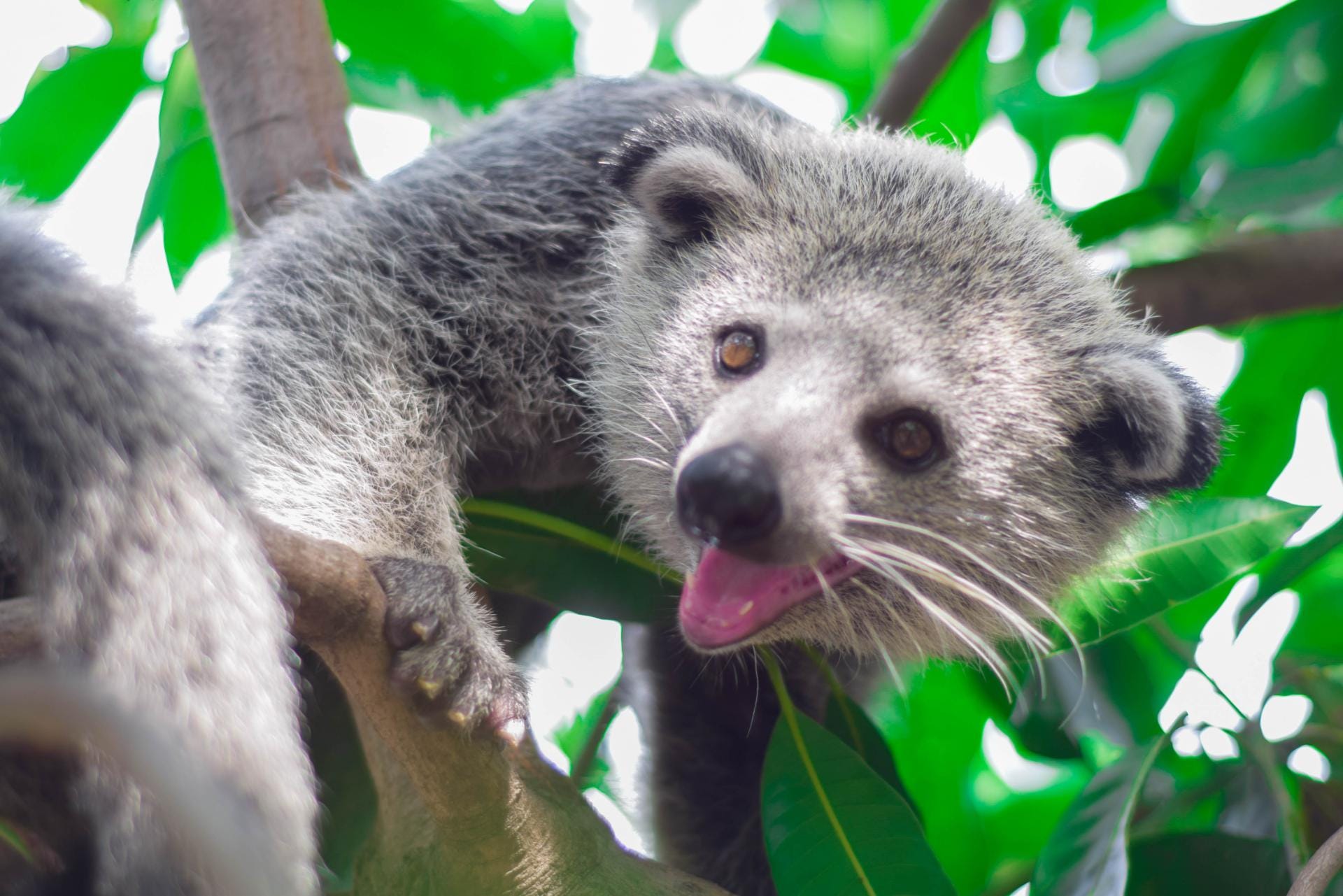
Binturongs belong to the genus Arctictis, which comes from the Greek words “arkt-” meaning bear and “iktis” meaning weasel. Now, wolverines belong to the same family as weasels, so I feel a touch of pride at my assessment…but not so fast, Ranger Beau. Binturongs belong to a family called Viverridae which comprises a group of feliform (that is, catlike) mammals.
You’re right, that’s enough taxonomy for today, eh? Binturongs are actually in a group of animals called civets. These creatures are primarily found in the tropical rain forests of Africa and Asia where they use their various adaptations to thrive in arboreal environments.
Binturongs spend almost all their time in trees and use their powerful prehensile tails to climb through the canopies of the Cambodian, Vietnamese and Indonesian rain forests they call home. You’ve seen bears and cats climbing trees, I’m sure, but have you ever seen one climb down a tree head first? Cats in particular are famous for getting stuck in trees because their curved claws are great for going up, but not so helpful for going down.
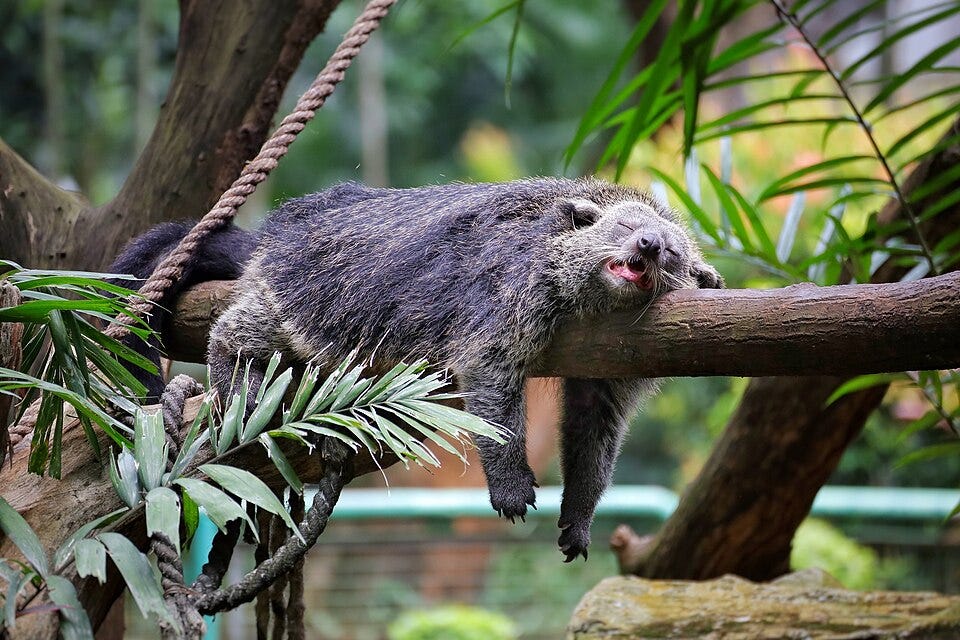
The binturong can actually climb down trees headfirst though! Like squirrels, binturongs have ankles that can rotate up to 180 degrees, allowing their claws to grip tree trunks no matter which way they’re facing. Being nocturnal, binturongs love to stretch out on a branch and sleep before prowling at dusk.
While the binturong, like many other civets, has scent glands, they live solitary lives and denote their territory as most other animals do: with urine! Interestingly, when exposed to bacteria on their skin, the urine produces a compound called 2-acetyl-1-pyrroline (2AP), which is the same compound produced by popcorn when it pops. Dog owners will also recognize the “Frito paw” smell, as harmless bacteria on your dog’s feet also produce 2AP.
Biologists also suspect this musk plays a role in reproduction: imagine if all you needed to do to signal you were “in the mood” would be to make a bag of popcorn. Like bears (and wolverines!), female binturongs are capable of “delayed implantation” which means they can keep a fertilized egg from attaching to their uterine walls (thereby becoming pregnant) until the conditions are right. When she’s ready, mama binturong will give birth to a litter of binlets (what a great name for babies) after three months or so.
While technically classified as carnivores, the binturong will eat small animals like rodents, fish, and worms when the opportunity, but it prefers to eat fruit. A favorite food of the binturong is the fruit of the strangler fig tree. Binturongs produce enzymes necessary to break down the outer coating of the fig’s seeds and so play a crucial role in the strangler fig’s propagation. You’ve probably seen these trees in movies, they look like big clumps of vines that grow around other trees:
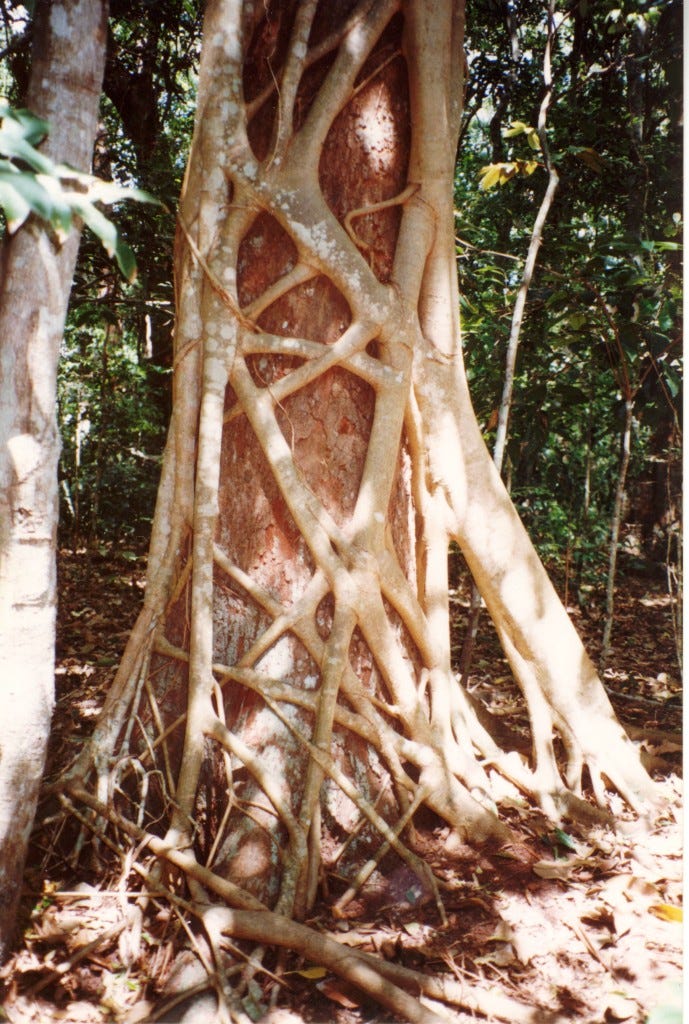
While they kind of look like parasites, these trees are incredibly important parts of rain forest ecosystems by providing shelter, flowers, and yes, fruit, for animals, and botanists also think the fig branches provide protection for the “host” tree. These kinds of trees are called “hemi-epiphytes”: epiphytes are plants that grow on other plants. The “hemi-” part means strangler figs spend part of their life in this state, usually starting in the canopy and working their way down until they can establish roots of their own. While other animals help these trees too, the binturong’s unique digestive enzymes (and perhaps the sticky quality of their poop!) as well as the canopy lifestyle (the places binturongs like to hang out are the places strangler figs have the easiest time germinating) make our friend one of the best fig gardeners in the tropics!
Of course, we should always do our best to impact animals as little as we can, and even though binturongs are not considered endangered, they are vulnerable. Deforestation is a big problem, as it is for many rain forest dwellers, thanks to climate change and logging. Binturongs are also poached for “traditional medicine” and kept as illegal pets. Sometimes they are used in “kopi luwak” production—this is a process by which coffee cherries are fed to a civet (like the binturong) and partially digested by the animals before being used to make coffee. Questions about palatability aside, it’s hard to produce any quantities of this stuff at a usable scale while remaining ethical (in my opinion).
Fortunately, there are efforts to protect binturongs, including the ABConservation organization based out of Palawan, Philippines. Additionally, Fauna and Flora has a page to contribute to binturong conservation.
I’d love to meet one of these guys one day. I wonder if I’ll get in trouble for bringing them fig newtons?
Binturong wiki entry (I am aware of the irony of my don’t use wiki as a source anecdote; luckily I am not being graded by my journalism teacher here. I think?)
Study on seed dispersal effectiveness (SDE) of animals (including binturong) in Borneo
Fauna and Flora is one of the more reputable charities you can donate to
Tuesday Zoosday
Animal Alphabet Soup: Axolotl
·
Jun 2
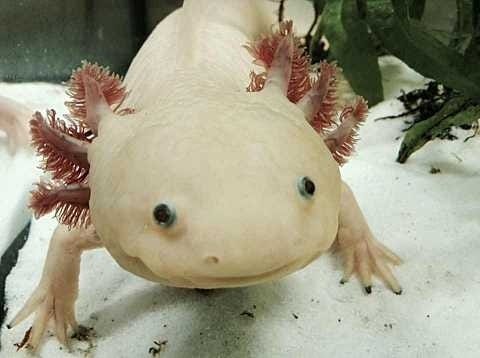
Bisous, Zoo Bisous! Welcome to Tuesday Zoosday! This is the first installment in the feature’s first series, Animal Alphabet Soup! Each week we’ll cover an animal starting with each letter of the (English) Alphabet! Enjoy!
Who do you think is coming next?
Comments
Nothing yet. Say the first thing.
Sign in to join the conversation.