
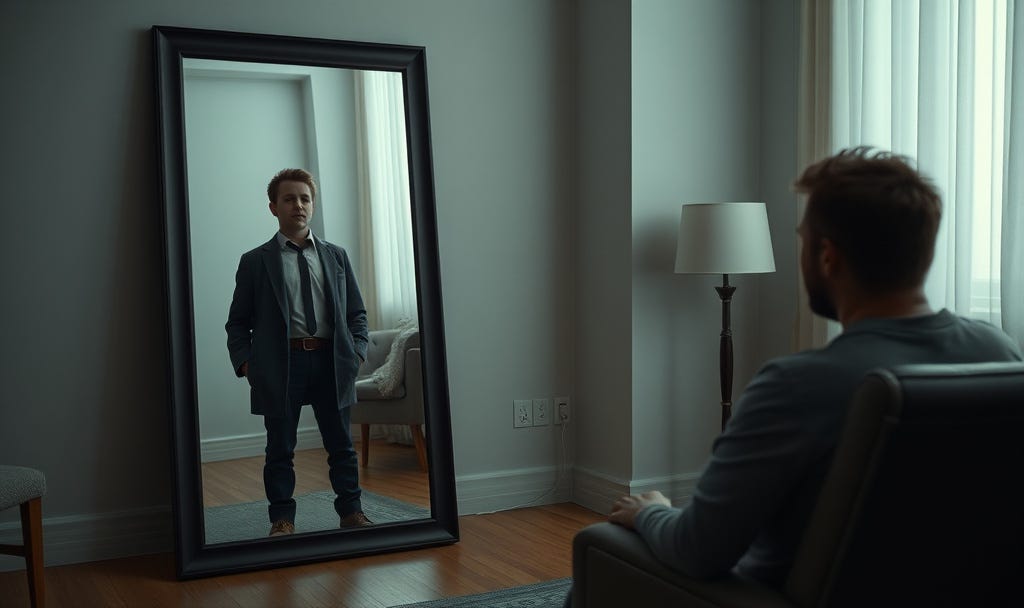
The truth is, almost all relationships involve risk.
Because every relationship inevitably carries the risk of not being understood, not being valued, not being cared for, or even being abandoned. Even the relationship between children and their parents.
Although the world celebrates the greatness of maternal love, there are all kinds of mothers. They, too, were once daughters who needed to be loved and cared for. If they themselves grew up in environments marked by deprivation, then even with their best efforts, they may not be able to offer what we call “unconditional” love. Perhaps religion or spiritual growth allows some people to experience unconditional love. Otherwise, almost all human relationships involve risk.
For some people, that risk feels so immense that they must armour themselves into someone formidable. They may even need to diminish the worth of others in order to maintain their own self-esteem. Only then can they feel safe.
The way T arranged our first appointment was already unusual.
He first asked his secretary to call my office. Unfortunately, the only time he wanted happened to be on my day off, so the secretary left it there.
Later, T called personally. When my assistant explained that I never see clients on Mondays, he became somewhat irritated.
After he booked a Tuesday appointment, his secretary called again and asked my assistant,
“Are you sure the psychologist really can’t do Mondays?”
T came because his wife insisted.
She had already moved out of their mansion and wanted a divorce.
After much deliberation, he reluctantly agreed to therapy.
“I don’t want her to be so upset. She won’t have a good life without me either. I’ll see whether our marriage can still be saved.”
That was how he introduced himself.
T grew up in a wealthy family.
He never had to worry about money and had become accustomed to people serving him.
After graduating from university and working for two years, he joined the investment bank in which his father had an ownership stake. He had spent his entire career in investment.
He genuinely could not understand why, despite his wealth and status, his wife still wanted to leave him.
“I don’t know what she wants.”
He said this with obvious anger.
It took several sessions before I finally understood why she wanted a divorce.
T had numerous extramarital affairs.
At the same time, he tightly controlled his wife’s social life while freely pursuing other women himself.
Naturally, he saw nothing wrong with this.
Men and women, in his view, were never equal.
He had countless justifications for maintaining his lifestyle.
When I asked how he and his wife had first met, he relaxed for the first time.
“I liked taking care of her. She used to be very obedient. When we were dating, I took her to Paris to meet my friends. I bought her lots of designer clothes. She felt proud to be with me. She loved dressing up beautifully every day...”
As he recalled those early days, a rare sense of calmness and security appeared on his face.
“So,” I asked directly,
“Did your wife know, while you were dating, that you were sleeping with other women?”
He immediately straightened his back and answered loudly.
“Of course she didn’t know then. But after we got married, she started noticing clues. At first she pretended not to see them. Then one of my girlfriends called her. That’s when everything exploded.”
Whenever I tried to understand how they argued, T would quickly avoid the conversation.
He disliked describing what happened when his wife confronted him.
To T, having multiple partners simply felt necessary.
Yet when I asked what emotional needs those relationships fulfilled, he could not answer.
Instead, he began boasting about his sexual performance.
When I told him that such explicit descriptions felt intrusive and that I neither wanted nor needed to hear them, he suddenly looked pleased.
“Aren’t psychologists supposed to understand their patients? I’m your patient.”
Throughout therapy, T often adopted an intimidating stance.
He became angry whenever small things did not go his way.
One day his chauffeur happened to be ill, so he had to drive himself to my clinic.
Unable to find parking, he sat down and immediately started shouting at me, demanding to know why my clinic did not provide private parking spaces.
Whenever I asked about his feelings—especially regarding the divorce—he would avoid the topic.
He fiercely resisted experiencing any sense of vulnerability, let alone talking about it.
As a result, our sessions repeatedly revolved around the things that made him angry.
Only when I came to understand how deeply he missed being his wife’s hero—providing her with material comfort and protecting her from being mistreated by her own family—did he slowly begin expressing his hurt through anger.
“How could she do this to me? I’ve been so good to her. After we got married, I bought her a flat and a car. What more did she want?”
His eyes became red as he spoke.
I replied,
“You feel that you’ve done everything you possibly could to love her, yet she still wants to leave.”
I continued,
“When you were in primary school, you had no friends. It didn’t seem to bother you because you convinced yourself those children were idiots. Later, when you started working and still had no friends, you complained to your father. He told you not to waste your time on those people. He knew important people—who were they compared to him? Throughout your life, you’ve protected yourself from being hurt by believing you were superior to others. But that strategy doesn’t work in marriage. The more you relate to your wife from that position, the more she wants to leave.”
For the first time, T’s eyes filled with tears.
Narcissistic Personality Disorder causes tremendous suffering for the people around them.
At the same time, it is often difficult for those living with narcissism to recognise that they, too, are suffering.
Editor's note: This article was originally published in Chinese in the Hong Kong Economic Journal on 14 February 2023. The version below is a literal English translation.
Comments
Nothing yet. Say the first thing.
Sign in to join the conversation.