
Spoilers ahead...
I WILL ALWAYS BE a “the book was better” person. And I told myself, when I went to see The Odyssey with friends last week, that I wasn’t going to write about it. I was just going to take part in the cultural phenomenon. But people kept talking about it in ways that were like catnip for me (like what’s going on with the gods in this film?, and does the adaptation do them some injustice?) So, I couldn’t help myself. I will admit, to show my hand, that Nolan’s Odyssey made me cry. If you’ve seen it, you can probably guess the scene: it was the tears of Athena.
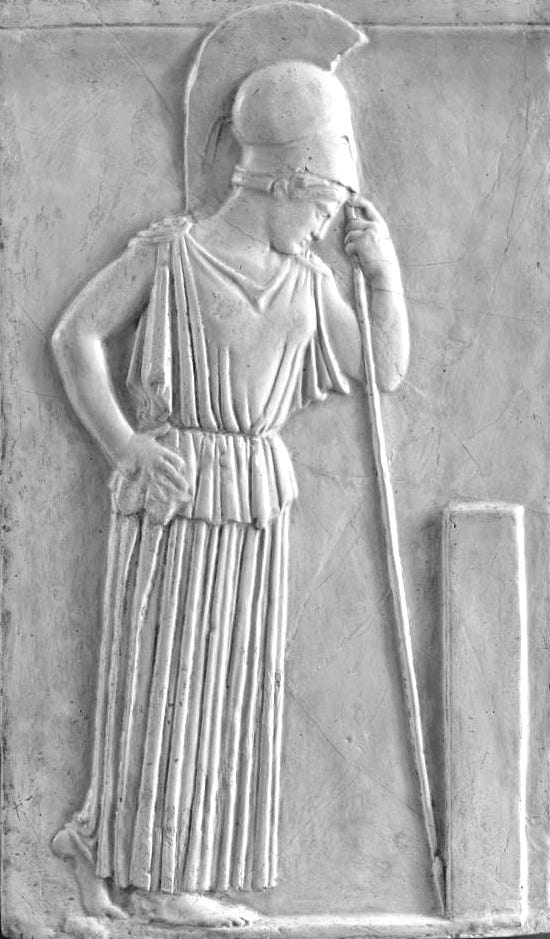
Late in the film, after Odysseus has finally landed back on Ithaca, as he’s testing his welcome with Penelope, he admits that—for the many years he was gone—he couldn’t come back home because he didn’t know how. We’ve already sat through the great battle at Troy, as viewers. We’ve seen how the acts of cunning played out. We watched the soldiers shit themselves as they waited in the horse, beyond the city gates, for days. But now, we re-enter the story through the filter of Odysseus’s narration and we see it with all of the violence, and none of the glory. It becomes what we know that war is; an incredible violation of any common or shared sense of humanity. Athena—who can only be seen by us (the viewers) and Odysseus—sits next to him and listens, as he speaks. And his telling makes her cry. When Zendaya’s Athena wrinkled up her face, I had to cry too.
Why did I cry? Maybe, in part, because I knew that so many other Americans were watching this same scene. Maybe because I knew that they would know that Athena was crying for Odysseus, and for Troy, but also for humanity. Which means that she was crying for us. Maybe I cried because I felt like we needed to be cried for, here in this place where so many terrible things have happened, and keep happening, and which has become a great engine for producing terrible things. Maybe I cried because I knew that so many of the people who saw this film would wonder what it’s done to them, this world of war. And they will wonder what it will take for us to be able to go home to some time and place where there’s not war. Because it does feel, to so many of us, as if we are lost.
Of course, I also cried because I love movies, and I love to cry when I watch movies. It’s cathartic. We’ve been introducing my ten-year-old daughter to Great Movies of the 20th century, like Trading Places and Ghostbusters. We’ve even got her watching Chaplin films, and sometimes I cry a little bit when it hits me that he’s walking around, in those ridiculous shoes, more than 100 years ago and I am watching him tromp around from my living room couch, in 2026, while my tiny dog sleeps on my lap. And then I say, “can you believe that we’re looking so deep into the past right now?” Or “oh my God, look at those cars!” And my family says “quiet, please, we’re watching the movie right now.” So, it’s not rare for me to cry about movies. But still, Athena’s tears were a sign, for me, that the film had preserved a certain kind of important (and, I would argue, beautiful) power.
WHAT NOLAN HAS produced is a blockbuster Hollywood film, and it has all of the trappings of the genre. He plays by the Hollywood rule books, when it comes to the gods, for the most part. He makes them appear in ways that won’t offend secular viewers (Poseidon is present, for instance, but as the sheer power of the ocean). On social media, many of my colleagues in religious studies and theology have been noting Nolan’s failure to allow the gods to appear with the full range of power and agency that Homer (or other ancient texts) gives them. And (though I read Andrew Thayer’s essay before I went, and found myself sympathetic with his argument) I can’t really disagree with that. Nolan’s Athena, Zendaya’s Athena, is not the Athena who leaps, screaming, from the crack in a godhead. She doesn’t brandish a sword. And she’s not a great political strategist. Nevertheless, Athena does keep some of her power in this film. Chiefly, she keeps the wisdom.
Early in the film, her execution of it looks a little clumsy. She chastises, or even scolds, Odysseus for believing that he’s not bound by prophecy or that he (and not the gods) is somehow responsible for monitoring the line between life and death. She wields her judgement and wisdom in a heavy-handed way. But I think she wielded that power masterfully, through her tears.
A number of my colleagues have commented that Athena’s role in the film has been reduced to impotence through another secularizing strategy that’s commonly applied to supernatural phenomena in Hollywood films: psychologization. By presenting us with an Athena who appears to Odysseus alone, the film makes it look as if she is merely a figment of his imagination. She doesn’t have to be real, she can just be “in his head.” This sort of critique is commonplace enough that Jacobin ran this teaser, for an essay by Eileen Jones that decimates the film. It’s presented as completely godless, against the background of a deity who is featured as a character in the film. Talk about erasure.

What looks (on the surface) like impotence or mere psychology is not actually alien to Homer’s narrative, however. One of the features of his telling that I actually enjoyed was the way that, when Athena showed up in the life of people, it was either in complete disguise or in a form that’s only visible to the person she wants to engage with. She has the power of relative invisibility, in that sense. What I see in that sort of exchange is not impotence, but selective intimacy. Sure, in Homer’s narrative she appears to other characters, like Telemachus. And I do think that his character would have been enriched, in the film, by some conversations with Athena. It would have strengthened his bond with his father and made him less puerile. But I think the intimacy Athena chooses with specific people is part of what makes her apparition powerful. She doesn’t give her wisdom cheaply.
I also don’t think that the film would have worked without Athena as a figure: a real character with presence, and dialogue. Odysseus crying all alone about what he did, in Troy, would have been just that. I didn’t find Matt Damon’s performance, in that culminating scene, to be the most powerful. He’s just another male hero who earned his wisdom too late, after too many people were dead. He didn’t make me cry, she did. It was Zendaya’s beautiful face, turning a little wrinkly with sorrow that provoked me. And it was the moment when Odysseus’s own memory pictures began to change: when, in his mind, the figure being slaughtered in Troy was Athena herself, bound by the arms of soldiers. Or when her statue is beheaded, the head rolling down the steps like a ball. The war sacrificed the sense of common humanity, and wisdom itself was slaughtered. This understanding didn’t come to Odysseus on his own, it was relational: it was an understanding, a form of wisdom, that emerged when he understood what he had done to the only god that he actually respected, or listened to.
I learned, from feminist theologians like Dorothee Sölle, about something that once seemed like an oxymoron to me: divine vulnerability. Before I knew anything about theology I always assumed that divine power was the power to make miracles, to have complete sovereignty over action, or to simply be absolute. But there are moments, even in ancient texts, where it becomes clear that divine power is sensitive to what humans do and can be affected by it. This sensitivity might look like God getting really, really angry when his people break the covenant with him. Or it might look like a god being put to death. Or a god staging a great weaving contest because she’s so jealous about the skill of a little human, and now we have spiders. Either way, those moments of divine vulnerability—wherever they lead—are often powerful in the lives of humans. They have a powerful effect. Divine vulnerability can generate powerful reactions, not unlike watching your mother cry over what you’ve done.
ATHENA HAS ALWAYS been, for me, the most compelling of the Greek gods. I’m not into war, but I do love a woman who can brandish a sword. More than that, however, her wisdom is something that has always intrigued me. It’s seemed, to me, like the best and most beautiful sort of power: the kind that doesn’t corrode you, or eventually eat you alive. It seems like the only power worth having, really. But it’s the kind that’s most difficult to find. It doesn’t respond to active searching, as if it can sense desperation, and you only tend to find it after real pain.
I am still a little childish about the magic of movies, most especially when I am watching them with other people, and I feel a mood passing through the room. There are so few ways to share feelings like that these days. People in America, notoriously, are quite lonely. It’s kind of miraculous that we’re still going to movie theaters, after everything that’s happened. So, I will admit that it felt powerful to be in the theater with others, in a moment when I knew that at least some of us could feel that incipient wisdom.
Part of the pleasure of watching a film like The Odyssey, is the sense that we are taking part in something quasi-eternal. We’re engaging in an adaptation of a story that’s so ancient, it almost feels as if it came from the beginning of time. It didn’t, of course. And the adaptation is actually so new, and fresh, and current that it’s really just a flash in the pan. But people take these stories more seriously because they make us feel as if we are part of the long flow of time, connected to something so much bigger than the moment we inhabit, as if we live in a world where there really is such a thing as a homecoming, or a world after war, or wisdom. And maybe we’re lying to ourselves a bit. Or maybe you could say that we’re dreaming. There’s something about a movie that feels, oddly, like a collective dream.
Why not let this new Athena have that power, to make people cry? To make people feel the unsettling charge of wisdom, the power that can work through us without also corrupting us? The kind of power that might even make people feel a little stronger for what we have to face? I’ll let her have it.
If you liked what you read (or hated it!), please help me share it with others.
Subscribe, for free, to support my work existentially.
Comments
Nothing yet. Say the first thing.
Sign in to join the conversation.