
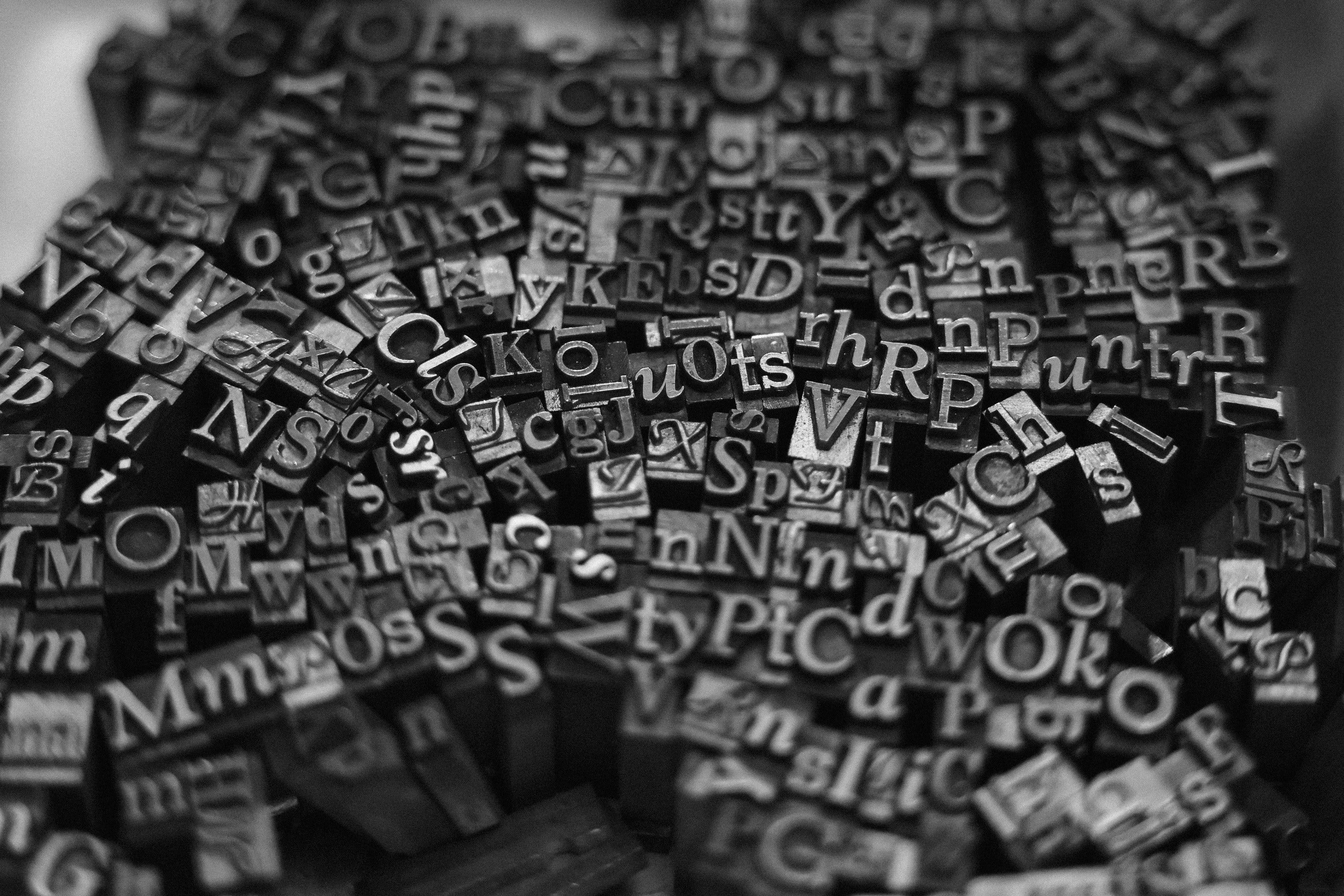
A COUPLE OF weeks ago, I started to actually think about language again. I’d been at an event where the subjects under discussion were technology, devotion, and language. It struck me that I’d spent much of the recent past thinking about the first two, maybe even a bit obsessively, but I’d been taking language for granted. Part of it was, I will admit, that I’m bored by language about language. I love using language, and I love working with it like raw matter. I love shaping it, crafting it, singing it, speaking it, and absorbing it. And yet when people want to talk to me about language, and the rules, and structures, and logic, and processes that govern it, my eyes glaze over. But something shifted for me, recently. It’s as if language came back to life.
I’ve been concerned, as perhaps you are too, about what’s felt like a new sort of existential condition. But I’ve been thinking about it as a technological problem, or perhaps an attention problem. I’ve been feeling as if there’s something I’m trying to protect, but I haven’t been able to figure out what it is. I’ve tried to describe it in various ways: perhaps it’s interiority, I thought to myself at one point. But now, I think it’s language. I fear for language. Not that my trust was ever robust, but I’ve stopped trusting that we are creating, investing in, sharing, building, developing the right vessels to carry language into the future.
There are opposing tensions, built into language itself, between what I will describe as its magical and mechanical facets. As a whole, language itself is both. But when it becomes subject to analysis, it tends to be the most mechanical things that we focus on (the rules of grammar, the shape or function of words, the processes through which it becomes replicable). We want to understand it, so we search for the marks and patterns that simplify and explain it. This makes it easier to understand, and replicate. But a myopic focus on mechanics can kill magic. It’s always been poetry, perhaps, in its various forms and guises that works to bring these functions back together, to reweave them into a more integral fabric.
The morning after the event, as I was having breakfast in my hotel lobby, I noticed that one of my readers had posted a link to an essay, in the comment section of a post from weeks ago. I had a little time, so I clicked on the link and read it. It turned out to be one of those things that shows up in your life with timing that’s so strange and synchronous, it makes you want to believe in things like fate.
The essay wasn’t necessarily revelatory. What felt sort of revelatory to me was the way that I read it. The essay was by a neuropsychologist, Nicholas Humphrey. It’s essentially a theological essay, written by a scientist. Humphrey is making a defense of the soul. Unlike many, he’s willing to call it a soul (a term so charged that even I, a theologian, tend to avoid it!) But he’s willing to do this because, he insists, the soul is constructed by language. It’s something that culture creates for us, like a passport, and it bestows us with a “spiritual identity and rights.” We weave one another souls, he’s sort of suggesting, with language.
I think it’s actually a beautiful way to put it, and there’s a tenderness to this craft of weaving that I don’t think he really illuminates (he also spends a bit too much time on illusionism). But I’m trying to imagine how I would have read this same essay even a week or two earlier. I think, honestly, that I would have found it a bit reductive. Over the years I’ve grown to mistrust language about language. I’ve worried that it’s somehow designed to disregard the rich terrain of precognitive life that escapes capture in language. I’ve felt as if it doesn’t really take seriously the matter of dreams, or the deeply shared and collective nature of something like an idea that feels irreducibly magical, to me. I’ve felt as if it doesn’t have enough respect for the complex and messy matter of our bodies that actually make the language. I’d grown to feel as if so much language about language was subjecting it to logic and process and function, and that really disenchanted language for me. But because I’d somehow re-enchanted it, I was reading the whole thing differently. I didn’t find it reductive at all. It felt true.
For the last several years I’ve been thinking, somewhat obsessively, about reading and writing. I’ve been thinking about the practices (the technologies, really, as I’ve recently argued) that we’ve created to use and share language in particular ways. But I haven’t been thinking much about what they do with language, or what language does with them. And yet, why do I care so much about reading and writing? It’s because of their intimate relationship to language, how much these practices have become part of the way that we speak to one another, and hold one another, and welcome one another into the world. It’s because of the incredible and mysterious power that language has.
But I think that language, at least in the spaces of American culture where I use and encounter it, has been reduced to its own bare life. It’s been cheapened. People (perhaps even people like me) have convinced themselves that it isn’t really mysterious or powerful at all.
SAM ALTMAN IS the purveyor of what might be the apex product of this cheapening of language. He is the CEO of a company that has enriched itself on the cheapening of language. He’s reduced the value of language, so we might believe that we need his new language processing machine more than we need our own language. Not that he’s made the conditions for this possible. The conditions were there. The LLM was born into our culture because our culture allowed it to be, because it created the conditions to manifest, and then nurture, it. But Altman has become insanely rich because he’s so dramatically accelerated this cheapening of language.
It’s not simply that the LLM appeared in the world and made words cheap. Our educational systems had already decided that words, and language, were almost beside the point. They’d been taking them for granted for a very long time. Reading and writing have become cheap and simple tools everyone needs so that they can access the real goods of education: the toys you can learn how to play with, and the credentials you can use to make people afraid of you, so that they give you money. Forget about actually learning to speak other languages: why should Americans worry about that? And the leader of our nation seems to prove to us, over and over again, that language might just be a form of mental diarrhea. The rise of the LLM was possible because this is what language has become to our culture: something cheap, something to take for granted, or waste, or exploit. But, I think, the LLM is also a technology that’s rapidly accelerated this cheapening.
A couple of weeks ago, after the news stories appeared about the threats against his life, I saw one account in which Altman confessed to having underestimated the power of words. He was connecting the dots between the New Yorker profile of him, and that threat against his life. He seemed somehow shocked that something as simple and cheap as a string of written words in some elitist publication with declining stock could actually become a threat against his life: a thing worth billions of dollars, if you quantify life that way. Apparently Altman thought words were just some mental objects that could be operated, almost mechanically. He didn’t realize that they were, instead, something akin to life itself.
I was struck by the tragedy of that statement. This man, who has so irresponsibly contributed to the cheapening of what might actually be our most precious resource, merely to enrich his own company, finally (when it’s too late) begins to understand the weight of what he has done. Or what he has helped to do. I felt so angry. But I also felt so completely torn apart. I think I just felt, acutely, the tragedy of what’s happened: how cheap language has become, how seemingly without value, monetary or otherwise.
But what I’ve realized, since then, is that this cheapening has affected me more than I’ve realized. I’ve spent the last several years thinking about (mourning, grieving over) writing and reading. These are technologies that language has created, or that we’ve created to share language in new ways. Because they are technologies that have structured my entire identity and form of life, really, I understand them as embodied practices. They feel real and concrete to me. But I’ve ignored their relationship to language. And I don’t think it’s because language had become cheap to me. But I do think that it had been disenchanted.
I’d stopped actually thinking about language. I’d been taking it for granted, and relying on my own sense that it would always just be powerful, no matter what. I’d let something hide the magic of language, for me, so that it was only the technologies I used to channel and reshape language that felt sacred to me. I didn’t have the capacity to fight against the cheapening of language, because I wasn’t paying enough attention. Or I wasn’t paying attention to the right thing.
It’s ironic, of course, because I spend hours and hours in the classroom every week trying to help my students understand the power of words. It’s because I was so incredibly confused about the way that one particular word (God) could have so much social and political and cultural power that I was drawn, like a curious child, to get a PhD in theology. But all of this had been swept under the rug of my mind, I think. It had become part of the underworld of my ideas. I’d started to experience all of this only with a sense of amnesia.
I’ve also lost my sense of what a galactic underworld really is, since I first started this blog. I’ve actually thought, numerous times, that I might as well just change the name. No one really understands it, sometimes not even me. It sounds cool. But perhaps at the cost of being comprehensible. And yet, I haven’t been able to surrender it. But I’m realizing that language is the galactic underworld. Words are the little stars, illuminating that beautiful but abyssal set of powers circulating in and around us. Phrases are the little constellations that let us find the names to help us float, so we don’t drown in that abyss and can build worlds on it instead. So we can build one another souls.
I want to live in a world where language will still be strange enough, and extravagant enough, and intricate enough, and mysterious enough to do that.
If you liked (or even hated!) what you read, please help me share Galactic Underworlds with new people.
Subscribers are the reason I write here! Subscribe, for free, to receive my next post.
Comments
Nothing yet. Say the first thing.
Sign in to join the conversation.