

On Friday April 24, the S&P 500 closed up about 0.75% at a fresh 52-week high while more than 300 of its 500 components fell on the day. That exact configuration has never happened before. Full stop. Loosen the threshold a touch and the same setup appeared on March 22, 2000 as the TMT bubble was about to burst.
That oddity is the jumping-off point for John Hussman’s April letter, Causes and Conditions. His arithmetic is valuation biased, but doesn’t lie. He’s been wrong on timing in the past and says so in print every single month. He has learnt from his mistakes. That alone puts him way ahead of most public market commentators in my book, who continue to follow the same common narrative expecting a different outcome.
Hussman’s April letter is worth your time to read in full. I want to look at three things from it that need explaining, because the financial media is not going to tell you any of this.
Hussman opens with Graham and Dodd, via Warren Buffett: Price is what you pay. Value is what you get. This is the core of his argument:
The defining feature of a Ponzi scheme is that it persuades investors to pay for future cash flows that, at least in part, don’t actually exist, while creating the impression that those cash flows imply an attractive return on the price investors pay.
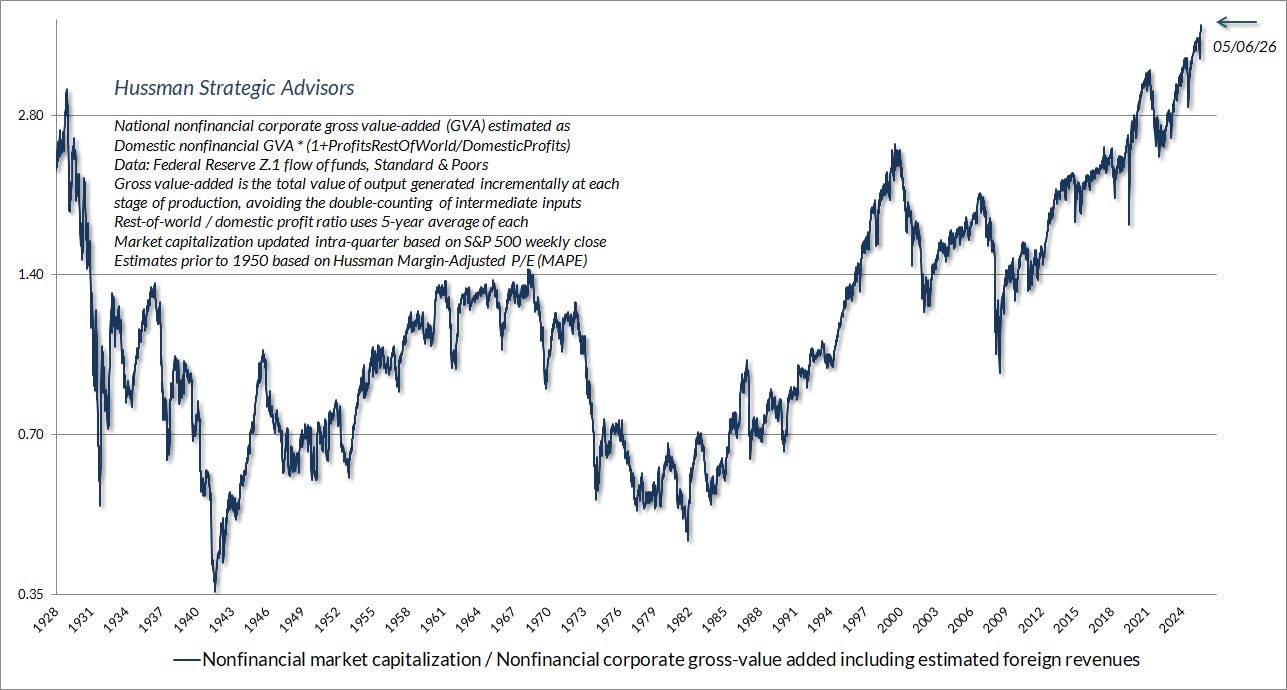
The argument that backs it up runs through the whole letter, but the key is this: his most reliable valuation measure, the ratio of nonfinancial market capitalisation to gross value-added (a sort of economy-wide price-to-revenue ratio), is now at the highest extreme in U.S. history. Higher than 1929. Higher than 2000. Higher than every other peak in a hundred years of market cycles.
You might say profit margins are at record highs too, so the multiples are justified. That brings us to the second piece, and this is the one nobody on CNBC will explain to you properly.
The mirror
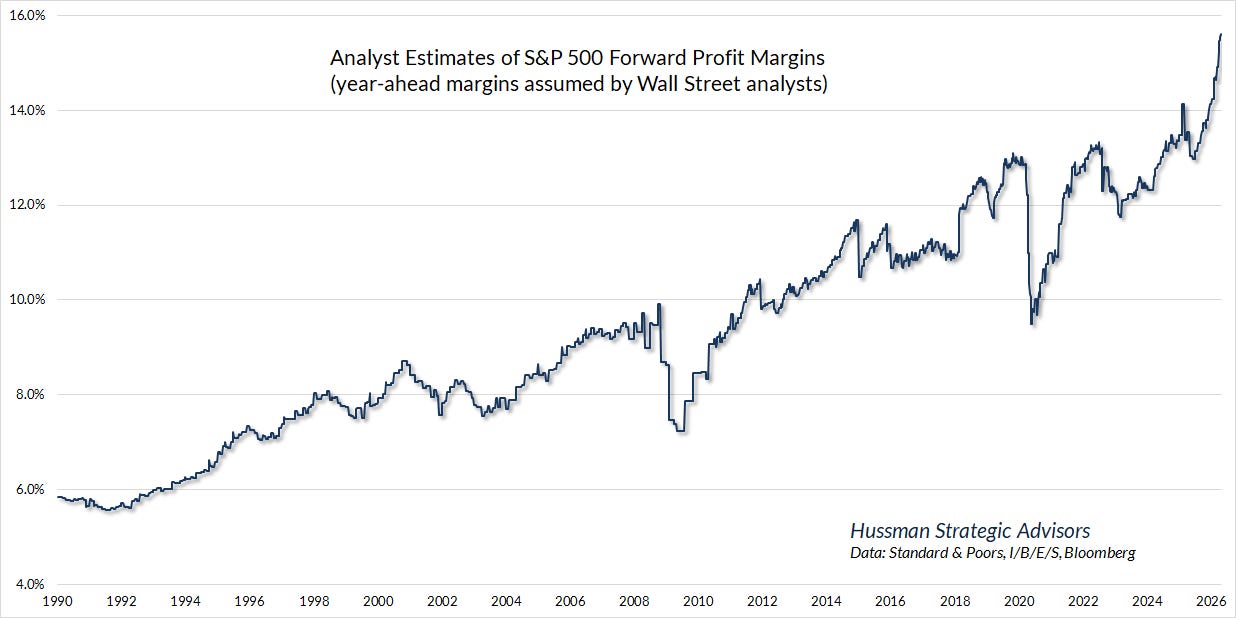
Wall Street analysts currently expect forward profit margins for the S&P 500 that are, in Hussman’s phrase, “easily the most extreme in history.” The chart he shows is a near-vertical move higher in recent quarters. To accept those expectations as a basis for paying current prices, you have to assume the elevated margins are permanent.
Why are profit margins this high in the first place? This is the part that gets buried. What investors observe as record corporate profits are the mirror image of record deficits. That’s an accounting identity. The deficit of one sector of the economy, where consumption and net investment exceed income, must show up as a surplus of another sector, where income exceeds consumption and net investment. Without exception. Basic national income accounting. It has the same status as 2 + 2 = 4. (I knew my accountancy qualification would come in useful one day…)
So: U.S. corporate profits are at record levels. Whose deficits are funding them? The U.S. government runs a chronic deficit. American households in the bottom 90% run a chronic deficit (their wages and salaries don’t cover their spending and investment needs).
Now go back to the question. Are these record profit margins permanent?
To answer yes, you have to also answer yes to: are the record deficits permanent? Because you cannot have one without the other. They are the same phenomenon viewed from opposite sides. One reason for the current upsurge in earnings is that AI companies recognize revenue immediately upon closing a deal (upfront) while spreading the associated costs of infrastructure (GPUs, servers, data centers) over several years (amortized). Creative accounting is alive and well.
If the U.S. government starts cutting deficits aggressively, by raising taxes or cutting benefits, corporate profits fall. If household debt accumulation slows, corporate profits fall. If the trade balance shifts toward surplus, corporate profits fall. The mirror image is unavoidable. Unlikely in the short term, but if something cant go on forever it won’t.
Second and third order
First order: profits are at record highs. Second order: they’re high because someone else is in deficit. Third order: if those deficits ever revert toward historical norms, profits revert with them. Fourth order: what does the wealth distribution look like in either scenario, and does the political system tolerate it?
The technology piece deserves the same treatment. Everyone tells you AI will be transformational. Hussman makes a striking observation that should give you pause. Real U.S. GDP growth over the past 25 years has run at the slowest compound rate in the country’s history. That includes the iPhone, cloud computing, social media, mobile internet, electric vehicles, and the early years of large language models. All of it. Slowest 25-year growth in the history of the Republic.
What technology has done is shift the distribution of income. Same pie, different slices. Capital takes more, labour takes less, and the gap shows up as productivity rising faster than real wages.
I wrote about this ilast year.
The productivity gains from AI will be captured by capital, with labour absorbing the disruption. White-collar employment will compress, especially in finance, law, accounting, consulting. Spending power in the broad middle falls. The tax take falls and the Government is even more in debt. Corporate profits rise on the productivity side and fall on the demand side.
Profits will rise short term before the fall in demand kicks in later; the illusion of rising productivity.
There’s a further effect Hussman touches on in his April letter.
When wealth concentration reaches certain extremes, the political response stops being polite. Trust in institutions has been collapsing for decades.
The OECD numbers I quoted in November (only 17% of Americans and 27% of Brits trust the government to do the right thing) sit alongside this market story, not separate from it. The K-shaped economy and the trust collapse are the same phenomenon viewed from different windows.
Markets don’t reprice gradually for things like that. They reprice in jumps. Mandelbrot called these wild discontinuities part of the deep structure of price. Most people, including most professional fund managers, still model the world as if returns were Gaussian. They aren’t. They never have been. And the further we get from any historical anchor of social stability, the fatter the tails will get.
If you’re an investor, here’s the practical question. Are you holding equities at the highest valuations in U.S. history because you believe the Mag 7 and AI tech will compound earnings at 25% forever, or because you’ve been told for fifteen years that the market always comes back from any “correction”, or because every dip below a record high gets chased automatically by retail money on autopilot.
The honest part
Here’s the part of Hussman’s letter I most appreciate, and the part that most clearly distinguishes him from the doom-monger crowd. He is not telling you to short the market. He is not telling you the crash is coming next month, or even next year.
What is important is his framing of risk. Watch out for the trap door!
Crashes don’t need a specific trigger. They happen when investor risk-tolerance evaporates against valuations that have left no buffer.
The condition is what matters, much more than any specific trigger. And the condition is, by every measure he tracks, the most extreme in a century.
What this means for you
The profit margins behind today’s record valuations are not a structural feature of a more productive economy. They are the mirror image of record deficits. Believing in permanent record margins requires believing in permanent record deficits. Both are mathematically tied. You can’t decouple them by pretending they don’t.
Three things to think about. One thing to do.
First, examine what you actually own and why. If you’re holding broad equities through a 60/40 portfolio or a passive index fund, you are holding a position with the worst expected real return in a hundred years on the most reliable historical measures. That doesn’t mean sell everything tomorrow. It means understand the asymmetry. Upside, modest. Downside, large. You should at least know.
Second, watch the K-shaped economy. The accounting identity that drives record profits also drives record wealth concentration, which drives political instability, which drives policy responses, which drives market outcomes. The political cycle and the market cycle are increasingly the same cycle. Trust in institutions has been collapsing for decades, as I covered in November. We are nowhere near the bottom of that decline, and the implications for asset prices are not benign.
Third, develop your own framework for dealing with uncertainty. Think in probability ranges. Think fractally. There two key two metrics you need to know and understand. Rate of change of both inflation and GDP. The single most useful intellectual move I’ve made in the past 12 months has been giving up the urge to know what happens next and why and replacing it with the discipline of allowing the data to map the probabilities and investing accordingly. If the data changes so does the strategy. As Keynes said, “If the facts change I change my mind. What do you do sir?” This is NOT market timing on which I will have more to say, along with “buy and hold” as an investment strategy, in a later piece I am working on.
So: read Hussman’s April letter. It’s at hussmanfunds.com. Then look at your own portfolio with the question, what am I assuming about the permanence of these margins? If your answer is anything other than “I’ve thought about it carefully,” you have homework to do.
Price is what you pay. Value is what you get. The gap between the two has rarely been wider, and it has never been wider on one of the most reliable measures we have.
The mirror is on the wall. Time to take an honest look. The reflection may not be the one you expect; trust it and, as ever, love yourself and go gently.
Comments
Nothing yet. Say the first thing.
Sign in to join the conversation.