
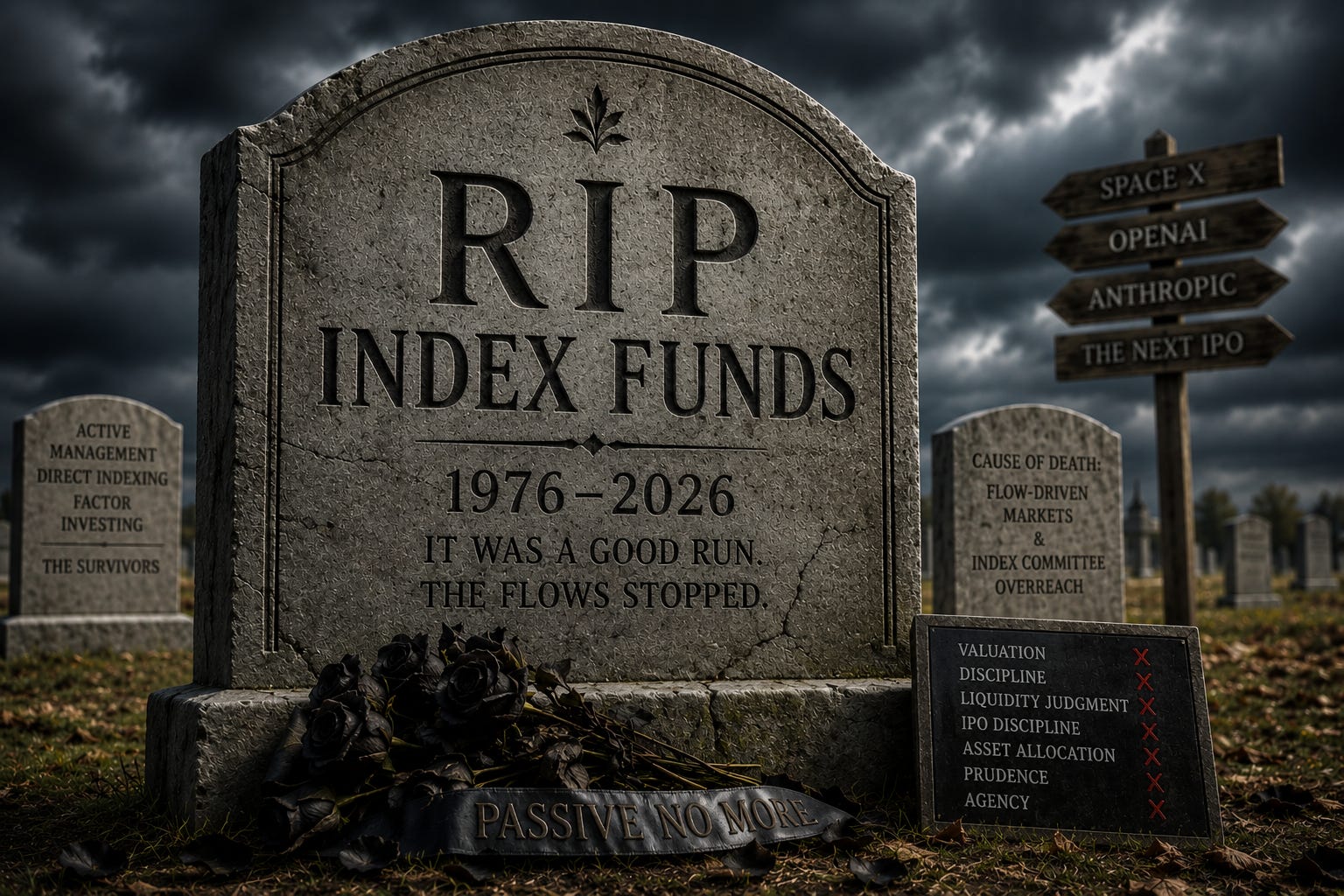
Vanguard pioneered the first index fund available to individual investors when founder John Bogle launched the First Index Investment Trust (now the Vanguard 500 Index Fund) in 1976. Designed to track the S&P 500, it was initially mocked by the financial industry but revolutionized investing. Bogle’s creation popularized the “buy the haystack” philosophy: instead of trying to beat the market by paying hefty fees for active fund managers, investors could match overall market returns with incredibly low costs.
Bogle’s brilliant idea has morphed into a colossus. Active fund management has taken a back seat to buying the biggest stocks in the index because…they are the biggest.
This is the bit nobody mentions at the index-fund fan club. Once enough money pours into a market-cap-weighted index, price stops being an opinion about value and becomes a function of plumbing. Money arrives; it is handed to the biggest companies because they are the biggest; that makes them bigger; which attracts more money. Rinse, repeat, to the moon. Now bolt on a derivatives market larger than the cash market beneath it — options volume overtook equity volume some time ago — and you have a tail wagging a very large, very expensive dog. Valuation? Valuation is what happens to other people. The flows decide.
We are told index funds are passive and neutral. They are neither. “Passive” is the finest piece of marketing the industry has produced since “this time it’s different.” Behind every index sits a committee, and that committee makes thoroughly active decisions: who goes in, when, and on what terms. They have simply outsourced the blame to a rulebook. And in March, the rulebook changed.
Nasdaq rewrote the entry rules for its flagship 100. The new “Fast Entry” provision — live since the 1st of May — lets a sufficiently enormous newcomer (top-40 by market cap, roughly $100bn and up) leapfrog the queue and join the index a mere fifteen trading days after floating. Gone is the three-month waiting period. Gone are the liquidity tests. These were not bureaucratic fripperies; they existed to protect the very people about to be force-fed the shares. The newcomer doesn’t even displace anyone — the index simply grows past 100 to make room. How accommodating.
Phil Bak, who has actually sat in these listing pitch meetings, put it best on his Substack: it is, he writes, simply “madness.” You think you are buying technology when you buy the Nasdaq 100; you end up part-owner of Costco and a warehouse of other things, while Oracle and Uber sit elsewhere because they happened to list on the wrong exchange. Allocating capital by listing venue is, as Phil notes, utterly disconnected from anything resembling investment merit. But it is marvellous for the exchange that wins the listing.
Which brings us, inevitably, to the rocket.
SpaceX is reportedly going public on the 12th of June — nine days from this writing — chasing a valuation of “at least” $1.8 trillion. That would be the largest flotation in the history of capitalism, raising something like $75bn. It would also be a company that lost the thick end of $5bn last year, whose founder retains around 85% of the votes, and which Morningstar valued this week at $780bn — comfortably less than half the asking price, and they were not shy about calling it overpriced.
Now stitch the two stories together, because the market already has. Thanks to Fast Entry, trillions of pounds and dollars of passive pension and retirement money — yours, quite possibly — will be obliged to buy SpaceX at whatever the IPO printer spits out, roughly a fortnight after listing, regardless of price, profit, or sanity.
Morningstar said the quiet part out loud: small float, a ravenous appetite for anything with “AI” in the prospectus, and that unprecedented fast track into the index mean the shares will “likely survive separation and may even ascend — at least for a time.” At least for a time…
This is the punchline of passive’s long con. The vehicle sold to you as the humble, neutral, hands-off way to own the market has become the mechanism that buys the most fashionable, most expensive, most speculative asset on Earth at the worst possible moment; and calls it discipline.
So what to do?
First, retire the word “passive” from your own vocabulary. You are not passive; you have merely delegated your active decisions to a committee in New Jersey. Take them back. Second, where you want broad exposure cheaply — fine, but know precisely what the rulebook is doing on your behalf. Third, active management earns its fee only where it has a genuine edge and a repeatable process — and most have neither, which is rather the point of everything I bang on about here. And as ever: watch the flows into, and one day out of, BlackRock and Vanguard. The tide that lifted all of this can ebb, and when it does, the flow runs the other way…rapidly.
The brilliant idea is dead.
Major Tom is strapped in, the countdown is running, and your retirement savings have quietly been volunteered as ballast. Bowie told us how this particular Space Oddity tends to end. Mind how you go.
RIP. 🪦
Nothing here is investment advice — your scribe is a grumpy old navigator, not your adviser. Sources: Nasdaq-100 “Fast Entry” methodology (effective 1 May 2026); SpaceX IPO reporting and prospectus; Morningstar initiation note (June 2026).
Comments
Nothing yet. Say the first thing.
Sign in to join the conversation.