

I received an inspiring comment / question from Jess Nash for my previous post For Integration, Against Demonization. I wrote a reply, and then thought it deserves its own post, with some further thoughts.
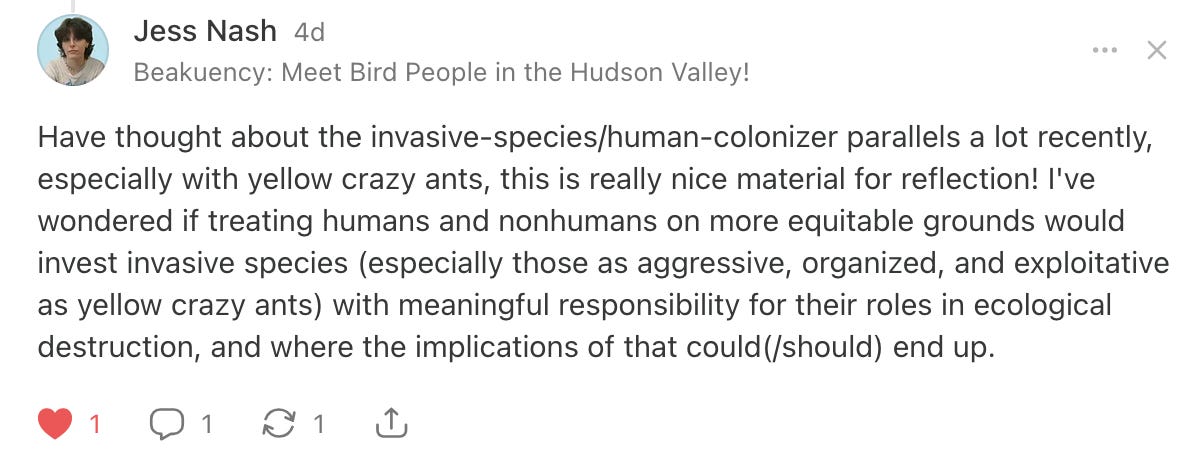
Have thought about the invasive-species/human-colonizer parallels a lot recently, especially with yellow crazy ants, this is really nice material for reflection! I've wondered if treating humans and nonhumans on more equitable grounds would invest invasive species (especially those as aggressive, organized, and exploitative as yellow crazy ants) with meaningful responsibility for their roles in ecological destruction, and where the implications of that could(/should) end up.
I think demonization and accountability are two different things. Accountability is necessary and must be assessed proportionately and specifically to the damage caused. In the case of a species, that would mean being removed from a particular area because of the concrete harm it causes there. In the case of immigration, people can and should be deported for specific violations of specific laws. A country cannot accept an infinite number of immigrants, especially those who do not comply with the regulations in place.
But as someone who has jumped through the hoops of immigration, my question is: are those regulations truly fair and inclusive, giving outsiders a genuine chance to integrate in a way that is not disruptive to the resident community? Is meeting them with hostility really helpful to what we are trying to achieve? In my experience, the system felt designed to set you up to fail, making compliance so difficult because of the aggressive view that “they are coming for our resources, we need to get rid of them, only keep the ‘right’ ones, however that gets defined” rather than asking: “what conditions would allow coexistence?”
And historically, what was considered ‘right’ was based on human convenience and aesthetic preference, not necessarily on the balance of the landscape. And that is what fascinates me about the indigenous framework (Contribution of Indigenous Peoples’ understandings and relational frameworks to invasive alien species management). It advocates for management that is just and compassionate rather than driven by demonization, with an aim to understand the finer context of each landscape and for the sake of long-term balance. Which does not mean giving anyone a pass for causing harm.
I think if we are going to be so pro-native, we must give the same passionate support to Indigenous-led biodiversity management, just as one would remove invasive plants to create space for a native plant to grow.
I know this framework not only as an idea, but as an experience.
In The Invasiveness of Native Plant People in 2024, Pam Walatka wrote:
Nativism has taken hold because people who support it are well-intentioned and respectable; nativists sincerely want to help the environment.
The hatred came before the danger; eucalyptus were never considered dangerous before nativism taught people to hate them.
The science is not in yet; evidence-based policies are a thing of the future.
During the Covid-19 pandemic lockdown, I was in Brooklyn, New York, and I belonged to the population that was considered literally to be a biological threat to the survival of the local ecosystem. Once the president Donald J. Trump called it “Chinese virus”, I started seeing changes in some of my neighbors’ behaviors. They frowned, covered their faces, sometimes crossed the street so they wouldn’t have to pass me. News of people who looked like me being beaten started to flow in. (Anti-Asian American Hate Crimes Spike During the Early Stages of the COVID-19 Pandemic). A friend who lived nearby sent me a warning about a man in our neighborhood who did not believe in the pandemic yet was posting on social media about his intention of assaulting Asian women for spreading the virus. I looked at his posts and found out he was ‘patrolling’ the same Dunkin’ Donuts that I frequented.
I felt that I had a tiny glimpse of what the Korean population went through in 1923 Japan (Kantō Massacre), a history that, as a Japanese born, I cannot claim to be apart from. Or the Indigenous population in the US, or the Jewish population under the Nazi regime.
If the virus originated in Asia, by all means research and find out if there was anyone to be held accountable. But how does demonizing and trying to physically remove this particular “species”, one that may or may not be connected to the ecological harm in a specific time and place, help accomplish the goal? Whatever political side you were on, did the president who demonized us help you feel that the country was working together towards the solution, or make you feel reassured?
To me, resisting the normalization of demonization is not “just” a matter of language. I experienced this biological threat framing as part of my own life, and it’s the same logic as invasive species thinking: the organism itself becomes the threat, not necessarily its behavior in specific situations. It is difficult for me to witness extreme language being used to promote Nativism in the natural world — such as “terrorists” and “tumors” by leading figures of the gardening or nature conservation world* — especially in this time of ICE raids we are going through.**
*This topic is explored in depth in this article, with counterarguments to the nativist positions: Seeking Peace in Our Gardens | Conservation Sense and Nonsense, April 1st, 2026.)
** ICE Receives 100,000 Applications from Patriotic Americans Who Want to Help Remove Murderers, Gang Members, Pedophiles, and Terrorists from the U.S. | www.dhs.gov, Aug 2025.
Once I was invited to a discussion to develop a public art project in NYC about immigrants. The organizer’s idea, as I understood it, was that anyone who wants to come to the US should give themselves permission to come here. Feeling a bit alarmed by the language that sounded rather extreme to my ears, I said, “you wouldn’t want to sound like you are encouraging people to break the laws?” They told me they didn’t agree with me, they were not concerned about the laws and that people were entitled to select their own path, wherever it leads, and that it is a form of empowerment.
The thing is, I really don’t think there are any immigrants who enjoy or take pride in being on an illegal status. We are not asking to be celebrated for breaking laws. What we need is practical support that helps us integrate, which, if you are on an illegal status, is especially hard to come by. We need more pathways to legal status, a system designed with compassion and the assessment of reality that helps us navigate to a place where we can not only benefit from the social infrastructure, but also give back. Not the “We love immigrants” signs in Park Slope, nor public art that tells us not to be bothered by the laws. Unconditional support for undocumented immigrants, if it does not bother to work on the actual reform of the laws, is rather ignoring the reality we face as immigrants. And it gets even worse when you hear one of those progressive immigrant-lovers expressing gratitude to the food delivery order app so they didn’t have to deal with someone with an accent that is so hard to understand over the phone. (True story!)
An example of what helpful alliance looks like, calling for specific legal reform in plain language: New York Farm Bureau Statement on Homeland Security Investigations (HSI) Immigration Raids
Situations like immigration raids underscore the dire need for immigration reform in the United States. Farmers are just one of many groups that have been asking for a better guest worker program in this country for about 40 years.
From the super exciting book I’m currently reading, The Unruly Wild: Embracing Ecological Change in the Southwest by Juliet C. Stromberg (The University of Arizona Press, March 2026):
Rather than using a militaristic framework for invasive species,” he advised, “we need to consider alternatives that recognize our relationship with them, while still promoting conservation action.
Just giving a pass to anyone is not compassion. Compassion is to actually be patient and listen, and find a way to coexist.
Fujino Enterprise
For Integration, Against Demonization
·
Mar 24

The real challenge of learning a language that is not your own is understanding the emotional impact a word or expression carries for native speakers. This is obviously far more complex than reading dictionary definitions. I remember, 15 years ago when I started taking ESL classes, feeling surprised to learn that the word “primitive” did not have a straightforwardly positive connotation in American English, and that I had to be careful using it. To me, primitiveness suggested a source of energy residing in the core of our being.
Comments
Nothing yet. Say the first thing.
Sign in to join the conversation.