
“Total revenue increased 83% compared to 2024 to a record $456 million. We are targeting over $1 billion in revenue for 2026, driven by our 800G and 1.6T transceiver ramp.”— Dr. Chih-Hsiang (Thompson) Lin, CEO & Founder, Applied Optoelectronics
After years of watching semiconductor transitions play out, I can say this one is different. The shift from copper to fiber-optic interconnects inside AI data centers isn't gradual — it's physics-forced. Copper can't move data fast enough, far enough, or efficiently enough to connect tens of thousands of GPUs in a modern training cluster. Fiber isn't optional. Applied Optoelectronics (NASDAQ: AAOI) is one of the few companies in the world that makes the laser chips these transceivers require — in-house, in Texas, at scale.
The stock has returned +441% year-to-date as of June 9, 2026. That is not a typo. From a 52-week low of $15.29 to a high of $233.67. And the fundamental story — if management executes — still has a meaningful runway ahead.
AAOI is not just riding the AI wave. It manufactures the glass that carries the light that makes AI possible.
Every time Microsoft, Amazon, or Google builds a new AI data center, they install racks of GPU servers. Those servers need to communicate — transferring enormous amounts of data between GPUs at speeds that make standard copper cables useless beyond a few meters. The answer is fiber-optic transceivers: small modules that convert electrical signals into beams of light, send them down optical fiber, and convert them back. AAOI makes those modules.
What makes AAOI structurally different from most transceiver companies is vertical integration. AAOI designs and manufactures its own Indium Phosphide (InP) laser chips — the single most expensive and difficult component inside a transceiver — at its Sugar Land, Texas facility. Competitors buy lasers externally. AAOI makes them. That is the cost advantage, supply chain control, and customization speed that has made AAOI the first-choice 800G supplier for Microsoft’s AI buildout.
Two distinct businesses inside one ticker
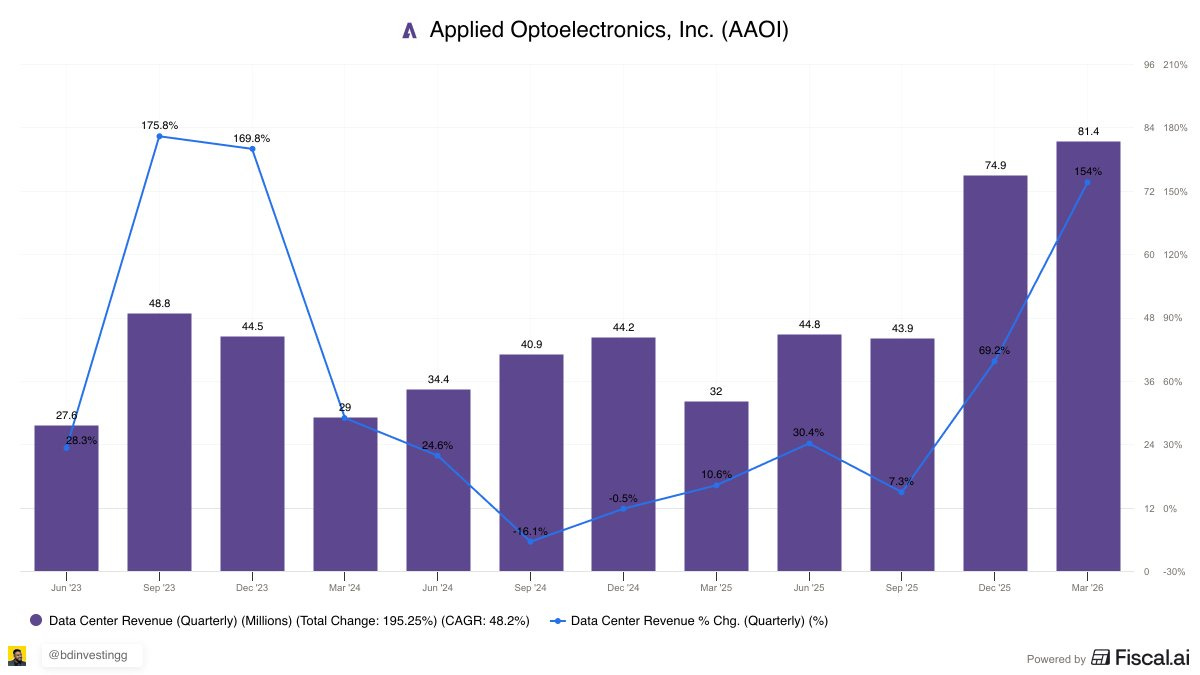
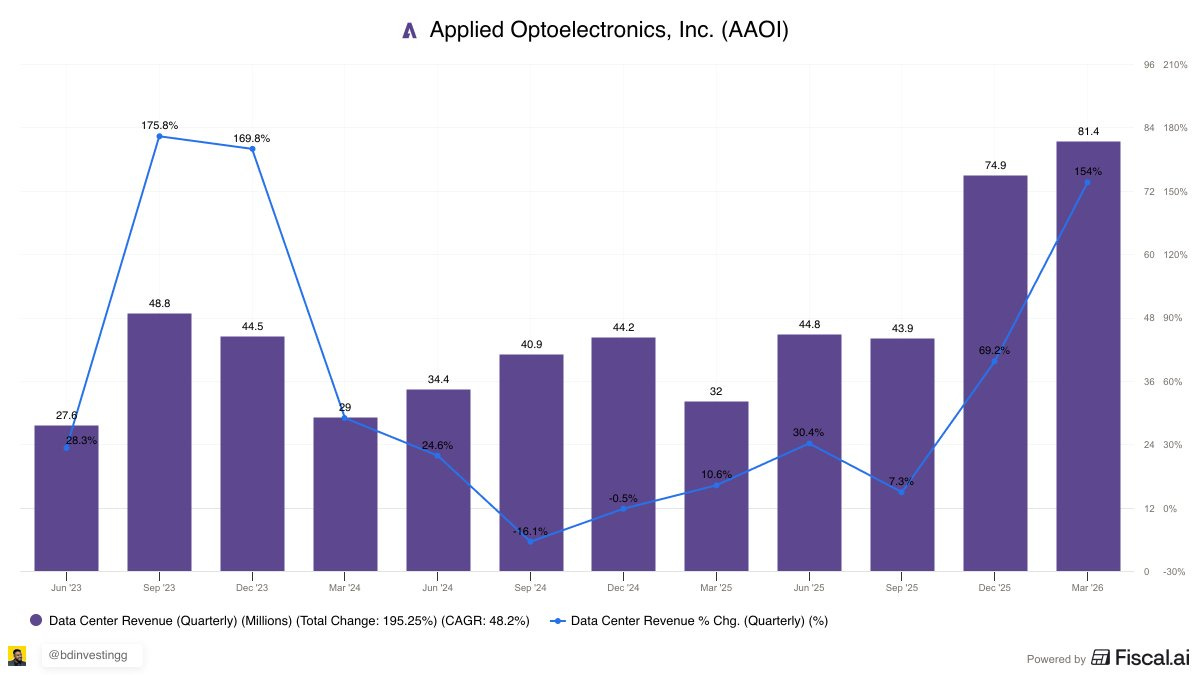
Datacenter / AI segment (~54% of Q1 2026 revenue)800G and 1.6T optical transceivers for hyperscale AI clusters. Revenue grew +154% YoY in Q1 2026. First volume 800G shipments began Q1. 1.6T deliveries begin Q3 2026. $324M+ in backlogged 800G and 1.6T orders. Microsoft (~44% of 2024 revenue) and Amazon (customer warrant issued) are primary customers.
CATV / broadband segment (~44% of Q1 2026 revenue)Fiber and cable TV hardware for DOCSIS 4.0 / 1.8 GHz network upgrades. Mediacom multi-year contract signed for QuantumLink deployment. Guided to >$325M for FY2026. This is the steady revenue base that funds the AI ramp — and it is growing, not declining.
The CATV segment is not the story. It is the foundation. The AI data center segment is the rocket.
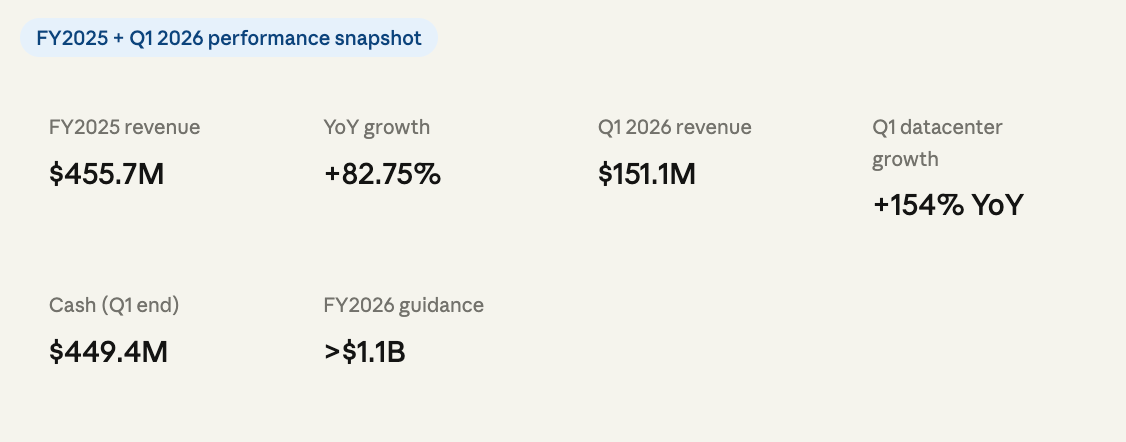
The quarterly progression is the story of a company arriving at an inflection:
Q1 2025: $99.9M
Q2 2025: $107.8M
Q3 2025: $116.6M
Q4 2025: $131.4M (+31.2% GAAP gross margin, record at the time)
Q1 2026: $151.1M (+51.3% YoY) ✅ 5th consecutive record quarter
Q1 2026 gross margin dipped to 29.1% from 31.2% in Q4 2025. This is the number skeptics point to. The explanation is real: new product ramps always carry higher initial costs. Management guided 35% gross margin by Q4 2026 and 40%+ by 2027. If they deliver, the margin-compression narrative dissolves entirely.
The Q2 2026 guidance is $180–$198M (midpoint $189M) — another step-up of 19–31% sequential growth heading into the back half, where the real capacity ramp kicks in. Management is targeting 60–80% sequential growth in Q3 and Q4 as the new Pearland, Texas, facility and expanded Taiwan lines come online.
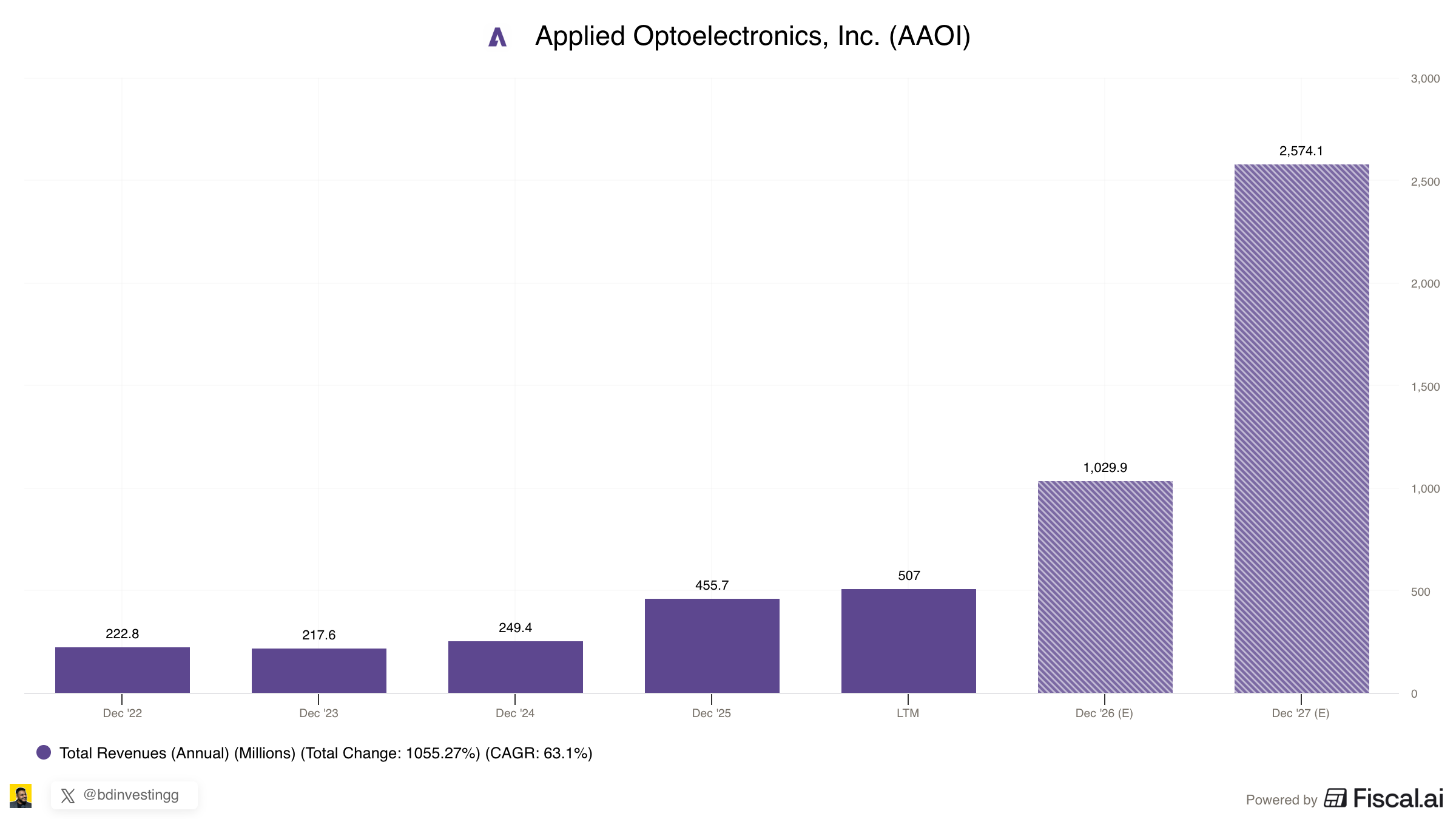
Revenue doubling in a single calendar year — from $455M in 2025 to $1.1B+ in 2026 — is not an estimate. It is the guided base case, backed by $324M in confirmed backlogged orders.
Comments
Nothing yet. Say the first thing.
Sign in to join the conversation.