
Kurzgesagt, one of the most popular educational YouTube channels, posted a video called ‘A.I. ‐ Humanity's Final Invention?’ on Tuesday. It claimed that:
Intelligence is the ability to learn, reason and solve problems.
Intelligence is power and since humans have exploited it the most, we’ve come to dominate the planet, progressing at an accelerating rate.
AI is software which solves mental tasks with a computer.
At the beginning, AIs performed very specific tasks, sometimes better than humans.
Over time, the number of tasks AI can complete better than humans have increased, and those tasks have become more complex.
This has been driven by an explosion in computer processing and the quantity of data collected in the information age.
Machine learning, where algorithms write their own code to improve themselves, has sped this process up further, but we don’t know exactly how they do it (i.e. black box code).
ChatGPT was the inflection point for most people. Trained on almost everything published on the internet, it can complete a large range of tasks better than most people.
What still marks humans out is our general intelligence, the ability to learn and adapt to different situations, rather than being trained on one specific task.
Artificial General Intelligence (AGI) – AI as intelligent as humans – would bridge this gap. We don’t know how to build it or how it will work, but it could potentially scale very quickly.
Most AI researchers think it will happen this century and some within a few years.
AGI would be more effective than humans because it wouldn’t have the same biological restrictions (i.e. we need to sleep, we can’t clone ourselves, nor become an expert in new domains very quickly).
If AGI kept developing, it could lead to an Intelligence Explosion, where AIs are smarter than the smartest humans and develops independently.
We don’t know what that would look like, nor how it would work, but it would change everything.
The video was recommended by PauseAI, a group campaigning for AI development to temporarily stop, and Mark Tegmark, Founder of the Future of Life Institute and an influential technology futurist in Silicon Valley.
I read Tegmark’s book, Life 3.0, a few years ago, where he anticipated the immediate effects of AGI, as well as more long-term ones. The immediate effects, such as increased structural unemployment, are convincing (although admittedly not entirely his own, given all the research on the Fourth Industrial Revolution).
The long-term scenarios he posits, some taking place over billion-year timeframes, are, however, science fiction. Here is a selection of the chapter titles: ‘Cyborgs and Uploads’, ‘Protector God’, and ‘Our Cosmic Endowment: The Next Billion Years and Beyond’. It’s unserious.
If Tegmark wants to genuinely influence the direction of AI (as at the moment, it seems he’s shouting into the wind), he needs to answer two questions:
How should AGI be regulated? It’s not enough to say: ‘We don’t know what this stuff will look like so we should pause all development’. That’s not going to happen. So, what’s your middle ground?
You claim that both Superintelligent AI needs to be regulated and that it will also be impossible to regulate a technology with “godlike powers”. This isn’t a consistent argument. You can’t raise the importance of regulation and then say it’s futile. What’s your solution?
Sticking with the theme of scary AI, Nick Bostrom, author of Superintelligence, gave an interview where he said that we may only be a year or two away from the technological singularity, where AI improves itself so fast that there is an intelligence explosion, and that it therefore might not be worth making long-term investments in human capital like college degrees because the timeframes are so short.
It's incredibly disappointing to see one of AI’s preeminent thinkers fall into the trap that has plagued millenarians and rapturists through the ages: the idea that you shouldn’t prepare for the future because you don’t think it will come. Bostrom should ask himself two questions:
What if he’s wrong and technological singularity is further away, if it ever happens at all?
Even if’s he’s right, what should people do instead? Surely becoming more intelligent would make you more equipped for the age of AGI. And even if Bostrom thinks it’s a fools errand, should we all just become hedonists in the meantime?
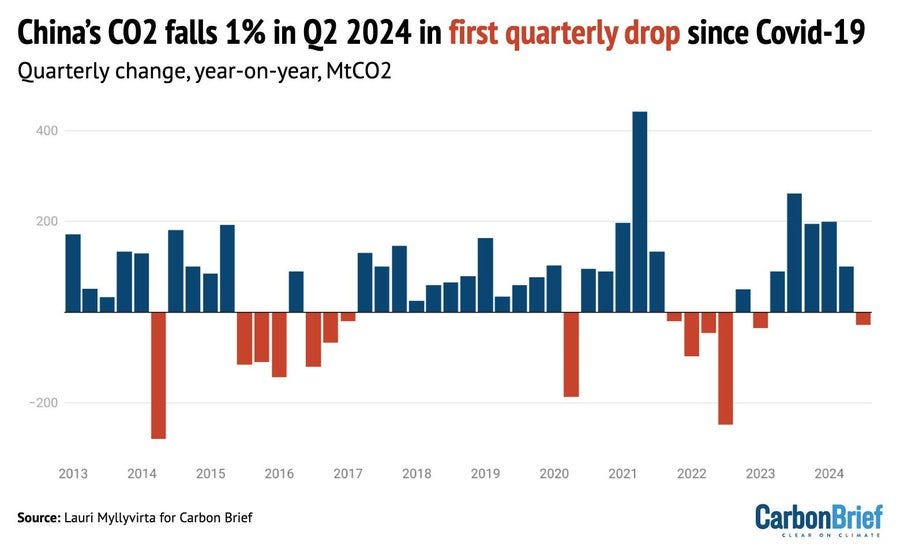
New analysis by Carbon Brief shows that China’s CO2 emissions dropped 1% in Q2 of 2024, the first quarterly drop since Covid-19. This would put China on track for a fall in annual CO2 this year, meaning emissions would've peaked in 2023. The key drivers are record growth of solar and wind, as well as EVs and China's real-estate slowdown.
The IPCC meeting in Sofia, Bulgaria, failed to agree on a timeline for seventh assessment report. The IPCC reports, coordinated by the UN, are the most authoritative international reports on the state of climate change. The first report was published in 1990 and the sixth and most recent report was published in 2023. During that time, the reports have steadily become more frequent, with six years between the most recent report and the one before it. Many countries wanted the seventh report to be published in 2028 (5 years after the previous one), but countries such as China, India, South Africa and Kenya blocked the motion. No date was agreed.
Samsung has developed a solid-state electric vehicle (EV) battery with a 600-mile range, 20-year lifespan that charges in just nine minutes. It’s thought that these could be scaled in production in around five years.
I recently read ‘The Genetic Lottery: Why DNA Matters For Social Equality’ by Kathryn Paige Harden, which convincingly argues that intelligence is, to a significant extent, hereditary, that it has a large effect on life outcomes (almost as much as family income), and that we therefore need to rethink how we go about social policy.
The trouble, Harden argues, is that this science has become taboo because of its historic connections with eugenics, which sought to ascribe moral value and hierarchies to genetic features. The hierarchies eugenicists tried to justify have generally been racist ones, i.e. using science to ‘show’ differences in intelligence between races and then use it to underpin immoral political projects. Not only does Harden persuasively argue that we cannot use the current science available to make such claims, but that it shouldn’t be a victory for intellectual Nazis even if it was somehow proven in the future.
To make this argument, Harden adapts the philosophy of John Rawls to genetics: if intelligence and life outcomes are, to a large extent, the result of our genetics, which we have no control over, then our successes are not wholly our own. The political Left make this argument in the context of our environment to critique inequality, stating that because an individual’s background (class, gender, support received from the state, etc) has a significant bearing on accomplishments, people who achieve more therefore aren’t morally superior. By including genetics in this argument, Harden goes even further, undermining the very concept of meritocracy.
The question, then, is what you do with this information. Here, Harden reaches again for Rawls, using his famous thought experiment – if you didn’t know what position you would be born into, what kind of society would you like to live in? – and his core belief: that inequalities must be arranged so they help the least well off.
The first three of this four paragraph summary of Harden’s argument are, I think, undeniable, the implications of which would revolutionise society. What does support for those less intelligent due to their DNA look like, for example? The fourth, however, could face challenges that Harden doesn’t anticipate. Here’s one…
A fundamental problem with Rawlsian philosophy is that it presumes that society is steady state, with no conception of progress. However, you shouldn’t just order society based on the most equitable distribution of the current resources, but also consider how to order society to grow the number of resources in the future. I’d rather be poor in modern day Britain than a medieval duke. In relation to Harden’s genetic arguments, this would mean also considering what ordering of society based on genetic factors would most advance development. You can see how such an argument could slide back into the eugenics Harden worked so hard to avoid.
No posts
Comments
Nothing yet. Say the first thing.
Sign in to join the conversation.