
Q&A with Team Scientist Devin Pope

Devin Pope is the Steven G. Rothmeier Professor of Behavioral Science and Economics at the Booth School of Business at the University of Chicago. His research spans a variety of topics sitting at the intersection between economics and psychology and has been published in journals such as the American Economic Review, the Quarterly Journal of Economics, Nature, Science, and Psychological Science.
BCFG: Do you have a favorite research finding from your work in the last several years about how psychological biases affect markets? If so, could you describe it and its implications?
Devin: One of my favorite papers that I have written shows how people’s car buying behavior changes depending on the weather at the time of purchase. A sunny, warm day in October in Chicago causes a lot of car buyers to choose the convertible option when buying a new car. A recent snowstorm leads people to prefer the 4-wheel drive option. A similar thing can happen when buying a house. When you buy a house in the summertime, you tend to place more value on homes that have a swimming pool or central air. When you buy a house in the wintertime, you care more about fireplaces. Our preferences are influenced by whatever is happening in the moment. This can lead to suboptimal decisions when buying durable goods like cars and houses.
BCFG: You’ve been involved in some really important research in Sweden on how offering a variety of different types of monetary incentives for vaccination can impact uptake. Could you share your key takeaways from this work to date?
Devin: Across multiple studies, we document an important finding: paying people (~$25) to get vaccinated can have large effects on behavior. Further, we don’t find evidence of unintended consequences. Of course, our work is not the final say on this important topic, but I think people should update their priors towards the value of simple monetary programs to encourage healthy behavior.
BCFG: What is a psychological bias that’s often under-discussed in economics but that you think has big consequences in everyday decision-making?
Devin: An understudied phenomenon in my opinion is how our preferences and decision making can change with important life events. Take for example having a baby. Anecdotes abound and now we are starting to see more and more research showing that having a baby can dramatically affect parents. It can cause parents to be more patient, commit less crime, become more religious, etc. Of course, the experience of having a baby will not be the same for everyone, but understanding life changes on average for new parents deserves more attention in my opinion.
Many thanks to Devin Pope for sharing his expertise with BCFG! Learn more about his research here.
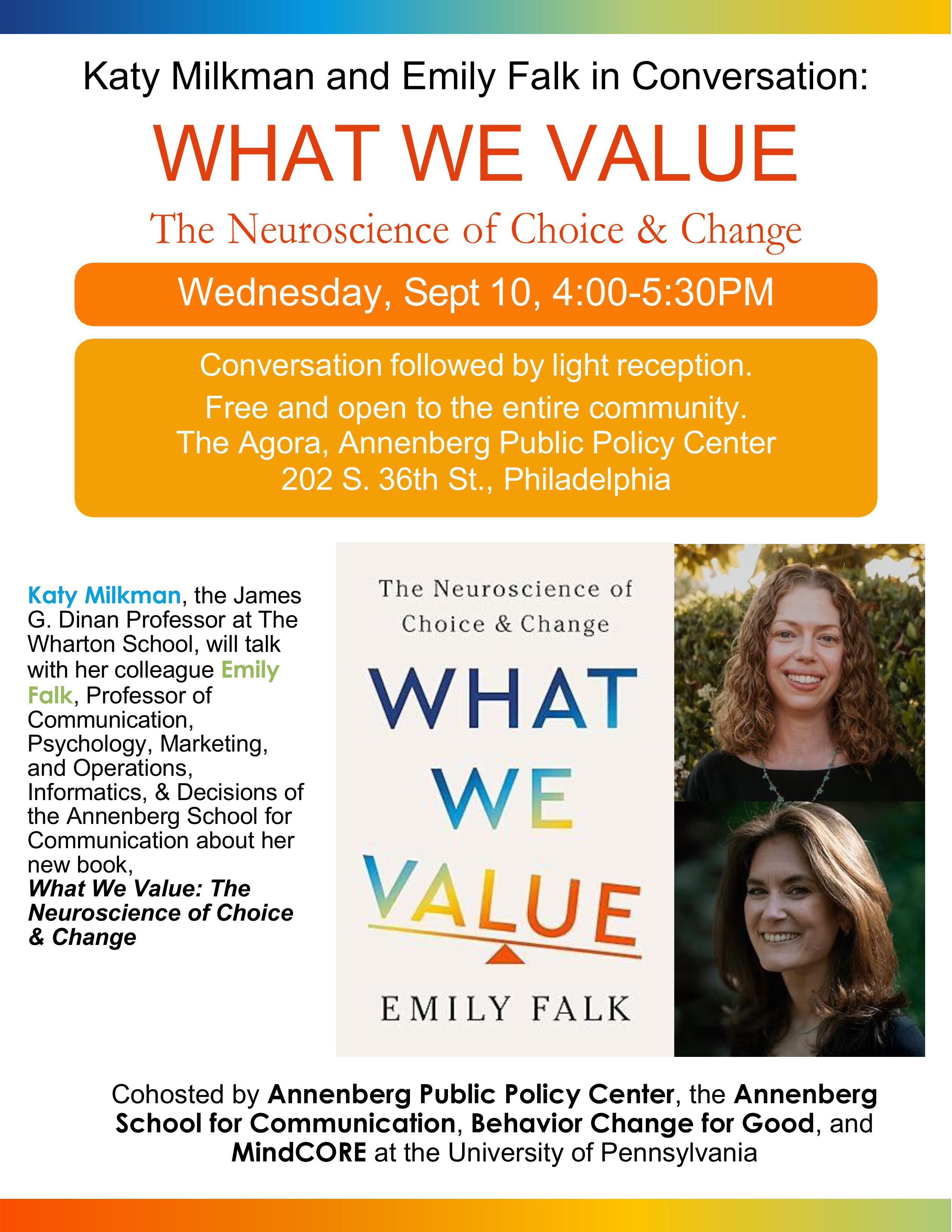
BCFG Co-Presents: A Conversation on What We Value
University of Pennsylvania Professor and BCFG Team Scientist Emily Falk will join Katy Milkman at Penn for a conversation about Professor Falk’s new book, What We Value: The Neuroscience of Choice & Change.
Mark your calendars for Wednesday, September 10th from 4:00-5:30pm for this conversation followed by a light reception. If you’re in or near Philadelphia, we hope you can join us for this free, in-person event.
Malcolm Gladwell Reviews Jens Ludwig’s Unforgiving Places

In The New Yorker, Malcolm Gladwell recently shared a glowing review of Team Scientist Jens Ludwig’s new book Unforgiving Places. Ludwig argues that behavioral science can help curb violent crime and shed light on its underlying causes. “As Ludwig reminds us,” Gladwell writes, “we have been trying to stop violent offenders without understanding what goes on in the mind of the violent offender.” Read the full review here.
Selected New Journal Articles from BCFG Team Scientists

Goal Harmony, co-authored by Ayelet Fishbach & Jiabi Wang, Journal of Personality and Social Psychology
Generalizability of Choice Architecture Interventions, co-authored by Barnabas Szaszi, Daniel G. Goldstein, Dilip Soman & Susan Michie, Nature Reviews Psychology
Machine Learning Who to Nudge: Causal vs Predictive Targeting in a Field Experiment on Student Financial Aid Renewal, co-authored by Susan Athey, Niall Keleher, & Jann Spiess, Journal of Econometrics
Can Stereotype Reactance Prompt Women to Compete? A Field Experiment, co-authored by Sophia Pink, Jose Cervantez, Erika Kirgios, Edward H. Chang, & Katy Milkman, Organization Science
Spotlighted Podcasts

The Hidden Costs of Healthcare Churn, featuring Team Scientist Ezekiel Emanuel, The Indicator from Planet Money
How a Single Source of Information Can Seem Like Several, hosted by Co-Director Katy Milkman, Choiceology
You 2.0: The Passion Pill, featuring Team Scientist Jon Jachimowicz, Hidden Brain
Don’t forget to follow us on social media, where we share new research, job postings, and more: LinkedIn / X / Facebook / Bluesky
Thanks for reading the Behavior Change for Good Newsletter! Subscribe for free to receive new posts and donate to support our work.
Comments
Nothing yet. Say the first thing.
Sign in to join the conversation.