
BCFG’s new megastudy published in the Proceedings of the National Academy of Sciences found that behaviorally-informed emails can accelerate student math progress. Led by BCFG Co-Director Angela Duckworth, this megastudy with 140,000+ teachers and 3 million students was conducted in collaboration with Zearn Math, a leading math learning platform used by 1 in 4 elementary-school students nationwide.
What did the megastudy test?
We tested 15 interventions directed at teachers to evaluate how different behavioral science approaches could help teachers improve their students’ math progress. Over four weeks, math teachers received: (1) weekly emails, and (2) weekly messages posted on the Zearn Math teacher dashboard. For instance, one intervention prompted teachers to make a specific plan for using the platform, while another appealed to their empathy for their students.

What were the key takeaways from the research?
The most effective of the 15 interventions tested prompted teachers to log into the Zearn platform’s dashboard weekly to check their students’ progress. This intervention increased students’ math lesson completion by 5.06% during the 4-week intervention period.
Messages that referenced data specific to a teacher’s students boosted progress by 2.26% more than other messages, with effects lasting 8 weeks post-intervention.
Overall, the effects of these interventions were modest—underscoring just how difficult it is to nudge behavior change via email.
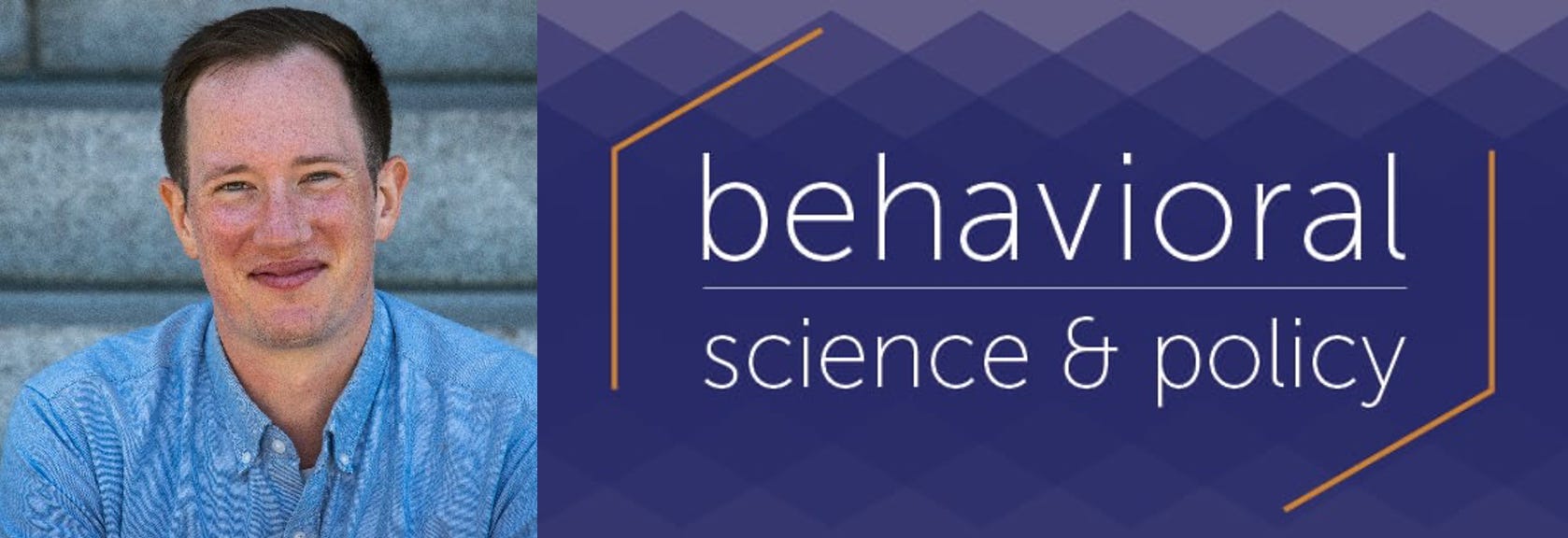
Congratulations to Jan Voelkel for receiving the 2025 Young Investigator Award from the Behavioral Science and Policy Association (BSPA). This award honors an early-career scholar whose work has advanced the rigorous application of behavioral science to policy and practice across sectors. Starting in Fall 2025, Jan will join the faculty at Cornell University as an Assistant Professor. We’re thrilled to see his impactful research recognized by BSPA and have loved hosting Jan as a post-doc.

Keynote #1: Team Scientist and Yale Sociology Professor Nicholas Christakis discussed how social network interventions can be used to promote cooperation and innovation ranging from online groups to remote villages.
Keynote #2: Harvard Economics Professor Raj Chetty presented on the drivers of economic opportunity and how data science can inform policies to improve upward mobility.

What We Value: The Neuroscience of Choice and Change by Emily Falk
Unforgiving Places: The Unexpected Origins of American Gun Violence by Jens Ludwig
Ordinary Magic: The Science of How We Can Achieve Big Change with Small Acts by Greg Walton
When Do “Nudges” Increase Welfare?, co-authored by Hunt Allcott, Daniel Cohen, William Morrison & Dmitry Taubinsky, The American Economic Review
Reluctance to Downplay: Asymmetric Sensitivity to Differences in the Severity of Moral Transgressions, co-authored by Amanda Geiser, Ike Silver & Deborah Small, Psychological Science
High-Frequency Location Data Show That Race Affects Citations and Fines for Speeding, co-authored by Pradhi Aggarwal, Alec Brandon, Ariel Goldszmidt, Justin Holz, John List, Ian Muir, Gregory Sun & Thomas Yu, Science

A Numbers Game: With Guests Linda Chang & Stephen M. Colbert, hosted by Co-Director Katy Milkman, Choiceology
Policymaking Is Not a Science — Yet, featuring Team Scientist John List, Freakonomics Radio
Say Anything (1989), hosted by Team Scientist Eli Finkel & featuring Team Scientist Laurie Santos, Love Factually
Don’t forget to follow us on social media, where we share new research, job postings, and more: LinkedIn / X / Facebook / BlueSky
No posts
Comments
Nothing yet. Say the first thing.
Sign in to join the conversation.