
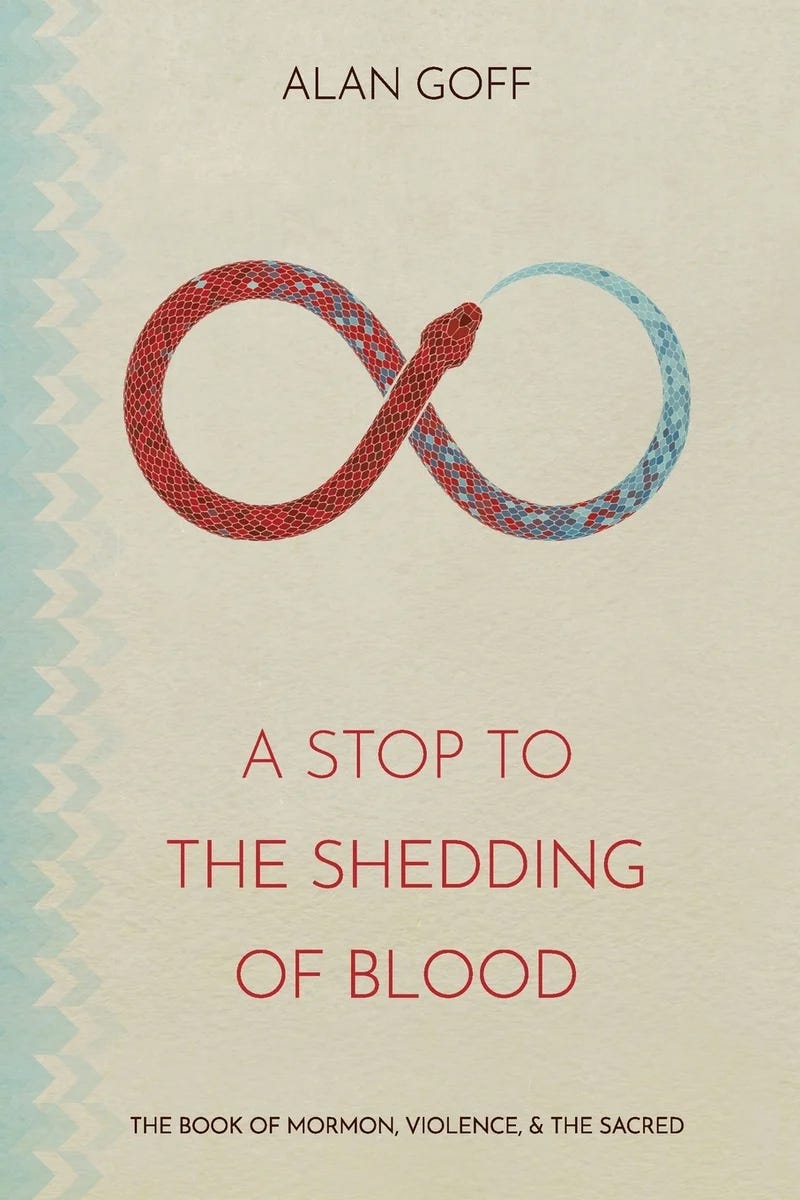
Alan Goff’s new book A Stop to the Shedding of Blood: The Book of Mormon, Violence, and the Sacred, examines instances of violence in the Bible and Book of Mormon: does God endorse or prohibit violence, force attached to sacredness?
Using the framework developed by René Girard, who asserts the Bible universally prohibits human violence and denounces the attribution of sanctioned violence to deity, Alan extends that analysis to the Book of Mormon as interpreted by Eugene England, who applied Girard’s critique and injunction to LDS scripture.
For England the example of the people of Ammon is the model all Christians are obliged to follow, resulting in the renunciation of all violence—even in self-defense. The study critiques both Girard’s and England’s claims to universal moral and sacred principles regarding violence, the same conclusions and principles applicable in all historical, social, and personal circumstances.
The book examines such Book of Mormon narratives as the deaths of Laban and of Abinadi, the symbolic and literal disavowal of all violence by the Anti-Nephi-Lehies, the period of peace after the appearance of Jesus, the murders at Ammonihah after Alma and Amulek’s preaching, and others.
The lessons of violence and pacificism are applied to modern instances recent in history: World War II as “the good war,” genocides in Rwanda and East Timor, and issues of defensive, offensive, and preemptive war using standard ethical categories such as deontology (applying categorical imperatives—universal moral rules) and utilitarianism (doing what is pragmatic and works out for the best for the greatest number of people).
Drawing critically on René Girard’s theory of mimetic rivalry, Alan Goff offers a deeply theoretical examination of violence in the Book of Mormon. Goff navigates the charged intersections of divine command, human conscience, and covenantal obligation through close readings of the Book of Mormon’s morally complex narratives: Nephi’s execution of Laban, Abinadi’s martyrdom, Captain Moroni’s summary justice, and the theological puzzles of righteous warfare. Engaging phenomenology, virtue ethics, and other critical lenses, Goff demonstrates that the Nephite record is no simple morality tale but rather “saturated scripture” that demands repeated engagement. This volume takes seriously the Book of Mormon’s standing as Hebraic scripture and confronts its portrayals of divinely sanctioned violence. Goff argues that covenant requires robust ethical reflection: like Abraham bargaining for Sodom, readers must wrestle with the moral tensions embedded in sacred narrative. For scholars of Restoration scripture, students of religious ethics, and thoughtful believers seeking to deepen their engagement with difficult texts, this book models “the works of Abraham,” who refused to evade the abundant, excessive, and troubling encounters with the divine that scripture records. Erudite, theoretical, and respectful, this work gives us a Book of Mormon worthy of the most rigorous moral and theological scrutiny.
—Rosalynde Welch, Research Fellow and Associate Director, BYU Maxwell Institute, Author of Seven Songs: Christ in the Old Testament and Ether: A Brief Theological Introduction
I always appreciate an author who can challenge my assumptions and open my heart to new ways of loving an already beloved text. Alan Goff delivers. By exploring both the remarkable possibilities and significant limitations of applying a Girardian lens to the Book of Mormon, Goff beautifully illustrates how the overflowing abundance of that inspired narrative stubbornly resists monolithic analysis and continues, as we should expect, to surprise and unsettle its readers.
—J. David Pulsipher, Professor of History, Brigham Young University–Idaho, Co-author of Proclaim Peace: The Restoration’s Answer to an Age of Conflict, and co-editor of War and Peace in Our Time: The Mormon Perspectives
Comments
Nothing yet. Say the first thing.
Sign in to join the conversation.