
This past December I had an opportunity to spend a month in Vancouver, Canada and I took my Brompton! It would be the first time my bike left the Bay and it would be a sort of trial run for more ambitious trips in the future. Could I really manage it? Would I actually use the bike enough to justify bringing it?
To safely transport my Brompton, I acquired a Vincita Sightseer 3.5 that could store my bike and all my clothing for a month. I picked the bag based on some online reviews but mainly because its wheels allowed me to roll and manipulate the bag without much back strain.
Then one beautiful morning, I packed it up, took the train to the airport and caught my flight to Vancouver! The bag was super easy to get on and off both the Caltrain and the SkyTrain. I also used a cab as a last-mile connection and it fit well in the boot.
City of Vancouver Cycling Review
When I arrived in Vancouver, the weather was stunning. For a place known to be incredibly rainy, I knew I had to take every opportunity to ride. I was on my bike within about 2 hours after I had landed. My first ride took me along the waterfront area, after which I cut through the West End to get dinner and catch the sunset at English Bay. The Taylor Swift concert was happening that weekend and throughout the city signs had been put up with different song titles encouraging people to find them all. Watch Nic Laporte visit all signs on a bike!
Vancouver has a reputation for its good bicycle infrastructure within Canada. However, Vancouver has stagnated in its bike network expansion while places like Montreal and even Edmonton are expanding it. So I was curious to see it first hand given that I used to live in Montreal previously and took it for granted.
My experience was positive in the downtown area: I really liked that the streets had protected bike lanes that stretched end-to-end to form a connected network. I travelled from the Waterfront to the Beach Ave bikeway and back all on protected routes.
There were several protected intersections when high traffic corridors intersected. On smaller side streets in the West End, modal filters were common and I found traffic to be light. The bikeways were well-lit, and the presence of other cyclists meant I never felt alone nor needed high-powered lights to get home safely.
Once you leave the downtown areas infrastructure is spotty. There is a mix of shared “bike route” streets (similar to Bicycle Boulevard in the Bay i.e. no infrastructure at all), some bike lanes, some disconnected protected sections and off-road paths (like Central Valley Greenway). Strangely, I found that many of the big streets did not have protected infrastructure. In fact, it seems that the City actively scraps plans to add bikeways to streets that are getting redone. Many destinations and even SkyTrain stations did not have good bicycle access which was really sad to see. It seems that this experience is shared by others who actually live in the city.
The lack of infrastructure became clear when I joined a memorial ride for a cyclist that had recently been killed by a driver. While it started at a neighbourhood park that I accessed via a protected bikeway from a SkyTrain station, we made our way from Bike Boulevards and off-road trails to smaller and then eventually bigger streets. The infrastructure got progressively worse. We ultimately stopped at the site at which the cyclist had been killed: the intersection of two large and high-speed stroads. I returned home via a different SkyTrain station (Nanaimo) but had to use the sidewalk because of the lack of any separation between cars and cyclists.
Joining the memorial ride echoes the importance of advocacy wherever you live. Bicycle infrastructure can save lives while providing significant financial and health benefits to the people and society. It’s a critical tool in our fight against climate change and makes the streets safer for us all, including drivers. We must demand it.
Suburbs with excellent infrastructure!
For the vast majority of my trip I stayed in Coquitlam, a suburb of Vancouver. I regularly rode around the area (known as “the Tri-Cities”). This is where (Metro) Vancouver actually blew my mind. Even though the area was super car-centric (think huge parking lots and big-box stores, high speed roads), I was surrounded by literal award-winning bicycle infrastructure and the beginnings and ambition of a great network.
For example, I would routinely ride to the neighbouring suburb of Port Moody where they had just completed an award winning protected bikeway on St Johns Street (think of it as their equivalent to El Camino Real) to grab a meal or to work at a co-working space, The Fountainhead Network.
The area also had some really high-quality off-street paved trails that broke up sections of urban riding. These trails offered pleasant transitions between urban areas, breaking up the ride with nature while connecting interesting destinations.
In Coquitlam, I lived a few minutes away from a brand-new, also award-winning, sidewalk-level bicycle lane on Guildford Road complete with protected intersections. The route forms a direct connection between Lafarge Lake Skytrain station and Port Moody going through Coquitlam. These lanes were so new that the cones and construction equipment were still there! Having visited the area before, the bikeway had a side-effect of increasing the separation between the sidewalk and the road, making it a more pleasant walking and crossing experience.
All these safe bike routes meant that I was able to do a variety of chores, exercise and commuting without having to rely on a car. It got me much needed fresh air and I looked forward to getting outside when the rain broke (and sometimes even in the rain… more on that later!)
In another suburb, Burnaby, the main bike hack they seem to employ is to just add a multi-use path to many big roads. Occasionally, the multi-use path was in addition to the sidewalk, meaning more space dedicated to active transportation. These multi-use paths were awesome: they were direct routes to my destinations, including making a visit to someone at the hospital.
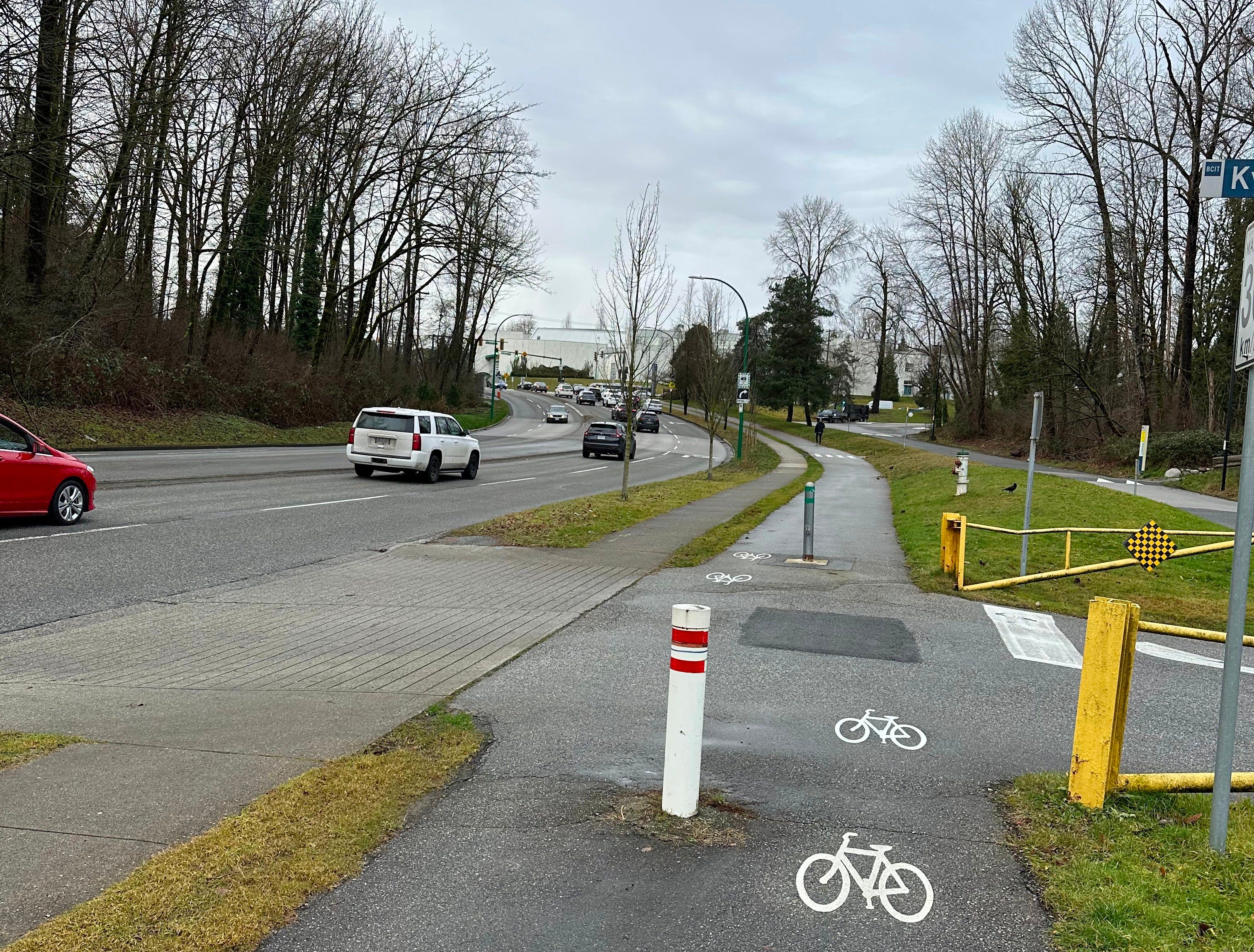
This kind of bicycle infrastructure is the stuff of dreams for us in the Bay. While I have seen similar things in Fremont, I don’t even think San Francisco has it this good.
While I felt that Vancouver was full of cars it somehow got blessed with great transit and some pockets of a decent bike network. Since it is a denser place, cycling was a more viable way to get between lots of destinations within a short amount of time. In the Bay (outside SF and Oakland) the dense areas are small and far apart and therefore you need to travel a large distance to get between them. Over here in the South Bay, I can often spend 15-20 mins biking through side streets and residential areas before I can get anywhere. Sometimes I need to take the train to put me within a 10 minute biking distance of my destination.
but… what about the rain!!?
One of the most common arguments against biking in Vancouver is rain. I heard this from a few people: “How are you going to cycle in the rain?”I was also worried about this given that I didn’t quite like being in the rain growing up either.
Rain in Vancouver was interesting: there were many days that were just cloudy with some rain either in the morning or evening. And then there were some days in which it was raining all day. Most of the time the rain was very light. On days where the rain and clouds broke, the gorgeous sun peeked out and everyone takes the opportunity to go outside.
When you live in Canada you really have to embrace the weather and get the right gear to enjoy it. In particular, I had the Rover Rain Cape from Cleverhood which I’ve barely gotten to use while in the Bay so far.
The Rover Rain Cape was AWESOME! It’s such an incredible feeling to walk in the rain with no umbrella and be basically invincible. Something I probably experienced for the first time in a long time was excitement to go into the rain and walk around. It sparked joy.
Did I get a bit wet? Yes, absolutely. Did I have a blast every time? Yes, absolutely.
Closing thoughts
Overall, I surprised myself by biking at least 2-3 times a week. The rides were both utilitarian and fun. It was assuring that I had my trusty bicycle with me. It kept me active and encouraged me to get outside, especially on beautiful days.
In short, taking my Brompton to Vancouver for a trial run was an awesome idea. I found surprisingly good infrastructure (especially in suburbs) and managed the rain handily. The Brompton gave me freedom to explore and immerse myself in a new place in a way I probably could not while in a car or on the bus. I’d say this was a big win for my Brompton and I look forward to taking it elsewhere!
Comments
Nothing yet. Say the first thing.
Sign in to join the conversation.