
Hello again Science fans!
I’ve been overseas for a while. Thanks to David for swapping dates with me last month. While I was able to keep up with calendar updates while I was away, finding time to reliably write the newsletter wasn’t going to be easy. But I’m back now, and over my jet lag (I think).
This weekend marks the unofficial start of summer here in the US. We tend to mark summer as running from Memorial Day to Labor Day. This year that means the longest possible summer period, as Memorial Day is as early as it can be, and Labor Day is as late as it can be. In many parts of the world, the unofficial start of summer is May 1. But it sure wasn’t summer-like in Germany for my last week, what with morning temperatures of 35, highs barely reaching 50, and rain. It is quite summery there now though.
Of course, astronomical summer starts on the summer solstice, June 21 this year, and ends September 22 with the autumnal equinox. Any season is a state of mind, so take your pick and celebrate as you see fit.
A couple of scheduling items, before we get into the science news:
The last Ask a Science Envoy talk by Wonderfest for 2026 will occur this Wednesday, May 27. There has been some confusion on the date, so if you were planning on attending on Tuesday, know that the event is actually scheduled for Wednesday. The Wonderfest website may not have been updated to reflect this change yet, but our calendar has and I’ve verified that Wednesday is the correct day.
The Tech Interactive in San Jose will be holding STEM Summer Camp sessions for children grades 2 - 6. This type of daily course doesn’t fit into our calendar structure well, so we don’t list them there, but instead mention them here. The camps are broken into weekly sessions, separated by ages. If you have children in this grade range and are looking for something for them to do this summer that’s both fun and educational, take a look at their listings for these camps.
Climate and the Environment
I wish I could say things are looking up on this topic, but the UN has just issued a warning that Earth’s climate is further out of balance than at any time in recorded history. 2025 was not quite as hot as 2024 due to the La Niña weather pattern in effect these past months. That is over, and models point to a “super” El Niño later this year, perhaps as strong as the biggest one since we started keeping records in the 1870s.
This should exacerbate the water shortage issues in the West this summer. The lack of snow pack in the mountains this spring has had a dire impact on waterflow in the Colorado River, setting up unprecedented shortages in areas that rely on the Colorado for fresh water supply.
Still, the Administration continues to ignore the science and weaken or eliminate decades of conservation progress, defunding non-fossil fuel energy programs and supporting reductions in air quality regulations.
Space
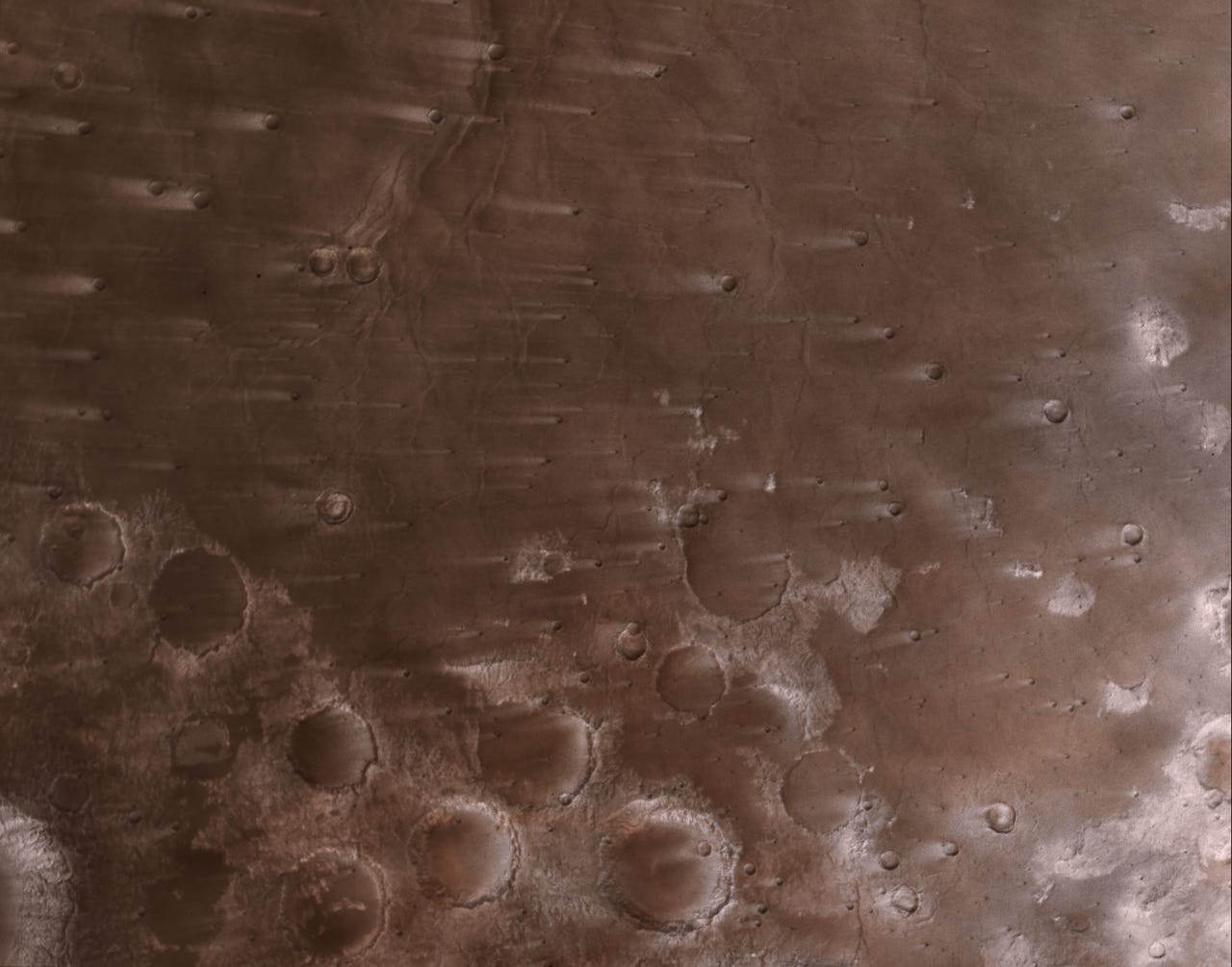
The Psyche mission which is going to, well, the asteroid Psyche, just passed by Mars where it got a gravity boost and course adjustment. It also tested out some of its instruments, taking pictures of the Martian surface during a rather close approach. NASA released the image above, detailing wind-blown impact craters in the Syrtis Major region. For scale, each pixel represents nearly 1,200 feet. The large craters near the center-bottom average about 30 miles in diameter. Here’s more about the Psyche mission.
We already know that Mars spins slightly faster each year, but up until now we didn’t know why. Scientists in the Netherlands think they know, and it involves a potentially active volcanic region on the surface..
NASA released 12,000 more pictures from Artemis II’s trip to the moon, taken by the onboard crew. Here are some of the most inspiring ones.
We only confirmed the existance of exoplanets (planets orbiting alien stars) in the early 1990s. We now have confirmed nearly 6,300 such exoplanets. And the T16 project, which uses existing data from the TESS (Transiting Exoplanet Survey Satellite) project and a new technique to look for exoplanets just announced 10,091 new candidate exoplanets. You can read Phil Plait’s thoughts on this here. Not to be outdone, the new Rubin observatory has found 11,000 new asteroids! And it is still in testing phase! It also imaged abound 80,000 previously known asteroids.
Health
Half of US adults under the age of 50 get wellness advice from social media influencers. Just how qualified are these people to be dispensing advice? Fewer than one in five are conventional medical professionals. Some base their advice on a sample of one…their own experiences, and have thousands of followers.
Have you heard of the interstitium? It is a third bodily system, circulating fluids within the human body, after the well-known cardiovascular and lymphatic systems. Researchers are just beginning to understand this system, but the implications are enormous. This NY Times article uses clever animation to illustrate these systems. The interstitium links Eastern and Western medicine ideas. It was discovered because of tattoos!
Breaking News! (because it appeared in my inbox while I was prepping the SciSchmooze)
Between the Administrations release of information about UFOs, and the new film Disclosure Day from Steven Spielberg, expect interest from the media and public about UFOs to increase. Our friend Andrew Fraknoi, Bay Area Astronomer and educator, has put together a list of resources that skeptics have found regarding UFO cases and claims. Click here to download this list. Among other things, Andrew is the lead author of the most-frequently-used introductory astronomy textbook in the US.
Have a great week in science, and an enjoyable, peaceful Memorial Day weekend!
Bob
Upcoming Events:
Click to see the next two weeks of events in your browser.
Monday, 05/25/2026
‘Click chemistry’: Molecules as Legos! - 05/25/2026 06:00 PM
Hopmonk Tavern Novato
Click Chemistry has been used to build new materials, map livingcells in real time, and revolutionize drugs for cancer treatment.
When it comes to simple, elegant reactions, biology has always had chemistry beat. Living organisms seamlessly and effortlessly turn simple, non-toxic building blocks into complex advanced materials. Sugars snap together to become cellulose and lignin to form giant redwood trees; amino acids join to make proteins that make up all manner of catalysts and functional biomaterials. But it turns out human chemists haven’t always had this ability with creating molecules. Enter “Click Chemistry”! At the turn of the 21st century, Professor K. Barry Sharpless and his collaborators turned conventional chemistry synthesis upside down by designing a system that treats molecules as Legos - just as nature does. Since then, Click Chemistry has been used to build new materials, map living cells in real time, and revolutionize drugs for cancer treatment. And this clever, fast, and useful framework for creating the molecules humans need to improve our lives only continues to show more promise for the future.
Speaker: Karen Frindell Teuscher, Santa Rosa Junior College
Tuesday, 05/26/2026
AI and the Developing Child: Myths, Evidence, and Open Questions - Livestream - 05/26/2026 12:00 PM
Stanford University
This talk will focus on the role and impact of artificial intelligence (AI) on children’s cognitive and social development. It will highlight how children interact with, perceive, and learn from AI systems, including how they develop trust in these “AI companions.” The talk will also discuss emerging evidence and open questions regarding how generative AI tools shape children’s curiosity, creativity, and critical thinking. It will conclude with a discussion of how social science researchers can amplify their collective voice to ensure that AI is developed and implemented in ways that are safe and beneficial for children.
Speaker: Yung Xu, Harvard University
Using iron meteorites to trace the earliest protoplanetary disk chemistry - 05/26/2026 12:00 PM
Braun (Geology) Corner (Bldg 320), Rm 220 Stanford
The chemical and thermal conditions of the earliest protoplanetary disk set the stage for everything that followed - from the compositions of the first planetesimals to the volatile budgets of rocky planets. Iron meteorites, as the remnant cores of the first generation of differentiated planetesimals, preserve a direct record of these earliest conditions and the processes that shaped them. In this talk, I will present results from a series of studies using the elemental and isotopic compositions of iron meteorites to reconstruct three interconnected aspects of earliest disk chemistry: the thermal structure of the inner disk and its role in establishing the volatile and moderately volatile element compositions of the first planetesimals; the collisional and dynamical histories of these bodies and how they were disrupted and reassembled in the earliest solar system; and the processes that controlled the distribution of nitrogen, carbon, and water across the disk. Together, these results reveal that the chemical diversity we observe among rocky bodies today was largely inherited from the conditions and processes of the earliest disk, within the first few million years of solar system history.
Speaker: Daman Grewal, Yale University
Anyons in van der Waals materials - 05/26/2026 03:30 PM
Hewlett Teaching Center Stanford
Anyons are quasiparticles that obey exchange statistics distinct from those of fermions and bosons. Such particles can emerge in fractional quantum Hall (FQH) systems, providing a platform for exploring exotic topological phases of matter. In this talk, I will present our group’s recent efforts to investigate anyons in bilayer graphene-based van der Waals heterostructures. I will first briefly review the fractional quantum Hall phase space in bilayer graphene, which hosts a remarkably rich landscape of topological orders, including candidate non-Abelian states. I will then give an overview of the interferometry experiments in our group, at both odd- and even-denominator filling factors, designed to probe the exchange statistics of Abelian and non-Abelian quasiparticles.
Speaker: Yuval Ronen, Weizmann Institute of Science, Israel
Steve Jobs in Exile: NeXT and the Making of a Comeback - 05/26/2026 07:00 PM
Computer History Museum Mountain View
In 1985, Steve Jobs left Apple - the company he had cofounded - after a dramatic power struggle. Soon after, he launched a new venture called NeXT. Though often described as his “wilderness years,” the NeXT era proved transformative, reshaping Jobs as a leader and creating technologies that would later form the foundation of modern Apple platforms.
Join the Computer History Museum for a special CHM Live book talk with Geoffrey Cain, author of Steve Jobs in Exile: The Untold Story of NeXT and the Remaking of an American Visionary, and key figures from NeXT’s history, including Dan’l Lewin and Bud Tribble.
The event will explore how Jobs built NeXT, was transformed by its near failure and rethought his approach to leadership, product design, and innovation, setting the stage for one of the most remarkable comebacks in business history and even playing a role in the early development of the World Wide Web.
Join us for an inside look at the NeXT era’s bold ideas, technical breakthroughs, and intense culture that transformed Steve Jobs and the future of computing.
What You’ll Experience
The untold story of Steve Jobs’s “lost decade” and the founding of NeXT - and its vital impact on Apple’s success today.Firsthand reflections from key players at NeXT, including Dan’l Lewin, Bud Tribble, and others.New insights into how failure, reinvention, and technology shaped one of Silicon Valley’s greatest comebacks.
Charismatic Cetaceans and Anthropology of the Sea - Livestream - 05/26/2026 07:00 PM
American Cetacean Society
On April 5th, 2026, members of the ACS SF Bay chapter gathered in Monterey for a whale watch led by marine biologist and Monterey Bay Whale Watch owner, Nancy Black. What a wondrous four hours we had - treated to cetaceans not commonly seen in the numbers we witnessed. For many of us, the encounter with the Northern Right Whale Dolphins was a first and we were dazzled observing their sleek dorsal-finless bodies and witnessing their ‘playful’ behavior. Please join us as photographer-extraordinaire Jodi Frediani shares photos from that day and anthropologist Andrew Loyd Smith discusses his research examining human - cetacean interactions during whale-watching excursions with a focus on Monterey Bay. He will discuss his work that explores how encounters with pelagic dolphin species - especially northern right whale dolphins and Pacific white-sided dolphins - elicit distinctive responses of awe, but even framed in terms such as “weird.”
Register at weblink to receive link information
Wednesday, 05/27/2026
World Otter Day - 05/27/2026 10:00 AM
CuriOdyssey San Mateo
We’re celebrating World Otter Day and launching a tribute to our sweet Gunner, the North American River Otter. Special activities all day long. Come remember. Come celebrate.
Antarctic macroalgal forests: species interactions and impacts of changing ice - 05/27/2026 11:00 AM
Monterey Bay Aquarium Research Institute Moss Landing
Don’t let anyone tell you that there are no forests in Antarctica. There are forests of large brown macroalgae (seaweeds), with a rich understory of red macroalgae, along the northern third of the western Antarctic Peninsula (WAP). The vast majority of the macroalgae are chemically defended from herbivores, but are in a mutualistic relationship with huge densities of associated small crustaceans. The crustaceans benefit because the chemically defended algae provide a refuge from predators, and the crustaceans benefit the macroalgae by keeping them clean of fouling microalgae.
Macroalgal forests decrease in the central WAP because of increased annual sea ice, which reduces light availability. However, sea ice has been decreasing dramatically over the past decade. We predict that the central WAP communities are changing accordingly, and have shown that even sites that already had high macroalgal cover have experienced major increases in macroalgal biomass over only a few years.
Attend in person or click here register to watch online
Speaker: Charles Amsler, University of Alabama, Birmingham
UC Santa Cruz Whole Earth Seminar - 05/27/2026 12:00 PM
Earth and Marine Sciences Building Santa Cruz
Speaker: Wenbo Wu, UC Berkeley
AI and Strategic Stability: A Framework for U.S. - China Technology Competition - 05/27/2026 12:00 PM
Gates Computer Science Building Stanford
Strategic stability exists when neither side thinks it can improve its strategic outcome by striking first. Today, strategic stability is increasingly important and potentially fragile. Nuclear weapons are no longer the only technology that threatens a state with devastation. AI competition and emergent AI capabilities could challenge strategic stability in many ways, including offensive and defensive cyber operations, sensing, ballistic missile defense, and intelligence / counterintelligence operations. This talk will provide a detailed account of how AI, nuclear deterrence, and semiconductor interdependence jointly shape strategic stability in U.S. - China competition. From there, the seminar will make the case that AI introduces both new deterrence tools and new threats to strategic stability, especially through its effects on cyber operations, intelligence, and command-and-control.
Speaker: Eyck Freymann, Stanford University
Attend in person or watch online (see weblink)
Stanford Planetary Science and Exploration Seminar - 05/27/2026 12:30 PM
Mitchell Earth Sciences Building (04-560) Stanford
Interplanetary dust particles (IDPs) are small particles ranging from nanometers to centimeters that are present throughout the solar system. IDPs are produced by several processes such as cometary outgassing, asteroidal collisions, and grain-grain mutual collisions. As IDPs orbit the Sun, they impact all planetary bodies and contribute to several important processes, including contamination of planetary atmospheres with metallic atoms, erosion and weathering of planetary surfaces, and chemical modification of the solar wind. IDPs are also a natural hazard to all robotic and human spacecraft and/or landed assets (e.g., on the lunar surface).
In this talk, I describe the fundamentals of the distribution of IDPs in the solar system (also known as the “zodiacal cloud”) and touch on both remote-sensing and in-situ observations. I also compare models and constraints on our solar system’s zodiacal cloud to those observed around other stars - so called “exozodiacal clouds”. This comparison helps to place our solar system in context with other star systems and in doing so, may point to evidence of our solar system’s particularly violent youth.
Speaker: Andrew Poppe, UC Berkeley
Attend in person (Room 350/372) or watch online (see weblink)
Feedback between Ecology, Evolution, and Behavior: Applying Insights across Disciplines - Livestream - 05/27/2026 03:00 PM
UC Davis Bodega Marine Laboratory
Speaker: Brian Lerch, CPB Postdoctoral Fellow, UC Davis
Register for Zoom at weblink
Astronomy on Tap: Baton Rouge - Livestream - 05/27/2026 05:00 PM
Astronomy on Tap
Astrology or Astronomy?
Speakers: Adrien Picquenot; Caroline Davis
What We Get Wrong About Empathy - SOLD OUT - 05/27/2026 07:00 PM
Planted SF San Francisco
Even when we try to put ourselves in someone else’s shoes, we’re often missing the deeper frameworks that shape how they think and act.
In this lecture, Konner Brewer, Stanford Lecturer and Product Manager for Applied AI at Google, explores why understanding others is more complex than it seems. Through case studies and classic experiments, she reveals a key insight: people can’t always explain why they do what they do.
Instead, we rely on stories - our own and others’ - to make sense of behavior. This talk challenges conventional ideas of empathy, because in a globalized world, if we want to truly connect with others, it’s not enough to feel what we would feel in their position, we have to learn how to see the world as they do.
Wonderfest: Ask a Science Envoy: Rock Clocks & Supernovae - 05/27/2026 07:00 PM
Hopmonk Tavern Novato
Wonderfest Science Envoys are early-career researchers with enhanced communication skills and aspirations. Following short talks on provocative modern science topics, these two Science Envoys will answer questions with insight and enthusiasm:
UC Berkeley geophysicist Caroline Hasler on Measuring Geologic Time with Rock Clocks - In microscopically small crystals within rocks, radioactive elements decay at predictable rates and function as tiny clocks. These “rock clocks” help us to figure out the timing of major events in Earth history - from the moment of Earth’s formation to the asteroid impact that killed the dinosaurs.UC Berkeley astronomer Eli Wiston on Seeing Core-collapse Supernovae with Radio Telescopes - At the end of its life, a massive star will contract and explode in spectacular fashion, outshining the light of an entire galaxy. While most astronomers focus on the optical light given off by these stellar explosions, there is a wealth of new information to be gained by observing invisible wavelengths. With radio telescopes, we can study new aspects of supernovae: their stars’ activity in the years before death, their environments, and what they leave behind after the explosion fades.
Nerd Nite SF #160: Japanese Cocktail Histories, How to Throw a FUNCTION, and This is NOT Legal Advice - 05/27/2026 07:00 PM
Rickshaw Stop San Francisco
We like to have a good time here at Nerd Nite. In fact, we think of our show as a kind of educational party, a one-bar crawl through the beautiful strangeness of the world and all the fascinating things in it, brought to you every month with a healthy dose of liquid courage. That’s why this month we’re featuring three spectacular speakers who will get your party going! Every party needs good drinks and every party-er needs good anecdotes to keep the conversation rolling, so where better to start than a cocktail that tells the history of Japan’s modern drinking culture? Once you’ve picked your drinks of choice it’s time to call in a professional party planner - get ready to learn the art and science of throwing a FUNCTION. Of course, most parties get a little bit out of control at some point (at least, the good ones do), and when that happens you need to know just how close you can get to the letter of the law without going over. (We have to assume that party cops follow The Price is Right rules.)
Virtual Skeptics on the Pub - 05/27/2026 07:00 PM
Bay Area Skeptics
This is a casual night of socializing with fellow science-forward skeptics and with others inhabiting our oblate spheroidal planet.
Please join us! This is a free event brought to you by Bay Area Skeptics. All are welcome.
AI and Empire Building - 05/27/2026 07:30 PM
Shaping San Francisco San Francisco
We bring together several sharp critics of the hype machine that has long characterized the internet and our successive tech booms, currently blowing up in the AI bubble. Lost in the hand wringing over the more exaggerated claims of boosters and doomers is the ongoing reproduction of a colonial seizure of what should be our common wealth. This process has long historic roots and in some ways it is thanks to our amnesiac culture that the current crop of billionaire investors and tech bros have gotten away with doing it all again.
Speakers: Wendy Liu, Alex Hanna, Tamara Kneese, and Elizabeth Travelslight.
Thursday, 05/28/2026
When AI Meets Energy - 05/28/2026 01:30 PM
Environment and Energy Building (Y2E2) Stanford
AI data centers are projected to consume hundreds of terawatt-hours annually by 2035, demanding power conversion technologies that are not only energy-efficient but also cost-effective, scalable, and reliable. It is estimated that the global market for power supplies, distribution, and management systems serving AI data centers and cloud computing is expected to reach approximately $145 - 150 billion. Conventional line-frequency transformers and multi-stage AC-DC architectures suffer from low efficiency, bulkiness, high cost, low reliability, and limited dynamic response. To support the rapid growth of AI workloads and comply with emerging energy and environmental standards, innovative power electronics solutions are urgently needed. This presentation explores the development of a novel megawatt-scale, medium-voltage (MV) power conversion system based on a Variable Air Gap Solid-State Transformer architecture. The approach aims to reduce energy loss, footprint, and cost while enabling flexible, modular deployment, and achieving more reliable operation in large-scale AI data centers.
Speaker: Chris Mi, San Diego State University
Attend in person or online (see weblink)
PARC Forum: Moving quantum from lab to fab - 05/28/2026 05:00 PM
PARC Forum Palo Alto
Featuring speakers from GlobalFoundries and the SRI-managed QED-C, discussions will cover the state of the quantum ecosystem, manufacturing at scale, and emerging applications beyond computing.
Top quantum experts will come together to discuss how the U.S. is working to create a competitive edge across industry, academia, and government. Discussion topics will include:
Manufacturing at scale - what a quantum-capable supply chain looks like & who is building itThe current state of the quantum ecosystem - a maturity assessment across computing, sensing, and communicationsBeyond quantum computing - applications that industry is beginning to commercializeQED-C’s role in advancing U.S. quantum industrial strategy
Quantum technologies are rapidly advancing toward real-world applications across computing, sensing, communications, and cybersecurity. As the sector scales, success depends on more than breakthrough science - it requires robust supply chains, reliable manufacturing, and a qualified workforce. The quantum industry doesn’t need to start from scratch: It can leverage deep existing capabilities in semiconductors, photonics, lasers, and electronics to accelerate the transition from lab to market.
This PARC Forum is bringing together organizations with distinct but interlocking roles spanning the quantum value chain - from fundamental science to industrial manufacturing.
GlobalFoundries (GF) is where quantum enters the world at scale. GF serves as the critical manufacturing backbone for companies building quantum systems, producing quantum chips using proven semiconductor infrastructure that no startup can replicate on its own.
QED-C - the Quantum Economic Development Consortium, managed by SRI, translates standards into industry roadmaps, coordinates more than 300 member companies, and identifies and aims to close workforce and supply chain gaps.
After Dark: At The Edge - 05/28/2026 06:00 PM
ExplOratorium San Francisco
Vibe with a special performance from the experimental music group Circuit des Yeux.
Ages 18+
NightLife: Mabuhay - 05/28/2026 06:00 PM
California Academy of Sciences San Francisco
Calling all kaibigan - this one’s for you. Come through for a night of Filipino pride, flavor, and feel-good energy.
Inside the Next Big Bay Area Earthquake - 05/28/2026 07:00 PM
Donkey & Goat Winery Berkeley
The Hayward Fault runs through the East Bay - including Oakland and Berkeley - and is capable of producing a major magnitude 7 earthquake. Its last big event was in 1868, leaving scientists with limited data on what the next one might look like.
In this lecture, Artie Rodgers, seismologist at Lawrence Livermore National Laboratory, explores how supercomputer simulations are used to model future earthquakes on the Hayward Fault. These models help predict how the ground could shake - and what that means for the Bay Area.
Rodgers will break down what scientists know, what remains uncertain, and how research is helping us better prepare for the next big one.
Bay Area Mycological Society monthly meeting - 05/28/2026 07:30 PM
Bay Area Mycological Society Berkeley
Saumitra Kelkar is a naturalist and educator based in Oakland, California. He taught high school biology in Oakland public schools for 4 years and now works in native plant landscaping. In his free time, he posts videos about Oakland’s unique local ecology on his Instagram page, @Oakland.bio, and enjoys photographing insects, fungi, and plants to post on iNaturalist and learn about the living things that are often overlooked.
Friday, 05/29/2026
Morning Hike at Bear Creek Redwoods - 05/29/2026 09:00 AM
Bear Creek Redwoods Los Gatos
Join us for this beautiful hike! A POST volunteer will share a few words about POST’s decades of conservation success before the hiking group explores a strenuous but mostly shaded 5.4 mile hike with ~900 feet of elevation gain.
In one of the county’s best preserved, second-growth coastal redwood forests, we’ll also pass extensive areas of Douglas fir and oak woodland, as well as a few remaining old-growth redwoods. The proximity to the San Andreas fault results in a unique geology and landscape, while there are many remnants of a rich cultural history of the region. The park is also home to a wide variety of mammals, birds and reptiles, some of which might be spotted along the trails.
Register at weblink
UC Santa Cruz IGPP Seminar - 05/29/2026 12:00 PM
Earth and Marine Sciences Building Santa Cruz
Speaker: Benjamin Idini, UC Santa Cruz
Saturday, 05/30/2026
Wetland Plant Tour at the EEC - 05/30/2026 09:30 AM
Don Edwards Refuge Environmental Education Center Alviso
Enjoy a guided walk through the Refuge’s many habitats while learning about our native plant species!
Calling all plant enthusiasts! Join us on a guided tour through the Refuge’s many habitat types. On our walk, we’ll stop to see, smell, touch, and even taste a variety of native plants that call the Refuge home. We’ll also discuss the importance of native plants in supporting native animals, keeping our watersheds clean, and protecting humans from the effects of climate change.
This will be a leisurely hike, of a distance of around 0.8 miles, on mostly flat terrain.
This program is great for families and adults!
Register at weblink
Science Saturday: Discover Dinos - 05/30/2026 10:00 AM
Pacific Grove Museum of Natural History Pacific Grove
Join us for Science Saturday to dig into the world of geology and paleontology! Fossil fun, special collections, dinosaur crafts, and special guests: this family-friendly event includes free admission to the Museum.
Mt. Sutro Geology & Paleo Tour - 05/30/2026 10:00 AM
The Aldea Center on Mt. Sutro San Francisco
Learn about fascinating geologic evidence contained in the rocks underneath Mt. Sutro of ancient island arcs, lost marine basins, oceanic trenches and subduction along the Pacific Ocean Ring of Fire and the important role played by radiolarian fossils contained in chert beds. All part of the interesting story of California’s assembly from microcontinents and island arcs rafting across the Pacific Basin over the last 400 million years.
High Altitudes for High Energies: Chasing Solar Flares by Balloon - 05/30/2026 07:30 PM
San Jose Astronomical Association San Jose
Solar flares drive space weather which can affect satellites, astronauts, and life on Earth. Having a better understanding of what drives solar flares can lead to better space weather prediction. In this talk, I will discuss the GRIPS (Gamma-Ray Imager/Polarimeter for Solar flares) high altitude balloon mission and its applications for studying particle acceleration in flares. Join me to explore the world of low-cost access to space, solar flare science, and the implications of space weather!
Speaker: Meredith Wieber, UC Berkeley
Sunday, 05/31/2026
Gunner: A Celebration of Life - 05/31/2026 10:00 AM
CuriOdyssey San Mateo
A loving farewell to our sweet North American River Otter, Gunner. Special tribute activities throughout the day. Come remember. Come celebrate.
Monday, 06/01/2026
Stanford Energy Seminar - 06/01/2026 04:30 PM
Hewlett Teaching Center Stanford
Speaker: Sunya Norman, Salesforce
Attend in person or watch online (see weblink)
The Fall and Rise of Forward Physics - Livestream - 06/01/2026 04:30 PM
Stanford Linear Accelerator
Particle colliders have been the workhorse tool for particle physics since they were invented over 60 years ago. Forward particles are those that are produced at colliders and then travel in a direction close to the beamline. For decades, forward particles were largely ignored, and all of the large detectors currently operating at colliders are blind to them. In the last few years, however, our understanding of the forward region has been transformed and we now know that this region contains a treasure trove of physics, including the most energetic neutrinos ever produced by humans, possible evidence for dark matter, milli-charged particles, and new forces, and a wealth of other valuable information. To capture some of this potential, the Forward Search Experiment (FASER) has been operating in the forward region of the Large Hadron Collider since 2022. FASER’s latest results will be described, along with lessons learned and their implications for the future of particle physics.
Speaker: Jonathan Feng, UC Irvine
Watch online (see weblink)
Tuesday, 06/02/2026
Coherent Control for Precision Measurements - 06/02/2026 03:30 PM
Hewlett Teaching Center Stanford
The Godmother of Silicon Valley - 06/02/2026 07:00 PM
Computer History Museum Mountain View
Wednesday, 06/03/2026
At the Ice Edge: Ocean Impacts on Arctic Whales and Sea Ice - 06/03/2026 11:00 AM
Monterey Bay Aquarium Research Institute Moss Landing
UC Santa Cruz Whole Earth Seminar - 06/03/2026 12:00 PM
Earth and Marine Sciences Building Santa Cruz
UC Davis Bodega Marine Laboratory Seminar Series - CANCELED - 06/03/2026 03:00 PM
UC Davis Bodega Marine Laboratory
Rewilding San Francisco - 06/03/2026 07:30 PM
Shaping San Francisco San Francisco
Thursday, 06/04/2026
PARC Forum: Nobel laureate John M. Martinis discusses the quantum frontier - 06/04/2026 05:00 PM
SRI International Palo Alto
After Dark: Home Away from Home - 06/04/2026 06:00 PM
ExplOratorium San Francisco
NightLife - 06/04/2026 06:00 PM
California Academy of Sciences San Francisco
Open Question: Home in Space - 06/04/2026 07:00 PM
ExplOratorium San Francisco
How scientists are building the AI-powered laboratory - 06/04/2026 07:00 PM
SLAC Public Lecture Series
Friday, 06/05/2026
UC Santa Cruz IGPP Seminar - 06/05/2026 12:00 PM
Earth and Marine Sciences Building Santa Cruz
First Friday Nights at CuriOdyssey - 06/05/2026 05:00 PM
CuriOdyssey San Mateo
In Town Star Party - 06/05/2026 09:30 PM
San Jose Astronomical Association San Jose
Saturday, 06/06/2026
First Saturday Tour at the Santa Cruz Arboretum - 06/06/2026 11:00 AM
UC Santa Cruz Arboretum Santa Cruz
East Bay Green@Home Tour - 06/06/2026 11:00 AM
Varies
Are There Gray Foxes in Your Backyard? - 06/06/2026 01:00 PM
Don Edwards Refuge Headquarters & Visitors Center Fremont
Starry Nights Star Party - 06/06/2026 09:30 PM
Rancho Canada Del Oro Open Space Preserve Morgan Hill
Sunday, 06/07/2026
Summer Family Hiking - 06/07/2026 10:00 AM
Tilden Regional Park Berkeley
InsectPalooza 2026 - 06/07/2026 12:00 PM
Minnesota Street Project San Francisco
Solar Observing - 06/07/2026 02:00 PM
San Jose Astronomical Association San Jose
James Lick Legacy Day: 150 Years of Discovery - 06/07/2026 07:00 PM
Chabot Space and Science Center Oakland
Monday, 06/08/2026
Arctic Unfrozen - 06/08/2026 05:30 PM
Commonwealth Club San Francisco
Comments
Nothing yet. Say the first thing.
Sign in to join the conversation.