
Greetings, fellow Group 14 travelers!
This week, we follow one thread through the cosmic tapestry: Silicon (Si). From the 'ghost sand' clogging our local turbines to the 'primal grit' forged in the first galaxies, Silicon is a paradox of materials science. The way we manage it determines whether it remains a hurdle to clear or becomes the backbone of the telescopes that let us see forever.
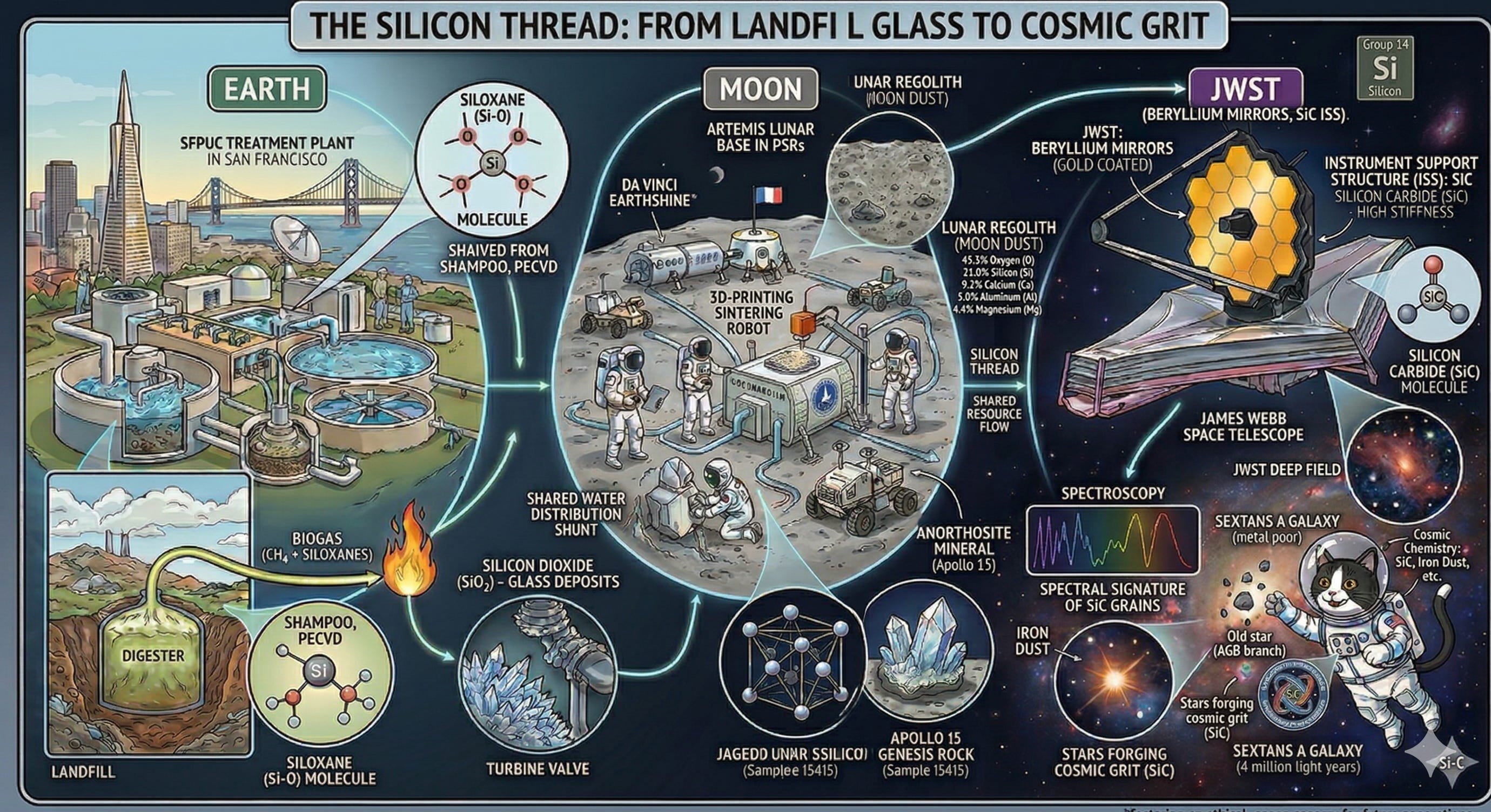
In Silicon Valley, we usually treat silicon as the hero—the “brain” in our semiconductors. But in our landfills and wastewater plants, it plays a villainous role in the form of Siloxanes. These are silicon-oxygen molecules (found in everything from shampoos to chip-manufacturing layers) that give products a silky feel.
When organic waste breaks down, these volatile siloxanes hitch a ride in the resulting biogas. When we try to burn that gas for renewable energy, the heat converts them into silicon dioxide (SiO2)—literally glass.
Imagine running a high-performance engine while a “ghost” slowly pours fine sand into the pistons. This “glassification” creates a hard white crust that destroys turbines and engines.
Locally, projects like the San Francisco’s Southeast Biogas Utilization Project are breaking ground to better refine these gases, showing that in the Bay Area, there are ongoing efforts to engineering our way from silicon waste to clean, sustainable power.
As we look toward Artemis, our focus shifts from silicon as a pollutant to silicon as a resource—though not without complexity. The Moon is essentially a giant silicon-rich ball of rock and glass.
The “Genesis” Rock: During the Apollo 15 mission, astronauts Irwin and Scott brought back the famous “Genesis Rock” (Sample 15415). It is composed almost entirely of Anorthosite, a silicate-rich rock that formed the Moon’s Highlands billions of years ago.
ISRU Engineering: To address the extreme cost of mass transport, researchers are investigating In-Situ Resource Utilization (ISRU). Lunar regolith is roughly 45% Oxygen and 21% Silicon by mass, making it a tempting reservoir. While laser-sintering aims to 3D-print structures from this dust, the physical reality of manipulating raw lunar silicon—characterized by its jagged, unweathered edges—remains a severe engineering risk to both equipment and environment.
The ethics of ISRU is one of the most debated topics in contemporary “soft law.” As we transition to a “settlement” era—marked by the 2026 expansion of the Artemis Accords to 61 signatory nations (with Oman joining this past January)—the question isn’t just if we can use lunar resources, but who has the right to them.
1. The Utilitarian Argument: Efficiency as a Virtue
From an engineering standpoint, ISRU is often framed as a necessary path for deep-space flight. Proponents argue it reduces the environmental tax of Earth-side launches and provides a “Lifeboat” safety margin by sourcing oxygen and propellant locally. In this view, the expansion of human presence takes precedence over the preservation of abiotic (non-living) rock.
2. The Legal & Equitable Dilemma: CHM vs. “First in Time”
The primary conflict lies in the tension between two historical doctrines:
Common Heritage of Mankind (CHM): Codified in the 1979 Moon Agreement, this principle argues that space resources belong to everyone. It builds on the 1967 Outer Space Treaty, which declared space the “province of all mankind.”
Operational Deconfliction: The Artemis Accords (2020) take a different tack. They rely on the 1967 Treaty to argue that while you cannot own the Moon, extraction is legal and does not constitute “national appropriation.”
The Ethical Risk: Critics, highlighted in the March 2026 Open Lunar report, worry that “Safety Zones” could lead to “de facto” land grabs. If a nation monopolizes a rare patch of water ice in a Permanently Shadowed Region (PSR), they haven’t technically “appropriated” the territory, but they have effectively monopolized a vital resource, potentially marginalizing nations that are not yet spacefaring.
Finally, we look beyond our solar system to the “primitive kitchen” of the early universe. In a massive recent find, the James Webb Space Telescope (JWST) looked at Sextans A, a tiny, metal-poor galaxy 4 million light-years away.
Standard models suggested these primitive galaxies couldn’t “bake” much dust. But JWST spotted the tell-tale signature of Silicon Carbide (SiC) being forged in the atmospheres of aging stars.
The Technical Handshake: The irony is sublime. While the JWST’s famous mirrors are gold-coated beryllium, they rely on a massive, ultra-rigid backbone—the Instrument Support Structure (ISS)—made of high-tech Silicon Carbide. We are using SiC technology in space to look back in time and discover where the first grains of SiC were born.
If you want to see these “Silicon-born” discoveries in high-definition, you won’t want to miss the legendary Alex Filippenko on Wednesday, April 29. He will be in the East Bay at the Orinda Theater to discuss the most exciting, late-breaking results from the JWST.
It is a fitting venue for a talk about our collective future; while we look at the universe through JWST, the Orinda ONE project is doing the “In-Situ” work here on Earth—uniting the community to enhance and preserve the heart of Orinda. Just as Artemis seeks to build a sustainable home on the Moon, Orinda ONE is a reminder that the best science happens when the community is aligned.
See you somewhere in the Si-Valley (or at the Orinda Theater!),
Lili
Chemical Engineering Colloquium: Delivering on the Promise of Genome Editing (Monday, April 13, Stanford)
Speaker: Nobel Laureate Dr. Jennifer Doudna. A premier event at the Shriram Center for the Stanford engineering community to discuss the molecular mechanisms of targeted cellular delivery.
Time/Location: 4:30 p.m. – 5:30 p.m. | Shriram Center, Room 104
After Dark: Altered States at the Exploratorium (Thursday, April 16, San Francisco)
Explore the science of perception, featuring research on psychedelics and unusual sensory experiences. Includes a performance by Sarah Davachi as part of the Resonance series—a perfect intersection of physics and perception.
Alex Filippenko: Exciting Results from JWST (Wednesday, April 29, Orinda)
A must-attend event at the Orinda Theater in the East Bay. Come for the astrophysics, stay for the community spirit and learn about the Orinda ONE project.
Upcoming Events:
Click to see the next two weeks of events in your browser.
Monday, 04/13/2026
Why Study Insect Ecology in the Field? - 04/13/2026 12:00 PM
Sonoma State University - Biology Colloquium Rohnert Park
From Dr. Yang’s website: “...I am working to develop a temporally explicit view of ecology that examines how ecological communities combine complex, coordinated and changing interactions over time. I am particularly interested in the effects of climate change on species interactions, community responses to strong perturbation events, phenological cues and phenological shifts, and seasonal changes in the nature and outcomes of species interactions. I study several different organisms in a wide range of ecological communities, each of which contributes to a broader understanding of how species interactions change over time...”
Speaker: Louie Yang, UC Davis
Thinking with Things - 04/13/2026 12:30 PM
Computing and Data Science Building (CoDA) Stanford
As our tools grow more intimate and invasive, understanding the patterns at play when artifacts and minds interact has never been more urgent. We routinely underestimate what seem like minor details, yet subtle shifts dramatically alter what follows. Drawing on two decades of designing learning spaces and digital experiences, this talk explores how physical spaces, digital interfaces, and even the simplest everyday tools actively nudge our thinking and how we might intentionally design interactions to shape it for the better.
Speaker: Scott Doorley, Stanford University
Programmable quantum matter at the frontier of classical simulations - 04/13/2026 02:30 PM
Physics North Berkeley
Quantum computers have begun to achieve the scale and precision required to simulate condensed matter models in regimes that push the limits of classical supercomputers, offering a fully programmable platform for simulating quantum materials. This talk will explore recent experiments at the frontier of quantum advantage for simulating the dynamics of magnets and correlated electrons using Quantinuum’s latest generations of trapped-ion quantum processors.
Speaker: Andrew Potter, University of British Columbia
Statistical Structural Biology - 04/13/2026 04:00 PM
Grimes Engineering Center Berkeley
In a post-“AlphaFold has solved structure prediction” world, our lab is obsessed with the concept of statistical structural biology.First, we collect large datasets (X-ray fragment screens from 1000s of individual crystals) and use new statistical approaches to identify small molecule binders. This inspires new inhibitors, allosteric modulators, and enzyme design strategies. Second, we examine how experimental information in X-ray crystallography and CryoEM encodes statistical distributions of conformations. This inspires software (e.g. qFit) that reveals hidden conformations and new guidance frameworks for diffusion models. Our work reveals the extent of memorization in current models and suggests experiments to extract even more information for improved training. These two statistical approaches to structural biology are synergistic in examining many aspects of biological mechanism. A current focus is the promiscuity of ligand binding in drug metabolizing proteins, as part of the OpenADMET consortium.
Speaker: James Fraser, UC San Francisco
Chromatin coordination and feedback enable precise gene regulation during development - 04/13/2026 04:00 PM
James H. Clark Center (Bldg 340) Stanford
Speaker: Angelike Stathopoulos, California Institute of Technology
Room: Auditorium
New developments in quantum black hole - 04/13/2026 04:15 PM
Physics North Berkeley
How should we understand black holes at a quantum mechanical level? In the past years, we have made dramatic progress in answering this question, from a better understanding of how information can escape from a black hole to exact gravitational calculations of black hole entropies. In this talk, I will describe some of the advancements we have made in understanding black hole thermodynamics: I will describe how quantum gravity corrections drastically alter the physics of black holes at low temperatures, how such effects completely change the dynamical evolution of a single charged black hole when left alone to evaporate, and how, in special cases, we can now compute the entropy of black holes with arbitrary precision without relying on a UV completion of quantum gravity. Along the way, I will point out several parallels between phenomena that we have seen in the past century in atomic physics and novel effects that we can now explicitly compute for black holes.
Speaker: Luca Iliesiu, UC Berkeley
Curating Investor Access to Cleantech 2.0 - 04/13/2026 04:30 PM
Hewlett Teaching Center Stanford
Disruptive forces of change such as urgent electricity demand, onshoring supply chains, and increased weather volatility are combining to create the biggest innovation wave in a generation: Cleantech 2.0. In the US, early-stage cleantech companies are emerging to address some of the biggest challenges facing businesses today. They use unprecedented tools and offer a leap of value, leading to increased profits, reduced risk and improved resilience.
Yet US early-stage cleantech is too often overlooked by investors. It is a complex, dynamic, and technical space. Assessing early-stage cleantech presents a challenge, and investors have limited access pathways that usually rely on picking individual funds and companies when predicting winners is daunting.
In this talk, Jane Woodward aims to demystify Cleantech 2.0- what drives it, what makes it enduring, and what these companies look like. This talk will also make the case for a strategic approach to bring investors into this space, using a hybrid portfolio structure designed to capture upside, mitigate downside, and provide early access to disruptive innovation.
Speaker: Jane Woodward, WovenEarth Ventures and Stanford University
Attend in person or watch online (see weblink)
Colliders in the Sky: Probing Fundamental Physics with Cosmological Data - 04/13/2026 04:30 PM
Stanford Linear Accelerator (SLAC) Colloquium Series Menlo Park
The first fractions of a second after the Big Bang likely involved physics operating at energy scales orders of magnitude above those accessible to terrestrial experiments. This epoch - known as inflation - played a crucial role in cosmic history, sourcing quantum fluctuations that seed structure formation in the late Universe. Despite its importance, the inflationary period is poorly understood, and little is known about its particle content or interactions. In this talk, I will describe how modern cosmological observations allow us to probe this ultra-high-energy regime by searching for subtle patterns in the distribution of cosmic microwave background radiation and galaxy positions. I will present recent results using observational data, highlighting how new techniques enable precision measurements of primordial particle physics, effectively turning the Universe into a “cosmic collider”. I will conclude by discussing how the next generation of survey data, if modeled precisely enough, could lead to significant advancements in our knowledge of the inflationary Universe.
Speaker: Oliver Philcox, Stanford university
Attend in person or watch online (see weblink)
120 Years After 1906: Strengthening San Francisco for the Next Big Earthquake - 04/13/2026 05:30 PM
SF Planning + Urban Research Assoc. (SPUR) San Francisco
To commemorate the 1906 Great San Francisco Earthquake and Fire, SPUR and partners are hosting a conversation on the past, present, and future of seismic safety in San Francisco. Join us to explore how the city has strengthened its building stock through retrofit programs and policy reforms, where risks remain, and what is needed next. Speakers will discuss how proactive investments today can protect lives, safeguard the city’s existing buildings, and ensure San Francisco is prepared for future earthquakes. SPUR will share recommendations from its latest policy brief connecting earthquake resilience to the city’s downtown revitalization and decarbonization goals.
Register at weblink
Tuesday, 04/14/2026
Attempts to deliver on the promise of natural products - 04/14/2026 11:00 AM
Latimer Hall Berkeley
Natural product (NP) total synthesis involves experimental discovery and decision-making at every stage: why this route and not another? Why this intermediate and not its close analog? Why this NP, optimized for the producer organism’s survival in its ecological niche, and not a close analog, optimized for therapeutic use? The vast numbers of options surrounding all possible choices exceed human capacity for evaluation. Our group has begun to make these decisions with the aid of computation. These calculations, which contain numerous approximations, are not taken at face value, but instead subjected to experimental interrogation. If correct, however, computational predictions can greatly simplify our choice of reagent, choice of intermediate (subTGT), or even choice of NP target (TGT).
Speaker: Ryan Shenvi, Scrips Research Institute
The Impact of Cellphone Bans in Schools on Student Outcomes: Evidence from Florida - Livestream - 04/14/2026 12:00 PM
Stanford University
Cellphone bans in schools have become a popular policy in recent years in the United States, yet very little is known about their effects on student outcomes. In this study, we try to fill this gap by examining the causal effects of bans on student test scores, suspensions, and absences using detailed student-level data from Florida and a quasi-experimental research strategy relying upon differences in pre-ban cellphone use by students, as measured by building-level Advan data. Several important findings emerge. First, we show that the enforcement of cellphone bans in schools led to a significant increase in student suspensions in the short-term, especially among Black students, but disciplinary actions began to dissipate after the first year, potentially suggesting a new steady state after an initial adjustment period. Second, we find significant improvements in student test scores in the second year of the ban after that initial adjustment period. Third, the findings suggest that cellphone bans in schools significantly reduce student unexcused absences, an effect that may explain a large fraction of the test score gains. The effects of cellphone bans are more pronounced in middle and high school settings where student smartphone ownership is more common.
Speaker: David Figlio, University of Rochester
Register at weblink
Two Targets, One Parasite: Designing Selective Covalent Inhibitors for Chagas Disease - 04/14/2026 02:00 PM
Tan Hall Berkeley
Chagas Disease, caused by the protozoan parasite Trypanosoma cruzi, affects millions worldwide, yet current therapies suffer from limited efficacy, long treatment duration, and poor tolerability. Two complementary discovery strategies, one mechanism - driven and one phenotypically guided, were explored toward safer, shorter-course treatments. Covalent picolinamides were developed as highly selective inhibitors of the essential T. cruzi kinase CLK1, achieving potent cellular activity and cures in mouse infections models. In parallel, covalent cyanotriazoles were optimized into IID432, a selective T. cruzi topoisomerase II poison capable of delivering an unprecedented single-dose cure in vivo and now advancing toward clinical evaluation. Together, these strategies illustrate how mechanistic insight and covalent design can enable next-generation therapies for Chagas Disease.
Speaker: Olivier René, Novartis
How Might Quantum Platforms Reshape Many-Body Physics? - 04/14/2026 03:30 PM
Hewlett Teaching Center Stanford
Quantum platforms are approaching a scale at which they will enable the realization of a vast number of quantum circuits. Some of these will solve computational problems of interest to industry and commerce; others will address longstanding questions about quantum systems; and still others will vindicate Wigner and Dyson. Yet even this will leave ample room for posing entirely new questions about many-body quantum systems.In this talk, I will describe two possibilities. The first is a concrete proposal: defining and studying quantum games of various kinds. The second is a broader vision: using quantum platforms in a “discovery mode,” analogous to the role particle accelerators have played in uncovering new particle physics.
Speaker: Shavaji Sopndhi, University of Oxford
SLAC on Tap: Atoms in slow motion, the skyrmion, and crackling magnets: the hidden world of quantum materials - 04/14/2026 05:30 PM
The Dutch Goose Menlo Park
What do the sound of Rice Krispies and the motion of atoms and magnets have in common? SLAC scientist Joshua Turner will take us inside the hidden world of quantum materials; he will show how watching atoms in slow motion can tell us about exotic phases of matter such as high-temperature superconductivity, how tracking the way electrons spin can reveal new types of particles, and what “listening” to the chaotic motion of atoms and magnets can tell us about the properties of matter itself. Stick around after the talk for trivia, giveaways, a live cereal sound check, and the chance to create some chaotic motion of your own with a coordinated dance break.
Building California’s First Statewide Breeding Bird Atlas - 04/14/2026 06:00 PM
Hopkins Marine Station Pacific Grove
Join Van Pierszalowskifor an overview of the California Bird Atlas project, one of the most ambitious community-driven research efforts ever undertaken in the state. While 44 states have already completed a statewide breeding bird atlas, California has long been an outlier. That is now changing.
The Atlas officially launched in January 2026 and will document the breeding distribution and behavior of every bird species across California during a five-year field period (2026 - 2030). Organized by the nonprofit California Bird Atlas in collaboration with partners statewide, including Monterey Audubon Society, this talk will explain how the project works, how birders of all experience levels can participate, and share an early status update from the first months of fieldwork.
Izzy Abbot Lecture Hall
Wonderfest: Ask a Science Envoy: Cosmology & Evolution - 04/14/2026 07:00 PM
Hopmonk Tavern Novato
Stanford physicist Mahlet Shiferaw on Learning Cosmology from Galaxies - The Universe is shaped by an invisible “cosmic web” of dark matter that guides where galaxies form. By comparing observations of galaxies to predictions from models, we can probe the nature of dark matter and dark energy. Cosmologists are now developing new modeling and inference techniques to unlock even more information from upcoming galaxy surveys.
Stanford biologist Sebastian Somolinos on Give Evolution a Chance - When was the last time you watched evolution happen? Evolution is nature’s most powerful problem solver, yet creatures like horseshoe crabs remind us that it can also be slow and stubbornly conservative. To unlock evolution’s full creative potential, and to appreciate evolution more fully, we must learn how to accelerate it. We need to give evolution a chance.
Skeptics in a Real Pub - 04/14/2026 07:00 PM
Fiddler’s Green Millbrae
Enjoy an evening of socializing and feasting with fellow Bay Area science-forward folk in an Irish Pub on the Peninsula with great food. < Menu >
Join us! This is a free event brought to you by Bay Area Skeptics. All are welcome.
Astronomy on Tap: East Bay - 04/14/2026 07:30 PM
Two Pitchers Oakland Oakland
This month, we have two excellent talks lined up: First, Caleb Harada (UC Berkeley) exoplanets and the exotic zoo of neighboring worlds. Then we’ll hear from Maya Beleznay (Stanford) about how astronomers weigh neutron stars!
Wednesday, 04/15/2026
Next Generation of Advanced Imaging: Challenges, State of the Art, and Scientific Applications - 04/15/2026 11:00 AM
Monterey Bay Aquarium Research Institute Moss Landing
Advanced imaging technologies are rapidly reshaping how we observe and quantify the world, from satellites to laboratory instruments, across all industries and sciences. In this talk, Ryan Barlow, CEO and Founder of GeoPulse Solutions, will explore the current state of spectral imaging systems, highlighting both their transformative capabilities and the engineering challenges that limit broader adoption.
Drawing from a career spent at the forefront of development - including sensor systems deployed for trace explosive detection in Afghanistan, augmented reality hardware, and satellite payloads for imaging methane - Ryan will provide real-world insight into the evolution of advanced imaging instrumentation.
The discussion will examine the practical barriers to deploying next-generation imaging systems - cost, complexity, calibration, data processing, and system integration - and present an outlook for the future. The talk will also highlight the recent product launch of MODI, a laboratory automation platform for research and inspection.
Attendees will gain perspective on where advanced imaging stands today, what challenges remain, and how thoughtful engineering can expand its scientific and commercial impact.
Attend in person or online (see weblink)
Crowdsourcing the Hunt for Nearby Worlds - 04/15/2026 12:00 PM
Harvard Radcliffe Institute
Aaron Meisner is an astrophysicist working at the intersection of image processing, participatory science, and machine learning. At Radcliffe, he will combine these techniques to search for cold worlds in the Sun’s neighborhood of our Milky Way galaxy.
Register at weblink
From Watershed to Whales: Tracking the source and transport of microplastics in the greater Monterey Bay region - 04/15/2026 12:00 PM
Earth and Marine Sciences Building Santa Cruz
Plastic pollution is one of the defining environmental challenges of the 21st century. Microplastics are now pervasive throughout marine ecosystems, yet the pathways by which they move from land into coastal food webs remain poorly understood. From 2023-2025, our team conducted a comprehensive regional assessment of microplastics across the river-ocean continuum of central California. We sampled four major rivers, beach sands, coastal seawater, and key marine organisms including forage fish, krill, and blue whales. Processing more than 15,000 liters of water and 1,500 liters of sand yielded 25,000 microplastic particles as confirmed by uFTIR. While uFTIR analysis confirmed over two dozen polymer types in these particles, 94% were, polystyrene, polyethylene, polyamides, and polyester. Microplastic concentrations in river water declined across sampling events spanning before, during, and after high-flow periods, consistent with rapid downstream export and deposition of microplastics in the coastal ocean. Beaches emerged as major accumulation zones, with concentrations roughly thirty times higher than adjacent waters. Fibers, often blue and consistent with textile-derived microfibers, dominated larger particle classes, while polystyrene foam fragments suggest local consumer sources. Early biological analyses indicate that microplastics are reaching upper levels of the marine food web, including blue whales. Together, these findings provide the first source-to-sea baseline for microplastics in central California and reveal how human activity and environmental transport processes structure exposure across ecosystems, from rivers to the largest animals on Earth.
Speaker: Matthew Samboca, Stanford University
Probing Jupiter’s Moon Io for a Magma Ocean - 04/15/2026 12:30 PM
Mitchell Earth Sciences Building (04-560) Stanford
Io’s extensive volcanism was predicted in 1979 as a consequence of Europa and Ganymede’s gravitational influence on Io’s orbit around Jupiter. Less than a week later, this was confirmed by Voyager 1 observations of volcanic plumes on Io’s surface. Decades later, the Galileo spacecraft (named for Io’s discoverer) observed magnetic field variations that hinted a global magma ocean may be swirling beneath Io’s surface. Following tradition, I raced to predict if Juno flybys of Io would reveal another signature of a magma ocean from gravity field measurements. In this seminar, I will cover both the geophysical theory used to make my prediction and the spacecraft observational techniques that were needed to confirm it.
Speaker: Szilard Gyulay, NASA Ames Research Center
Attend in person or watch online (see weblink)
Room 350/372
‘Cultivating Sustainable Sovereignty: Palestinian Agrarian Lives in Transnational Focus’ - 04/15/2026 03:30 PM
McCone Hall Berkeley
This talk will share a chapter from my first book project, Cultivating Sustainable Sovereignty: Palestinian Agrarian Lives in Transnational Focus. How have Palestinian agro-ecological and food systems changed due to settler colonialism over time? How do Palestinians’ agricultural practices and relationships - their food sovereignty efforts - serve their struggles for cultural and political sovereignty? Finally, how has the struggle for Palestinian food sovereignty turned global? I argue that Palestinian farmers in the northern West Bank use sustainable development to remain on their lands, but that doing so requires them to engage in the booms and busts of global capital. Furthermore, I detail how Israel uses agricultural science and the law to claim Palestinian farmers as naturally part of the environment and inferior cultivators - thus justifying their expulsion. I trace how such rhetoric by Israel and its supporters changed from the 20th century Green Revolution primacy of technoscientific dominance over “traditional” Palestinian agriculture, to the 21st century extolling of Jewish agricultural practices as authentic to the land and therefore, environmentally friendly. Finally, I demonstrate that Palestinian Americans’ engagement with practices of food sovereignty outside of Palestine is part of a transnational project of stewarding and protecting traditional Palestinian crops and foods that are under threat within Palestine under the hopes of returning the plants - and people - to the land someday. In both Palestine and the diaspora, Palestinians demonstrate creative methods to maintain and transmit cultural food knowledge across generations in the face of political and environmental threats to their livelihoods.
Speaker: Gabi Kirk, Cal Poly Humboldt
Can AI assist in Mathematics and Computer Science research? - 04/15/2026 04:00 PM
Sutardja Dai Hall Berkeley
We share our experience using LLMs to obtain new results in mathematics and computer science. We begin with an illustrative example from load-balancing in planet-scale cloud systems, outlining the abilities and limitations of LLMs. Next, we describe our experience with AlphaEvolve, an evolutionary language model from Google DeepMind, to establish new results in the approximability of the Traveling Salesman Problem (TSP), and MAX-CUT problem. We also derive new bounds for several Ramsey numbers. Our methodology entails evolving fleets of Python programs that generate proof chunks to yield these results, and to accelerate proof verification by up to 10,000x. We suggest that our results on inapproximability and Ramsey theory could not have been discovered by hand, and conclude with reflections on the state and promise of AI in mathematics and CS research.
Speaker: Prabhakar Raghavan, Google
Attend in person or watch online (See weblink)
Dark Matter and Black Holes - SOLD OUT - 04/15/2026 07:00 PM
Planted SF San Francisco
Everything we can see - stars, planets, galaxies, and even ourselves - makes up only a small fraction of the cosmos. The rest appears to be dominated by mysterious forces we cannot directly observe.
In this mind-bending lecture, Stefano Profumo, Professor of Physics at the University of California, Santa Cruz, explores two of the greatest mysteries in modern astrophysics: dark matter and black holes. Dark matter acts as the unseen scaffolding holding galaxies together, yet scientists still don’t know what it actually is. Black holes, meanwhile, are regions where gravity becomes so extreme that not even light can escape - and where the laws of physics begin to break down.
Drawing on research in particle physics and cosmology, Profumo unpacks what scientists know, what remains deeply puzzling, and why these two cosmic mysteries may be more connected than they first appear.
eBird and Community Science - 04/15/2026 07:00 PM
Covalent Metrology Conference Room Sunnyvale
Join us for an in-person evening about eBird and community science! Brian Sullivan will speak on the work he and the rest of the team at Cornell are finding what can be learned within the mountain of data that is collected by eBird. Our everyday observations serve the greater understanding of bird trends and the Center for Biodiversity & Higher Education are creating new methods of gathering data that continue to inform our conservation efforts and
Speaker: Brian Sullivan, Cornell University
Register at weblink
Thursday, 04/16/2026
AVs & the City: DRIVE AI Demo Day - 04/16/2026 12:00 PM
Richmond Field Station Berkeley
AVs & the City: The DRIVE AI Demo Day is a drop-in event that transforms UC Berkeley’s Richmond Field Station into a 175-acre living laboratory for the future of autonomous mobility the day before 10th Anniversary Autonomous Vehicles & the City Symposium at the Commonwealth Club World Affairs of California (see our listing).
This immersive event features live, hands-on demonstrations spanning the full spectrum of autonomy - from autonomous passenger vehicles and heavy-duty freight solutions to the vehicle-to-everything (V2X) communication and smart infrastructure that binds them together. Beyond ground-based transit, the program features dedicated drone and advanced aviation demonstrations for freight and logistics.
Designed to bridge the gap between lab research and real-world deployment, the day highlights how integrated infrastructure and connected mobility can safely support the next generation of transport.
This is an opportunity for industry leaders, policymakers, and researchers to witness the next wave of electrification, robotics, and digital twins operating in a single, unified environment. The DRIVE AI Demo Day sets the stage to showcase how the next wave of transportation technology is promoting a safer, more efficient autonomous ecosystem.
Hosted in partnership Autonomous Vehicles & the City Initiative at the University of San Francisco.
Decoding marine physiological mechanisms to build biotechnological resilience - 04/16/2026 12:30 PM
Valley Life Sciences Building Berkeley
Cutting-edge biotechnological innovations and transdisciplinary approaches have opened the door for deep understanding of physiological activities within marine organisms. These tools and approaches facilitate integrated studies of complex endogenous processes, such as immunological responses, metabolic pathway perturbations, and mechanisms that underpin survival and resilience in the face of unprecedented global change effects.
Multi-omics approaches are now being used routinely to investigate genotype to phenotype research questions in organisms exposed to a range of environmental conditions, such as increasing ocean temperatures and pathogen loads. Of particular importance is the area of biomarker discovery for early diagnostics of health, nutritional improvements, growth enhancement and production success in fisheries and aquaculture. Integrating these new advances with ground-truthedtraditional techniques may give us the best chance to understand and respond to current and future global environmental challenges:
How does an organism respond to stressors (e.g., diseases,pollutants, temperature, acidification) and their cumulative effects?
What are the tipping points for populations facing increased stress frequencies and magnitudes? Can these be predicted?
Can we add resilience and future-proof our commercially important marine populations and preserve those which areecologically sensitive?
As scientists, we have much to do…!
Speaker: Andrea Alfaro, UC Davis
Unveiling Planetary Habitability through Volatile Cycles: The Problem of Chemical Identifiability in Planetary Scienses - 04/16/2026 03:30 PM
Campbell Hall, Rm 131 Berkeley
Speaker: Eva Scheller, UC Berkeley
UC Berkeley Energy and Resources Group Colloquium - 04/16/2026 04:00 PM
Giannini Hall Berkeley
Despite the increasing availability of climate data, there is a significant gap between the production of scientific information and its practical use within planning and decision-making. Over the past two decades, climate services - decision-support processes and tools - have been developed at this interface to transform climate data into usable information. This talk will examine three key elements of climate services: the production of foundational climate datasets, the co-production of a climate services platform for the state of California, and a framework to more effectively bridge gaps between science, policy, and practice at state-levels.
Speaker: Nancy Freitas, UC Berkeley
Hydrogen Fuel and Fuel Cells for Sustainable and Environmentally-Friendly Power Generation - 04/16/2026 04:00 PM
Sonoma State Dept. of Engineering Science Rohnert Park
Recent developments in hydrogen production from renewable energies and fuel cell (FC) technologies have increased interest in their application toward sustainable and emission-free electricity generation. In addition to the fuel-to-electricity conversion advantages of FCs over conventional generation methods, their heat exhaust can also be recovered for combined heat and power (CHP) operations to improve their overall system efficiency. Furthermore, exciting achievements have been made in fuel-cell-powered passenger vehicles, heavy-duty trucks, and off-road vehicles. This presentation will cover hydrogen production from renewable energies, the use of hydrogen fuel for FC-based electricity production, and for transport technologies.
Speaker: Hashem Nehrir, Montana State University, emeritus
Attend in person or click here to watch on Zoom (passcode 2009A)
Multimode superconducting circuits for quantum information science - 04/16/2026 04:00 PM
Sonoma State Dept. of Engineering Science Rohnert Park
Superconducting circuits support quantum degrees of freedom that can be used to encode quantum bits. These superconducting qubits are a leading quantum information technology, but they are plagued by errors when performing multi-qubit conditional operations. One alternative is to make multi-mode circuits where multi-qubit operations are natural. I will introduce superconducting qubits and then explain our recent results on the trimon, a circuit that implements 3 qubit modes that all resemble transmon qubits. Strong dispersive couplings between the modes made a 3-qubit conditional gate the primitive operation. I will show how combining multiple drive tones allows us to remove conditionality at will and drive “forbidden” transitions, achieving complete control of a 2-qubit Hamiltonian. I will discuss prospects for deploying the trimon in large processor architectures.
Speaker: Eli Levenson-Falk, University of Southern California
Attend in person or click here to watch on Zoom (passcode 2009A)
This talk was originally scheduled for April 2, 2026.
A Field Guide to Spotting Misinformation - Livestream - 04/16/2026 04:00 PM
Skeptical Inquirer
For most of human history, survival depended on two things: group loyalty and split-second decisions. Today, those same ancient instincts are plugged into a network of billions of strangers and an endless stream of content. Deception is a universal survival strategy in nature; by understanding how the rapid pace of technology has outpaced our evolved defenses, we can see misinformation not as a personal failure, but as a biological challenge.
Drawing on her upcoming book, A Field Guide to Spotting Misinformation, Trecek-King places our modern misinformation crisis into a biological and historical context. She’ll explore how our ancient hardware makes us vulnerable and provides the practical tools we need to navigate the digital age without getting played.
See weblink for connection options
Ecology of the Shasta-Trinity National Forest: How the Interrelationships between Flora, Fauna and Funga form the largest forest in California - 04/16/2026 05:45 PM
Sebastopol Grange Sebastopol
Mikhael found himself out of work last year due to health issues and chose to travel to Mt. Shasta for 6 weeks. While there, he studied everything he came across, from the ground to the sky. Waking to the sounds of chipmunks chittering as they chased each other up the trees, then delving deeper into the woods to see what should present itself, he followed the various mushrooms up in elevation through the months. He came upon many different biomes, each with their different communities of plants and animals and fungi! Come explore some of the interrelationships between these multitudinous kingdoms of life.
Speaker: Mikhael Crystallah-Selk
After Dark: Altered States - 04/16/2026 06:00 PM
ExplOratorium San Francisco
Question your perception with unusual sensory experiences and hear from researchers on psychedelics.
Ages 18+
Fungus Among Us NightLife - 04/16/2026 06:00 PM
California Academy of Sciences San Francisco
Explore the weird and wonderful world of ‘shrooms during our annual mushroom celebration. Expect fascinating talks, exciting surprises, and a marketplace full of artwork and local orgs to connect with.
Starfish and the Unexpected Outcomes of Evolution - 04/16/2026 07:00 PM
Decentered Arts Studio San Francisco
With five arms, no clear front or back, and no obvious head, starfish break many of the rules we expect animals to follow. So how did such unusual symmetry evolve - and what happened to the head?
In this fascinating lecture, marine biologist Chris Lowe, Professor of Biology at Stanford University and researcher at Stanford’s Hopkins Marine Station in Monterey, explores a surprising discovery: starfish may actually be built almost entirely from the genetic program that forms the head in other animals.
By studying the genes that shape animal bodies during development, Lowe reveals how evolution transformed a typical bilateral animal into one of the ocean’s strangest creatures - and why starfish might be, genetically speaking, almost all head.
Nerd Nite SF #159: Karaoke, Naval Misadventures, and Wild Fermentation - 04/16/2026 07:00 PM
Rickshaw Stop San Francisco
Ready for another good, old-fashioned, classic Nerd Nite SF? We’re back at it again at the Rickshaw and ready to rumble! It’s been fun experimenting with format and location for our first few shows of the year, but you just can’t beat a classic Nerd Night show: We’ve got talks about the art and philosophy of karaoke, the not-so-human origins of the very human love for booze, and a howling history of the unluckiest ship to ever sail under the US flag.
Life, Love, Death, and the Other Self of Karaoke
By: Benjamin Poynter
A talk chronicling data and studies behind real-life excursions into the activity of karaoke across Los Angeles and the cities of Japan. After a certain point, when does the regular self transform into the ‘other’ self when participating in karaoke nights long enough, and what are the parallels, constructive or destructive, between those two selves that reveal themselves? Karaoke is a pastime that has moved beyond a fun, nighttime affair into a form in which people rely on it as a means of expressing and confessing what they normally cannot in daily life. Out of that, tales of love, lifelong friendship, tragedy, inventions, and even language study have come out of the speaker’s excursions. This talk is paired with an ongoing project where 125+ Japanese songs have been performed publicly as a means of studying the language and a special, interactive game, which is now in development out of those experiences.
Get Down, Mr. President! The Unluckiest Ship in the History of the US Navy
By: Sam Litt
Tired of constantly hearing depressing news about the current US military? Come have a laugh at the hapless and absurd tale of a US Naval destroyer from WWII instead! Forget about your dread of endless American imperialism with this true story of 1940’s US militaristic incompetence, and learn how we nearly lost the Second World War - to ourselves.
Wild Fermentation, The Chimpanzee Diet & The Origins of Alcohol Production
By: Aleksey Maro
Why are humans attracted to alcohol? The answer might be buried in the fruit-filled diet of our early ancestors. Following the ‘Drunken Monkey’ hypothesis, Aleksey measured the alcohol content in fruits eaten by our nearest relatives - chimpanzees - and found they’re essentially knocking back 1 - 2 drinks a day. Join us as we track the evolutionary trail from fermented forest fruit to the mysterious origins of that which has brought us here today (beer).
The Invasive Spartina Project and Rails- Livestream - 04/16/2026 07:00 PM
Golden Gate Bird Alliance
The Invasive Spartina Project (ISP) is tasked with removing invasive Spartina species to restoring native habitat in SF Bay and protect our newly restored tidal wetlands. Tall, dense, and fast-growing, hybrid Spartina outcompetes other marsh species, overrunning wetlands and mudflats. Infestation reduces shorebird habitat but also provides cover for secretive marsh birds, including endangered California Ridgway’s Rails (RIRA). From 2005-2025, hybrid Spartina was reduced from 805 to 18 net acres, a reduction of over 97%. We also actively enhance habitat, including planting over 650,000 natives to provide cover for rails at over 40 sites. In 2027, we plan to begin our restoration work in San Leandro Bay, including at Arrowhead Marsh. This talk will cover what we have achieved so far and our plans for the future.
Speakers: Jeanne Hammond, Tobias Rohmer, and Jen McBroom, Olofson Environmental Inc
Friday, 04/17/2026
How sleep shapes the infant brain - 04/17/2026 12:00 PM
Li Ka Shing Center for Learning and Knowledge Stanford
Speaker: Mark Blumberg, University of Iowa
Attend in person or via Zoom
This event was originally scheduled for January 16, 2026
Room LK130
UC Santa Cruz IGPP Seminar - 04/17/2026 12:00 PM
Earth and Marine Sciences Building Santa Cruz
Speaker: Lindy Elkins-Tanton, UC Berkeley
Autonomous Vehicles & the City: Policy, Deployment and Ecosystem Leadership - 04/17/2026 12:00 PM
Commonwealth Club San Francisco
As autonomous vehicle technology reaches maturation, the most urgent challenges are no longer just technical - they are civic and systemic.
The 2026 Autonomous Vehicles and the City Symposium marks our 10th anniversary, and goes “Beyond the Tech” to focus on building a robust automation ecosystem that works for people and cities alike. From AI perception and roadway safety to manufacturing friction, regulatory clarity, curb and edge management, and seamless integration with public transit, this year’s convening examines how automation can reduce collisions, advance Vision Zero goals, and expand mobility choice.
Featuring leading policymakers, regulators, OEMs, researchers, and innovators - and a joint USF - UC Berkeley PATH Demo Day - this two-day event tackles what it truly takes to move automation from breakthrough technology to sustainable urban system.
See weblink for speaker list and full agenda
Attend in person or watch online (see weblink for tickets)
Breaking it and fixing it: new chemistry with nitrogen - 04/17/2026 04:00 PM
Latimer Hall Berkeley
Atmospheric N2 is a cheap, abundant resource with great potential for energy storage and chemical synthesis, but it is difficult to convert it into other compounds (“fixing” nitrogen). This seminar will describe some challenges and opportunities of nitrogen fixation, as well as my students’ discoveries of how to break the N-N bond of N2 using homogeneous transition-metal complexes. More recently, we have identified a new mechanism for sequential C-H activation and N-N activation to create C-N bonds. Detailed mechanistic studies reveal a cyclic reaction, which gives a route from atmospheric N2 and petroleum-derived arenes to substituted anilines. This is an important step toward preparing useful chemicals using air as a starting material.
Speaker: Patrick Holland, Yale University
Saturday, 04/18/2026
Butterfly Garden Volunteer Work Day at the EEC - 04/18/2026 09:30 AM
Don Edwards Refuge Environmental Education Center Alviso
Help us maintain and improve the habitat and trails at the Environmental Education Center at the Don Edwards SF Bay NWR while enjoying wildlife and scenic views! Activities may include removing invasive plants, picking up litter, or maintaining trails! All gloves and tools will be provided, so just make sure to dress comfortably and bring a can-do attitude.
Please register and plan to arrive 10 minutes early so we have enough time to check you in and sign waivers before we get started!
Please note, volunteers under the age of 16 will need to be accompanied by a responsible adult. We are happy to sign off on volunteer hours.
Register at weblink
Earth Day 2026 - 04/18/2026 09:30 AM
Oakland Zoo Oakland
With the focus on “Species and Habitats” come learn how important the health of our watersheds are for wildlife and our communities and the small actions we can all take for a healthy Bay Area.
Connect with our incredible conservation partners and local environmental organizations at interactive booths, where you can learn how to protect wildlife and make a difference. Make sure to visit these organizations tabling in Flamingo Plaza.
Don Edwards SF Bay National Wildlife Refuge
East Bay Municipal Utility District (East Bay MUD)
Earth Day Gift Shop Giveaway!
Celebrate Earth Day with eco-friendly perks at the Gift Shop!
Get a free Sprouts Pencil with every purchaseSpend $50 or more and receive a free Oakland Zoo Tumbler
Sustainable gifts for your support - while supplies last!
Join us to celebrate and leave inspired to help protect our planet!
Mt. Sutro Geology & Paleo Tour - 04/18/2026 10:00 AM
Aldea Center on Mount Sutro San Francisco
Learn about fascinating geologic evidence contained in the rocks underneath Mt. Sutro of ancient island arcs, lost marine basins, oceanic trenches and subduction along the Pacific Ocean Ring of Fire and the important role played by radiolarian fossils contained in chert beds. All part of the interesting story of California’s assembly from microcontinents and island arcs rafting across the Pacific Basin over the last 400 million years.
PBC Earth Day EcoFest 2026 - 04/18/2026 10:30 AM
Pacifica State Beach Pacifica
Pacific Beach Coalition’s annual Earth Day EcoFest is a free, family-friendly outdoor community event. Starting off the day at 9am across more than 15 site locations for cleanup and habitat restoration events across San Mateo County, the fun continues from 10:30am - 1:30pm with our main festival event at Pacifica State Beach in Linda Mar.
The festival is co-sponsored by the City of Pacifica and will include more than 30 booths and activities with partners ranging from Recology of the Coast, North Coast County Water District, Peninsula Clean Energy, San Mateo County Parks Foundation and The Marine Mammal Center, in addition to City and County partners, local community-based organizations, schools, scientists, artists and advocates. With fun activities planned, including a Marine Robotics team, we expect that EcoFest will be an engaging, inspiring opportunity to celebrate Earth Month, Climate Week, the beauty of nature and our need to become better watershed stewards.
This year’s honoree, steelhead trout, provides a welcome reminder of how our unique coastal environment supports an incredibly resilient ecosystem, with a surviving population of these remarkable fish continuing to spawn, swim, and survive in San Pedro Creek. Visitors will be encouraged to take a Naturalist tour hosted by Linda Mar Water Quality Coalition and learn more, while we also present our educational programming shared throughout the year at school assemblies, workshops, and in the classroom with our teacher toolkits.
Learn more about the event on our website: https://www.pacificbeachcoalition.org/ecofest
2026 Earth Day Festival & Green Business Expo - 04/18/2026 12:00 PM
Yerba Buena Gardens San Francisco
Join the fun and kick off Earth Month and SF Climate Week with a bang at the Yerba Buena Gardens 2026 Earth Day Festival! The San Francisco Green Business Program is hosting an exciting Green Business Expo in partnership with the Yerba Buena Gardens Conservancy and Climatebase. This will be the official kickoff event for SF Climate Week!
Discover new sustainable products and services from local Green Businesses while enjoying live music from LoCura and family-friendly DJ Lamont, delicious food, a tree planting demo on our living rooftop, and other educational activities from SF Environment, Yerba Buena Gardens Festival, and partners
RSVP at weblink
SkeptiCAMP - 04/18/2026 01:00 PM
Berkeley Public Library West Branch Berkeley
To quote our friends at the Manchester Skeptic Society, “you don’t need to be a published author, famous podcaster or professional communicator to get involved.” Just an interested skeptic.
Attend, and/or consider presenting a 20 minute talk yourself.
Sunday, 04/19/2026
30 Years of Exoplanet Discovery - 04/19/2026 10:00 AM
College Nine, Lewis Multipurpose Room Santa Cruz
NASA’s Kepler mission confirmed the discovery of its first rocky planet, named Kepler-10b. Measuring 1.4 times the size of Earth, it is the smallest planet ever discovered outside our solar system.The discovery of this so-called exoplanet is based on more than eight months of data collected by the spacecraft from May 2009 to early January 2010.
“All of Kepler’s best capabilities have converged to yield the first solid evidence of a rocky planet orbiting a star other than our sun,” said Natalie Batalha, Kepler’s deputy science team lead at NASA’s Ames Research Center in Moffett Field, Calif., and primary author of a paper on the discovery accepted by the Astrophysical Journal. “The Kepler team made a commitment in 2010 about finding the telltale signatures of small planets in the data, and it’s beginning to pay off.”
Kepler’s ultra-precise photometer measures the tiny decrease in a star’s brightness that occurs when a planet crosses in front of it. The size of the planet can be derived from these periodic dips in brightness. The distance between the planet and the star is calculated by measuring the time between successive dips as the planet orbits the star.
Kepler is the first NASA mission capable of finding Earth-size planets in or near the habitable zone, the region in a planetary system where liquid water can exist on the planet’s surface. However, since it orbits once every 0.84 days, Kepler-10b is more than 20 times closer to its star than Mercury is to our sun and not in the habitable zone.
Speaker: Natalie Batalha, UC Santa Cruz
Junior Rangers at the Refuge: Native Plant Protectors - 04/19/2026 10:30 AM
Don Edwards Refuge Environmental Education Center Alviso
Love learning about new habitats? Curious about wildlife? Our Junior Rangers at the Refuge program is perfect for your family! Join us each month as we explore the Don Edwards SF Bay National Wildlife Refuge through fun, educational activities.
This April, we’ll learn about the hidden superpowers that help our California native species thrive. We’ll discover the varied aromas, textures, shapes, and sizes of plants on a guided walk through our Butterfly Garden. Then we’ll complete a colorful native plant craft to take home.
Our Junior Ranger program is perfect for families with elementary-aged children.
RSVP for your tickets at weblink
‘Climate Wayfinding’ - 04/19/2026 02:00 PM
Manny’s San Francisco
Join us for readings and a conversation about Dr. Wilkinson’s new book, Climate Wayfinding.
As climate disruption reshapes landscapes, politics, and daily life, a deeper question lingers beneath the headlines: How do we live - fully, honestly, boldly - within this moment? Where do we turn for steadiness and imagination as we find our way forward?
Join climate leader Dr. Katharine K. Wilkinson (co-editor of All We Can Save) and celebrated poet Jane Hirshfield for readings and a conversation about Dr. Wilkinson’s new book, Climate Wayfinding. Together, they will explore how we orient ourselves within a changing world and what poetry can offer those of us seeking courage, clarity, and pathways to contribution.
Whether you are steeped in climate work or newly curious, whether poetry is a familiar companion or something you rarely encounter, you’ll leave this conversation feeling nourished, grounded, and more equipped for the journey ahead.
Monday, 04/20/2026
Student-led Conservation of Steelhead Trout in the Petaluma Watershed - 04/20/2026 12:00 PM
Sonoma State University - Biology Colloquium Rohnert Park
Basics, intuition, and realization in dissipative SC circuits - 04/20/2026 02:30 PM
Physics North Berkeley
Imaging the freezing and melting of electrons in 2D Wigner crystals - 04/20/2026 04:15 PM
Physics North Berkeley
Stanford Energy Seminar - 04/20/2026 04:30 PM
Hewlett Teaching Center Stanford
Hope Versus Hype: Quantum, AI and the Path to Commercial Advantage - 04/20/2026 04:30 PM
Stanford Linear Accelerator (SLAC) Colloquium Series Menlo Park
The Long Now: The Geometry of Consciousness - 04/20/2026 07:00 PM
The Interval at Long Now San Francisco
Recycling, Waste Workers, and the Fight Against Climate Change - 04/20/2026 07:00 PM
The New Parkway Theater Oakland
30 Million Climate Heroes You’ve Never Heard Of - 04/20/2026 07:00 PM
The New Parkway Theater Oakland
Tuesday, 04/21/2026
Modulation of cancer-specific interactomes via chemical switches and molecular glues - 04/21/2026 11:00 AM
Latimer Hall Berkeley
Meet a Wildlife Scientist - 04/21/2026 11:00 AM
CuriOdyssey San Mateo
Who Pays? Private and Public Funding Innovation for Flooding and Sea Level Rise Resilience - 04/21/2026 03:00 PM
Bay Area Metro Center San Francisco
Gravity from Strong Correlations - 04/21/2026 03:30 PM
Hewlett Teaching Center Stanford
Optically driven many-body phases in one dimension - 04/21/2026 04:00 PM
Latimer Hall Berkeley
Nature-based solutions in the fight against Climate Change - 04/21/2026 05:30 PM
San Francisco Main Public Library San Francisco
Next-Generation Pathology: How Is Technology Changing the Way We Diagnose Disease? - 04/21/2026 06:00 PM
San Mateo Public Library San Mateo
Wonderfest: The Edge of Space-Time - 04/21/2026 07:00 PM
Bookshop West Portal San Francisco
Rare Fungi in Plain Sight: Leveraging the Power of Community Science for Biodiversity Studies - 04/21/2026 07:30 PM
Mycological Society of San Francisco San Francisco
Wednesday, 04/22/2026
The Frozen Frontier - A Journey into Antarctica - Livestream - 04/22/2026 10:00 AM
Road Scholar
Utah FORGE: A Field-Scale Geothermal Laboratory - 04/22/2026 12:00 PM
Earth and Marine Sciences Building Santa Cruz
AI for Climate Adaptation and Disaster Response: Public Sector Pathways to Impact - 04/22/2026 02:00 PM
SF Planning + Urban Research Assoc. (SPUR) San Francisco
Infrastructures for the Anthropocene: Nature-based Solutions and the infrastructuralisation of ‘Nature’ - 04/22/2026 03:30 PM
McCone Hall Berkeley
Formal Models of Language Generation - 04/22/2026 04:00 PM
Sutardja Dai Hall Berkeley
Behind the Book: Historian Jessica Riskin on ‘The Power of Life ‘ - 04/22/2026 05:30 PM
Levinthal Hall (Humanities Center) Bldg 02-100 Stanford
Virtual Skeptics on the Pub - 04/22/2026 07:00 PM
Bay Area Skeptics
Consumers and the Future of Energy Affordability - 04/22/2026 07:30 PM
Manny’s San Francisco
Thursday, 04/23/2026
Cortical Areas involved in motor control of the limbs: Plasticity within and across lifetimes - 04/23/2026 12:30 PM
Valley Life Sciences Building Berkeley
Development of decarbonization tools - 04/23/2026 01:30 PM
Environment and Energy Building (Y2E2) Stanford
A Local View of Stellar Astrophysics in the Early Universe - 04/23/2026 03:30 PM
Campbell Hall, Rm 131 Berkeley
UC Berkeley Energy and Resources Group Colloquium - Two Talks - 04/23/2026 04:00 PM
Giannini Hall Berkeley
After Dark: Climate Journeys - 04/23/2026 06:00 PM
ExplOratorium San Francisco
Fighting Wildfires from the Sky: Toward Safer, Around-the-Clock Aerial Operations - 04/23/2026 06:00 PM
Hacker Dojo Mountain View
Friday, 04/24/2026
Making the Invisible Visible: From Ocean Expeditions to Actionable Solutions - 04/24/2026 09:30 AM
swissnex San Francisco San Francisco
Climate Action Youth Summit 2026 - 04/24/2026 10:00 AM
Yerba Buena Gardens San Francisco
Seafloor Fiber Sensing in Monterey Bay: Earthquake Early Warning and Beyond - 04/24/2026 12:00 PM
Earth and Marine Sciences Building Santa Cruz
Magic State Cultivation on a Superconducting Quantum Processor - 04/24/2026 01:00 PM
Cory Hall Berkeley
Sabatier Plot and Beyond: Understand, Design and Deployment of Electrocatalysts - 04/24/2026 04:00 PM
Latimer Hall Berkeley
Saturday, 04/25/2026
Science Saturday: Student Scientists / Student Research Symposium - 04/25/2026 10:00 AM
Pacific Grove Museum of Natural History Pacific Grove
Wildflower Walk - 04/25/2026 10:00 AM
Bouverie Preserve Glen Ellen
Stewardship Saturday: Connecting Oysters, Marine Mammals, and Humans - 04/25/2026 10:15 AM
Hayward Regional Shoreline Hayward
California Native Homeland Festival 2026 - 04/25/2026 11:00 AM
ExplOratorium San Francisco
BUGOLOGY: WHERE SIDEWALKS MEET SOIL: FINDING LIFE IN THE CONCRETE JUNGLE - 04/25/2026 11:00 AM
Dogpatch Hub San Francisco
Love Our Earth Festival - 04/25/2026 12:00 PM
Cesar Chavez Ravenswood Middle School East Palo Alto
2026 Fellow Awards Ceremony - Livestream - 04/25/2026 07:30 PM
Computer History Museum
Reggae Under the Stars - A Tribute to Darryl Stanford - 04/25/2026 08:30 PM
College of San Mateo Bldg 36 San Mateo
Sunday, 04/26/2026
Stewardship Sunday: Rescuing and Rehabilitating Marine Mammals - 04/26/2026 10:00 AM
Morrow Rock Beach Morrow Bay
Wonderfest: HOPPERS: Animal Behavior - 04/26/2026 01:00 PM
Cameo Cinema St. Helena
Marine Science Sundays: Marine Mammal Mysteries - 04/26/2026 10:30 PM
Marine Mammal Center Sausalito
Monday, 04/27/2026
Shifting Forests: Examining the Ecological Effects of Kelp Forest Loss and Restoration - 04/27/2026 12:00 PM
Sonoma State University - Biology Colloquium Rohnert Park
Symbolic Systems Forum - 04/27/2026 12:30 PM
Computing and Data Science Building (CoDA) Stanford
Engineering Topological Quantum Matter in Space and Time - 04/27/2026 02:30 PM
Physics North Berkeley
UC Berkeley Physics Colloquium - 04/27/2026 04:15 PM
Physics North Berkeley
Stanford Energy Seminar - 04/27/2026 04:30 PM
Hewlett Teaching Center Stanford
Mushrooms of Tilden Botanic Garden - 04/27/2026 07:30 PM
Bay Area Mycological Society Berkeley
Comments
Nothing yet. Say the first thing.
Sign in to join the conversation.