
The Czech Republic has long been known for its strong ties with Israel across the political spectrum — from center-left to center-right parties. Within Czech society, there has traditionally existed an almost romanticized perception of the relationship between Czechs and the Jewish population. Although history is considerably more complex, it can be stated that in the 19th and 20th centuries antisemitism in the Czech lands never reached the same intensity and aggression seen in parts of Eastern Europe. Until recently, few would have questioned the importance of Jews having their own state where they could live safely.
However, this situation is beginning to change.
Thanks for reading Bat-El's Substack! Subscribe for free to receive new posts and support my work.
There has been a noticeable rise in antisemitism, particularly among younger generations — high school and university students who are significantly shaped by social media content. Anti-Jewish rhetoric is gradually moving from online spaces into public discourse. Jewish sites are being vandalized, private homes of Jewish residents are targeted, and antisemitic language is increasingly entering mainstream conversation.
A Case from the Academic Environment
Last winter, during Hanukkah celebrations at Jan Palach Square in Prague, a menorah was traditionally erected by the Jewish organization Chabad, as it has been annually for over fifteen years. A Charles University student reacted on social media:
“I walk here every day to school and someone put up a huge menorah with ‘Happy Hanukkah’ written on it. It feels inappropriate in the context of the genocide Israel is committing in Gaza. Religious symbols cannot be separated from politics. I don’t want to look at it. I don’t know who put it there, but they might as well have written ‘Happy Genocide.’”
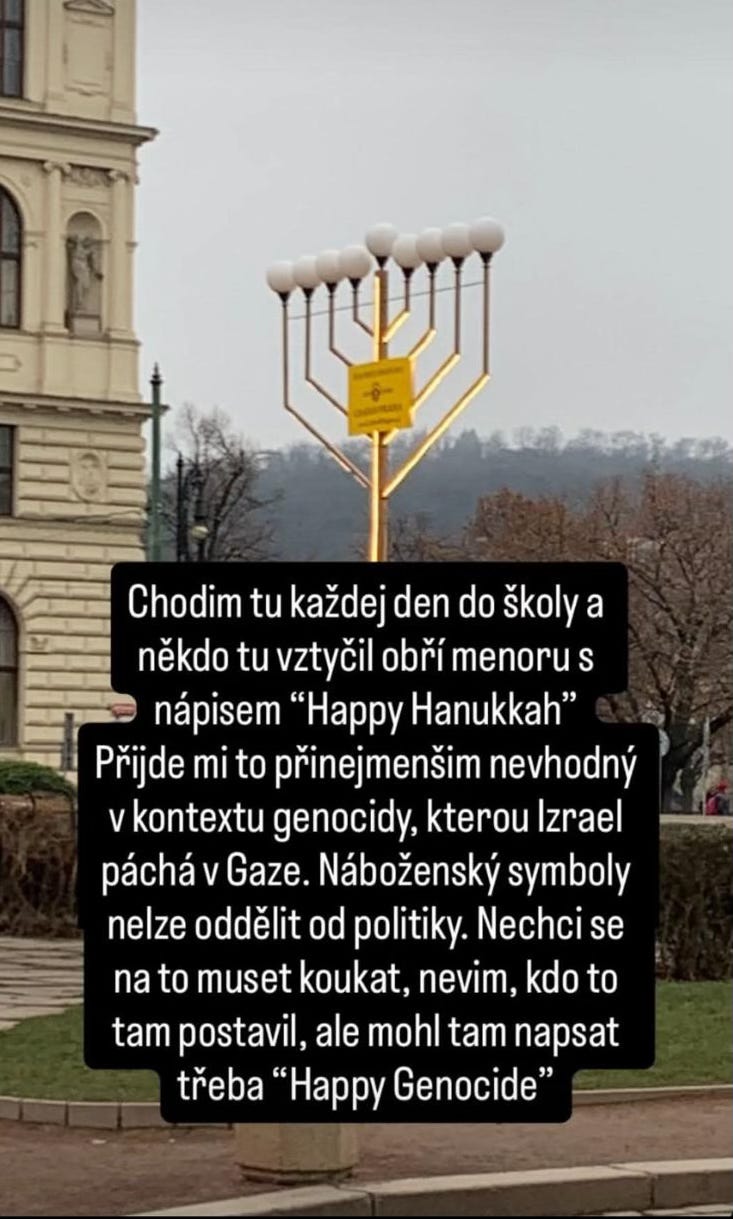
This statement reflects several alarming trends. The student adopts the principle of collective guilt toward an entire ethno-religious group and asserts that religious observance cannot be separated from politics. It also reveals a lack of historical awareness, as the menorah has stood in that location for more than fifteen years.
While the situation at Charles University has not yet reached mass proportions, a clear trend of ideological radicalization is visible, particularly among humanities students born after 2005. Ironically, antisemitism appears strongest in environments where tolerance might be expected to prevail. Students openly declare opposition to racism, homophobia, and xenophobia, yet simultaneously tolerate or justify hostility toward Jews.
This contradiction stems from the reframing of antisemitism through the language of anti-colonialism, anti-racism, and resistance to oppression. Within this discourse, Jewish identity is increasingly constructed as the identity of the oppressor.
Western Europe already demonstrates the consequences of such ideological radicalization, where universities have in some cases become platforms for anti-Jewish extremism. Israeli security services have repeatedly warned about extremist infiltration into European institutions, resulting in systematic harassment of Jewish students and normalization of antisemitism in academic environments.
A central question remains: why is the complexity of the Middle Eastern conflict not being acknowledged? Why are financial flows, structural issues within Palestinian society, and the long-term political instrumentalization of civilian suffering absent from public debate? Billions of dollars in international aid have flowed into Gaza in recent years, yet infrastructure and living conditions remain catastrophic. This contradiction rarely enters mainstream discussion.
Are we willing to ignore these warning signs? What will prevent the Czech Republic from following the path of France, Germany, or the United Kingdom, where Jewish communities are leaving in significant numbers?
Antisemitism has historically functioned as a mobilizing tool for political movements. Totalitarian regimes exploited it in the past; today, it is instrumentalized by radical Islamist ideologies through segments of the extreme left, and in other contexts by parts of the radical right. Should we accept antisemitism as a permanent feature of society, or seek new strategies to confront it?
Zionism as a New Stigma
A narrative has emerged in Czech public discourse suggesting that replacing the word “Jew” with “Zionist” legitimizes antisemitic rhetoric. Many believe that speaking about “Zionist Jews” is no longer antisemitism — after all, they argue, it does not target all Jews.
This mechanism is not new. Throughout history, Jews have been labeled “capitalist Jews,” “Bolshevik Jews,” “rich Jews,” “poor Jews,” “assimilated,” or “orthodox.” The pattern remains the same.
A widely publicized case in 2026 illustrates how antisemitic language can be normalized through influencers with large audiences and without meaningful institutional response. A Czech influencer published a video about the history of Zionism filled with half-truths and conspiratorial narratives, beginning with:
“At least my mom has told me for years that Jews, Zionist Jews, are behind everything. And she’s right — they really are everywhere.”
Although she denied antisemitic intent, audience reactions revealed the normalization of antisemitic stereotypes. Particularly alarming were positive responses from young viewers who interpreted the message as a revelation of hidden truth.
Following criticism, the influencer responded defensively, using vulgar language, accusing Jews of controlling the media, and claiming her critics were paid by Zionists. She later shared an invitation to an event organized by the Free Palestine movement.
In another incident, a tram stop was vandalized: a Jewish actor’s image was circled in red and labeled “ZIONIST.” The act received thousands of supportive reactions online. The perpetrator remains unknown, and the incident was not pursued legally.
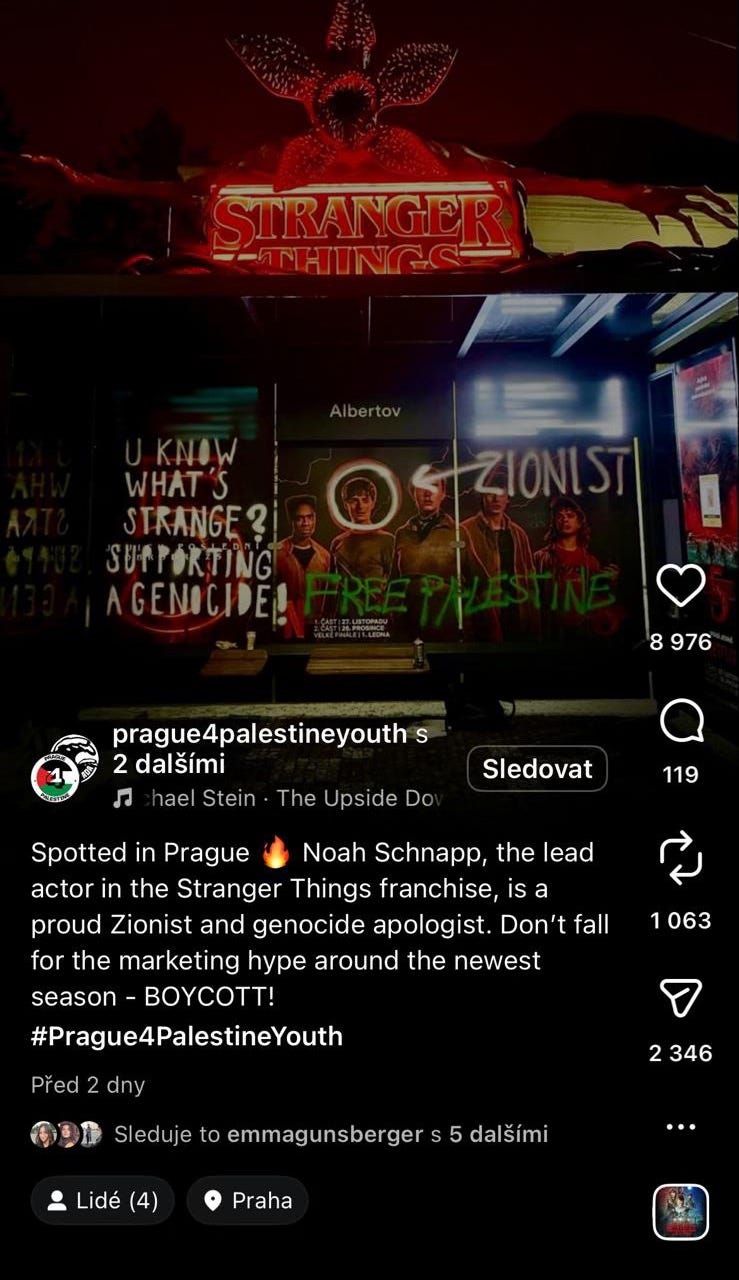
In 2026, the Czech Republic thus finds itself in a situation where high-profile influencers spread antisemitic conspiracy theories, political parties continue collaborating with them, vandalism with antisemitic undertones is publicly supported, and segments of university environments produce ideologically driven hostility toward Jews. While the government declares its commitment to combating antisemitism, such incidents often go unaddressed.
The message sent to society is troubling: spreading Jewish conspiracy theories is not considered antisemitism — as long as the word “Zionist” is used instead of “Jew.”
Blood Libel and Its Contemporary Forms
The term “blood libel” refers to a centuries-old accusation that Jews murder Christian children for ritual purposes. In the Czech context, this narrative is most closely associated with the Polná Affair and the wrongful accusation of Leopold Hilsner.
The origins of blood libel date back to 12th-century England and functioned historically as a tool for power, attention, and political gain. Unlike the Czech term “ritual murder,” the English phrase “blood libel” more accurately captures the conspiratorial dimension of these accusations.
Today, similar narratives reappear in modernized political forms, accusing Jews of shedding children’s blood. At one protest in Washington, shared by The New York Times on Instagram, a puppet of Benjamin Netanyahu was displayed with horns, vampire fangs, and blood around its mouth — imagery echoing medieval demonization tropes.
Understanding this historical continuity is essential.
Terezín as a Key
In our view, a new strategy to combat antisemitism must place the Terezín ghetto at the center of education.
While Auschwitz has become a global symbol through initiatives such as “Never Again,” often accompanied by symbolic gestures and commemorative photographs, society may have grown desensitized to images of gas chambers and mass murder.
Terezín, although less internationally known, offers a crucial opportunity to restore meaning to Holocaust education.
Its story remains significantly distorted. Postwar political developments, the Communist regime’s depoliticization of the Holocaust, and Czech nationalist memory frameworks reduced Terezín to a simplified narrative, often emphasizing children’s drawings, cultural life, and the opera Brundibár. While authentic, these elements obscure the reality that nearly 34,000 Jews died there between 1941 and 1945.
Through staged Red Cross visits, propaganda films, and systematic manipulation, the Nazis constructed a false image of Terezín as a “model Jewish settlement.” Approximately 80,000 Czechoslovak citizens were deported from Terezín to extermination camps, largely without broader public awareness of the scale of the crime.
The Nazis employed manipulation strategies strikingly similar to those used today by extremist movements: emotional framing, selective imagery, inversion of victim and perpetrator roles, and the targeted dissemination of hateful narratives.
If the Nazis were able nearly a century ago to conceal genocide occurring next door, one must ask:
How easily can false narratives be constructed today? How might Joseph Goebbels have used social media, algorithmic targeting, and artificial intelligence in the contemporary media environment?
Yvonne Batel Penkavova
Thanks for reading Bat-El's Substack! Subscribe for free to receive new posts and support my work.
Comments
Nothing yet. Say the first thing.
Sign in to join the conversation.