
Hey everyone —
So just to get this out of the way: In this house, we stan the Winter Olympics. That’s true even when there aren’t human-size Bialetti coffee pots dancing around the opening ceremonies.

Scott Bryan@scottygb
“I’ve been cast at the Winter Olympics Opening Ceremony” “What are you?” “A stovetop espresso maker.”

7:13 PM · Feb 6, 2026 · 3.6M Views
268 Replies · 5.32K Reposts · 75.5K Likes
Costume for Pride 2026, check.
Anyway. This is a climate newsletter. And so there is one important warming-minded issue I’d like to raise about these Olympics, however colorful they may be.
That is the issue of industrial snow.
And specifically whether or not we see machine-made snow on TV.
As the world warms, real snow is getting harder to come by. Ski resorts all over the world are (and have been) turning to machine-made or industrial snow — basically pumping water and a dust-like particle through a giant fan to create fake powder.
They’re also stockpiling snow in warehouses through the summer to then rolling that snow out again at the start of the next season, reports Rob Hodgetts for CNN.
There aren’t reliable figures on the percentage of fake snow at the Milan-Cortina games. But based on the fact that organizers did build giant water reservoirs in anticipation of the games, and that lower-elevation athletes had been complaining about rain-like conditions, we can guess it’s a not-insignificant proportion.
From Reuters:
For Milano Cortina, established resorts such as Livigno, Bormio, Cortina d’Ampezzo and Antholz-Anterselva have expanded infrastructure already in place for elite competition, adding reservoirs, pump stations and snow guns to meet Olympic requirements.
In Livigno alone, more than 600,000 cubic metres of snow have been produced since mid-December for freestyle and snowboard events, with production accelerated during short cold spells, said Nemanja Dogo, executive technical manager at snowmaking specialist TechnoAlpin, which has supplied systems to several Olympic and World Cup venues.
A snowstorm just before the games bailed out some degree of the no-snow panic. But it remains true that Alpine areas are warming faster than the global average.
In the years since Cortina held the Winter Olympics in 1956, the average February temperature has increased 3.6 degrees Celsius, according to Climate Central.
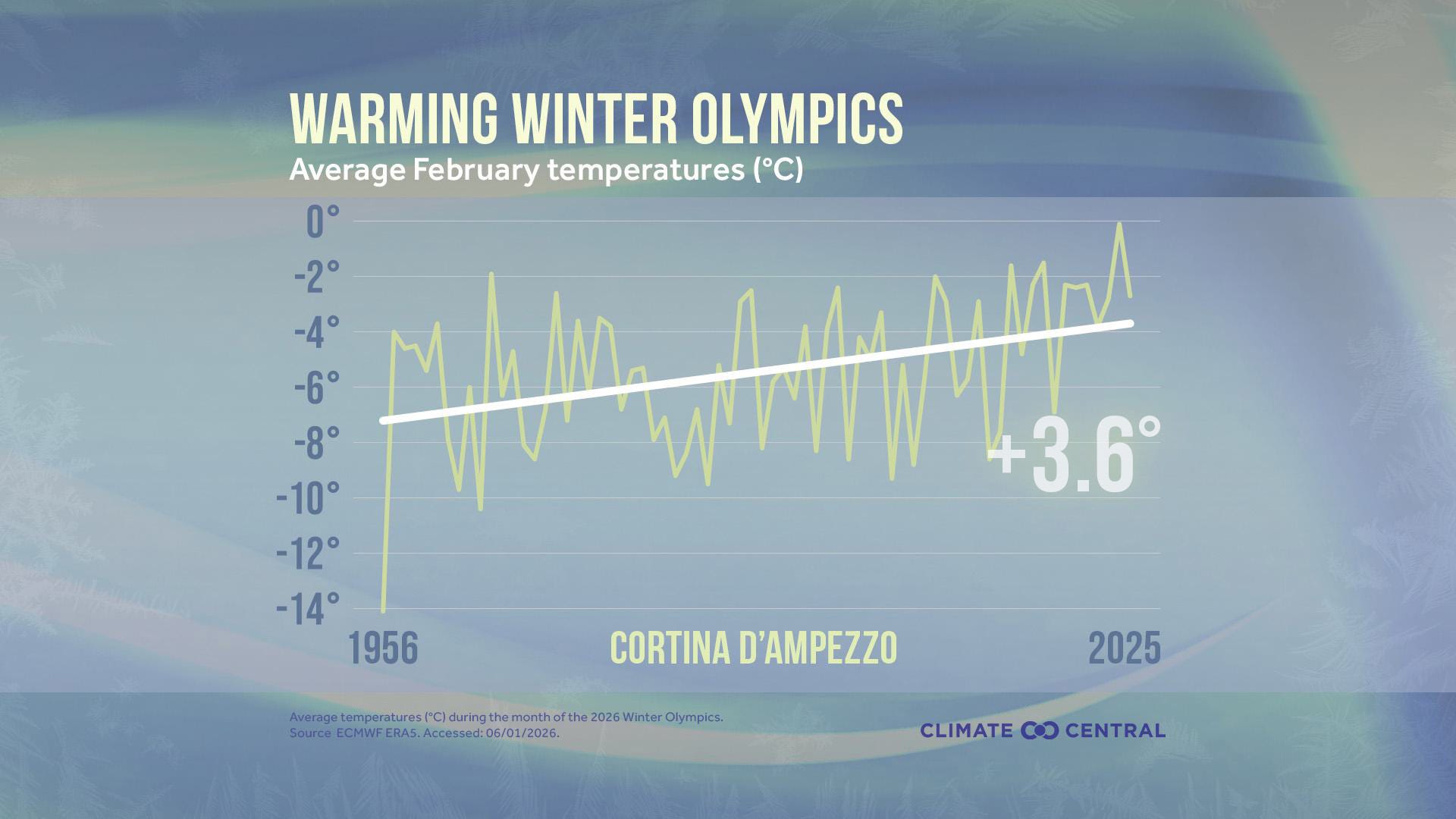
(Global temperatures are nearing a 1.5 degree increase, on average.)
Many of the towns that could host the winter Olympics will not be able to in the future. Of the 93 sites that have hosted Olympic and Paralympic Winter Games, only 52 places remain “climate-reliable” into the 2050s, according to a 2024 study in the journal Current Issues in Tourism. For the Paralympics, which are typically held after the Olympics in March, the number is even lower: 22 locations.
Which brings me back to the title of this email.
Perhaps the games should include “snow acknowledgments.”
Meaning: Tell us whether the snow we’re seeing is real or fake. Widen the lens to show us when a ski course is a ribbon of white on a brown landscape. Share the percentage of snow that’s being made industrially to host these events.
Doing so would help people grasp the consequences of global heating, which is driven primarily by burning fossil fuels and cutting down forests.
The term “snow acknowledgement” comes from an undergrad student of mine. Last week, one of her peers brought this Museum of Science Instagram video to class to lead a discussion about how the media communicates news of vanishing snow.
Why not just acknowledge the nature of the snow at the top of a broadcast? she asked (She says she’s seen a discussion like that on social media somewhere; I can’t find it, at least not using the term “snow acknowledgement.”)
The term is a nod to land acknowledgments, which celebrate the indigenous history and ownership of land at the start of some events and broadcasts.
It’s a little flip, I’ll admit, especially in the context of colonization and the theft of indigenous land. Still, I do think there’s something useful in the term.
The first Winter Games to use artificial snow were held in Lake Placid, New York, in 1980. Reliance on fake snow has only grown since then.
The LA Times describes the slippery progression:
Twelve years ago in Sochi, Russia, when temperatures rose into the mid 60s — so warm some snow groomers worked bare-chested — 80% of the snow used was artificial. Four years later more than 90% of the snow in Pyeongchang, South Korea, was man-made. Then came the 2022 Games in Beijing, the first to rely completely on fake snow.
There are times when broadcasters and officials acknowledge these facts. But NBC and the International Olympic Committee could do much more to make transparent where the snow comes from in Milan-Cortina and at future Winter Olympic games.
Withholding that information creates a false image of functional winter.
So give us the equivalent of an “AI Generated” label.
Just say it when it’s true: The snow is fake.
Thank you all for reading. Give me a shout and let me know what you think about the term “snow acknowledgment” — and I’ll pass along your thoughts to my students.
For more on snow and winter sports, check out this NYT piece on the extreme drought in the West. (Those of us in Oregon are desperate for snow and are complaining about it constantly; two of my students, Josie Brown and Alisa Ashton, wrote about the decline in snowpack in December).
Bloomberg also has some super-useful context.
Also check out Protect Our Winters, which is doing this work all the time, not just during the Olympics when TV viewers are paying attention.
As a reminder (did you need a reminder?) that the U.S. has an outsize role in the thawing of our winters, and the general wrecking of the atmosphere, check out another NYT piece on the Trump Admin’s assault on climate regs.
Thanks and more soon!
Warmly,
Thanks for reading BASELINE! This post is public so feel free to share it.
No posts
Comments
Nothing yet. Say the first thing.
Sign in to join the conversation.