
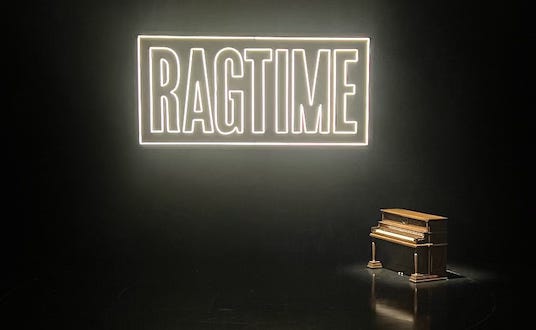
The devastating new production of Ragtime that just opened at Lincoln Center Theater has hurled me back in time to the original Ragtime, which I first saw almost thirty years ago up in Toronto, where Garth Drabinsky, the show’s future-jailbird producer, first mounted it.
I entered already a fan of the sprawling E.L. Doctorow novel that constituted the musical’s source. I’d burned through Ragtime as a teenager when it was first published in 1975, transfixed by Doctorow’s titanic plotting of history as fiction and enthralled by his revisionist re-imagination of a period in American history that I already was riveted by because of my love for ragtime music itself.
Watching Ragtime in Toronto, though, and especially later on Broadway, was like peering at history through the wrong end of a telescope. It all felt so far away, despite (or maybe because of) the dwarfing scale of Drabinsky’s over-produced production. History was not clarified. History was overwhelmed.
Even Lynn Ahrens and Stephen Flaherty’s ragtime-redolent score — which I appreciated — sounded heavy to me; anthem heavy. Big songs, sung big. Stop hollering, I remember thinking, and let us just hear you.
Boy, has that changed.
The anthems do keep coming in the new Ragtime; that has not changed — “Journey On,” “Your Daddy’s Son,” “Wheels of a Dream,” “Till We Reach That Day” (in Act I alone).
What’s changed are the times we are a-listening in — our terrible, awful moment in time. Suddenly Ragtime seems, not a deafening, wrong-way telescoping of distant history, but a cry of recognition, sharp and present tense, an admonition from one American epoch to another. ‘Beware!’ Ragtime’s anthems now seem to be thundering. The racism and the corruption beneath the surface of our distant time, have risen and are ravaging yours. ‘Do something!’ this new Ragtime demands, before it’s too late.
Ragtime (for those who may not know) tells a story of American hatred and inequity that has proven sadly perennial, set at the turn of the last century. It throws together an audaciously unlikely array of real-life historical figures from that time (J.P. Morgan, Booker T. Washington, Harry Houdini, the legendary chorine, Evelyn Nesbit) with emblematic fictional characters — a white New Rochelle family of privilege; a black ragtime piano tickler who becomes a revolutionary when racism takes from him everything he holds dear.
Doctorow’s plotting is so elaborate and insidiously delicious that I’m going to leave off further summary. The musical captures slices of his vast tapestry — all of it would be impossible. Beyond that, I will just say: Go and see for yourself.
The original Ragtime had a stupendous principal cast, including Brian Stokes Mitchell as the black piano radical, Coalhouse Walker, Jr., and Audra McDonald, as his beloved Sarah. The current production just about equals it. Though Nichelle Lewis is no Audra M., vocally, she delivers her anthems with such earth-shaking conviction it renders further comparison moot; as does Joshua Henry, who is pretty much a male Audra M., vocally and as an actor of rapturous truth. Caissie Levy takes the late-Marin Mazzie’s incomparable original portrayal of “Mother,” the conflicted New Rochelle matron, to a pinnacle of liberation. Brandon Uranowitz is superb as “Tateh” (first played by Peter Friedman), the ardent immigrant Jew who saves his daughter and himself with his art.
The chorus is vocally monumental, delivering Stephen Flaherty’s own vocal arrangements with one seething communal voice. The choreography is so richly filigreed and forceful that at times it made me gasp (bravo to choreographer Ellenore Scott, your previous work on Funny Girl is so forgiven).
Directed by LCT’s new artistic director, Lear deBessonet (remounting her culminating production at Encores!’s as its outgoing artistic director last year), this Ragtime implies immensity without resorting to the original production’s gigantism. The scale here never ceases to be human. The implications resonate for all of us.
I followed Garth Drabinsky around for the New York Times in the run-up to Ragtime’s original opening night on January 18, 1998 (you can read about that HERE). I watched Garth operate, and seemingly get away with murder. A few years later he went to jail for fraud, forgery and what we would now call Trumpian behavior.
The current Ragtime has reinforced for me a rather hopeful lesson. Sometimes, a musical ages into itself. Little about Ragtime has changed, beyond misbegotten production values. The show was empirically good in 1996, it is just as good in 2025 but seems way better. That’s because the right moment for Ragtime is now.
Comments
Nothing yet. Say the first thing.
Sign in to join the conversation.