
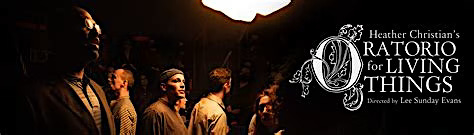
Oratorio for Living Things, by the recently-MacArthur-awarded composer Heather Christian, has its own antecedents but is still unlike almost anything I’ve heard or seen in the musical theater. Watching it, I found myself thinking of …Godspell…Hair…The Gospel at Colonus. Still, what Ms. Christian has constituted with Oratorio for Living Things feels wondrously different.
The show, I should mention, was originally produced Off-Broadway in 2022 at Ars Nova, where it won Obie and Lucille Lortel Awards, and I missed it. At Signature Theatre, where it has been revived, I finally caught up.
And found an actual oratorio — semi-sacred in spirit, with much Latin sung; vaguely narrative in form, with a story line that pursues a perpetually consecrating destination — through-sung virtuosically by a youthful company of twelve agile vocalists, accompanied by a terrific six-piece orchestra that sounded way bigger, suspended, half-and-half, in the top rows at opposite ends of the theater.
The story they sing — Ms. Christian’s oratorio story — is of the creation of time and the universe; and then of our creation (humanity’s); followed by our comparatively miniscule evolution within the overwhelming vastness of the cosmos; and our current de-evolution in the face of suicidal climate self-destruction.
If this sounds biblical (and/or political), well, it is, but from a fundamentally scientific centering. There is an innocence and a sophistication to Ms. Christian’s portentousness that bestows a nominal pass on pretentiousness. Still, in an evening of sometimes grandiose pronouncements, my favorite lines were her most anodyne:
Seventy Three minutes finding the keys to your car
Thirty days and seven hours deciding not to call someone back
Thirteen seconds of true bliss
two hundred and seventeen days with a headache in the morning
Fifteen hours biting your nails at the movies
One full year thinking about what you should have said
The space at Signature’s Romulus Linney Courtyard Theatre is tiered and tight, with seats rising rather steeply surrounding an almost slot-like stage area. Of course Oratorio for Living Things is immersive, with the cast floating up and down the stairways and popping up singly and in clusters, all around and below. Their movement is choreographed more than it is danced, but there is a lot of movement. Director Lee Sunday Evans is one stentorian traffic cop.
The music sung is often sublime and verges on the improvisatory in its affect, though I have no doubt that every note and inflection were rigorously rehearsed. They’d have to be. I’ve rarely heard a choir toss riffs and motifs around a room more deftly, flinging disjointed fragments of musicalized conversation at each other in inner and outer monologues that bubble up and soar over one another or unite into a rhythm section of vocalized sounds.
Oratorio for Living Things is, I’m telling you, not easy to describe. Nor was it easy for me to grasp. In the rich cacophonic babble of its harmonies, I pictured the Babel of voices rising up from our planet, all at once, en masse, and felt like an orbiting auditor from above. In the, at times, Easternish drone of Ms. Christian’s score — perky, yet limpid — I dropped into a hypnotic sense memory of night-long La Monte Young concerts I once drifted through downtown in the early-80s. (In 1981, I was working for a record label called Gramavision that recorded and released a version of Young’s ever-mutating The Well-Tuned Piano, so I actually got to meet the guy. He was (and, thankfully, still is), a piece of work.
Heather Christian is an iconoclast on the La Monte Young spectrum. Her musical mind, though minimalist, is limitless. The paces she puts her vocalists through are deceptively Olympian. How the heck they managed to memorize it all is a subject for a discussion I’d love to have with the whole bunch of them; how this all went down.
You have another couple of weeks to see it for yourselves. Prepare to be uplifted, in a multitude of mysteries.
Comments
Nothing yet. Say the first thing.
Sign in to join the conversation.