
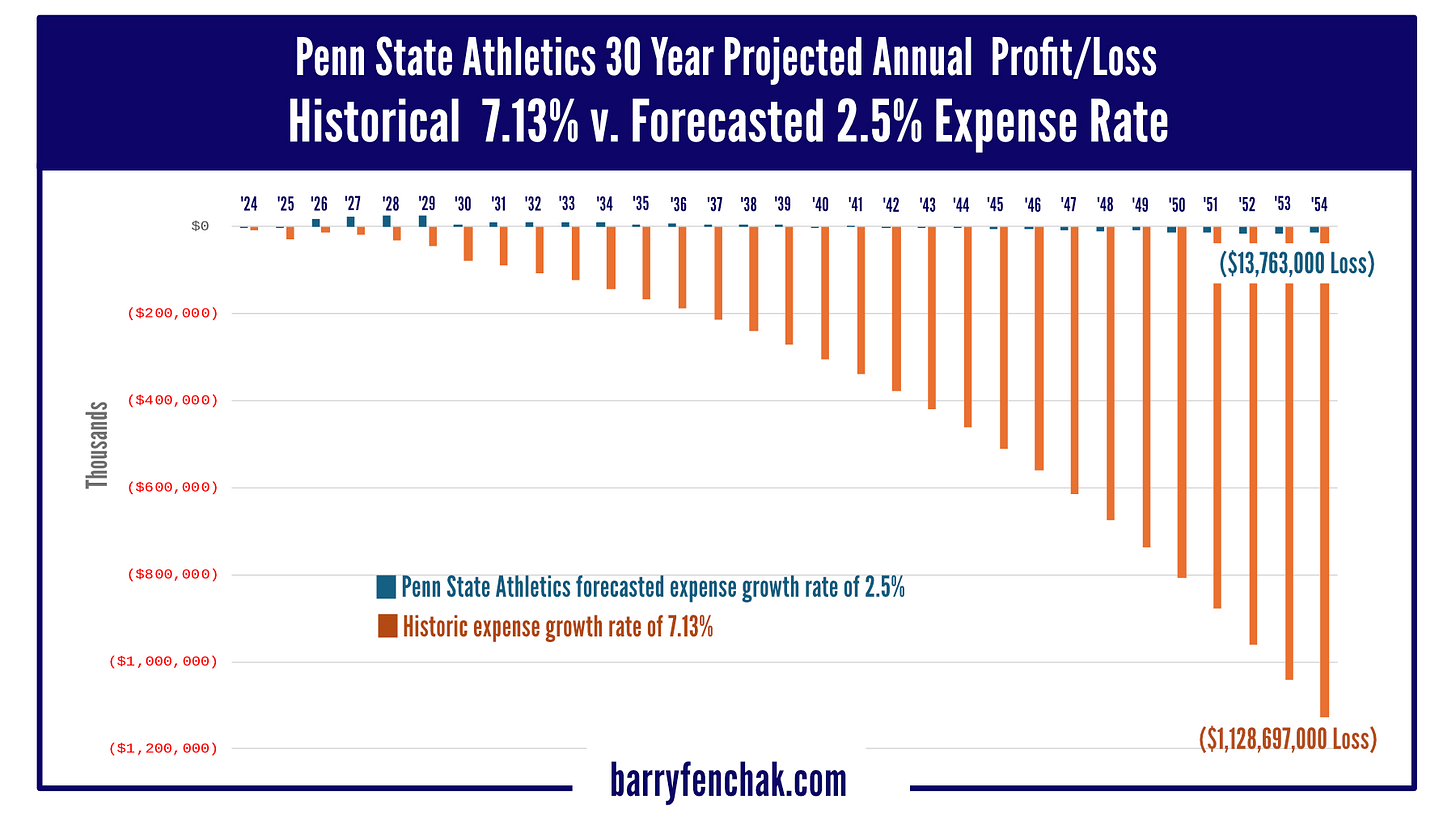
If you’ve been following along, you’re aware that the Penn State Athletics Department is heading for a fiscal cliff. Even without the unknown of how much a new championship-quality football coaching staff will cost, the reality is stark: within the next four to five years, expenses will begin to eclipse revenues at a rapid rate that will only get worse. You don’t have to have an MBA and/or several professional certifications (which I do have) to understand that when expenses exceed revenue, you lose money. When you do this for an extended period of time, you lose a lot of money. So how did Penn State end up in this position?
Penn State Athletics’ long-term fiscal health and selling the Beaver Stadium renovations.
Thanks for reading Barry Fenchak For Penn State Trustee! Subscribe for free to receive new posts and support my work.
On May 21, 2024, Penn State’s Vice President of Finance, Dr Sara Thorndike, addressed the Board of Trustees Committee on Finance, Business, and Capital Planning to justify the $700 million Beaver Stadium renovation project. In her presentation, Dr Thorndike explained the assumptions the Penn State Athletics used in creating their 30 year revenue versus expense calculations, a process called financial forecasting. These forecasts were not solely for the Beaver Stadium renovations, but for the entire Penn State Athletics operations - all revenues and expenses - which makes that information extremely important.
Dr Thorndike explained that if the Beaver Stadium renovations were approved, over the next 30 years Penn State Athletics would almost exactly break-even, with total revenues of $10.86 billion and expenses of $10.83 billion. This remarkable, some would say almost perfect, match of money coming in to money going out over such a long time period is a huge red flag. Anyone with fiduciary responsibilities has a duty to question and evaluate the underlying assumptions, so of course I did just that*.
Why go the hassle of financial forecasting?
As difficult as it is, forecasting a university’s future revenues and expenses has two important purposes: to use ‘what if’ scenarios to guide better decision making today, and to identify potential trouble areas so they can be addressed proactively (and less painfully).
There are currently many unknowns in college sports. How will revenue sharing and pay-for-play shake out in the coming years? How will conference re-alignments proceed? What will happen with the next wave of media contracts? When and how will private equity invade college sports?
To answer these questions, good forecasters use sophisticated financial tools that study past performance and analyze current trends. They know their business and are not afraid to ask questions, as well as listen to a broad range of opinions. Lousy projections, on the other hand, work backwards from how they want the future to look and then simply rubber-stamp the forecast. This leads to bad decision making because the danger lights are turned off, leading us to fall off the cliff.
We do have a good handle on how much money will be coming in.
On the revenue side, I did not find a lot of concerning issues with Dr Thorndike’s projections. They were reasonable and at the time her assumptions of consistently selling out Beaver Stadium, growing television and media revenue, increased merchandise sales, and philanthropy seemed in line with historical data, our peers, and current markets.
The greatest risk of overstating revenues might be the assumption that Beaver Stadium would consistently ‘sell out’ over the next 30 years, even with increasing prices passed on to the spectators. On the other hand, her projections for philanthropic donations might be a bit understated. Many of our Big10 Conference competitors have raised far more philanthropy than Penn State’s forecast, but perhaps not unreasonable given our weakness in fundraising, relative to our peers, in recent years.
The concerns start on the expense side.
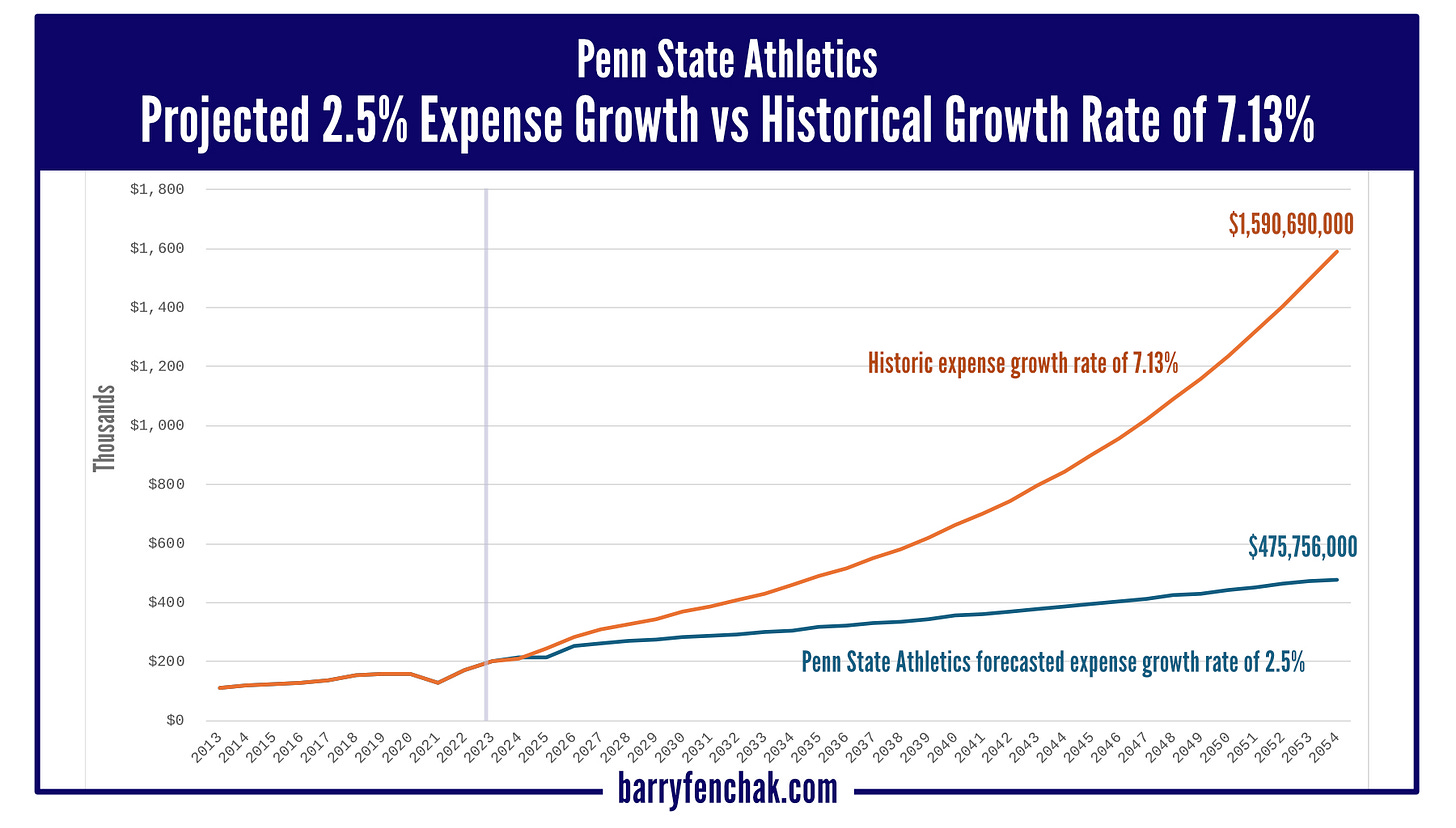
The largest portion of Penn State Athletics spending is the operating budget: athletic scholarships, travel, and salaries for coaches and administrative personnel. These costs are predictable and generally unaffected by future unknowns, and annual increases are regular and consistent. We have decades of historical data to track these known costs, which over the last decade have averaged a 7.13% annual rate of growth.
However, during her pitch Dr Thorndike promised that going forward, Penn State Athletics would be able to hold expenses to 2.5% growth annually over the next 30 years. She provided no plan or roadmap on how that miracle would be achieved.
At first brush, one might not appreciate the difference between 2.5% and 7.13% rates of growth, but a very large expense, compounded each year over 30 years, yields a huge difference. You can see that impact here:
I was in that meeting, and admit my jaw dropped to the floor at this blatant magical thinking. At the very least, one would expect the pitchman to have some rationale or justification to provide how such a dramatic decrease would be achieved, but none was forthcoming, even when questioned.
Using her forecasted 2.5% expense growth, Dr Thorndike showed that the first 15 of the next 30 years would have a net surplus that would almost exactly offset 15 years of projected losses to follow (the stronger performance in the earlier years would be expected in a stadium renovation, where revenues from naming rights and philanthropy are front-loaded and expenses like interest on the long-term debt are back-loaded).
This remarkable achievement would certainly justify a $700 million outlay if Penn State Athletics was able to demonstrate it was able to manage expenses. Instead, it might find itself having trouble holding to a 7.13% expense growth with the future revenue and expense challenges on the horizon:
· Travel will certainly get more expensive with the inclusion of the four west coast teams for all sports, which will multiply the cost increases due to inflation.
· Significant parts of Beaver Stadium will be over 70 years old in 30 years, and there is little money in the 30 year plan for any significant new athletic capital projects, including not only the bulk of Beaver Stadium, but also for aging facilities such as the Natatorium.
· The NCAA has approved a higher scholarship ceiling for many sports. If Penn State is going to be competitive, its scholarship costs will not only increase as tuition rises, but by even larger amounts to fully fund the rosters.
· The new private equity revenue sharing model is a huge unknown, and early reports on how such a deal might be structured would only further exacerbate Penn State’s long-term fiscal deficits.
· The number of full-time Penn State Athletics staff and administration positions has exploded, and senior administration has shown no appetite for curbing this growth nor of reining in gigantic compensation increases for the most highly-paid employees.
What 7.13% a year expense growth looks like.
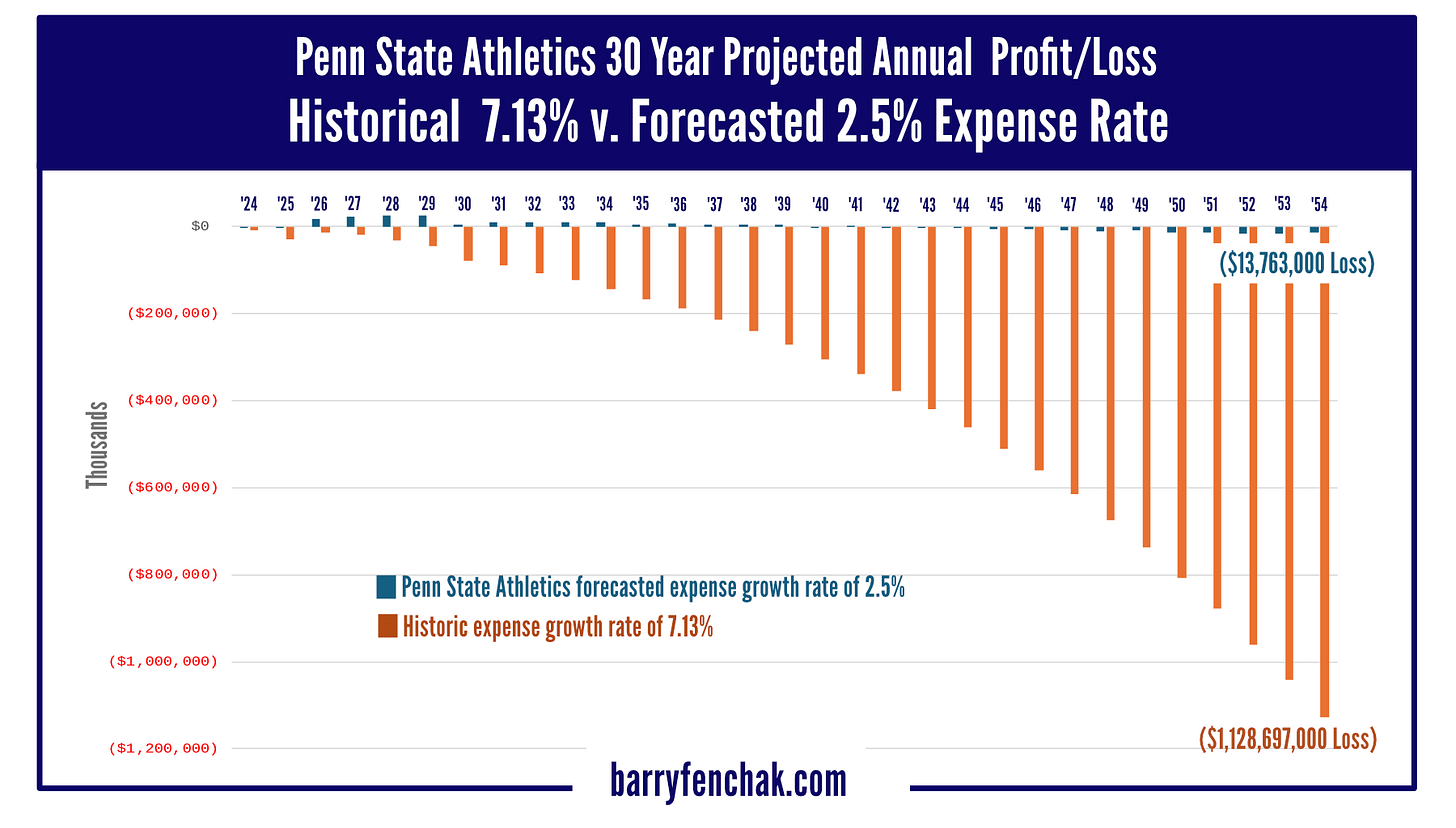
If Penn State Athletics keeps up the trend of 7.13% average expense growth, at the end of 30 years Penn State will have a loss of over $11.6 billion instead of $28 million profit. That’s an almost $12 billion swing that inverts a modest projected gain into a massive deficit. Such is the power of compounded growth over long times frames.
How will Penn State keep the Athletics Department afloat?
In about four years Penn State will have three options: they can either increase revenue, reduce expenses, or do both.
Possible ways to increase revenue include the ‘private equity kick-the-can-down-the-road’ philosophy (currently being legally challenged); raise ticket prices (a tricky balancing act when needing to maintain sellout crowds); find a way to increase media dollars (difficult as Penn State is part of the Big10 Conference revenue sharing plan and has no unilateral ability to control that); raise more philanthropy (alumni and large donors remain resistant); and/or get more money from the Commonwealth of Pennsylvania (I will rate that one ‘highly unlikely’).
To reduce expenses, the Athletics Department would have to drastically cut their staffing levels, number of scholarships awarded, and non-revenue producing sports would have to be cut. The current and previous university administration have shown zero appetite for any reductions in these areas, especially staffing.
The final option is tapping into the only significant revenue stream available, the General Fund, aka tuition dollars. The university has already used these funds to collateralized debt taken on for athletics, like the $700 million debt on the stadium renovations. But direct appropriation of those dollars, or a tuition add-on such as an ‘Athletics Fee’, could be a public relations nightmare.
What happens now?
As we are constantly reminded, Penn State is a $10 billion a year enterprise and there is a lot is at stake. The current Penn State administration and Board of Trustees rubberstamped the Beaver Stadium Renovation Project, and many other unwise decisions regarding athletics, while fully aligning itself with everything they were told would make this year a national championship season.
They may have felt that Penn State’s prestige would be restored and hopefully attract back the alumni philanthropy that has been underperforming our cohorts since 2012. The Board of Trustee’s questionable behavior would be vindicated, and Board of Trustees Chair Karen Peetz’s 2014 prediction that ‘this will all be forgotten’ would come true. Or, perhaps, they may just be more focused on football than on prudent governance of the University and its assets.
Whatever the reasons for their actions, the result is that Penn State Athletics is soon going to face painful fiscal realities. The only question is how painful, and that will be determined by how long Penn State leadership waits to mitigate the pain and take prudent, decisive actions. I hope this is soon.
But hope is not a strategy and ignoring reality is not a good business plan. Penn State’s finances are in shambles, we have the highest tuition in the Big10 Conference, and close to the worst academics.
We also have the highest paid president among all sixteen Big10 Conference public flagships (who is also among the highest paid in the nation), and she has a lavishly compensated staff. They need to roll up their sleeves and find some solutions.
It’s time they earned their bonuses.
*I’m sharing my spreadsheets with sources here: https://docs.google.com/spreadsheets/d/1JCJctRoFIqVgtKso7kgnwVoG3xQTC6TqEUK8AweHO4E/edit?gid=1244796576#gid=1244796576.
As a former Penn State alumni-elected trustee, I enjoy sharing my personal observations, concerns, and ideas about Penn State. I invite you to contact me with your opinions so that we can engage in meaningful conversations on those topics: barry@barryfenchak.com.
Thanks for reading Barry Fenchak For Penn State Trustee! Subscribe for free to receive new posts and support my work.
Comments
Nothing yet. Say the first thing.
Sign in to join the conversation.