
This is the first installment in Army on Screen series, where I explore the Egyptian military in cinema, TV, and pop culture.
Frederick Wiseman’s Sinai Field Mission feels unusual. For extended periods, it provides little in the traditional sense: no narration, no clear argument, no dramatic storyline, and no effort to captivate the audience. It begins with paperwork, remains focused on paperwork, and emphasizes that this is the core of the story. The film does not seek spectacle, nor does it attempt to dramatize the Arab-Israeli conflict or dangle easily digestible context for viewers.
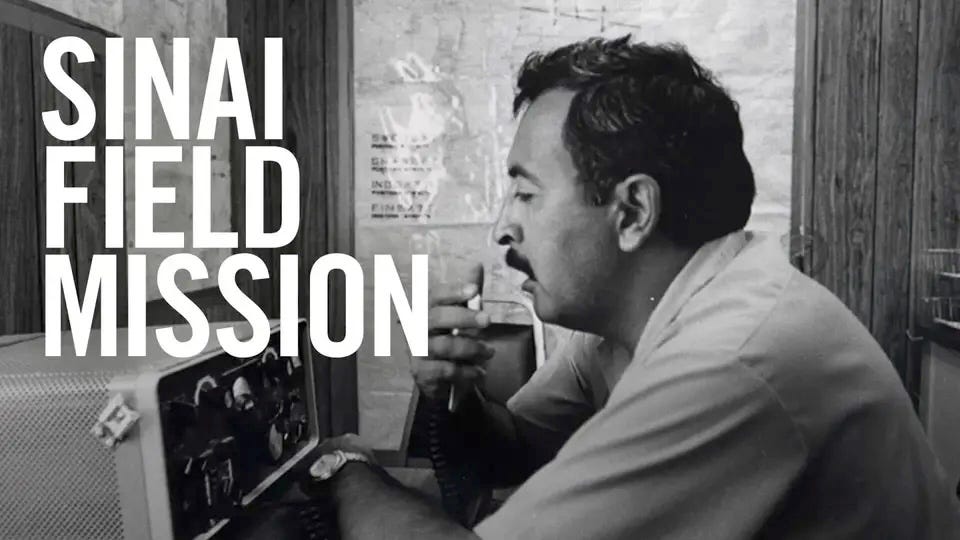
Wiseman explores the post-war landscape, focusing on how its aftermath is organized, managed, and endured. The film starts off resembling an administrative record and gradually transforms into a profound human portrayal of life in the desert.
Born in 1930, Frederick Wiseman, who passed away in February 2026, had by the time he made Sinai Field Mission in 1978 already established himself as one of the most distinctive documentary filmmakers in the US.
His style was innovative and distinctive. It features no talking heads, voiceovers, or musical cues to influence feelings. Instead, he creates meaning gradually by observing institutions from within, letting their routines, hierarchies, and contradictions reveal themselves over time through repeated exposure.

By avoiding explicit interpretation, Wiseman prompts viewers to engage directly with how institutions function in real time. His earlier work explored prisons, hospitals, schools, and police departments, and in this film, he applies the same approach to a US-led monitoring mission in Sinai, presenting it as a lived environment.
The Sinai Field Mission was created in the aftermath of the October 1973 war, as part of the arrangements following the Egyptian-Israeli disengagement agreements of the mid-1970s. Established in early 1976, it was part of a US effort to monitor the buffer zones and strategic passes in Sinai, verify compliance, and help prevent renewed conflict between Egypt and Israel.
Mostly staffed by American civil servants, the mission functioned as an early warning and verification system, monitoring movements, reporting violations, and enabling communication between the two sides. Essentially, it was a technical and bureaucratic approach to addressing a political issue.
That arrangement lasted until April 1982, when the mission’s mandate ended and its functions were replaced by the Multinational Force and Observers, coinciding with Israel’s final withdrawal from Sinai and the restoration of Egyptian sovereignty over the peninsula.
The first half of the film relentlessly concentrates on routine activities: meetings, reports, radio transmissions, supply logistics, and maintenance work. The camera stays on forms being filled out, procedures discussed, and minor issues being escalated and resolved.
Even the closest moment of tension, a heated exchange between a US mission member and an Israeli officer, stays within the confines of logistics and protocol. The conflict never transcends the bureaucratic boundaries that shape it. Instead, a different narrative comes into focus—one driven by process rather than events. The film starts to resemble surveillance footage or an institutional archive, with the detached tone of a camera recording passively, unconcerned with drama.
The film subtly shifts without announcement. Bureaucracy recedes as new elements emerge, and people within the system begin to form. The Americans at the mission open up through heavy drinking, crude jokes, and improvised camaraderie rituals. At one point, alcohol is passed and drunk from a Texas boot, symbolizing transplanted Americana in the Sinai desert.

Elsewhere, a different rhythm emerges as some men turn to religion, gathering for prayer, discussing faith, and invoking God to structure their time and make sense of their surroundings. Wiseman sees these as parallel responses to the same conditions: isolation, heat, monotony, and the suspension of time at the mission. One man visibly struggles with the environment, killing time by practicing archery. The gesture is almost absurd, yet understandable. In such a place where little happens, people invent ways to fill the hours.
Even during leisure, the institution never relaxes. Senior staff discuss damaged furniture after a party, insisting it be investigated. Complaints about UN personnel using facilities or eating mission rations surface. These minor infractions seem humorous but are revealing, as in a regulated environment, small issues become overly significant. Order must be maintained over things like broken chairs or extra meals.
The mission interacts with Egyptian and Israeli counterparts, exchanging information and reports, with an Egyptian liaison reminding us it’s part of a larger political landscape. Still, the film is focused on the American perspective, a US-run enclave that observes and mediates without fully belonging.
Sinai Field Mission demands patience, and it does not reward it in obvious ways. There are no dramatic payoffs, no clear conclusions, no emotional crescendos engineered for effect. For many viewers, it will feel slow, even tedious.
The film is currently available to stream only on Kanopy, a further testament to how niche its audience is likely to remain. And perhaps that is fitting. This is not a film designed for mass appeal. It is a patient, stubborn work that asks you to look closely at something most people would overlook.
Comments
Nothing yet. Say the first thing.
Sign in to join the conversation.