
Early October
and the harvest,
the shock
and the cold dark
rough transport.
This morning the pear,
sweet ripened
Comice, is ready
to share her story
of orchard and sun,
to let me drink in,
let me sing,
her mortal sugar.
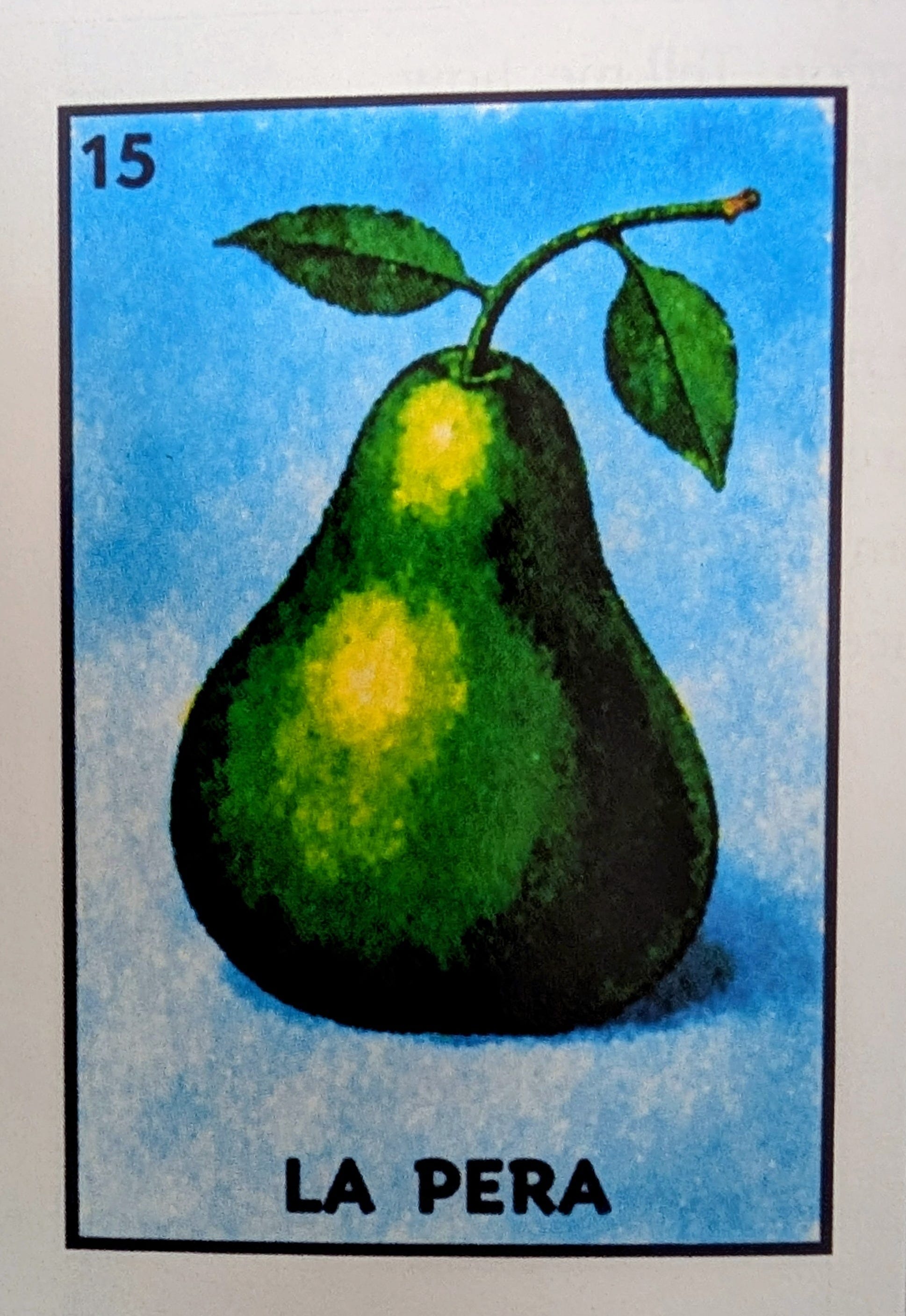
Yesterday, like a select few others, I came home to an exciting surprise. Well, not a complete surprise. had messaged me a couple of weeks ago to let me know I’d be receiving the wonderful gift that is this new book of poems. But life being what life is, it slipped my mind until I reached into the mailbox.
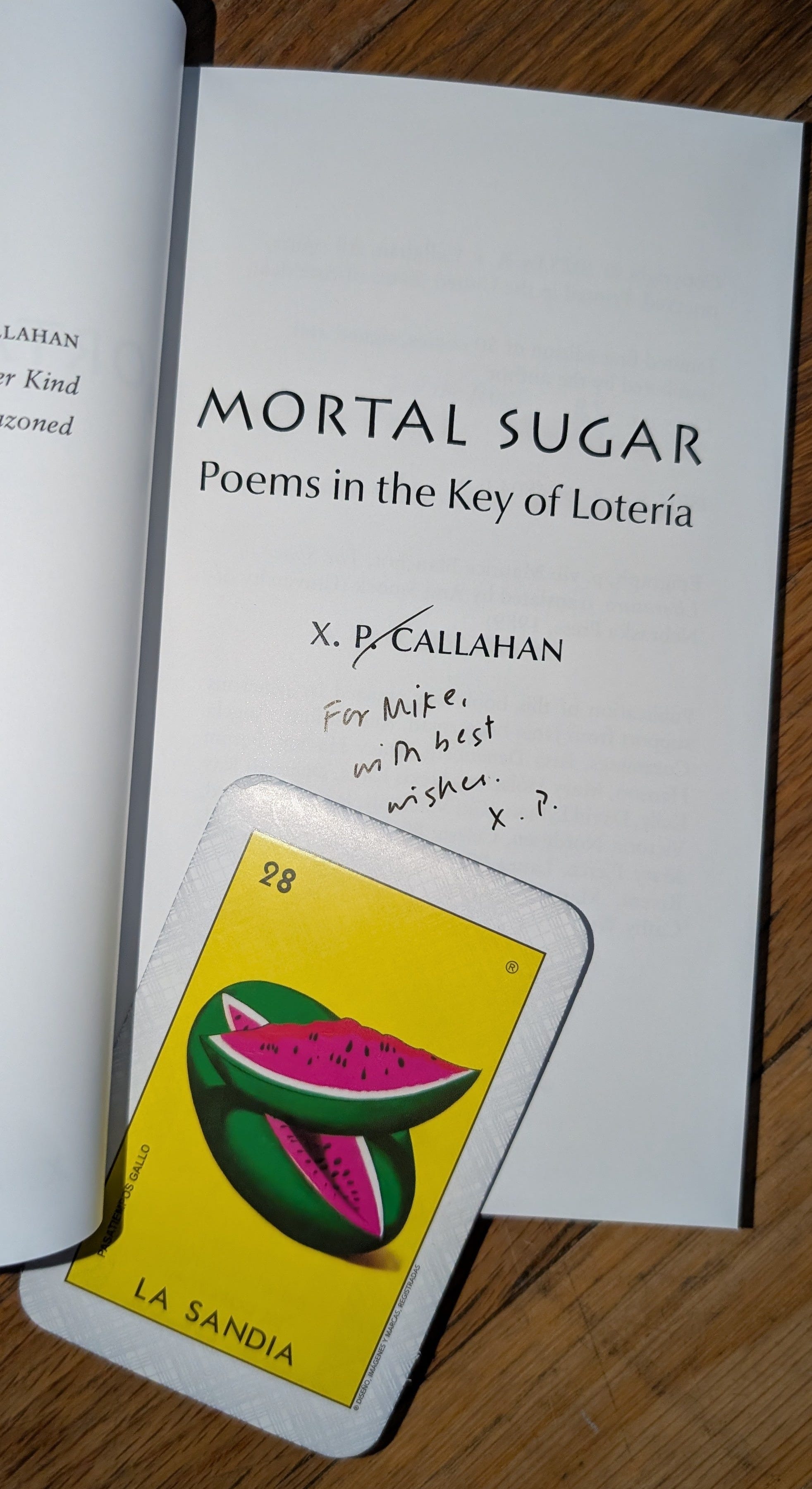
I immediately dove into it. The thing about a Lotería card is that it’s not innocent. Sure, the pear on its sky-blue background looks harmless enough. But X. P. Callahan’s Mortal Sugar makes clear from the jump that these little pictures are soaked in the complications of history. There are colonial imports, racial caricatures and the skid marks of imperialism hiding in plain sight. Callahan’s move isn’t to redraw them or embody them in the way that ekphrastic poems are typically handled. Instead, the speaker sits in conversation with each and “rattle the deck’s foundations.” Each poem is a quick strike of fifty-four syllables for fifty-four cards.
This poem in particular stuck out every time I went through the book. It might be the matter-of-fact opening, calling to mind a bit of Charles Wright. It feels like it’s torn from a ledger making note of the newest harvest. The second couplet cuts through the cold open with heavy, definite sounds. The shock, cold, dark, and rough quickly turn the feeling from a physical to an emotional account-keeping. I love the way the sounds of those words alternate between rising and falling sounds. Say them out loud in order and you’ll hear the ups and downs. This creates movement and tension in the sentence.
Speaking of tension in the sentence, did you notice the missing commas? Callahan doesn’t give a breather in the assault, creating a torrent of negative adjectives that crash into the ear until a literal break in the day brings our savior: “This morning the pear”
Suddenly, there are so many commas. Now we are encouraged to linger. The pear, anthropomorphized, gives all of herself to us. “to share her story/ of orchard and sun.” She is giving us where she comes from and what gives her life. The pear is baring her entire soul to us. We’re not spared from the tug, though. “Orchard and sun” rise and fall respectively, pulling at each other and resonating with the rhythm created earlier in the piece.
This rhythm is momentarily broken by the final couplet of the poem, with its nasally light i sounds set against the refrain of “let me.” There is a build-up here in emotion and sound and form that makes the final line hit that much harder. The line lends itself to the title of the book, and for good reason. From a perspective of sound, the o and the u in “mortal sugar” sit really heavy in the mouth, and help to pull down what would otherwise be a rising -a sound at the end. That is helped by consonants around them that help to choke out the schwa. The short version is that when you say “mortal sugar” it just sounds nice. It sounds right. And it helps soothe the passage of an otherwise rough idea. Life as commodity. A sweetness that is only obtainable through death. The pear has to be destroyed for us to know her sugar. She has to give herself completely.
That’s pretty fucking dark, but that’s the point. That’s the move Callahan keeps pulling across the book. There’s a rooster that shrugs through Gethsemane, a ladder that mourns being sanded down, and a watermelon that detonates into Dallas 1963. Each bright and folkloric card is juxtaposed against replies that are grievous truths. This amazing book (which you can request to purchase by reaching out to X. P. through DM) is about pointing out the ugly that was buried inside the idea of acceptable destruction. Kind of makes you think about the ugly that’s buried in the destruction we accept today.
Comments
Nothing yet. Say the first thing.
Sign in to join the conversation.