
This newsletter focuses on how using English as the global language affects the way we see the world. I’m a journalist with more than 20 years’ experience in both Western and non-Western TV News. As a second-language English speaker, I believe language is culture, and I look for the hidden angles and cultural mistranslations within mainstream stories. I’m obsessed with accents, which is why I loved writing this post. Hope you’ll enjoy it too.
The world of second-language English speakers has a new hero. Perhaps a new villain, depending on your point of view. Or maybe just another victim of the international community using English as the global language, while assuming the level of ‘Proficient English’ on a CV ensures everything will be OK. Unfortunately on Thursday night, during the opening match of the 2026 FIFA World Cup, it wasn’t.
Our story unfolds within the iconic Estadio Azteca in Mexico City. Co-hosts Mexico were taking on South Africa in front of a crowd of more than 80,000 people and many millions more watching the start of the tournament on their screens around the world. I will leave the details of what’s been described as an eventful game to those who actually know what they’re talking about football-wise, but I’ll just say it wasn’t looking good for South Africa, who had let in two goals with less than half an hour to go.
It got even worse for them when, at the 84th minute, the South African player Themba Zwane was dismissed after a VAR (video assistant referee) review for flinging his arm in the face of a Mexican player. The outcome of that VAR review had to be explained to the crowd.
And that, dear readers, is when the referee Wilton Sampaio stepped into foreign-accent worldwide-meme folklore.
The Brazilian referee earned his FIFA badge in 2013, was a VAR official at the 2018 Russia World Cup and refereed four matches at Qatar 2022, including England vs France, which is where many England fans may remember his name from (not fondly, it must be said).
Sampaio has attracted attention for issuing a total of three red cards in the opening match, but it’s the video clip of his announcement of one of those decisions that’s gone viral. Watch the video below and you’ll see - and hear - why.
As I hope you know, I’m not one to point fingers at someone’s accent - for obvious reasons. But hand on heart, what could you understand? Nothing? Yeah, me neither, apart from ‘red card’ at the end.
In fairness I don’t speak footballese so some of the phrases used might not have sounded familiar, but the bewildered facial expression of South African player Khuliso Mudau is by far the most eloquent part of the video. Mudau is an experienced international defender, not some wide-eyed debutante at his first major game, and still it’s pretty obvious he has no idea what’s going on.
The truth is that Sampaio’s thick accent renders what he say unintelligible. It makes for a funny viral clip (though probably not that funny for Sampaio himself) but it does also highlight a bigger issue.
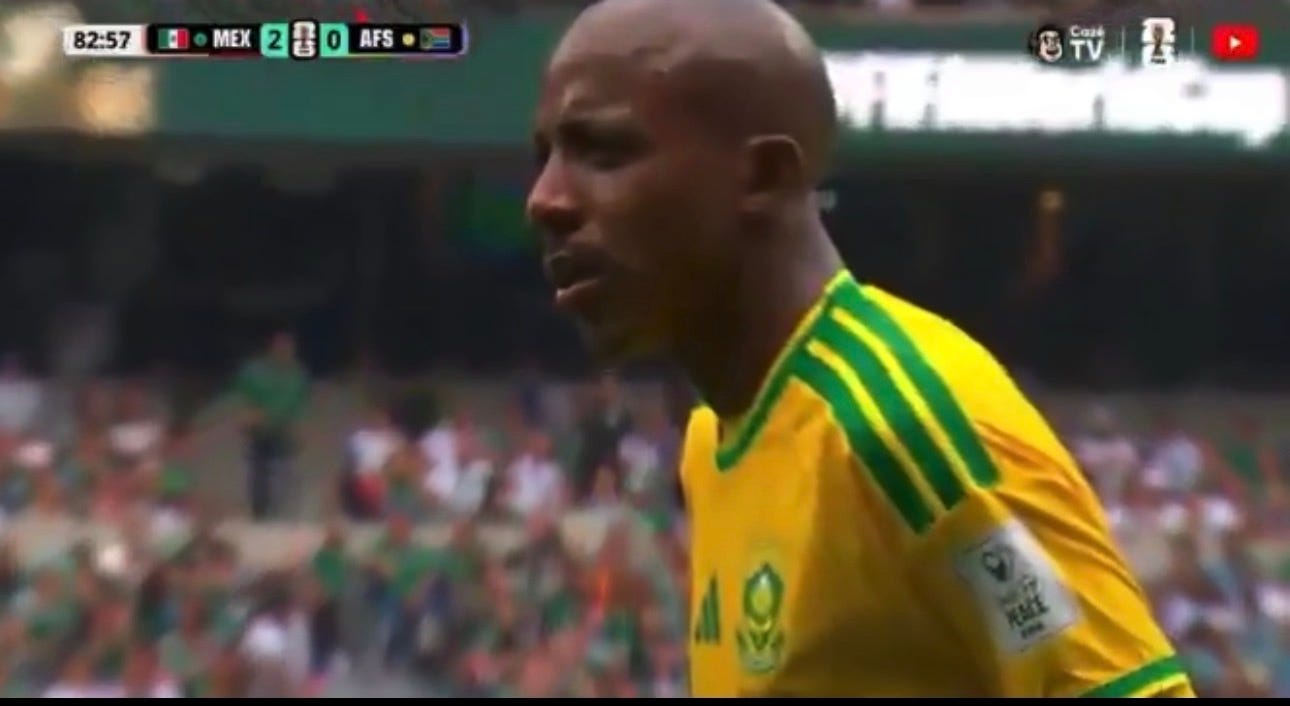
There is a reason why this clip is going viral now. After all, Sampaio himself has refereed at previous international fixtures, including matches at previous World Cups. So what’s changed?
Although FIFA operates in four official languages (English, Spanish, French and German) it does require all of its referees to speak English. As it happens, in previous World Cups there have been more Spanish-speaking teams, and even more Arabic-speaking teams, than English-speaking ones. But on the football field, as in so many other fields of the non-football variety, English is the dominant language for global communication. Whether rightly or wrongly, that’s a theme for another time.
So the use of English was always the case, not a one-off for this USA co-hosted World Cup. What’s changed are the rules around VAR decisions. Referees must now explain VAR decisions to the fans inside the stadium through a loudspeaker and in English. The idea is to be more transparent with fans in the stadium who were often not getting enough information about why certain calls were made.
So the irony is that Sampaio’s announcement about the VAR decision was meant to clarify the situation. It ended up doing the exact opposite, with everyone, including players, wondering what on earth the referee was saying.
Sampaio obviously must speak English relatively well or he wouldn’t have his job. But he’s probably not used to speaking publicly. Add the slight distortion of any loudspeaker and huge spaces, and his accent made what he was saying almost impossible to understand. Cue confusion and, I’m sorry to say, worldwide derision.
And now, here’s the thorny bit.
Is all of this fair? Aren’t people allowed to have foreign accents? Isn’t it enough that literally the whole world has to learn how to speak English to have a shot at the biggest roles in most professions? Do we also all have to have flawless accents?
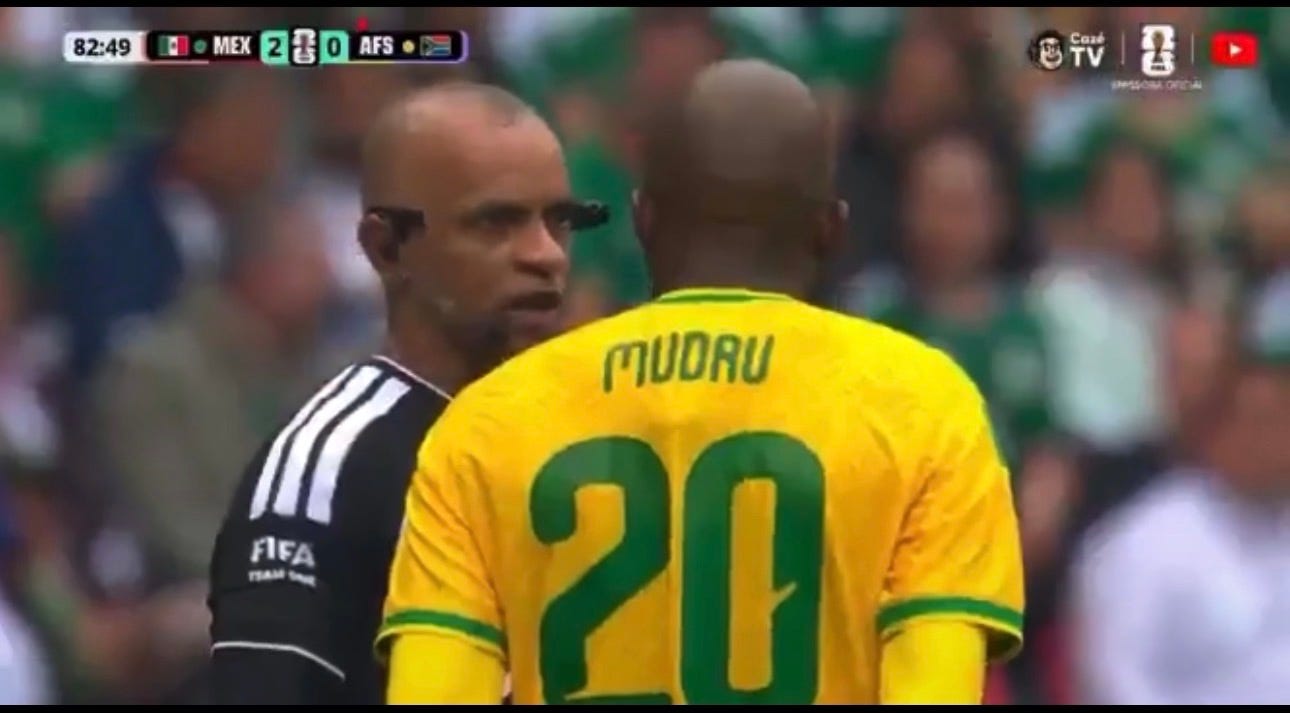
The truthful answer to that question (at the heart of many Substack posts I’ve written, like this and this, and here is why the issue is close to my heart) is both NO and YES. NO, you shouldn’t have to mimic a native speaker’s accent that you’ll probably never achieve and that would also end up negating your origins and authenticity.
But YES, your accent does matter. It’s true that everyone, technically speaking, has an accent. There is huge variation within the UK for example, and not all are clear if you’re not used to them. But accents that come from being second-language English often present added complications, to do with the different intonation, phonetics and diction that come from the mother tongue. It’s perfectly fine to sound different and distinctive, but the line between idiosyncratic and incomprehensible is, unfortunately, often a fine one. Clarity is non-negotiable if you want to be an effective communicator. And if you’re communicating as part of your profession, it’s up to you to make sure you’re as clear as possible, not up to others to strain to understand you.
The way we speak is a crucial part of who all of us are, so any kind of critique hits hard. Because of the discomfort around the issue, it’s often swept under the carpet and ignored until it flares up, though mercifully rarely as spectacularly as in the case of Wilton Sampaio. The Brazilian referee’s next World Cup game hasn’t yet been announced, but I bet he’ll be brushing up on his English skills before taking to the football field again.
I provide specific media and presenter training for second-language English speakers. For more info, click below.
Comments
Nothing yet. Say the first thing.
Sign in to join the conversation.