
This is the third and final post reflecting on the past year of writing on this platform. Rather than looking back, this one looks forward.
Across previous posts, there were ideas that surfaced but were not fully developed, and others that were missed entirely. I combined those gaps with an AI-assisted scan of current trends in AgeTech to outline a set of themes for the months ahead.
Each of these may unfold over one or more posts.
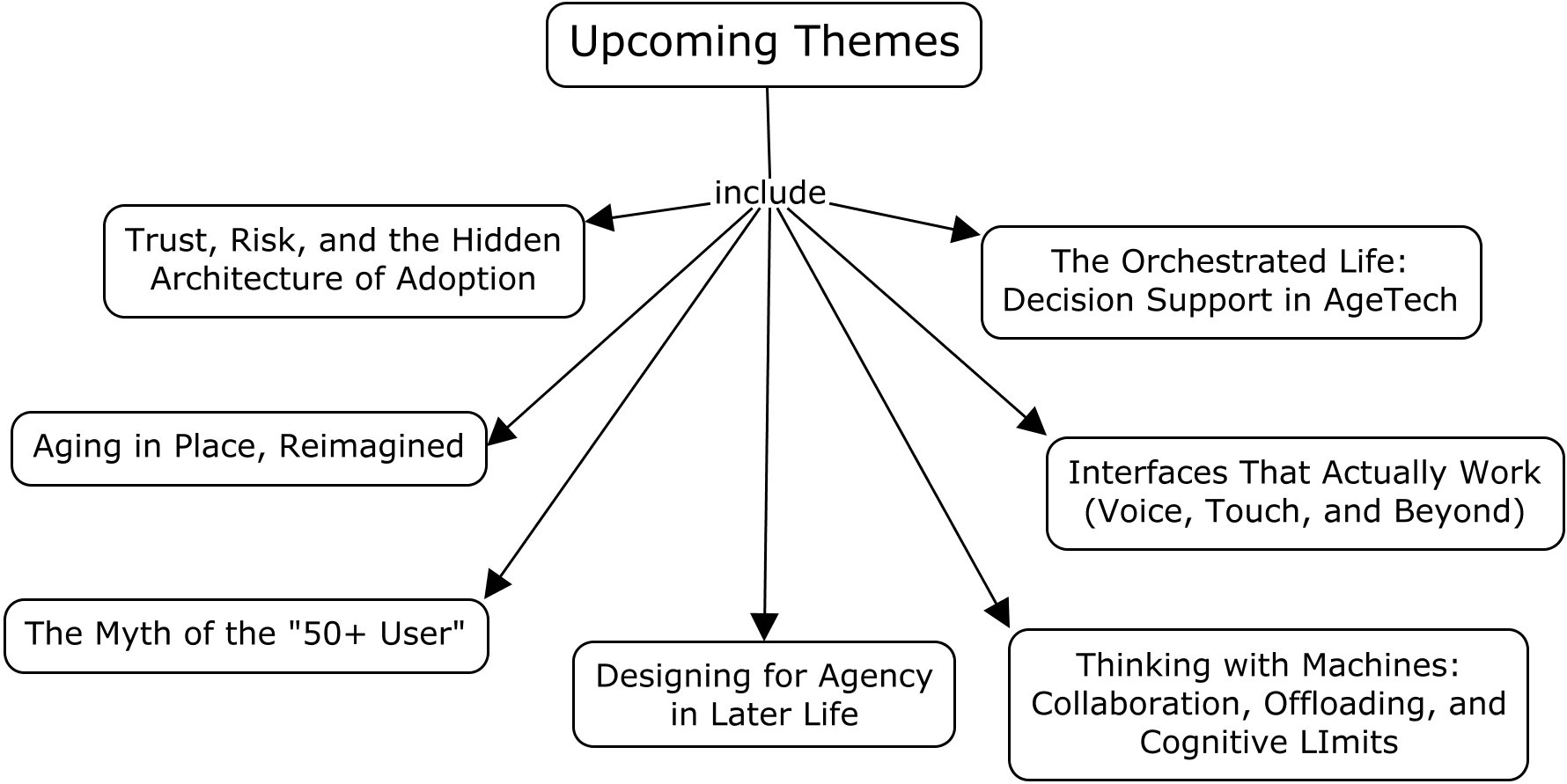
1. Designing for Agency in Later Life
How technology can extend or quietly erode an individual’s ability to act, decide, and self-direct over time.
Key question: What does it actually take to build systems that increase agency rather than replace it?
2. The Orchestrated Life: Decision Support in AgeTech
Moving from fragmented tools to integrated systems that help older adults make complex, cross-domain decisions.
Key question: Who or what is coordinating the decisions that matter most in later life?
3. Interfaces That Actually Work (Voice, Touch, and Beyond)
Rethinking the assumption that voice is the default interface for aging populations in a multimodal world.
Key question: What interaction models hold up under real-world cognitive, physical, and social conditions?
4. Thinking with Machines: Collaboration, Offloading, and Cognitive Limits
How AI reshapes human thinking from collaboration to delegation, and what that means for cognitive resilience in later life.
Key question: As we rely more on AI to think with us, what happens to the thinking we stop doing?
5. The Myth of the “50+ User”
Challenging the oversimplified segmentation of older adults and its consequences for design and adoption.
Key question: If the 50+ population is radically diverse, why are our products not?
6. Trust, Risk, and the Hidden Architecture of Adoption
Understanding how trust is built across systems, not just interfaces, in high-stakes AgeTech use cases.
Key question: What makes a system trustworthy enough to rely on when it actually matters?
7. Aging in Place, Reimagined
The evolution of “aging in place” from a preference to a technologically mediated ecosystem of care, monitoring, and services.
Key question: Are we designing homes for independence or for invisible supervision?
Taken together, these themes reflect a shift away from thinking about AgeTech as a collection of products and toward understanding it as a set of systems that shape capability, decision-making, and everyday life.
That shift, and its implications, will be the focus of what comes next.
Comments
Nothing yet. Say the first thing.
Sign in to join the conversation.