
This is the second post addressing the review/analysis of a year of writing short essays on this Substack.
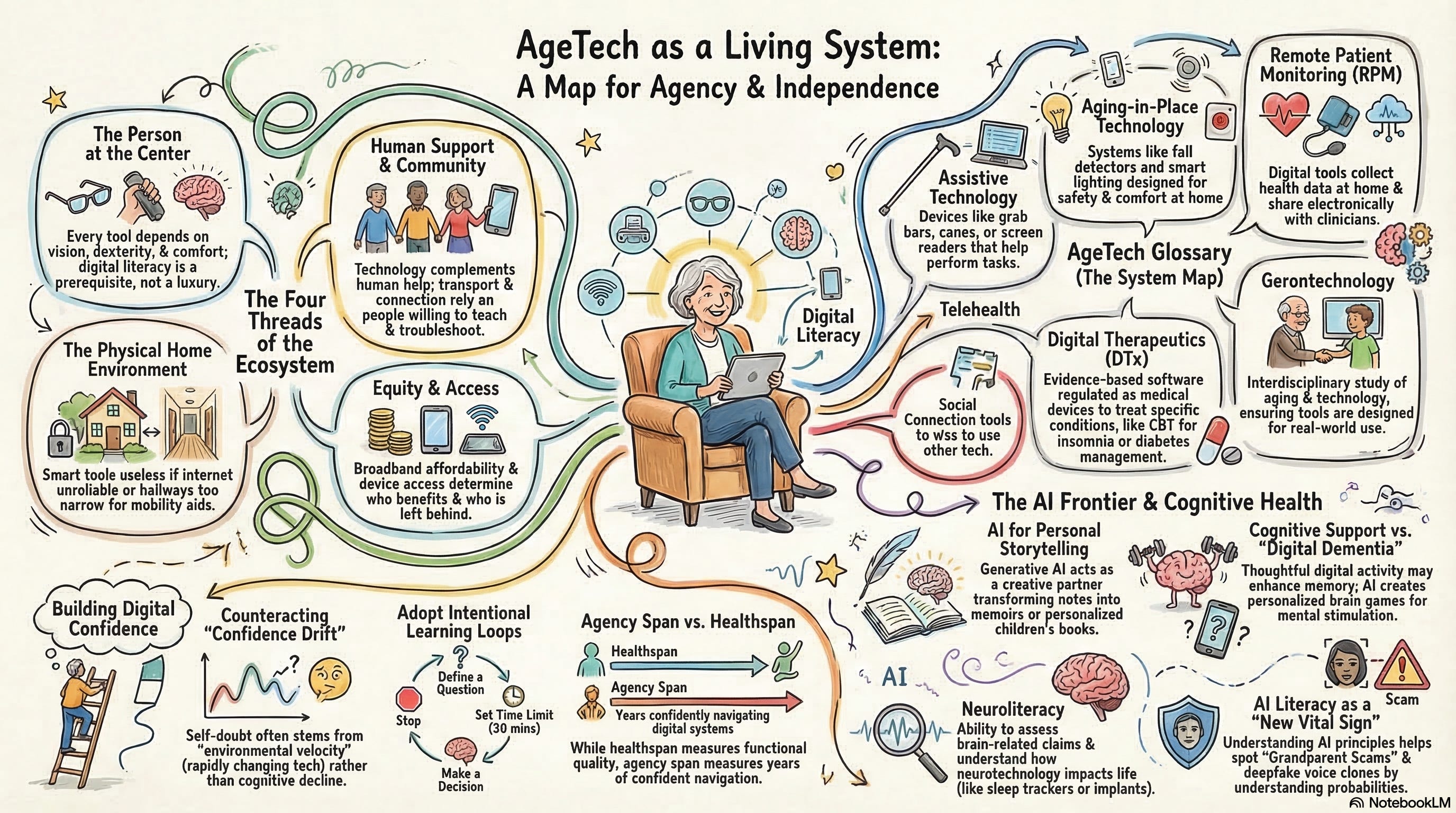
The concept of AgeTech as a living system shifts the focus from isolated tools to a set of interlocking conditions that determine whether those tools actually work in everyday life. Technology does not operate on its own. Its usefulness depends on how well it fits with the person, their home, their relationships, and the realities of their daily environment.
In practice, I see four threads that shape this system:
1. The Person at the Center
Every tool depends on the person using it. Vision, hearing, dexterity, health, and confidence all influence whether a device supports independence or becomes another source of frustration. In this context, digital literacy functions as a prerequisite, not an enhancement. Without it, even well-designed tools remain out of reach.
2. The Home Environment
The home sets the conditions for what technology can do. Mobility devices require space to move. Smart home systems depend on stable connectivity. If the environment is not already safe and functional, adding technology rarely compensates. It often exposes underlying constraints.
3. Human Support and Community
Technology extends human support. It does not replace it. People rely on others to introduce tools, troubleshoot problems, and build confidence over time. This includes family members, neighbors, volunteers, and local organizations. The presence or absence of this support often determines whether technology is adopted at all.
4. Equity and Access
Access shapes the entire system. Broadband, devices, pricing models, and usability all determine who benefits and who does not. A tool that cannot be afforded, understood, or maintained does not function as part of a supportive system.
Interconnectivity of the System
These threads do not operate independently. They reinforce or constrain one another:
Telehealth depends on digital literacy and connectivity.
Remote patient monitoring intersects with safety, cognition, and routine.
Smart home technologies are tied to mobility, layout, and infrastructure.
Social connection tools influence both mental health and willingness to engage with other technologies.
When something fails, it is rarely the device alone. It is usually a break somewhere in this system.
Thinking about AgeTech in this way changes the question. The goal is not to choose the right tool. It is to understand how the pieces fit together over time to support independence, dignity, and connection.
Comments
Nothing yet. Say the first thing.
Sign in to join the conversation.