
“As the office is attended with many unpleasant duties, gentlemen in these nicer times have shrunk from its performance and it has consequently fallen into disrepute; and too frequently into low indigent hands.”
John Ayrton Paris, Royal College of Physicians
In England and Wales, when a death presented as unnatural, it was the coroner’s duty to convene an inquest, made up of twelve to twenty-four men who were issued warrants to appear at a specified place and time. It was to occur as soon as possible after notification of the death. The inquests were often held alongside the investigations carried out by the police or magistrates (where there was no police presence).
The law required that it occur super visum corporis (upon viewing the body). When an inquest was convened, this was their first order of business. If the body was not viewed, the inquest was voided and any investigation had to stop. There was no formal area to view the deceased; often the jury was taken to where the body had been laid out on their bed. Equally, it was put on public display where the inquest was taking place, on a table for everyone to see. (Even in the days before refrigeration which must have added a macabre element to the proceedings.) Juries were required to examine the body, to look for signs of violence or poisoning, not simply have a quick gander and leave.
When completed, the jury gathered to hear testimony from everyone who had anything relevant to say, including any witnesses to the death. Circumstantial as well as physical evidence was given, with each bearing equal weight. The coroner, jury, and the accused were allowed to question those who gave testimony. In 1833, Coroner Charles Carttar, informed the accused, John Bodle, that “if you think proper, you may put any questions to the witnesses. You are not obliged to say anything to criminate yourself. Recollect that what you say will be taken down and, if necessary, used in evidence against you.” (Hempel, Inheritor’s Powder, 93).
Verdicts could come down quickly, with some juries taking only five to ten minutes to deliberate before giving their decision. In Scotland, they had three choices: guilty (to be held over for trial), innocent (to be released), or not proven. This last one was in situations where they suspected the defendant was guilty, but the prosecution had not made an adequate case against them.
Inquests were held in pubs. This practice grew from the belief that they should be open to all who wished to attend. That meant the venue had to be of sufficient size to contain coroner, defendant, jury, and spectators, as well as known and accessible to all. It wasn’t until the final years of the 1800s that municipal institutions or courtrooms were employed. In some rural areas, it wasn’t until the 1920s that inquests were finally relocated out of the local drinking establishment.
When I say “coroner’s inquest” you likely conjure an austere image of civility and reverence, a dignified gathering of respected, law-abiding men keen to see justice done. Weighing truth against fiction, listening intently for inconsistencies, and posing questions to clarify any confusion or omission, to ensure that the innocent went free and the guilty were sent to trial to answer for their crimes.
You would be wrong.
Coroners inquests were “spectator sports” for communities starved for entertainment, diversion, and not to mention scandal. They provided sordid conversation in the weeks that followed.
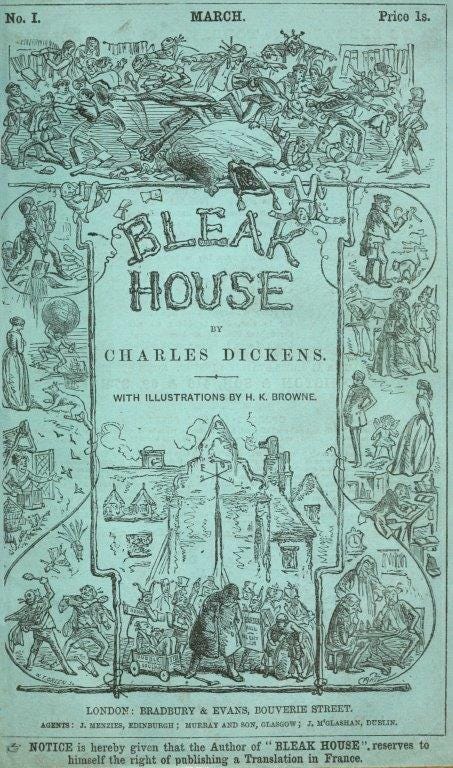
In the spirit of art reflecting life, Charles Dickens’ Bleak House, offers a wonderful, and sadly accurate, portrayal of both coroners and the inquests they convened. Dickens’ coroner (who is not given a name) is described as a man who “frequents more public houses than any man alive.” In Bleak House, the inquest is convened at the Sol’s Arms where the “smell of sawdust, beer tobacco smoke and spirits is inseparable in his vocation from death in its most awful shape.” During the proceedings, the coroner had to shout to make himself heard over the rowdy crowd whose attention is divided between the inquest and playing at skittles (a game that resembles nine-pin bowling). If you’re looking for a model, it’s difficult to do better than this one.
On occasion, the rambunctiousness of participants went beyond shouts and jeers. In the 1829 inquest into the death of Catherine Cashin, a drunken juryman interrupted the proceedings. As one report stated, his “conduct so boisterous as to distress the witness exceedingly and to put a stop for a time to the solemn investigation.” After a brief pause, the coroner tried to continue the proceedings only to be interrupted by Catherine’s brother-in-law.
He demanded that the man be removed since he was in no fit state to perform his duties. The drunken juryman took offence and became noisier and more difficult to control which made his eviction inevitable. It took multiple men almost 15 minutes to overpower him and drag him from the pub. (Hempel, Inheritors Powder, 86)
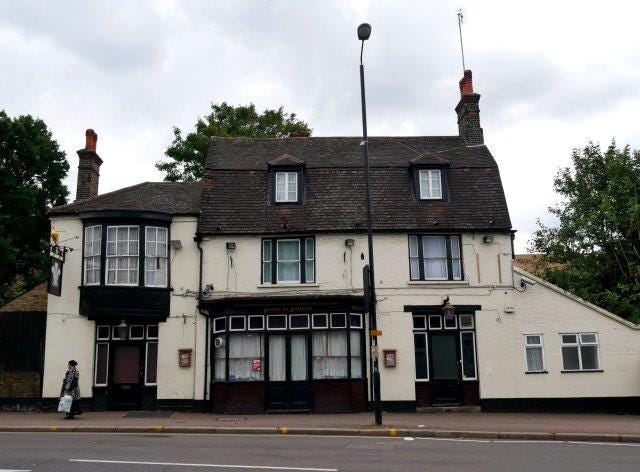
(Photo: Plume of Feathers where the famous George Bodle murder inquest took place in 1833.)
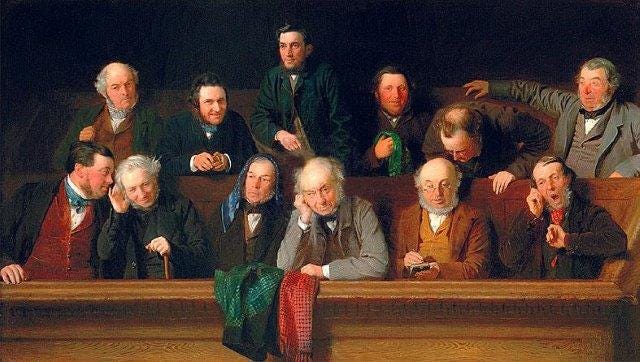
Fighting wasn’t the only drama, or entertainment (depending on your perspective), that could occur at a coroner’s jury. In cases of poison, the symptoms experienced by the victim prior to death and the condition of the internal organs during the autopsy were important in proving the cause of death. That made descriptions of such unpalatable aspects a necessity. Not every juror (coroner’s and criminal trial jury) had the stomach for it. In the 1859 trail of Dr. Thomas Smethurst for the murder of Miss Isabella Bankes, the details were too much for the foreman of the jury. He fainted. He was taken outside, to the fresh air, and he remained there until he had recovered enough to rejoin the proceedings.
Before we judge him too harshly, it is reported that when Gustave Flaubert wrote his description of Madame Bovary’s suicide, he threw up his dinner on, at least, two separate evenings. (Whorton, Century of Arsenic, 121)
(Painting: The Jury, by John Morgan)
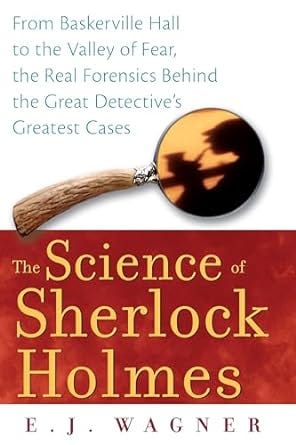
The Science of Sherlock Holmes, by E. J. Wagner
A short while ago, I received an email from Kim Taylor Blakemore (best-selling
author of After Alice Fell and The Deception; (https://www.kimtaylorblakemore.com) recommending a book. It happened that it was one of the first books I had read when I started this trek into the darker side of the nineteenth century. Her glowing words got me thinking that I should make others aware of its existence and value. So, before I delve into what I think of the book: Thanks Kim!
The book is E. J. Wagner’s, The Science of Sherlock Holmes and it is an excellent resource. There is a nice breadth to the forensics topics covered which makes it a good reference book for your shelves. Each chapter is a different theme, beginning with “Dialogue with the Dead” then moving on to subjects including disguises, ballistics, poison, and blood work.
Every aspect is tied back to one of Sherlock Holmes’s mysteries and she discusses how Conan Doyle fit current knowledge and science into his stories. Sometimes, going beyond what the police of the time were doing, for example the analysis of typewriters.
But Wagner goes beyond this. She interweaves Holmes with actual cases, showing how they complement or contradict each other. Some of the cases are famous, including the murder of Lizzie Borden’s parents where Wagner discusses the blood analysis employed by the police.
Of equal value to authors, she places the actions of police, scientists, and other law enforcement agents into their social context. Reputation, status, fear of scandal, all have a place in her explanation as to what was done. She not only tells us what; she tells us why. This helps authors create the scene and the characters. Social context is an aspect that doesn’t always make it into books about the history of crime.
There are gems of information that can enrich a story. Going back to the Borden case, it was here that I learned Mr. Borden’s autopsy took place on the dining room table.
There is so much you can take away from this book to enrich your fiction.
I think it’s obvious that there are many things I like about The Science of Sherlock Holmes, but what I particularly like is its style. This reads like a narrative rather than a textbook, or something intended solely to inform. It entertains as much as it intrigues and educates.
Mud. Everywhere. As someone who does a lot of walking through parks, this is an annoyance in life as well as in popular historical fiction. It doesn’t happen in every depiction of the nineteenth century, but it crops up enough that it’s made its way into my consciousness. There seems to be this idea that, prior to our century, the natural state of the earth was muddy. Streets. Muddy. Forecourts. Muddy. Paths. Muddy. Everything. Muddy.
I recall a TV series set in the American Midwest (maybe the Badlands, but can’t recall for certain). This is an area whose climate is semiarid, so mud is something they don’t experience often. But episodes showed people in the area where they were setting up living tents ankle-deep in mud. I don’t know if they are using this to create the appearance of hardship or if they think that mud is formed when lots of people walk over a patch of land. Or if they aren’t thinking at all and it has become a knee-jerk reaction to a historical setting. “Darn it, man, it’s the seventeen hundreds, there has to be mud!” And there was mud in the 1700s, but only after it rained, or the snow melted, or a bunch of people tossed a lot of water onto the dirt.
Keep in mind, not all mud is created equally. Before you describe their shoes as caked with mud, make certain that the mud actually will cake. In Bellville, (where I lived for a bit and spent far too much time running through the farmers’ fields around us) the land has a lot of clay in it. You couldn’t walk very far in the mud before you had to knock it off your shoes. Your feet got too heavy and cumbersome and sometimes, your shoe stayed in the mud while your foot moved on to the next step. But in North Bay, you don’t have that problem. You just get your shoes wet and the mud doesn’t build up on the shoes your mother told you to keep clean or else.
This issue we’re returning to my friend Eugène François Vidocq (nineteenth-century criminal and head and founder of the Sûreté nationale). There are so many fun and odd phrases in his Mémoires, I couldn’t stay away forever. The terms are taken from the 1859 edition published in Philadelphia. Except for the first one, each of these sayings was explained in the edition for its American audience. I have taken the core definition from there, and expanded, where possible, in other dictionary sources.
Blow the gaff: (colloquial; used through 19th century, British) To reveal a secret especially in a public way; usually referring to criminal activity.
Prigging lay: (colloquial; used through the 19th century, British) thieving business (prigs were pickpockets)
College chum: fellow prisoner. Chum was originally seventeenth-century slang from Oxford University and denoted a room-mate. In the Victorian era, it was expanded to include a fellow prisoner.
No posts
Comments
Nothing yet. Say the first thing.
Sign in to join the conversation.