
An idea floated around Europe in the 1800s. If you could expel those individuals predisposed to crime (aka recidivists/repeat offenders), the result would be a crime-free utopia. That was the logic behind Transportation.
This is the era when gentlemen scientists categorized and catalogued everything from insects to people. That criminals could be scientifically identified gained popularity from about the middle of the century. A great many scientists believed that criminal tendencies were inherited and, therefore, should have some outward indicator. Shape of the ear, spacing of the eyes, angle of the nose. One of the first intense studies of fingerprints in the nineteenth century was in search of the illusive trait which betrayed a person’s criminal predilections.
Others took a more practical approach: determining upon arrest if the individual was a repeat offender. But no criminal went to prison with the same name. Through most of the century, the best identifiers of recidivists were prison guards, which is why many convicts did what they could to serve each term in a different prison
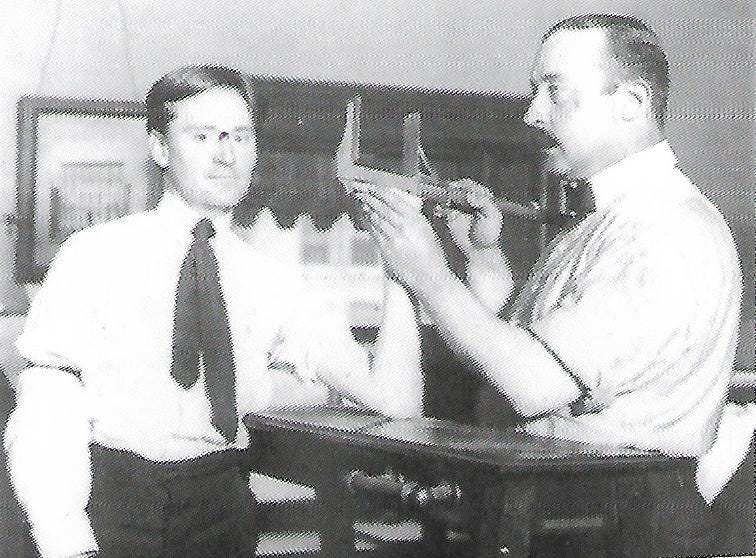
The first successful solution to the identification of recidivists arrived in the 1800s and was created by a police clerk who was the son of a statistician and anthropologist.
Born in 1835, Alphonse Bertillon was a poor student and seemed destined for mediocrity. His father used his influence and social connections in 1879 to get his son a job as a clerk in the Paris police. Bertillon’s days were spent filing a wealth of information about people who had been arrested; it was stored away and never used because there was no efficient system of retrieval. He decided to build his own system.
He recalled discussions at his father’s house about the theories of Belgian statistician Lambert Adolphe Jacques Quetelet who claimed that no two individuals were exactly the same size in all their measurements. The odds were placed at one in 286 million. Bertillon based his system on the measuring of body parts, aka anthropometry.
He sent a proposal to his superiors in 1879 and was summarily rejected. In 1882, his father stepped in (again), and Bertillon was granted funding for two assistants, and given three months to prove his system worked.
In true Hollywood fashion, success came during the final week of his trial period. Bertillon proved that a recent convict who gave the name Monsieur DuPont upon his arrest was, in fact, Monsieur Martin, a man who had already served time in prison. In 1884 Bertillon’s system allowed police to identify 241 recidivists, and in 1888, the Department of Judicial Identity was created with Bertillon was made its director.
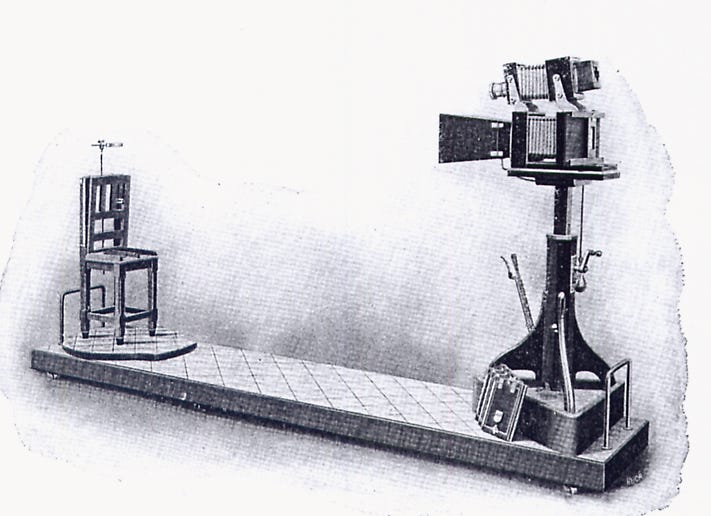
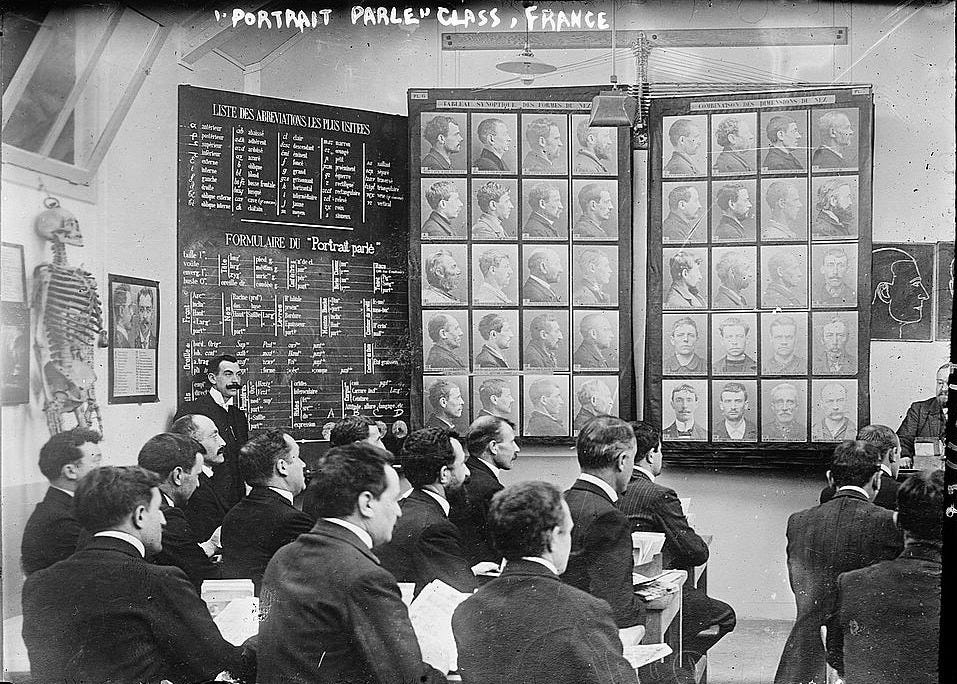
It was a card-based system (of which, eventually, there would be over 120,000 in Paris alone). The card contained a detailed description of the individual (including eye color which photographs could not). The anthropometry part involved eleven measurements of parts of the body which Bertillon (and others) believed never changed. These included length and width of the head, length of the left middle finger, left foot, and left forearm from elbow to the extended middle finger. It also included a photograph which was placed in the center of the card. It became the model for the traditional mug shot. He insisted that two photographs be taken: one from the front, and one in profile. Bertillon believed that the profile did not change and could not be disguised by moustaches/beards making it a better reference image. And, he believed that ears did not change from birth, and set about identifying 800 possible shapes and aspects of the human ear.
This system (which was also used to identify corpses) became known as Bertillonage and, eventually, spread across the globe. Illinois State Penitentiary adopted it in 1887, Scotland Yard in 1895, New York in 1897. By 1899 Germany, Belgium, Spain, Italy, the Netherlands, Russia, Sweden, Norway, Turkey, Monaco, Luxembourg, Romania, Switzerland, most of South America, and Tunisia had adopted some form of Bertillonage. Even Sherlock Holmes “spoke” well of the system.
One reason for the success was the efficiency and swiftness with which the cards could be retrieved. This was because Bertillon created a straight-forward system of classification and cross referencing. When an individual was arrested, police knew exactly where to look for a card.
Though it met with success, it was not long before its weaknesses were exposed, and there were many. It was discovered that two individuals could share the same measurements. The most famous case is that from Kansas in 1903 when Will West was incarcerated at the same time as William West and the measurements on their cards were identical. Worse, those parts of the body believed to be consistent throughout a lifetime actually changed with age.
Other shortcomings were that it could only be used on adults; the calipers, gauges, and rulers used tended to bend and become misaligned; officers were inconsistent in their use of the equipment which produced different measurements (some applied more pressure than others); it was labor intensive and time-consuming; it could not identify an unknown perpetrator, only individuals who had been convicted of a crime; it required a lot of training; and, criminals found ways to manipulate the measurements. Perhaps the greatest weakness was that it required perfection on the part of the police officer doing the measuring. “The minutest of mistakes could render the record worthless.” (Oller, Rogues Gallery, p. 241)
In New York, anthropometry lasted only fifteen years. Toronto Police did not abandon Bertillonage until 1914, and was one of the last police services in the world to change to fingerprints.
All that remains of Bertillon’s system is the format of the modern mug shot.
Want to learn more about forensics in the early twentieth century? I will be speaking to the South East chapter of the Crime Writers of America on Monday, July 13.
No posts
Comments
Nothing yet. Say the first thing.
Sign in to join the conversation.