
Is it not astonishing that while there have existed from time immemorial, under the name of Hippology, special marks for the precise description for the shape and colour of the horse, there has never existed until the present time, so far as we know, a methodical treatise on human description?” Alphonse Bertillon
Systems to identify criminals existed prior to Alphonse Bertillon’s (pronounced Bertiyohn) creation, but his was the first to succeed. Rather than using the “traditional” descriptions which were vague and subjective (words such as large, normal, medium, average, regular), he created a system of description which he referred to as “morphological vocabulary.” Lips could be pouting, or thin, or “lower lip prominent,” while facial wrinkles might be “horizontal on the forehead,” “horizontal fold at the root of the nose,” or crow’s feet. Distinctive marks were described, but they were also measured using a recognizable reference point. For example, distance from the left corner of the mouth. The intention was to create a description so detailed that a photograph was not necessary for the individual to be recognized. Bertillon referred to his cards as “speaking pictures.”
Bertillon expanded the number of features to be described. A card could have up to 243 categories. Information included birth place, occupation, general demeanor, attitude, voice, language, habiliments (clothing, dress, or specific occupational garments). Physical features included eyes, eyebrows, eyeball, and orbit, ears, forehead, general contour of head, chin, nose, mouth, lips, hair color, beard, hair growth pattern, neck, inclination of shoulders, build, skin color, ethnicity, and physiognomic expression (look or shape of a person’s face to determine inner character).
To ensure consistency, compilations were distributed showing a picture of the physical feature and, beneath it, the word which should be used to describe it.
The sheer quantity of information collected made this a prolonged process, made longer, and more labor-intensive, when the measurements were taken; a task often requiring at least two individuals to force cooperation on the criminals being processed.
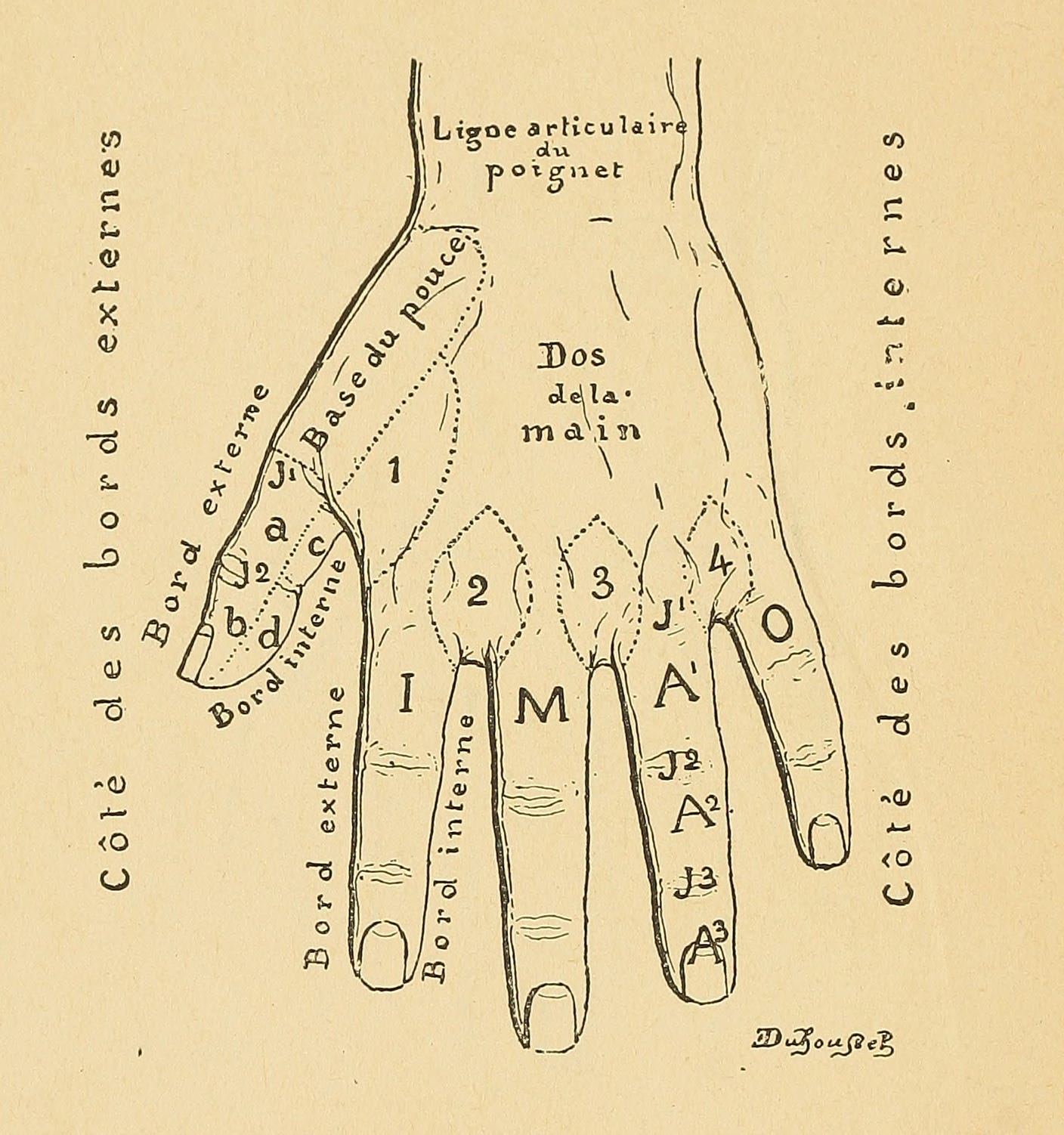
The recording of anthropometric measurements was an elaborate dance, in which the movements of both operator and prisoner had been strictly choreographed by Bertillon himself. All this rigorous discipline was aimed at preventing inconsistent positioning of the body from producing discrepancies in measurement. Simon Cole. Suspect Identities
There were up to 25 measurements, but the five primary ones were: width of head, and the length of the head along with the length of the left middle finger, foot, and forearm from elbow to extended left middle finger. Other measurements included height, nose, right ear, chin, teeth, and width of forehead.
Fingerprints were included in 1894, but only for four fingers. The entire ten were not taken until 1904. This meant it was no longer necessary to have an entire person, or even a suspect, to obtain an identification. You only needed a fingerprint and a bertillonage card.
In Cleveland in 1936, a severed arm was discovered behind Mr. Charles Page’s shop. The coroner, Pearse, was able to identify the victim by taking a thumbprint and giving it to Officer George Koestle who was able to match it to an existing Bertillonage card and provide investigators with an identification.
The failure to include all fingers proved an embarrassing shortcoming, and one that did great damage to Bertillon’s system. In 1910, Vincenzo Perugia stole the Mona Lisa and left behind a perfect thumbprint on the glass case. Perugia had been arrested previously and police had a bertillonage card in their “system.” The arrest should have been immediate. Except, the thumbprint left on the glass case came from his left hand while the thumbprint on file was from his right.
Two photographs are prominent on the cards and these became the basis for the modern mug shot: one from the front and the other from the right side. Bertillon insisted on the second one believing that the profile changed less with age, weight loss/gain, and could not be altered on men with the addition/removal of facial hair. He also believed that the ear was unique to each person and that it did not change through a person’s life.
Photographs were taken under special conditions so that all the “mug shots” were identical in lighting and style, but also to ensure that successive photographs of the same individual were similar enough that they could be accurately and easily compared with each other.
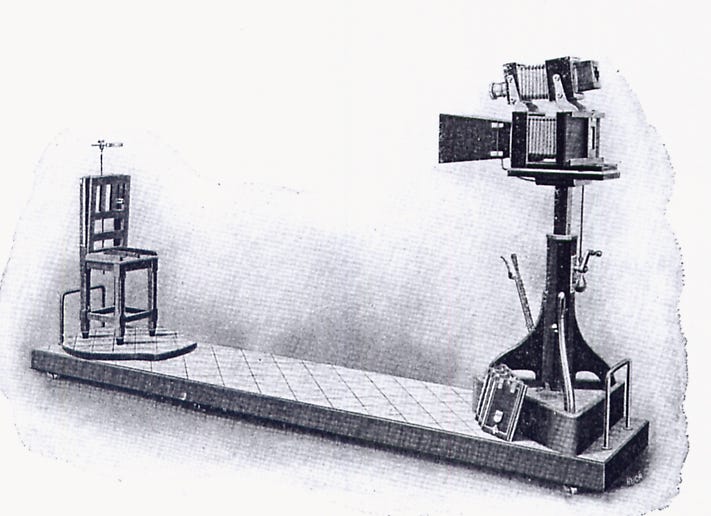
Photography was not what it is today. In the 1800s, the subject was required to remain entirely still for an extended period of time. Criminals were not inclined to cooperate. Often, they had to be restrained by a number of police officers to keep them in place. A special photographic contraption was created. It included a rod nailed to the back of a chair (which was nailed to the “floor” of the contraption), which fastened to a circlet into which the prisoner’s head was placed. The camera was also securely fixed to the “floor” to ensure that every photograph was taken from exactly the same angle and distance; something which had not been done before.
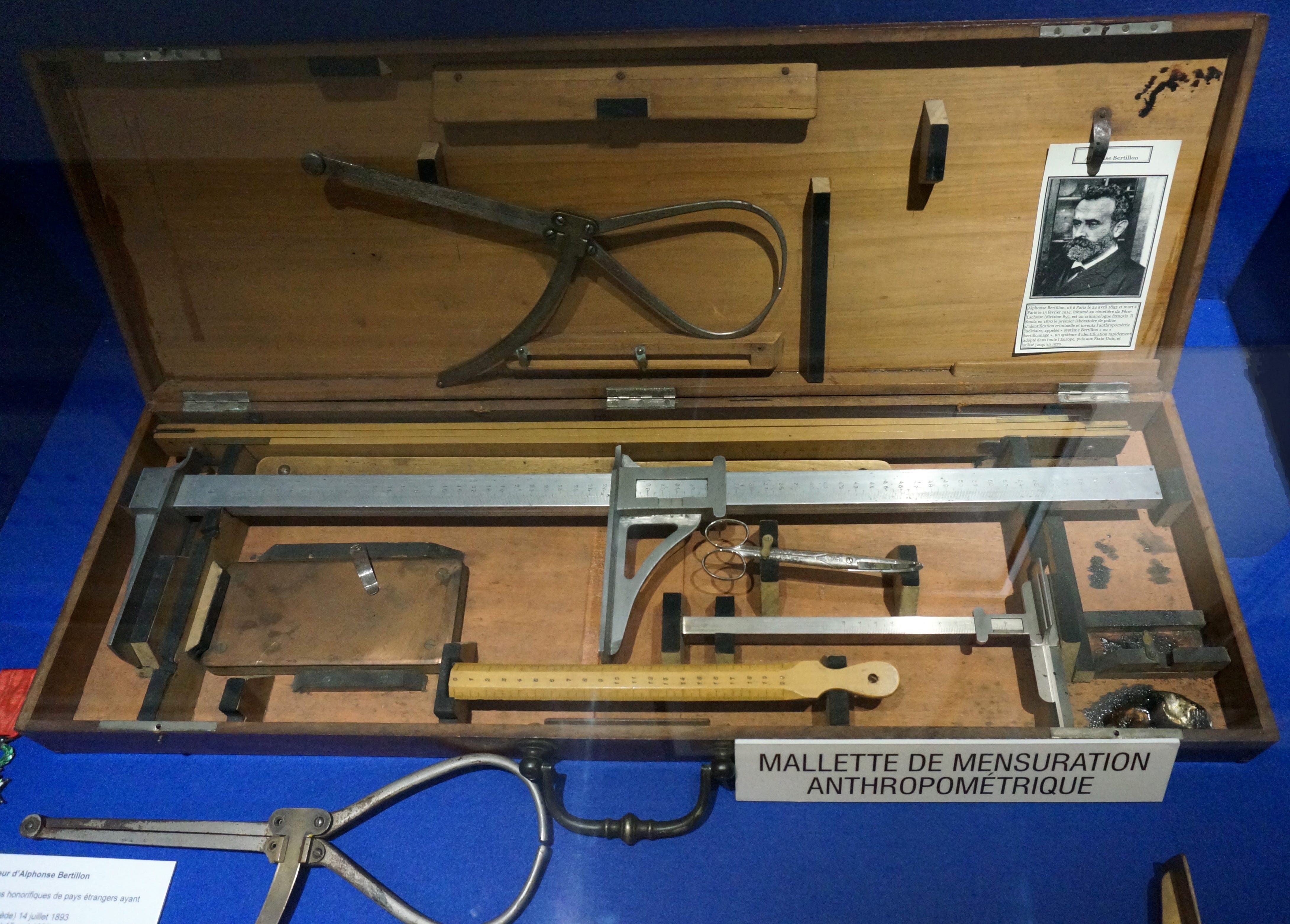
The exact order of compiling could vary but all consisted of: a precise description of the prisoner, with particular emphasis on the ear; any unique, or “peculiar” markings on the face or body; photographs were taken; measurements were made using calipers, gauges, and rulers, each taken three times and the number listed on the card was the average. Criminals would crunch up their toes, or stoop, keep their shoes on, or did not fully extend their fingers to corrupt the measurements.
One shortfall of the system was when women were arrested. Most officers trained in measuring prisoners were men. Such intimate touching was not considered proper on a woman. Matrons were present and might be recruited to participate in the process without formal training.
As noted above, the storage system was a significant reason for its success. One of the difficulties of using photographs or fingerprints alone as a system of identification was the difficulty retrieving the information. This came down to classification. Neither photographs nor fingerprints had a clear system by which to catalogue and retrieve them. Without such a system, every photograph/fingerprint would have to be looked at as each individual was arrested.
Multiple copies of each bertillon card were made with one filed alphabetically according to the name given. Another was filed according to measurements of length and breadth of the head and length of the middle finger. With the system based upon measurements and not visual features, a starting point was possible which eliminated the majority of cards, and the cross-referencing allowed them to find the card they needed quickly. One of the many reasons that fingerprints replaced anthropometry was the invention of a system to categorize fingerprints which allowed them to be retrieved almost as quickly as Bertillon’s cards.
For more information about historical crime and policing check out my LinkTree account Here.
No posts
Comments
Nothing yet. Say the first thing.
Sign in to join the conversation.