
Quick personal update before we start:
I’m a product designer by day, freelancer on the side and I kept noticing that every freelancer I know (myself included) runs their business across a mess of apps. Invoices in one tool. Clients tracked in another. Payment follow-ups happening over email. Contracts sitting in a folder nobody remembers the name of.
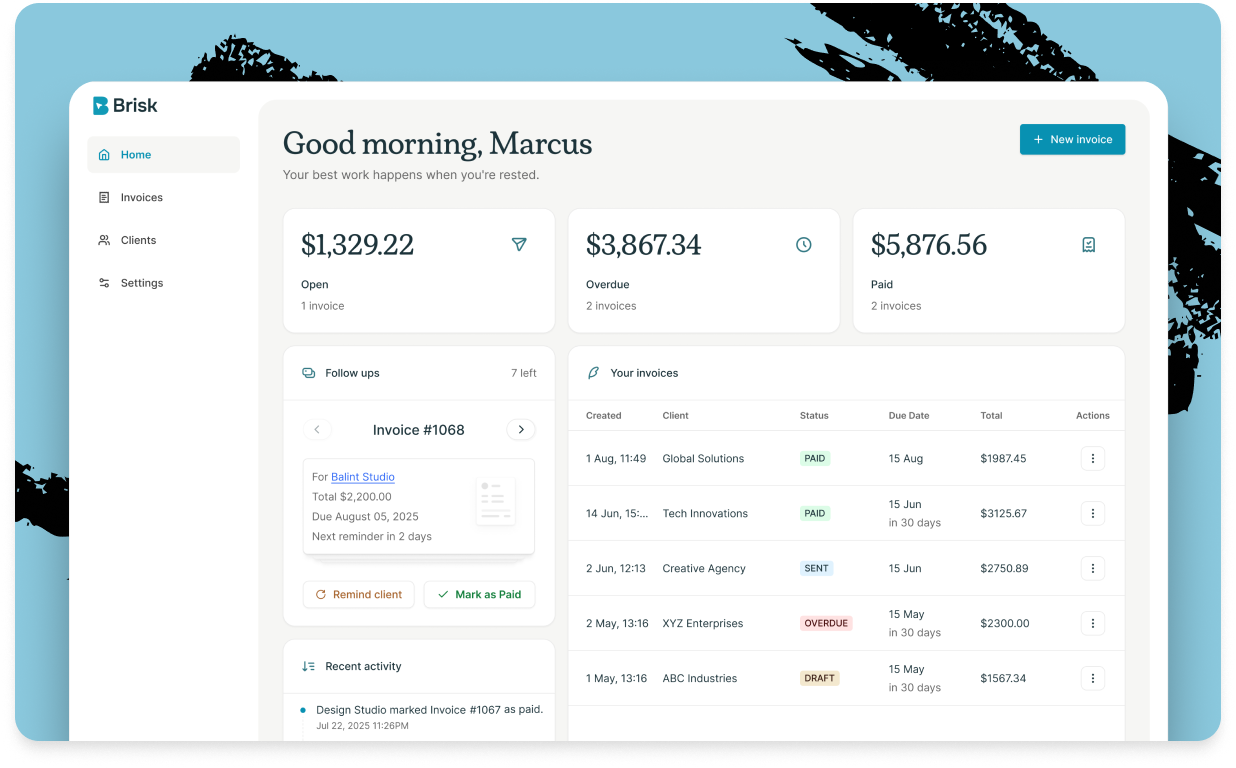
For the past few months I’ve been building a workspace for freelancers called Brisk.
It starts with invoicing and automatic payment reminders with contracts and proposals coming next.
The public launch is April 14, but I wanted you to have it before that.
Ok, deep breath, back to our regular newsletter issue.

I spent my first few years as a designer getting really good at the craft.
Spacing, typography, interaction patterns, component architecture. I could open a Figma file and make almost anything look right.
That got me hired, but it didn’t get me promoted.
The thing that changed my trajectory was learning the stuff nobody teaches in design courses:
How to present work without making stakeholders defensive.
How to say “I think this is the wrong feature to build” in a way that gets heard instead of ignored.
How to give feedback that makes another designer’s work better without making them feel bad.
How to write a one-paragraph summary of a complex problem that a VP can understand in 30 seconds.
None of that is in the job description. All of it determines how far you go.
The communication gap
When I talk to designers who feel stuck in their career, the pattern is almost always the same. Their work is good. Their portfolios are clean. They know the tools, but they can’t articulate why their design decisions matter in business terms.
“I redesigned the onboarding flow” doesn’t move a conversation in a leadership meeting.
“Onboarding drop-off was 40%, I identified three friction points and reduced it to 22%” does.
Same work. Different language. Completely different career outcome.
The designers who advance fastest learn to translate. They speak design with their team and business with their stakeholders. They don’t dumb down their work. They frame it in terms that connect to what the company cares about.
I noticed this shift in my own career around year four. I started sitting in meetings where the conversations were about revenue, retention, and quarterly targets.
The designers who could connect their work to those numbers had influence.
The ones who could only talk about spacing and visual hierarchy were treated like a service department.
Both groups were equally talented, only one group had a voice in product decisions.
Feedback as a skill
Giving feedback is something most designers do poorly for years before getting good at it. The default mode is either too gentle (saying “this is nice” when you see problems) or too blunt (pointing out issues without acknowledging what works).
The version that actually helps is specific and grounded:
“This flow works well for the happy path. I’m wondering what happens when the user doesn’t have any data yet. The empty state might need its own design.”
That gives the other designer something concrete to act on without making them feel like they failed.
Receiving feedback is just as important and just as hard.
The instinct when someone critiques your work is to defend it. To explain why you made the choices you made, but if you’re explaining before you’ve fully listened, you’re not receiving feedback, you’re kinda blocking it.
I’ve gotten better feedback from peers who were honest with me early than from managers who waited until the review to mention problems.
Being direct with people while respecting their work is a skill that takes practice and pays for itself constantly and being able to hear direct feedback without getting defensive is the other half of that skill.
Writing matters more than you think
I spend more time writing than I expected when I started my career.
Slack messages, design briefs, project summaries, feedback notes, presentation scripts.
The ability to write clearly and concisely is probably the most underrated skill in product design.
A well-written one-paragraph problem statement saves hours of alignment meetings.
A clear annotation in Figma prevents implementation mistakes.
A concise Slack message gets a faster response than a wall of text.
I tested this recently. I sent a Slack message to a PM that was four paragraphs long explaining a design decision. No response for two days.
I rewrote it as two sentences with a link to the Figma file. Response in 20 minutes. Same information. The short version got read. The long version got bookmarked and forgotten.
If you’re a designer who can write well, you’ll spend less time in meetings, fewer rounds on revisions, and less energy cleaning up misunderstandings.
Every other soft skill gets easier when your writing is clear.
Presenting without hiding
There’s another soft skill that’s connected to all of this: presenting your reasoning, not just your screens.
Most designers open a design review by sharing their screen and clicking through a prototype.
The feedback they get is surface-level:
“Can we try a different blue?”
“What if the button was bigger?”
The designers who get better feedback present differently.
They start with the problem and they share what they learned. They explain the tradeoffs they considered and after they show the design. By the time the room sees pixels, everyone already understands the logic behind the decisions.
This changes the quality of the conversation completely because instead of opinions about colors, you get questions about the approach.
Instead of “I don’t like this” you get “have you considered this scenario?”
That’s feedback you can actually use.
What this means practically
If you’re early in your career, keep building your craft.
You need that foundation, but start investing in the soft parts now, even in small ways.
Practice presenting your work out loud before the actual review.
Write down your reasoning before showing screens.
Ask for feedback on your communication, not just your designs.
Pay attention to how the designers you admire talk about their work in meetings.
Notice what they say before they show the screens.
The craft gets you in the room, but the soft parts determine what happens once you’re there and as you advance in your career, the ratio shifts.
The most senior designers I know spend maybe 20% of their time in Figma.
The other 80% is communication, alignment, mentoring, and decision-making.
The sooner you start building those skills, the less jarring that transition feels when it comes.
Thanks for reading :) If something in this issue resonated, please reply and tell me.
Even one line. These replies are my favorite part of writing this newsletter.
See you next Thursday 🙌
— Balint
What else am I working on?
1. Brisk - I’m building a client platform for freelancers. If you’re one, check it out.
2. The Psychology Behind Design - Learn how to design products that engage using psychology tactics explained from 28+ key principles, grab the free version.

No posts
Comments
Nothing yet. Say the first thing.
Sign in to join the conversation.