
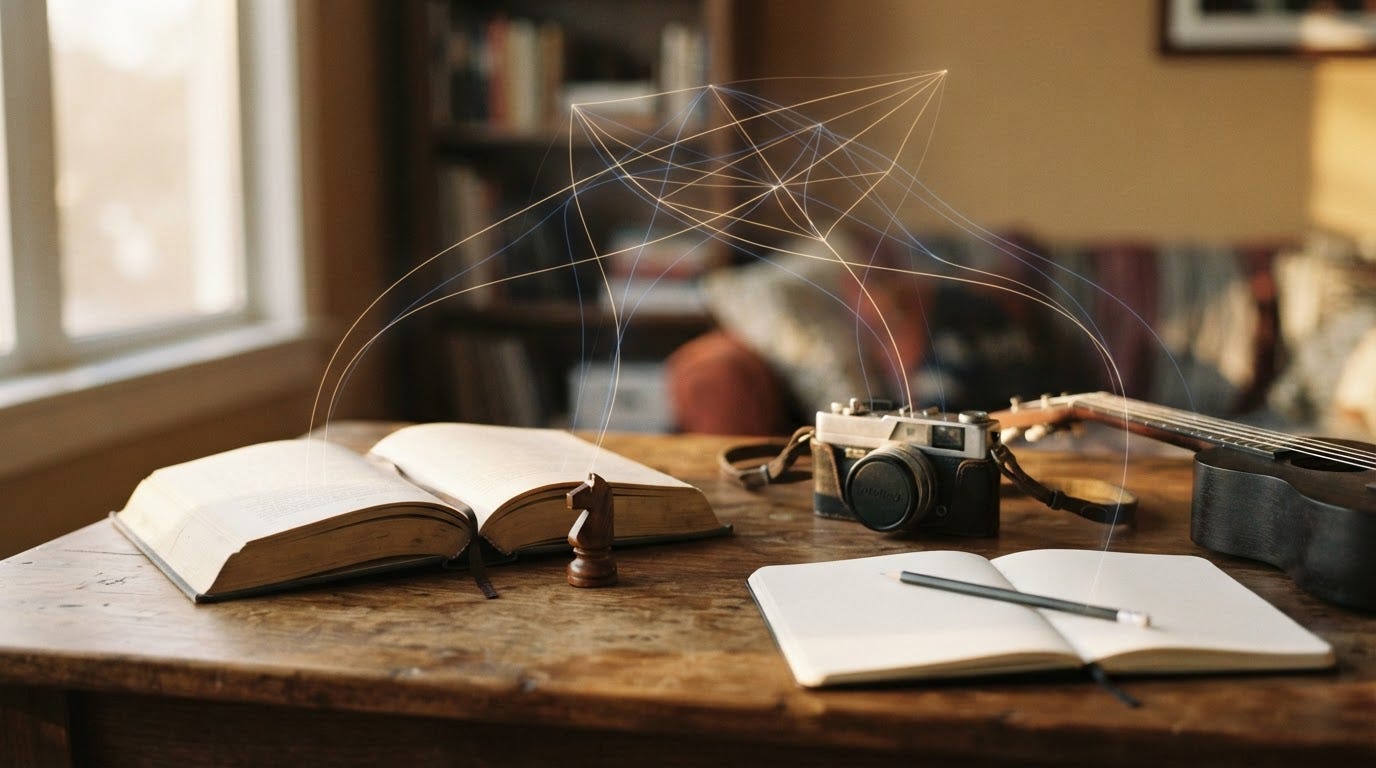
There is something strange about hobbies.
We usually think of them as the part of life that does not count.
Work counts. School counts. Exercise counts. Responsibilities count. The things that make money, build a career, or produce an obvious result are easy to defend.
But spending an hour reading a novel, taking photos, playing chess, cooking slowly, learning an instrument, gardening, drawing, fixing something with your hands, or walking with nowhere urgent to be can feel almost unnecessary.
Then years pass, and you realize those “unnecessary” things changed you.
Not in a dramatic before-and-after way.
More quietly.
You became more patient because you learned something that could not be rushed. You started noticing details because photography taught you to look twice. You became less afraid of being bad at something because an instrument made you sound terrible before you sounded decent. You learned to stay with a problem because chess punished impulsive moves. You learned that thoughts often become clearer after a long walk instead of another hour staring at them.
The hobby looked like free time.
Meanwhile, it was training the way you think.
Reading is one of the simplest examples.
A book asks something modern life rarely asks anymore: stay here.
There is no notification after three paragraphs. No new clip every fifteen seconds. No button begging you to move somewhere else.
You have to follow an idea.
Remember what happened earlier.
Sit through slower parts.
Imagine what another person might be feeling.
If you read fiction, you spend hours living inside minds that are not yours. You see decisions from the inside instead of judging them from a distance. Sometimes you understand a character you would dislike in real life.
That changes something.
It becomes harder to believe that every person can be understood from one visible behavior.
Reading quietly teaches patience with complexity.
And the ability to stay with complexity is useful far beyond books.
Some thoughts do not need another answer.
They need room.
This is why walking can be surprisingly powerful.
You leave the desk with a problem that feels tangled. For the first few minutes, nothing happens. Then your mind starts arranging things differently.
An idea appears.
A conversation makes more sense.
You suddenly know what the next step should be.
The walk did not give you new information. It reduced the amount competing with the information already inside you.
That is a skill worth noticing.
We have become very good at adding things when we feel stuck.
Another video.
Another article.
Another opinion.
Another search.
Walking teaches the opposite lesson.
Sometimes clarity arrives after subtraction.
Drawing, woodworking, pottery, cooking, knitting, writing, music—anything where you physically make something teaches a lesson that perfectionism hates.
The first version is usually bad.
The first pancake looks strange.
The first sketch is awkward.
The first song sounds rough.
The first thing you build is rarely the thing you imagined.
You can either stop because reality disappointed you, or keep going long enough to become better.
That is an important relationship to develop with yourself.
A lot of adults become afraid of activities where they are visibly beginners. We like doing things we already know how to do because competence feels comfortable.
A hobby gives you permission to be bad without your livelihood depending on it.
You learn that embarrassment passes.
You learn that skill is built through repetition.
You learn that the gap between what you can imagine and what you can currently produce is not proof that you should quit.
It is simply the beginning.
That lesson follows you everywhere.
Chess, cards, strategy games, sports, puzzles—even casual games reveal parts of your thinking quickly.
Do you become impatient when you are losing?
Do you rush because you want the discomfort to end?
Do you keep repeating the same mistake because changing your approach feels harder?
Can you accept that someone simply played better?
Can you stay calm when the result is uncertain?
A hobby becomes a small, safe place to meet your own habits.
You begin noticing that your first instinct is not always your best one.
You learn to pause.
Look again.
Try another route.
You also learn that losing does not always mean something went wrong.
Sometimes losing is information.
That is a useful way to approach life too.
Cooking is ordinary enough that people rarely think of it as mental training.
But good cooking requires presence.
You notice heat.
Timing.
Texture.
Smell.
What needs to happen first.
What can wait.
You cannot rush every part of it without changing the result.
And unlike many modern tasks, cooking has a clear ending.
You begin with separate ingredients.
You work with them.
Then something exists that did not exist an hour earlier.
There is satisfaction in that.
Especially if much of your work happens on screens, where the day can end with nothing physical showing what you did.
Cooking reminds the brain that effort can become something real.
Something finished.
Something shared.
Perhaps the most valuable hobby is the one you do privately.
No audience.
No posting.
No need to explain why you are doing it.
You just keep returning.
This is surprisingly rare now.
We are encouraged to turn interests into content, skills into income, and progress into something visible.
But there is value in getting better at something nobody knows about.
You read because you like reading.
You run because you like what happens to your mind afterward.
You play music in a room where nobody is listening.
You take photographs you never upload.
You write pages no one will read.
This changes your relationship with progress.
You stop needing every improvement to produce approval.
The activity itself becomes enough.
That kind of private satisfaction builds a quieter confidence than external praise ever can.
There is another reason hobbies matter more now.
Without hobbies, free time easily becomes consumption time.
You finish work and reach for your phone.
You have an empty hour and open a streaming service.
You feel bored and start scrolling.
Not because these things are terrible, but because they are the easiest available option.
A hobby changes the question.
Instead of asking, “What can I consume tonight?”
You have something you can return to.
A book waiting.
A recipe you wanted to try.
A camera.
A guitar.
A half-finished puzzle.
Running shoes.
A plant that needs care.
Something active replaces some of the passive input.
And after an hour, you often feel different.
Not because you accomplished something impressive.
Because you participated in your own life instead of only watching other people live theirs.
This matters.
You do not need to choose a hobby because it will improve your career.
You do not need to monetize it.
You do not need to become exceptional at it.
You do not even need to be naturally talented.
The best hobby may simply be one that changes your state in a useful way.
One that slows you down.
Makes you curious.
Keeps your hands busy.
Challenges you gently.
Gets you outside.
Brings you around people.
Lets you spend an hour without checking what everyone else is doing.
Those benefits are enough.
A hobby does not have to justify itself through productivity.
Sometimes the usefulness is hidden inside the way you return from it.
More patient.
More focused.
Less restless.
More interested in the world around you.
The hobbies that change us rarely announce themselves as important.
They happen on quiet evenings.
Weekend mornings.
Twenty minutes after dinner.
An hour when we could have scrolled but decided to make, read, walk, play, cook, learn, or practice instead.
Then those hours accumulate.
And somewhere along the way, you begin thinking differently.
You become more comfortable with slow progress.
Better at being a beginner.
More able to stay with one thing.
Less dependent on outside validation.
More observant.
More patient.
More willing to try again.
Maybe that is why hobbies matter.
They give us a place to practice being human without turning every hour into a project.
And quietly, while we think we are just enjoying ourselves, they shape the person who returns to the rest of life.
Balanced Discipline
No posts
Comments
Nothing yet. Say the first thing.
Sign in to join the conversation.