
Hello, I’m Junghyun Kim (a.k.a. Colin), CEO of Baerae. In this blog, I share my perspective on how the structure of blockchain, wallets, and the financial systems we live in has been formed—and how it is evolving. You can find more of my writing on the structural changes of digital assets at: https://baerae.substack.com
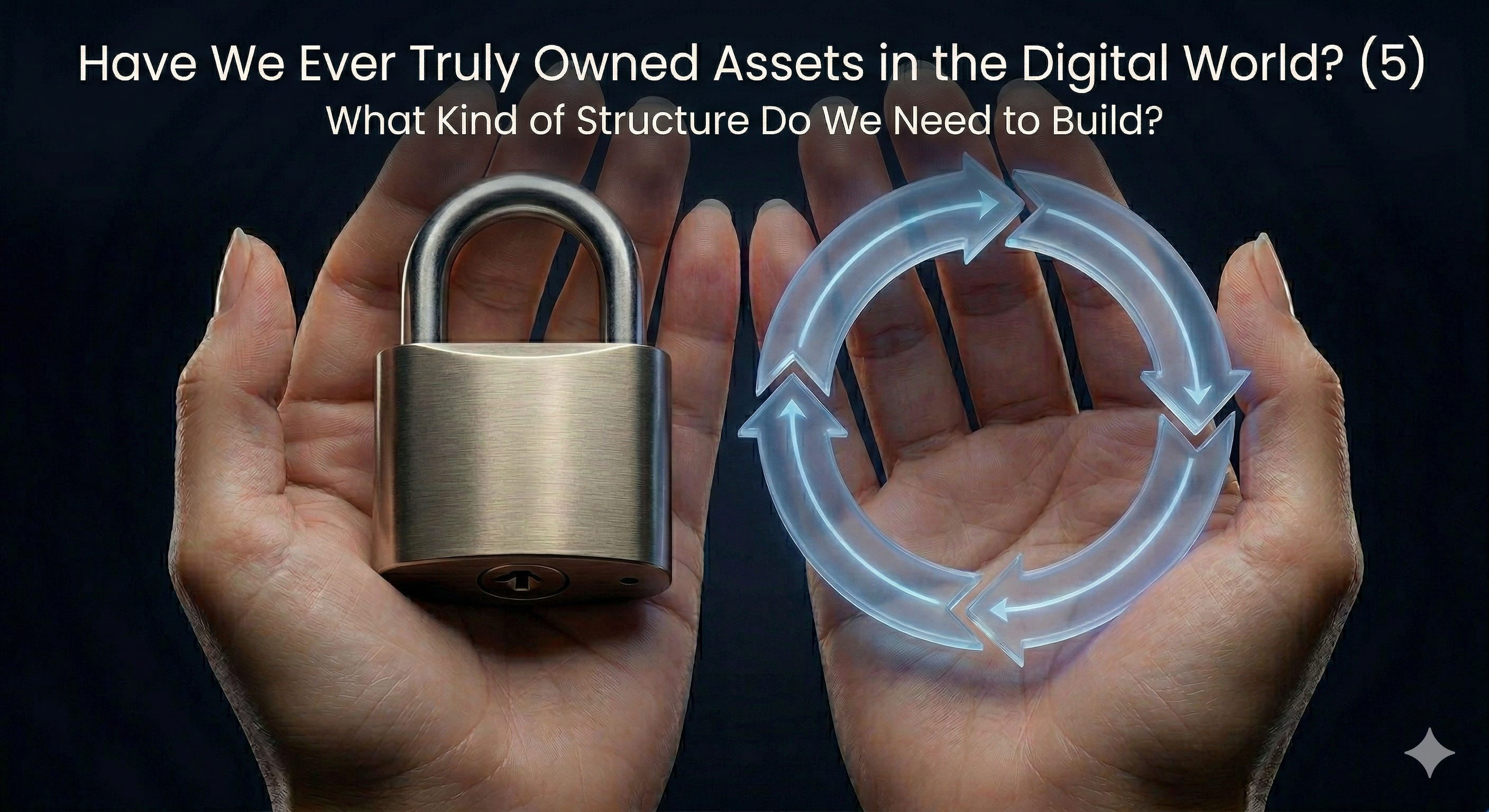
This series began with a simple question:
Have we ever truly owned assets in the digital world?
For a long time, we have treated the balances we see on screens as “ours.”
Bank accounts, stored value in platforms, assets on exchanges—they all felt like personal property. Most of the time, this system worked well, and we rarely questioned it.
But there are moments when that assumption breaks.
When a business stops, access to assets stops with it.
And only then do we realize:
What we had was not ownership of assets,
but rather a conditional right to access them.
One thing becomes clear through this series:
we have already experienced two fundamentally different structures.
The first is custody.
A system where someone else holds and manages assets on our behalf.
This structure is already widely adopted.
Most financial systems we use today operate this way.
And for the most part, it works.
But when something goes wrong,
its limitations surface all at once.
The second is self-custody.
A structure where individuals directly hold and control their assets.
No one can stop you.
But with that freedom comes full responsibility.
Both structures make sense.
And both exist for a reason.
The question is not which one is better.
Custody is widely used,
but repeatedly reveals the same limitations in times of crisis.
Self-custody provides control,
but its lack of recoverability makes it difficult for most people to adopt.
This leads to a simple realization:
A system that cannot recover will not be widely adopted.
And a system without control will repeatedly fail.
At this point, the question is no longer:
Who holds the assets?
Instead, it becomes:
What kind of structure can provide both control and recoverability?
We are no longer choosing between two extremes.
We are entering a phase where we must build something in between.
In this shift, the role of the wallet is also being redefined.
A wallet is no longer just a tool for storing keys.
It is becoming an interface that designs the structure of ownership itself.
A good wallet must satisfy all of the following:
The user retains control over their assets
That control is recoverable
The complexity is hidden from the user
It connects seamlessly with existing financial systems
If these conditions are not met together,
the system will ultimately not be chosen.
In recent years, we’ve seen various attempts to solve this problem:
Account abstraction
Passkey-based authentication
Social recovery
Smart wallets
All of these point in the same direction:
Maintaining control,
while making it possible to recover.
We see this not as an abstract idea, but as a practical problem.
A system where users can directly control their assets,
while still experiencing the simplicity of traditional financial services.
And when necessary,
a system that allows them to recover.
ZKAP started from this idea.
Within a single interface,
users can manage, move, and utilize their assets easily—
while the control itself remains with them.
We don’t believe this is a perfect answer.
But we believe it is a step closer to a practical solution
to the questions raised throughout this series.
While writing this series, one idea kept coming back to me.
What we truly want may not be ownership in the simple sense,
but a way to own assets that we can control—
without the risk of losing them.
And that difference is more significant than it seems.
Ownership is not simply about having control over an asset.
It only becomes meaningful when that state can be sustained without being lost.
If you’d like to dive deeper into these ideas or explore potential collaborations, feel free to reach out for a coffee chat anytime. You can contact me via X, Telegram, or LinkedIn.
No posts
Comments
Nothing yet. Say the first thing.
Sign in to join the conversation.