
Hello, I’m Junghyun Kim (a.k.a. Colin), founder of BaeRae. In this blog, I share my perspective on how blockchains, wallets, and the financial systems we live in have been structured—and how they are evolving. You can find more articles on the structural changes in digital assets at https://baerae.substack.com.
In previous posts, we explored how digital finance has long operated on custodial models, and what blockchain and DeFi have changed about that structure. Blockchain made it possible for individuals to hold and control their assets directly. DeFi extended that idea into financial systems, but we also saw that assets in DeFi are still bound within structures—just in different forms.
This naturally leads to the next question:
If we can now hold our assets directly, why do most people still choose not to?
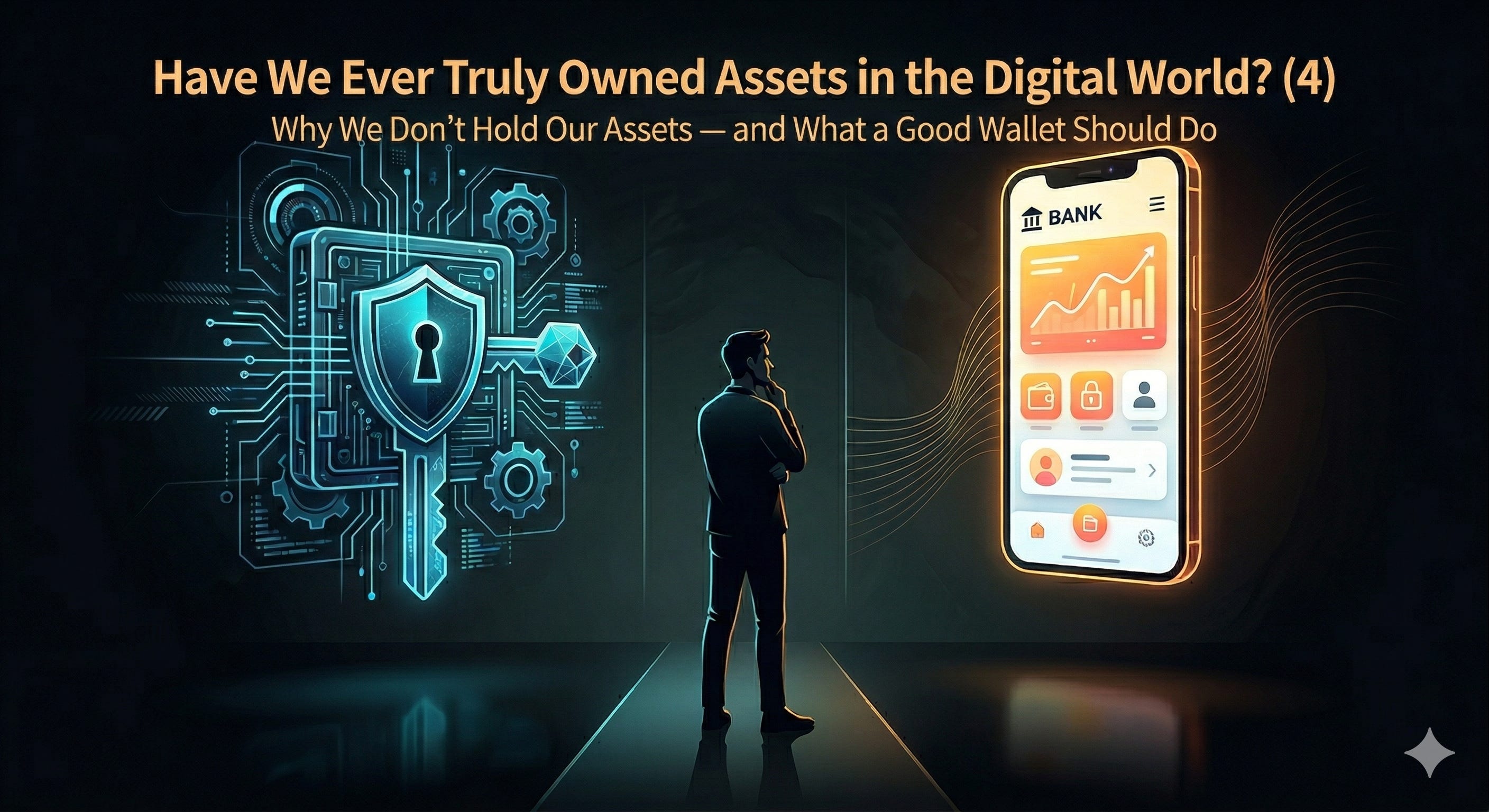
Blockchain introduced something fundamentally new: the ability for individuals to directly control their assets. With private keys, anyone can hold and move assets without relying on intermediaries.
But in reality, most people still choose exchanges and platforms.
The reason is simple.
People don’t choose control first.
They choose an experience where nothing goes wrong.
When we use a bank account, we don’t need to understand how the system works. If we forget our password, we can recover it. If something goes wrong, there is customer support. Responsibility is not entirely on the user.
Self-custody changes that.
If you lose your private key, your assets are gone.
If you send funds to the wrong address, they cannot be recovered.
Control increases—but so does responsibility.
This is the paradox of self-custody.
Technically, it offers stronger control.
Practically, it demands more from the user.
As a result, many people return to platforms. They keep assets in exchange accounts and rely on custodial wallets.
We are constantly choosing between two things:
control and convenience.
And more often than not, convenience wins.
This is where wallets come in.
A wallet is not just a tool for storing assets.
It is an attempt to bridge two worlds:
self-custody and usable financial experience.
A good wallet must satisfy both.
Assets should ultimately belong to the user.
No single party should be able to unilaterally block access or freeze funds.
The biggest limitation of pure self-custody is irreversibility.
A usable system must allow recovery.
This can take many forms:
key sharding
social recovery
passkey-based authentication
multi-approval systems
The goal is not to remove control, but to make it resilient to human error.
Most people don’t want to manage private keys, signatures, or gas fees.
A good wallet hides complexity,
so users can interact with it as naturally as they would with any financial service.
Pure self-custody places all responsibility on the user.
But real-world systems don’t work that way.
A good wallet distributes responsibility,
reduces risk,
and minimizes the burden placed on the user.
Across this series, one idea keeps emerging.
Neither pure custody nor pure self-custody works perfectly in practice.
What we are building now is something in between—
a system where control and experience are balanced.
And the wallet is the interface where this balance is designed.
If this is the direction, how does it translate into real financial services?
How do we create a system where users retain control,
while still interacting seamlessly with exchanges, banks, and payment systems?
In the next piece, I’ll explore how these ideas can be implemented in real products—and the direction we are building toward.
If you’d like to dive deeper into these ideas or explore potential collaborations, feel free to reach out for a coffee chat anytime. You can contact me via X, Telegram, or LinkedIn.
No posts
Comments
Nothing yet. Say the first thing.
Sign in to join the conversation.