
I’m running a new survey on waiting in relationships and I’d love your input. You can fill it in here. Thank you!
Last week, Christian pastor and author Doug Wilson (who serves as a confessor and adviser to the notorious Pete Hegseth) sparked controversy after publicly saying that taking away women’s right to vote is a good idea. It’s not the first time he says it; he is merely doubling down now on earlier statements, complete with a proposal of changing the legal framework that allows women to vote.
In another era, such a statement would have ended the conversation almost as soon as it began. It would have been dismissed as political absurdity, the kind of fringe provocation too detached from reality to merit serious attention.
Instead, the remarks circulated widely, generated debate, attracted defenders, and were treated by many within conservative circles as a legitimate contribution to an ongoing discussion about the future of American society. This is the real story: how the incident was covered.
What bothers me isn’t just that this one Christian nationalist pastor expressed nostalgia for a political order in which women lacked equal citizenship. It’s enough to go hang out in manosphere spaces to see how widespread this fantasy is. What bothers me more is that such ideas no longer seem out of place or dangerous to utter out loud within certain sectors of the contemporary American right.
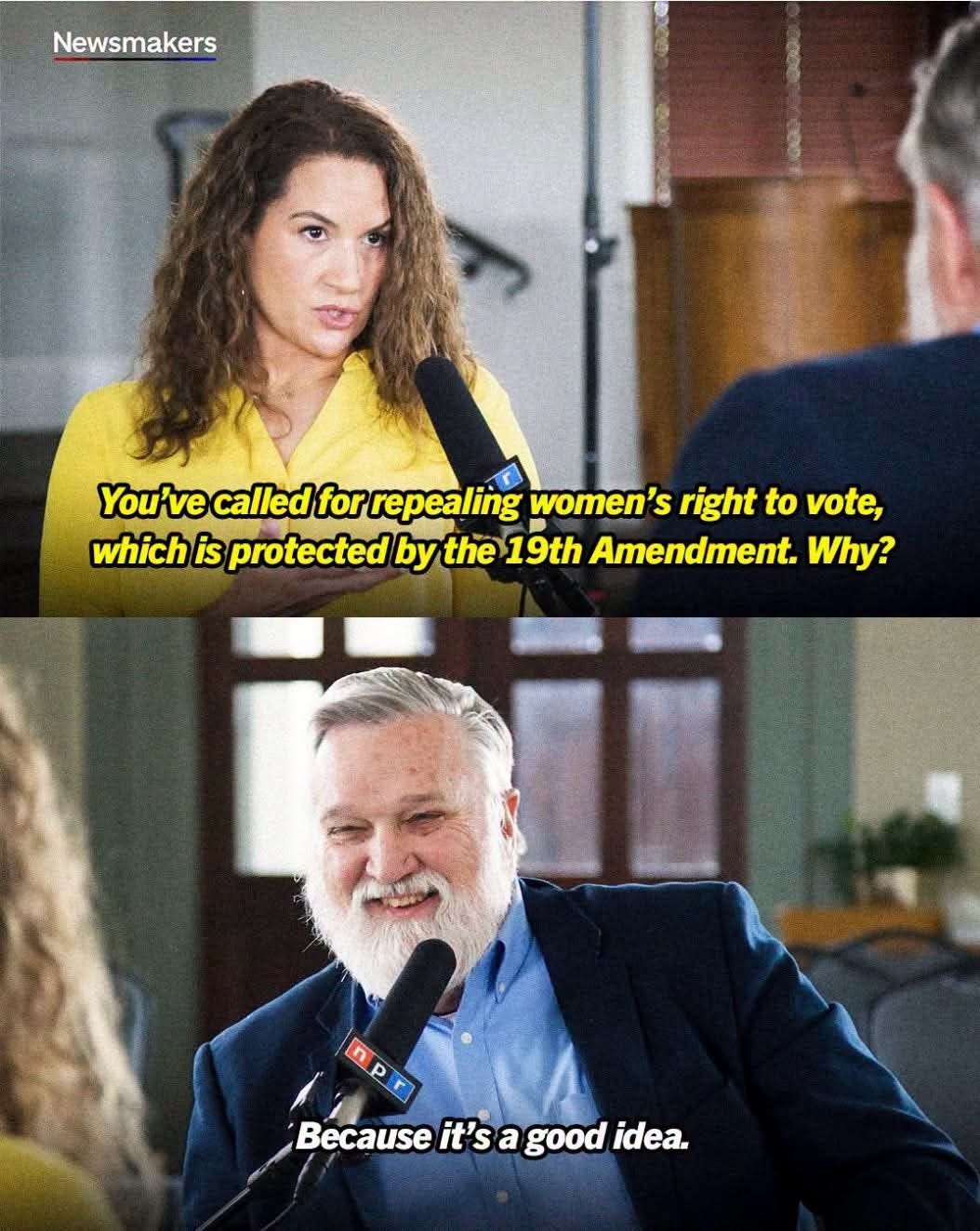
For decades, the right largely reconciled itself to women’s political equality, at least publicly, with an overall resigned air. ‘Fine, we’ll allow it, if we must.’ Opposition to women’s suffrage became politically toxic. You could oppose feminism, oppose abortion, oppose affirmative action, oppose equal pay legislation, oppose reproductive rights, and still operate comfortably within mainstream conservative politics. But questioning whether women should vote at all crossed a line that most conservatives understood could not be crossed.
That line appears increasingly fragile today.
To understand why, we need to stop thinking of Wilson’s comments as an isolated provocation and start examining the broader ideological currents that make them possible.
Of course, in most likelihood, unless reality gets even more absurd than it already is, women’s suffrage is not about to be repealed.
But I want to explore why influential voices increasingly feel comfortable imagining a world in which women’s political independence is no longer guaranteed.
One of the great myths of modern liberal democracy is that political rights, once won, become permanent. History suggests otherwise. We just need to look at all those nostalgic photos of women roaming free in 1970’s Afghanistan to understand that we can’t take any rights for granted.
Women’s suffrage is often remembered as the inevitable culmination of democratic progress. The story is typically told as a linear march from exclusion to inclusion, from injustice to equality. Once women gained the vote, the issue was supposedly settled.
But political victories rarely disappear because their opponents change their minds. More often, they disappear because their opponents lose the power to openly challenge them.
Opposition to women’s political equality never vanished from American society, but now it’s becoming socially unacceptable to express directly.
Throughout the twentieth century, various strands of conservative thought continued to frame women’s political independence as destabilizing (eyeroll). Anti-feminist activists such as Phyllis Schlafly built influential movements around the idea that women’s liberation threatened the family, social order, and traditional authority structures.
Just like today we have manosphere morons arguing that women’s rights are threatening civilization itself. (Talk about being emotional and dramatic.) So what changed in recent years is not the existence of these beliefs, but the willingness to say them out loud.
The rise of Christian nationalism, post-liberal conservatism, and explicitly patriarchal political movements has created an intellectual environment in which questions once considered settled or embarrassing to utter can once again be debated.
Women’s suffrage is becoming one of those questions.
Wilson’s comments are particularly revealing because they illuminate a recurring feature of anti-suffrage arguments throughout history.
The argument is rarely presented as hatred of women. Nobody says out loud that they want women to suffer.
Instead, it is presented as a defense of social harmony and even something that must be done for women’s own good. It’s horribly paternalistic and also deceiving for minds who are not inoculated against deceptive arguments.
Historically, opponents of women’s suffrage often argued that the family, rather than the individual, should be the fundamental political unit. Since families supposedly required ‘unified leadership’, husbands would ‘naturally’ serve as political representatives for their wives and children. Ugh.
According to this worldview, women did not need votes because they were allegedly already represented. People who claim this dislike us asking a simple question: Represented by whom? The answer has always been men.
What is being proposed or at least debated is not democratic representation but political dependency. A citizen whose political voice exists only through another person is not a full citizen.
The household voting model effectively transforms adult women into political extensions of husbands and fathers. It grants women interests but denies them agency. It acknowledges their existence while eliminating their autonomy.
This is not a democratic principle, it’s a good old patriarchal one. And it is far older than modern conservatism itself.
When feminists express concern about Project 2025 and the rise of anti-feminist rhetoric such as proposals to take women’s voting rights away, critics say the connection is overstated. They say that Project 2025 does not directly call for repealing women’s suffrage.
But focusing exclusively on formal voting rights misses the larger issue. Political citizenship consists of more than the ability to cast a ballot.
Meaningful political citizenship also requires economic independence, bodily autonomy, legal protection, educational access, and the practical ability to participate in public life as a self-determining individual.
When viewed through this broader lens, a troubling pattern emerges.
Project 2025 proposes sweeping restrictions on women’s reproductive rights, dramatic expansions of executive power, and the dismantling of numerous federal protections related to gender equality. Its underlying philosophy reflects a broader effort to strengthen traditional patriarchal authority structures while weakening institutions associated with liberal pluralism.
Whether a particular conservative politician supports or opposes these policies, their cumulative effect would still be to dramatically reduce the degree of independence available to women. Regardless of whether they also want to take away women’s formal right to vote, it structurally undermines it anyway.
Both kinds of discourse emerge from a worldview that treats female autonomy not as a democratic achievement but as a social problem requiring management. Male management, that is.
This is where the conversation becomes larger than Doug Wilson, larger than Project 2025, and larger than electoral politics.
Many influential thinkers associated with the contemporary New Right are not just criticizing isolated progressive policies. They are criticizing liberalism and democracy itself. Don’t get me wrong, I’m not a fan of the current political and economic model either, it can be improved on various counts. But the improvements must serve the cause of achieving more safety and representation for more people, not to restrict their rights or further disenfranchise them.
Writers such as Patrick Deneen argue that liberal individualism has allegedly eroded social cohesion, weakened communities, and undermined traditional institutions. Legal scholars such as Adrian Vermeule have similarly explored alternatives to classical liberal understandings of rights and governance.
Not all of these thinkers oppose women’s rights. Most of them would noinally reject that characterization outright. But their worldviews raise an important question: If individual autonomy is no longer the primary political value, whose authority takes precedence? Historically, the answer has often been the family, the church, the nation, or the state.
But within those structures, women have always occupied subordinate positions. Women’s equality depends heavily on the liberal principle that individuals possess rights independent of their social roles. Once that principle weakens, women’s political independence becomes more vulnerable than many people realize.
At first glance, a Christian nationalist pastor and a Silicon Valley defense technology company appear to inhabit entirely different universes. But I can see several intriguing points of convergence.
The emerging worldview associated with parts of the American technological elite increasingly emphasizes hierarchy, expertise, national strength, civilizational competition, and institutional discipline. Individual rights are often treated as secondary concerns compared to national effectiveness or strategic success.
The recent Palantir manifesto, The Technological Republic, embodies many of these themes. Its authors lament what they perceive as the decline of national purpose and advocate renewed alignment between technological power and state power.
Again, the issue is not that Palantir directly advocates repealing women’s suffrage, because it doesn’t (yet). The issue is that both projects share a growing skepticism toward egalitarianism itself. And the Palantir CEO, Peter Karp, also expressed that one of the benefits of AI replacing some office workers is that it will specifically replace the kind of liberal jobs that tend to be held by women who vote Democrat.
When equality is portrayed as some economic inefficiency, when hierarchy becomes synonymous with competence, and when democratic participation is framed as an obstacle to effective governance, the rights of historically marginalized groups become increasingly contingent.
Women’s political equality depends on the belief that equality has intrinsic value.
A society that prioritizes hierarchy above all else, like the one that the New Right is trying to build, eventually begins asking which equalities and whose rights are worth preserving.
The significance of women’s suffrage extends far beyond symbolic inclusion. Political scientists have repeatedly found that women’s participation alters policy outcomes in measurable ways.
Research from the National Bureau of Economic Research examining the effects of women’s suffrage in the United States found significant increases in public health spending, child welfare investments, and educational outcomes following women’s enfranchisement.
Women’s votes changed government priorities because women brought different experiences, concerns, and policy preferences into democratic decision making.
This shouldn’t be surprising; a democracy becomes more representative when more people are represented. The right to vote is not just a procedural mechanism, it’s an acknowledgment of equal political personhood.
That is why attacks on suffrage carry significance far beyond elections themselves. They reveal deeper assumptions about who counts as a full political subject and a person. Just like the manosphere isn’t shying away from calling women ‘foids’ or sub-human, conservatives are casting doubt on women’s fundamental personhood.
I don’t think the U.S. Congress is preparing to repeal the Nineteenth Amendment anytime soon or that women will wake up tomorrow to discover that their voting rights have disappeared.
That is not the immediate danger right now. The real danger is that arguments once considered beyond the boundaries of democratic legitimacy are slowly reentering public discourse with impunity.
The danger is that influential intellectuals, pastors, activists, and political figures increasingly speak about women’s independent political power as though it were a historical mistake or an option among many others, rather than a democratic achievement and a fundament of a just society.
The danger is that disenfranchisement of women (and potentially minorities too) no longer sounds unthinkable or undiscussable in civilized company.
Ideas do not become policy overnight, they become policy after years of normalization. Long before the rights of certain people disappear, their legitimacy is questioned. Long before exclusion is implemented, it is ‘debated’.
And long before some people lose equal citizenship, others first suggest that perhaps they never should have had it in the first place.
Palantir AI Manifesto: Patriarchy on Steroids
·
Apr 22

Artificial intelligence is often described as an impersonal force, some technological inevitability that reshapes labor markets and social structures according to neutral laws of efficiency. Its optimists even want to convince us that it can be good for us and aid with productivity.
Thanks for reading Bad Woman's Substack! This post is public so feel free to share it.
No posts
Comments
Nothing yet. Say the first thing.
Sign in to join the conversation.