
Quick favor I want to ask before we start: This is the last week for filling in my survey on waiting in relationships. I’d love your input. You can fill it in here. Thank you!
How do you know which thoughts are yours when someone has spent years teaching you to distrust your own?
You see, people often equate the perspecticide of coercive control with gaslighting, but what perspecticide does to you can go on much deeper and much more destabilizing, even in the long term. Even long after you left or got away from your abuser somehow. This is how you end up not knowing which thoughts are your own and which are induced, or if you’re exaggerating.
There is a particular stage of an abusive relationship that I think is difficult to explain to anyone who has never experienced it. It’s the point at which you stop asking only whether your partner is treating you badly or why he’s doing it or how can you mitigate it, and begin asking whether you can trust yourself to know what is happening at all.
Did he actually say that?
Was it really that bad?
Am I remembering this correctly?
Maybe I misunderstood him.
Maybe I was too sensitive.
Maybe I provoked him.
Maybe this is what relationships are like.
Maybe I’m exaggerating.
Maybe I’m the problem.
These questions can be profoundly disorienting because they appear, on the surface, to be questions about an external reality. In truth, they are actually questions about your own capacity to perceive reality. A woman caught in coercive control may eventually find herself not just negotiating with a difficult partner but negotiating with her own interpretation of her life. She knows that something feels wrong, but she no longer trusts the part of herself that is telling her so.
This is one of the most devastating consequences of coercive control, and it has a name: perspecticide. It’s a ruthless murder of your perspective, in order to gradually replace it with his or something close to it.
The term comes from classic research on coercive control (especially the work of Evan Stark). Stark’s contribution was to argue that domestic abuse isn’t just a collection of violent incidents, but a pattern of domination that deprives a person of liberty and autonomy. Within that framework, perspecticide describes a more profound psychological consequence of coercive control: the erosion of a person’s ability to develop and maintain an independent perspective on their own life.
Research into coercive control shifts the question away from whether a woman was physically assaulted and toward whether her capacity to act, interpret, and understand herself as an autonomous person has been systematically undermined.
I think this concept of perspecticide deserves way more attention than it receives now. We’re all familiar with the idea of gaslighting. We know, broadly, what it means to manipulate someone into doubting their memory or perception. But perspecticide allows us to see something larger happening in coercive relationships. The problem isn’t just that an abusive partner convinces a woman of one particular falsehood. It’s that, over time, he can interfere with the very process of knowledge and internal cognitive processing, by which she decides what is true, what matters, what she wants, what she remembers, and whether her own interpretation deserves to be trusted.
The abuse begins to operate at the level of epistemology. He is no longer simply telling her what to do, but influencing how she understands what she does. And eventually, he may not have to tell her anything at all.
That’s why a lot of abusive relationships are so hard to parse from the outside: when coercive controllers are successful at breaking their victim’s will, they sometimes rarely need to do anything overt, to forbid, punish or criticize. The victim’s terror from previous overt behaviors (even ones perpetrated very long ago) does this controlling work for them.
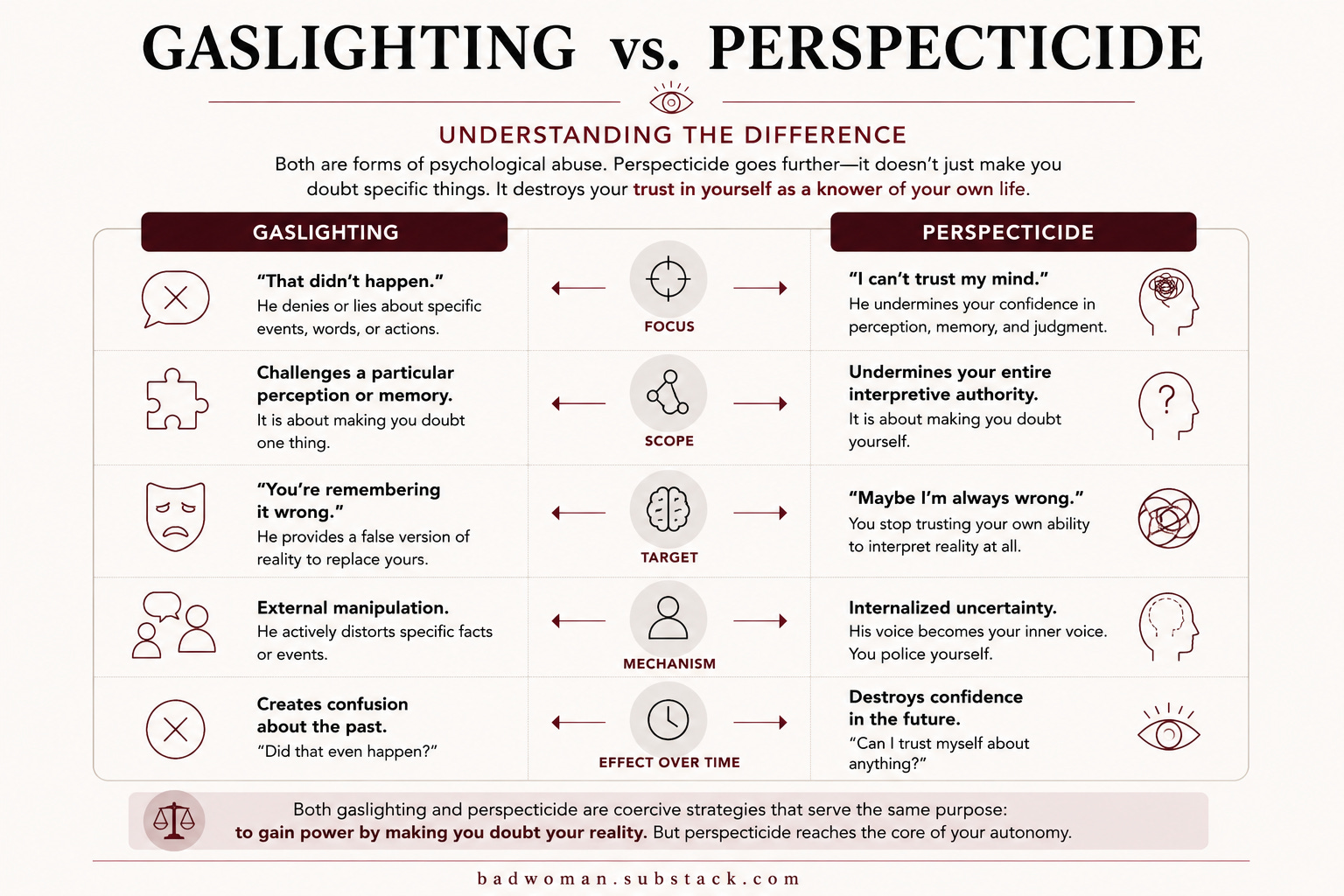
The popular understanding of gaslighting tends to focus on spectacular examples: someone denies an event that unquestionably happened, insists that a conversation never took place, hides an object and then tells their partner she imagined losing it. These examples are useful, but they can also give us an overly narrow picture of psychological manipulation.
Coercive control does not require a partner to spend every evening insisting that the sky is green. It can be much more mundane, subtle and insidious.
He tells you that you are overreacting to something that hurt you. He insists that your memory of an argument is distorted because you were emotional. He explains your anger by telling you that you are insecure. He tells you that your friends are putting ideas in your head. He says that your therapist does not understand the relationship or that she only heard your side of it. He insists that your family has always disliked him. He reminds you that other people think you are difficult. He tells you that you are becoming unstable, bitter, paranoid, or impossible to please.
None of these statements necessarily destroys your confidence on its own. The power lies in repetition. Over time, a woman can become accustomed to treating her own interpretation as the least reliable interpretation available.
She might remember an argument and immediately begin constructing the case against herself, or if she feels hurt she’ll then spend an hour asking whether she has the right to be hurt. She might notice that something has changed in the relationship but instinctively search for an explanation in her own supposed inadequacies.
This is an important distinction between ordinary disagreement and coercive control. In healthy relationships, two people can disagree about what happened while both retaining the basic assumption that the other person is entitled to their own perception. In coercive relationships, disagreement itself can become evidence of the victim’s supposed pathology. The fact that she sees things differently becomes proof that she is irrational. Her resistance becomes evidence of her instability. Her attempts to establish what happened become further evidence that she is “obsessed.”
The argument becomes impossible to win because the very act of disputing the abuser’s account has been incorporated into the account. That is a very, very efficient form of control.
One of the reasons coercive control can be so difficult to recognize from the outside is that the resulting self-doubt often looks like uncertainty about the relationship rather than a consequence of the relationship.
Friends ask ‘Why don’t you just leave?’ The woman answers ‘I don’t know.’ She may genuinely not know.
Not necessarily because she loves him too much or because she cannot see what is happening, but because her confidence in her own judgment has been progressively eroded.
This is one reason I find the familiar question ‘Why didn’t she leave?’ so intellectually bankrupt. Linda Caroll has written a beautiful personal essay about it recently, by the way. This oblivious question assumes that leaving is a straightforward decision made by an autonomous person whose perception of the situation remains intact. But coercive control can attack precisely those capacities. It can make the victim less certain of her judgment, less confident in her interpretation of events, less willing to trust other people, and less convinced that her own needs are legitimate.
The question then becomes circular: why didn’t she trust herself enough to leave? Because her abuser has already spent years teaching her not to trust herself.
Recent research is beginning to give more empirical substance to some of these observations. A 2025 qualitative study of women who had experienced intimate partner violence identified recurring patterns of self-doubt, self-blame, uncertainty about whether what they were experiencing was ‘really’ abuse, and difficulty trusting their own judgment. The results found that repeated interpersonal challenges can affect both people’s acceptance of misinformation and their confidence in their own recollections.
The research is still developing, and I think it is important not to overstate what we know. But the direction is significant. The psychological consequences of intimate partner abuse are not confined to fear or distress. They can also affect cognition, memory, self-evaluation, and the ability to make sense of one’s own experience. Because it’s essentially a deep trauma.
A person cannot easily defend her autonomy if she has been taught to distrust the instrument with which she recognizes that autonomy. Coercive control is an epistemic sabotage, not just an unpleasant experience.
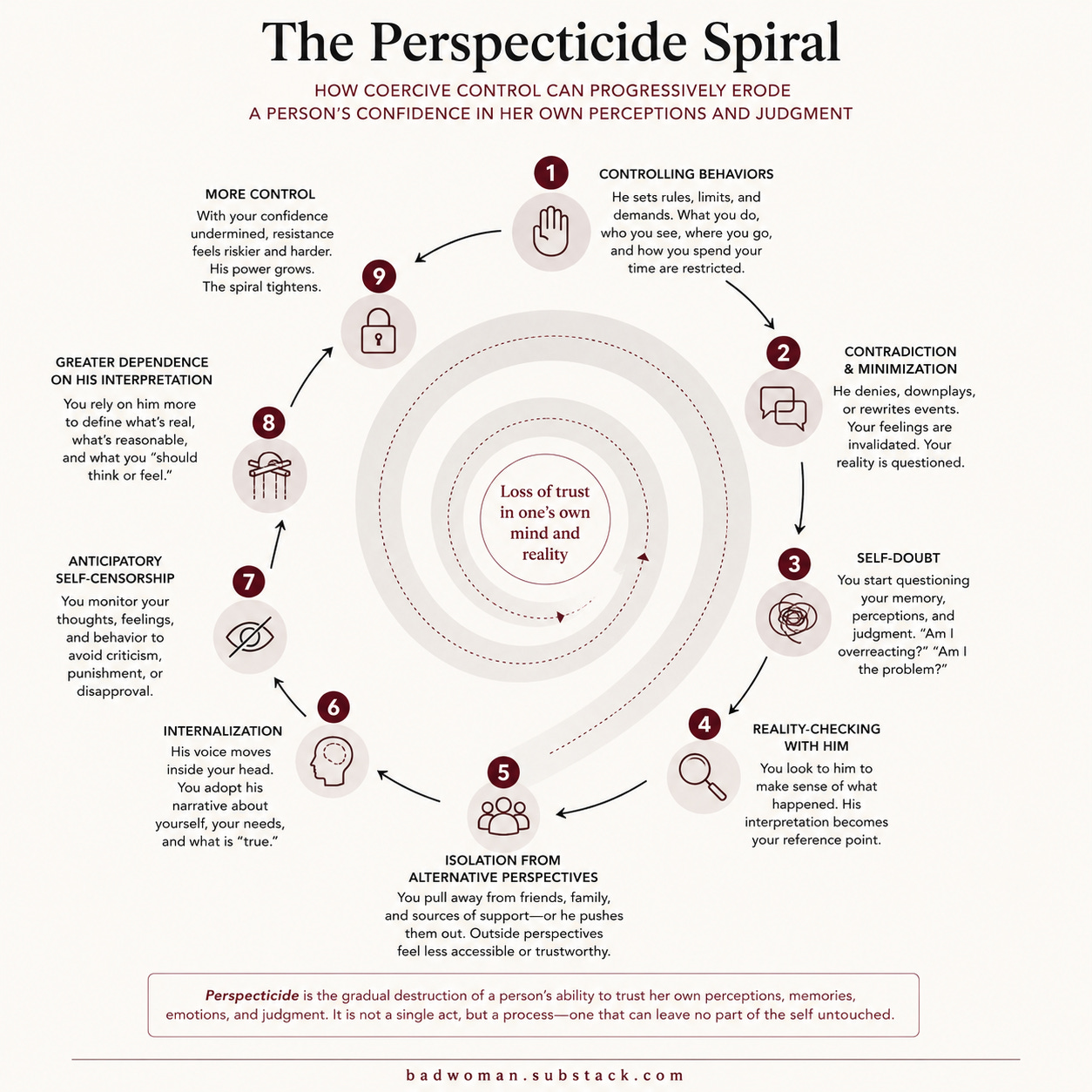
There is another feature of coercive control that I think deserves more attention: the way it can create a closed interpretive system.
Imagine a woman tells her partner that something he did hurt her. He tells her she is too sensitive.
She becomes upset. He tells her that her emotional reaction proves she is irrational.
She asks friends what they think. He tells her that her friends are biased against him and are interfering in the relationship.
She talks to a therapist. He tells her the therapist only knows her side of the story and has been manipulated by her.
She confronts him with something he previously said. He tells her that she remembers it incorrectly.
She writes things down. He tells her that obsessively documenting the relationship is proof that she is unstable.
She begins doubting herself. He tells her that her uncertainty proves she knows she is wrong.
And on and on it goes. There is no longer any piece of evidence that can easily establish or cross-reference her reality. The abuser can make every possible source of reality-checking unreliable:
Her perception → ‘You’re too sensitive’
Her memory → ‘You’re remembering it wrong’
Her emotions → ‘You’re irrational’
Her friends → ‘They hate me’
Her family → ‘They’re controlling you’
Her therapist → ‘They’re only hearing your side’
Her documentation → ‘You’re obsessed’
All arrows eventually point toward: His interpretation is the only interpretation that counts. Her records are just evidence of obsession, and even her uncertainty is evidence against her. The system has become self-sealing.
This is why I think the language of ‘communication problems’ is so inadequate when applied to coercive control and any abusive relationship in general. The real issue isn’t communication, but the fact that one person has hoarded disproportionate authority over what counts as a legitimate interpretation of events. You can’t communicate past that; the entitlement of an abuser is a conversation-ender.
We tend to understand isolation in very concrete terms: an abusive partner prevents a woman from seeing her friends. He criticizes her family, objects to coworkers or monitors her movements. He makes socializing so unpleasant that eventually she stops doing it, effectively becoming another casualty in the women’s loneliness epidemic. Sure, all of this is terrible and it matters.
But perspecticide involves another, less visible form of isolation: epistemic isolation.
You can have friends and still be isolated from reality. A woman may technically remain in contact with the people who love her while becoming increasingly reluctant to tell them what is happening. Perhaps she defended her partner to them so many times that she is embarrassed to admit that things have become worse or that they were right. Maybe she anticipates their judgment or she fears they will tell her to leave when she is not yet ready. Perhaps she has gradually adopted his characterization of them as hostile, jealous, meddling, or incapable of understanding the relationship and she now feels that they just don’t understand.
So she edits, leaves things out, and softens the story. She explains his behavior in a positive light before anyone else can name it for the shitstorm it is.
Eventually, the people around her may have only a partial picture of her life, while her partner has become the person whose interpretation she consults most frequently. That is a particularly dangerous habit of mind, but it’s one that was drilled into her.
Because one of the most important functions of relationships outside an abusive partnership is reality testing. Other people can remind us who we were before the relationship. They can notice changes we have stopped noticing or tell us that something we have normalized is not, in fact, normal.
Coercive control works much better when those alternative perspectives disappear. This is why research into the patterns of isolation and perspecticide is so important. The loss of perspective is not simply an internal psychological malfunction, it’s directly produced by the systematic restructuring of a person’s social and inner worlds.
The prison does not have to contain only one person, but it can contain only one interpretation.
The most unsettling stage of perspecticide is when the controlling partner no longer needs to be present or manifesting in an overt way for the control to continue.
This is where coercive control can become extraordinarily difficult to disentangle from the self.
You begin hearing his arguments in your own head.
You want to go somewhere and immediately think, He would think that’s inappropriate.
You buy something and think, He would say I’m wasting money.
You make plans and think, He would accuse me of not prioritizing the relationship.
You become angry or legitimately upset over something unrelated and think, I’m being dramatic.
You want something sexually and think, I’m being selfish or indencent.
You remember something he did and think, Maybe I’m exaggerating again.
Eventually, the controlling partner does not need to issue the command. You just anticipate it and becomes reflex.
I have heard of many women who continue being terrified or apprehensive around doing certain mundane things even decades after their abuser is no longer in the picture. Even decades after theur abuser is dead and so it’s certain he can no longer get to them. The internalized rules he created in their heads and the hypervigilance for compliance can sometimes never truly leave the survivors.
This is one of the reasons coercive control can be so much more psychologically invasive than ordinary relationship conflict or even less complex instances of emotional abuse. The controlling person is no longer just attempting to influence your behavior. He has become part of the cognitive environment within which you make decisions.
And because humans are social creatures, this can be extraordinarily powerful. We don’t construct our sense of self in isolation. Other people’s responses to us help teach us what kinds of people we are, what we are entitled to want, how much space we are permitted to occupy, and whether our perceptions are credible. We build ourselves relationally, and perhaps we never truly flourish and grow as people as much as we can do it in a healthy couple relationship.
When one person has disproportionate influence over that environment, they can exert enormous influence over the development of the other’s self-concept. The woman can eventually experience the resulting thoughts as her own. In some sense, they are. That is precisely what makes this form of control so difficult to undo.
There is a reason I think perspecticide belongs even more firmly within feminist analysis rather than being treated as just another psychological symptom of abusive relationships.
At its core, perspecticide is about epistemic authority: who gets to decide what is happening. And women have a long history of being denied that authority.
For centuries, women’s anger has been interpreted as hysteria, women’s certainty as arrogance, women’s sexuality as evidence of moral failure, women’s testimony as unreliable, and women’s distress as proof of instability. Feminist politics has repeatedly had to fight over the basic question of whether women are credible narrators of their own experiences.
Coercive control weaponizes those pre-existing cultural assumptions.
A controlling man doesn’t need to persuade everyone around him that his partner is irrational. He only needs to make her uncertain enough about her own rationality that she begins doing the work for him.
This is one reason I am not a fan of the contemporary cultural obsession with asking whether a woman is ‘objectively’ overreacting. I get why this is empowering when in a group with your female friends. It’s nice to vent your frustration over something and have your friends validate your perspective by telling you that in most cases you are not objectively overreacting.
Objectivity is valuable, of course, but intimate relationships don’t provide sterile lab conditions. There is no neutral observer standing outside the relationship with a clipboard determining exactly how much hurt is proportionate to a particular incident.
And coercive control often exploits precisely this demand for impossible certainty.
The woman thinks: Perhaps I need to prove that this is bad enough. But abusive relationships rarely come with a clean threshold. There may be no single incident that feels sufficiently dramatic. There may be no moment when the orchestra swells and a voice from the heavens announces: This is abuse.
There may simply be a gradual accumulation of restrictions, humiliations, contradictions, punishments, and doubts until a woman realizes that she has become someone she barely recognizes. The absence of one spectacular event does not mean the absence of a pattern.
And even if it’s not a pattern you can point to as justification, you are allowed to exit any relationship for any reason you want, even for no reason at all. You don’t need to accumulate enough proof or reasons to be allowed to.
The most typical thought produced by perspecticide is also the simplest:
Maybe I’m exaggerating. It sounds reasonable, cautious, and even self-reflective, in a culture that teaches us (especially women, because men are not normally buying into therapy culture as much, yet) that being self-reflective is good and considerate.
And sometimes it is, sure. People do misinterpret situations. We all have biases. We all misunderstand each other. We all remember things imperfectly. No feminist analysis should require us to abandon intellectual humility and diagnose every situation with no room for discussion.
But there is a difference between healthy self-reflection and compulsive self-invalidation. Anyone can ask, ‘Could I be wrong?’ and then consider the evidence.
Someone experiencing perspecticide may ask the same question indefinitely, because the point is no longer to discover whether she is wrong. The point has become to make her incapable of ever becoming sufficiently certain that she is right.
Self-reflection should increase one’s understanding, but chronic self-doubt can make understanding impossible.
This is why I hate seeing therapists and relationship coaches tell women in coercive relationships that they simply need to become more confident. Confidence is not a switch. You cannot reliably think your way out of a situation that has systematically undermined your confidence in your own thinking.
Sometimes the first step is much more modest. You begin noticing the reflex question itself.
Why do I automatically assume that I’m wrong?
Why do I need his agreement before I trust my own memory?
Why does every conflict end with an investigation into my personality?
Why do I spend more time proving that I’m allowed to be upset than thinking about why I’m upset?
Those questions are enormously important because they move the focus away from whether every individual disagreement can be settled into who’s right and who’s wrong and moves the focus toward the structure of the relationship itself.
If coercive control can interfere with a woman’s ability to trust her own perceptions, then recovery cannot consist solely of learning to identify the abusive partner’s behavior. It must also involve rebuilding her relationship with her own mind, which is why researchers of coercive control often focus on understanding the minds of abused women in greater detail.
That process can look surprisingly ordinary.
Writing things down.
Talking to people who knew you before the relationship.
Reconnecting with interests that gradually disappeared.
Making small decisions without seeking permission or anticipating someone else’s reaction.
Noticing which opinions feel spontaneous and which arrive already packaged in someone else’s vocabulary.
Learning that you can be uncertain without automatically concluding that you are wrong.
Most importantly, it can involve recovering the right to regard your own experience as evidence.
This does not mean believing that every feeling is objectively correct or that memory is infallible. It means reclaiming the ordinary human capacity to say: This is what happened to me. This is how it affected me. This is what I think about it.
You don’t need another person’s permission to have a perspective.
I know that sounds obvious. But for someone emerging from coercive control, it can sound revolutionary. Because perhaps the most profound thing coercive control takes from a person is not the freedom to go somewhere, see someone, wear something, spend money, work somewhere, or say something. It’s the sense that their interior world belongs to them.
The abuser becomes the editor of reality. He decides which events matter, which emotions are legitimate, which memories are accurate, which motives are acceptable, which relationships are trustworthy, and which interpretations are ‘crazy’. Eventually, the woman may find herself asking not simply, What should I do? but What am I allowed to think?
That is the perspecticide that i wish more women were aware of. And it’s also why coercive control is so much more than a collection of accumulating controlling behaviors. The ultimate objective of coercive control is not necessarily to make a woman obey every command. It’s to make resistance increasingly difficult to imagine.
When that happens, the most important thing she may eventually recover is not a particular boundary or decision. It’s authorship. The ability to look at her own life and believe that she is qualified to describe it.
The ability to experience discomfort without immediately translating it into personal failure or into something that needs to be compensated for with a sexual currency. Or the freedom to remember something without first asking whether someone else agrees with the memory. Or the ability to think a thought and wonder where it came from and if she really wants to carry it within.
And, eventually, the much simpler realization that should never have become so difficult: I know what I know. I feel what I feel. I am allowed to have a perspective of my own.
Thanks for reading Bad Woman's Substack! This post is public so feel free to share it.
Societal DARVO as Patriarchal Gaslighting
·
May 5

Before I get to my main essay of today, I want to ask a quick favor: I’m currently running a survey about how exclusivity is discussed (or not) in relationships. If you have 3-4 minutes to spare, please consider taking it HERE and help me uncover the power dynamics in these intimate negotiations. Thank you!
No posts
Comments
Nothing yet. Say the first thing.
Sign in to join the conversation.