
I recently shared one of my more popular articles from a few years ago that always ruffles a few feathers: How to Market a Book That Doesn’t Exist Yet, and one of the responses was, “Why would you??” to which I thought, “Why wouldn’t you?”
There are clearly several ‘sides’ to this issue, which brings me to Independence Day.
July 1995: The trailer for Independence Day showed us giant alien ships, destroyed the White House and NYC, answered exactly zero questions, and then had the nerve to disappear for a year like a bestselling author who swears the next book is almost finished.
The first teaser debuted on Independence Day 1995, a full year before the film’s July 1996 release. It revealed almost nothing about the plot, but it didn’t need to. The marketing created a question big enough that audiences spent the next twelve months wanting the answer.
Marketers still learn from the campaign today, thirty years later. The best time to market your book isn't launch week; it's before you've finished writing it.
💥 Gratitude to my exclusive advertising sponsor, the always-free Booklinker, and the paid tool, GeniusLink. I love both💥 (affiliate link).
Launch day isn’t the beginning. It’s opening night. The writing, audience building, and marketing are the years of rehearsal that came before it.
Sure, our little books aren’t giant Hollywood blockbusters (not yet, anyway), but the point still holds: Creating anticipation and building relationships can start long before your book is available for purchase.
The biggest misunderstanding about pre-publication marketing is that writers assume they’re trying to sell a book that doesn’t exist yet.
They’re not.
Reframe: We’re building an audience that already does exist.
That audience is the asset. The book is simply one way we serve that audience.
Readers rarely wake up one morning, discover a completely unknown author, and immediately buy their book, by golly. Most of us find authors gradually. We read an article. We see a social media post. A friend mentions them. We subscribe to a newsletter. We read another article. Then one day we see their book and think, “Oh, I know her.”
Familiarity matters. You’re a reader. You know this!
In marketing circles, this process is often called brand recognition. In real life, it’s simply trust. We tend to gravitate toward people, businesses, and authors we’ve encountered before- just one more reason why waiting until publication day can be such a challenge.
You’re asking readers to trust you before they’ve had any opportunity to get to know you.
For fiction writers, this process often looks different from what people expect. You don’t need to reveal your ending, post entire chapters, or spend two years shouting, “My book is coming!”
Movie studios don’t release the ending in a trailer. They create curiosity.
Authors can do the same by sharing research discoveries, interesting historical facts, worldbuilding details, character inspiration, location photos, writing challenges, and lessons learned along the way. Readers enjoy seeing behind the curtain. They like feeling as though they’re part of the journey rather than simply being handed a finished product at the end.
By launch day, readers are already invested because they’ve watched the project grow.
For nonfiction authors, the argument is even stronger. Let’s say you’re writing a book about leadership, trauma recovery, parenting, business, health, history, or, hey, book marketing. Every article you publish before launch becomes evidence that you know your subject. You’re not selling the book yet. You’re demonstrating expertise and building credibility.
Readers aren’t simply buying pages bound together with a cover. They’re buying confidence that you can help them solve a problem, answer a question, simply entertain, or teach them something valuable. They’re thinking, consciously or not, WIIFM (What’s In It For Me).
We all do that. Welcome to Earth.
Trust becomes the product before the product exists; as we’ve discussed previously, this is also where visibility comes into play.
Don’t worry, I’m not about to turn this into an SEO seminar.
Think of Google as a giant library catalog. Search engines and AI tools can only find content that exists. Every article, podcast appearance, guest post, interview, blog post, newsletter, blog tour, or video becomes another entry in that catalog.
If you don’t create content, there’s nothing to find.
Here’s the part many authors miss: marketing isn’t only about today’s readers. It’s about helping future readers find you six months, a year, or even five years from now. As your backlist grows, so does your trust factor.
One of my bestselling books on Amazon, Broken Pieces, was published in 2012 and is still in my top five sellers, sixteen years later, which blows my mind.
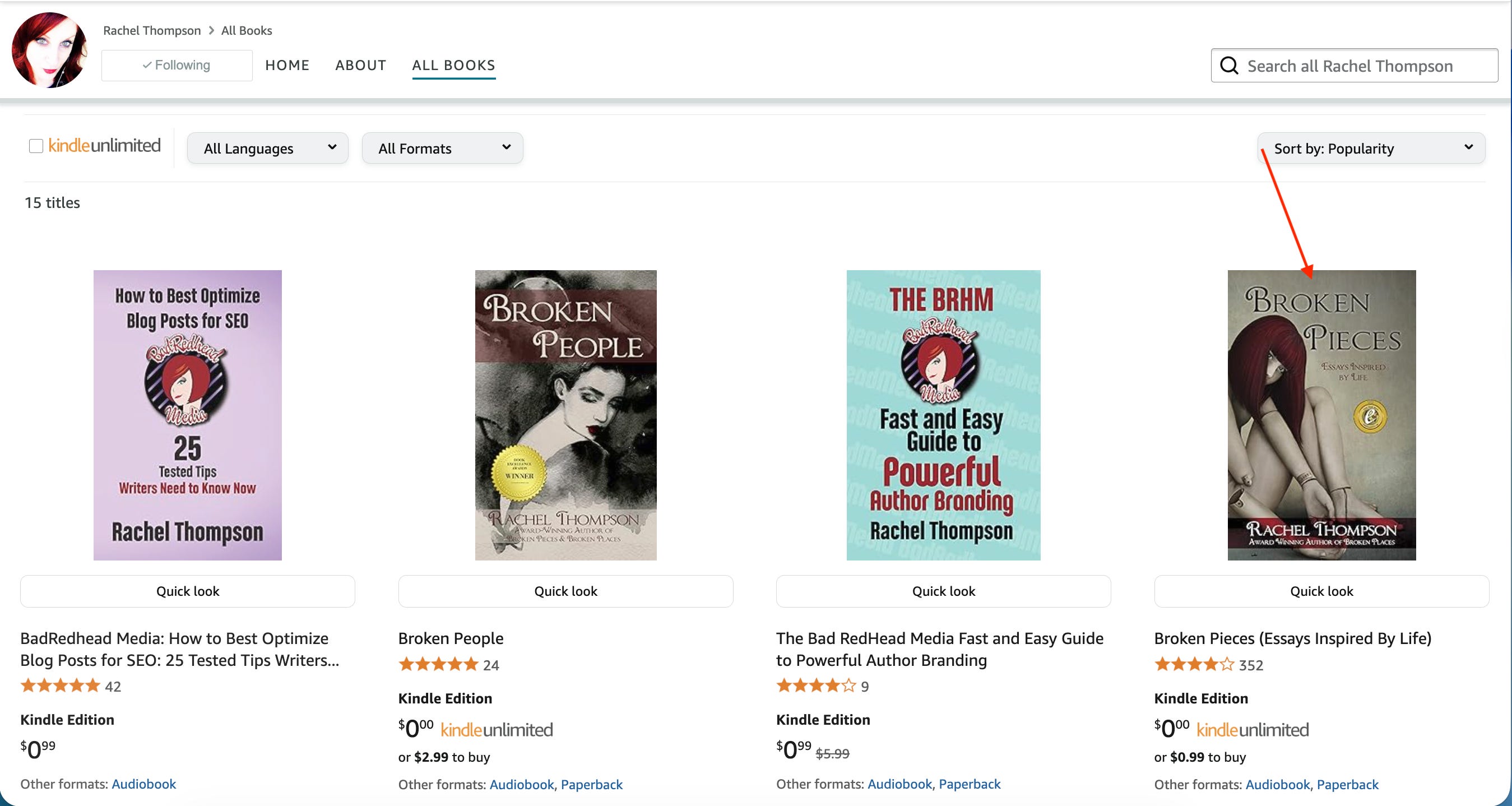
One blog post can continue working long after you’ve forgotten you wrote it. One newsletter can introduce someone to your work months after it was published. One podcast interview can lead a reader down a rabbit hole that eventually ends with them buying your book.
Visibility compounds, helping you stand out.
So when someone asks me why I would market a book that doesn’t exist yet, I understand the question. But I think a more strategic question is: Why would you wait?
The audience doesn’t wait for publication day to exist; trust doesn’t wait; visibility doesn’t wait; and the relationships we build certainly don’t have to wait.
The famous Independence Day teaser didn’t tell us the whole story for good reason; it gave us a question: What the heck is that thing? which is often the best marketing. Not revealing everything, but creating enough curiosity that people want more.
What’s interesting is that many people remember the giant spaceship and the explosions in NYC. They remember the “We will not go quietly into the night” speech. Few remember it was a take on the Dylan Thomas poem, Do Not Go Gentle Into That Good Night, later used in Interstellar, which I just wrote about 👇
The challenge authors face is that we don’t want readers to remember only the book; we also want them to remember the author who wrote it, which is why the best time to market your book is before it exists.
By launch day, readers shouldn’t be asking, “Who are you?” They should already know.
How does all this land?
• Google: How Search Works
• Google: Crawling and Indexing Documentation
• Substack Made Simple: Your 10-Minute Fix to Search Indexing
Most of what I write focuses on book marketing, Substack growth, writing and productivity, and helping writers become more visible online without losing our minds in the process. Sometimes I write about sci-fi, too, because, nerd.
Free Substack Tips: https://badredheadmediallc.substack.com/s/substack-tips.
Not quite ready to subscribe? I have a tip jar - any amount appreciated. 🙏
🌻 Free or paid, I’m glad you’re here. I’m available for hire. See my website or email me!

The truth is simple. Most authors don’t fail because their writing isn’t good. They struggle because readers never get the chance to find them. Let’s fix that.
Comments
Nothing yet. Say the first thing.
Sign in to join the conversation.