
This story is inspired by an event Rousseau relays in his Confessions, which he calls the worst thing he ever did.
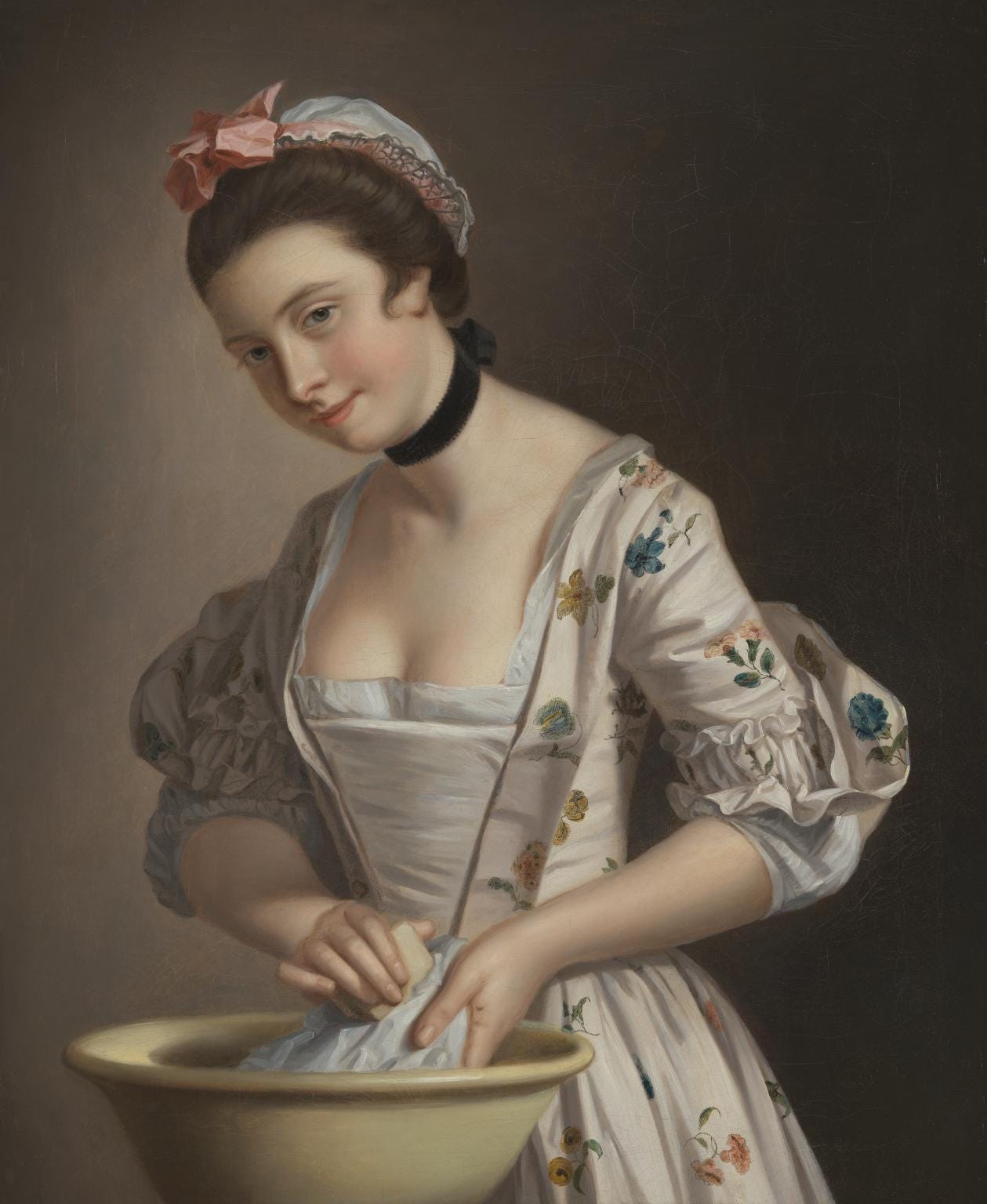
Lucette hadn’t been working for Madam Tulaggio above three months when she saw her mistress die.
She’d been a long time dying. Longer than those three months of employment, certainly. Cancer of the stomach. A slow and painful way to go, but Madam Tulaggio had borne it well, even in her last, bedridden weeks.
Before those weeks, Lucette had rarely entered her mistress’s presence, only ever sent to the chambers where Tulaggio wasn’t, toiling away unseen, a brownie of sorts. But the bedchamber needed cleaning and the fire building up, so her mistress had to put up with seeing the maids for a change.
It made Lucette shiver, feeling her mistress’s eyes on her as she bumbled around the room, yet never had Madam Tullagio deigned to speak to her except once, to ask for another log on the hearth in her paper-thin voice. Lucette was sure Madam Tullagio thought her slow and unthorough in her work. She was a terrible chambermaid. She knew it and the other staff knew it and the mistress knew it.
But then, no other girl had wanted to take on a position under a dying mistress, with no guarantee of continued employment in her inheritor’s household. No other girl but Lucette, who was too old to start in service, at 17 years, but who had pleaded for the work and promised – a lie, though she had meant it at the time – to labour hard and learn fast.
Her father, a master in the clockmaker’s guild, would never have let Lucette stoop so far as to accept work as a servant. But then, it was her father’s death and stepfather’s refusal to take her into his household that had made a desperate and hasty search for work an absolute necessity.
The day Madam Tulaggio died, Jacques was there too. A footman, he was also far below his natural station, though he kept his origins mysterious. He was Prolaisian, Lucette knew that much, and a few years her elder. He encouraged her to sing for the servants after the first time he’d heard her, claiming she was as good as the opera – as though he’d ever seen it, though the claim was gratifying all the same. Educated, he was a favourite of the mistress’s, who had him read to her as she lay day after day, and of the other staff, who enjoyed his stories of travel and of Tabresorteux, a city so much larger than Lazzina could ever aspire to.
He was sitting by the bed on a chair that creaked as he shifted, reading a novel. One of the moralising ones the mistress liked. Lucette was listening to him more than she was working. Listening more than Madam Tulaggio, she suspected, whose eyes were closed and breathing was shallow.
A repetition of a scene seen most days in the mistress’s bedchamber. Jacques would read until she was asleep – though often as not the mistress’s eyes would snap open the moment he stopped and command him to continue. A week previously, when he had finally risen from the chair, complaining that his leg had fallen asleep before Tullagio had, he hesitated by the dresser.
‘This ribbon is very beautiful,’ he said.
Lucette had stopped cleaning. She suspected she was only making things worse anyway.
‘Which?’ she asked.
He indicated a strip of scarlet, dangling from the mirror.
‘It would look pretty in your hair,’ he said. ‘Perhaps you could buy one like it.’
‘On my stater and tuppence a week?’
And he had left.
A week on and there they were again. Jacques trailed off from his reading.
‘Mistress?’ he said.
Lucette paused and looked over. She wasn’t supposed to speak in front of the mistress.
‘Something changed. Not sleep. She breaths deeper when she sleeps.’ Jacques put his hand close to Madam Tulaggio’s face. ‘I hardly feel anything.’
If the mistress’s chest rose and fell, it was imperceptible to Lucette.
‘Jacques, I think—’
‘Stay with her, Lucette. I’ll find Mr Vatani. Send for her physician.’ He looked at Lucette with large eyes. ‘Stay with her,’ he repeated.
A priest would be of more help than a physician, but Lucette didn’t say that. Instead, she sat down in Jacques’s chair, which creaked for her as it did for him, and kept vigil. Madam Tullagio’s eyes didn’t open. No air stirred in her breast. In a fit of impertinence, Lucette gripped her mistress’s bony, liver-spotted wrist but felt no beating pulse under her fingers.
When Jacques returned with Mr Vatani, Madam Tulaggio’s steward and secretary and man of business, Lucette was banished from the room. The physician arrived but didn’t stay long. Only then, finally, did they send for a priest to say the prayers and sanctify the body.
For the rest of the day, the house was quiet. Lucette and the other maid weren’t told any different, so continued their never-ending rotation through the rooms. From the dining room, she heard the door ease open and softly shut. Master Tulaggio, the nephew and inheritor, Lucette assumed. He had his own household over the river, on the other side of Lazzina.
Rumour in those final weeks was that he planned to sell the house and, in the meantime, close it up. A few servants, the good ones, he might take into his service. Lucette didn’t suffer from the delusion that she could find herself amongst them. But with a good reference, perhaps she would find another position. It was something. After a while, the door opened and shut once more, and she went back to her cleaning.
###
The household was chaos, over the following days, as the task of cataloguing all Madam Tulaggio had owned began. Everyone was conscripted into the task, even the maids. Some of it would be sent to Master Tulaggio’s house. Some would be sold. The rest returned to its place, presumably wondering what all the bother was about.
It was Mr Vatani who had hired Lucette and he who could write the most authoritative reference. Lucette needed that reference. Whether he had forgotten her in the confusion or merely did not care, he had not approached her to offer one. Instead, she spent those days trying to catch him alone, to make her request. When she finally did, it was the day of the mistress’s funeral, and Vatani was preparing to leave.
‘Excuse me, Mr Vatani, sir,’ Lucette said.
He was in the servant’s hall, already in his overcoat. The servants hadn’t been invited, but nor did Vatani trust them to continue the work without supervision, so a few had been given the day off.
‘Yes, Lucette?’ He had a reedy body and oversized head. It was a wonder he could remain upright.
‘I was wondering, sir, if you had given any thought to a reference. It’s only—’
‘If I can find the time. But really, I have a lot to be getting on with.’
‘Of course, Mr Vatani.’ Lucette kept her gaze firmly on his shoes and the cotton stockings that emerged from them. ‘When you hired me, you said—’
‘I’m aware of what I said, Lucette.’ That, though the work would most likely not be for long, it would at least get her a reference, which she would need to be hired anywhere else.
He turned to go, but stopped and added, ‘You can read, can’t you, Lucette?’
‘I can, sir. And write.’
He clicked his tongue in what sounded very much like annoyance.
‘A useful skill for a tradesman’s wife. Quite the reverse for a servant. One other thing, Lucette: it appears a ribbon has been misplaced from Madam Tullagio’s chambers. A red ribbon. Did you perhaps move it while cleaning?’
‘No, sir.’
He nodded once and, without another word, departed.
###
The following day, at servants’ dinner, Mr Vatani stormed in. Not in search of a meal: eating with them was beneath him. At the sight of him, all rose in haste.
‘I’m afraid a possession of Madam Tullagio’s has gone missing. I’ll be conducting searches of all your rooms, starting now. I hope not to find anything.’
The room was all wide eyes and open mouths. Vatani didn’t wait for questions.
‘It’s absurd!’ Lucette said, directing the exclamation at Jacques merely because he was sat next to her. ‘Can’t find something; assume the servants stole it. Absurd!’
‘Yes, yes you’re quite right. Authority makes tyrants of men. The pettier the authority, the pettier the tyranny.’ Jacques’s voice was hurried; his breath shallow. ‘And what could possibly have gone missing?’
‘A red ribbon, I think. Mr Vatani asked me about it yesterday. Probably the one you pointed out to me the other day.’
‘Oh? Oh. Well yes, of course it’ll turn up.’
The searches did not take long. Not quite an hour later, Vatani summoned the servants from their tasks. As they congregated, there was no mistaking the ribbon clutched in his fist. His face was a mask of white fury.
‘I am disappointed to say that this item was discovered in one of your rooms.’
He held it up between thumb and forefinger, a wispy little piece of muslin. Such an insubstantial thing. Who would be stupid enough to risk their position for it?
‘Jacques, can you explain yourself?’
‘Mr Vatani?’ Jacques squeaked. There were a few hasty intakes of breath. Those around him stepped a little away from the offender, like his guilt was contagious.
‘How did this end up in your room, Jacques?’
‘I… I don’t know, sir.’
‘You don’t know, Jacques?’ Vatani was close to shouting. ‘Did you take it? Either you took it, or someone gave it to you.’
Jacques stuttered for a few moments. His eyes were wild terror.
‘I was given it, sir,’ he said, his voice all desperation.
‘Given it? Are you sure about that?’
‘Yes, sir. Yes. Given it. Someone gave it to me. I wouldn’t… I didn’t…’
‘Who?’
‘Who!’ Jacques echoed. ‘I don’t…’
‘Come now! You must know who gave it to you!’
‘I um…’ The accused’s eyes ran haphazardly around the room. They met Lucette’s and stayed there a moment, before falling to the ground.
‘Lucette,’ Jacques said. ‘Lucette gave it to me.’
‘What?’ said Lucette, shaking her head and backing away. ‘No. I swear. I didn’t give—’
‘You’re sure it was Lucette, Jacques?’
Jacques briefly met her gaze again. She tried to send him her terror and her fury. The sickness in her stomach and the pounding in her ears. He himself looked like the rabbit who has heard the shot but not yet felt the bullet.
‘Yes,’ Jacques said. ‘It was Lucette. She gave it to me. I’m sure.’
‘Lucette,’ Vatani intoned, turning his face and his anger on her. ‘Is this true?’
‘No! No, sir. I didn’t take any ribbon! Sir, I—’
‘When I asked you about it, were you aware it was missing?’
‘Yesterday, you mean, sir? No, no I—’
‘But you’ve seen this ribbon before, yes?’
‘Yes,’ Lucette replied, trying her best to understand the situation – and what it would mean for her if she wasn’t believed. ‘I’ve seen it in Madam Tulaggio’s room. When I was cleaning.’
‘Saw it, and coveted it?’
‘No, sir!’ The audience, the half dozen other servants, made it all worse. A public humiliation for a crime she hadn’t committed. ‘I would never—’
‘But it’s the kind of thing girl’s like, isn’t it? Like to wear in their pretty hair?’
‘I suppose, sir, but—’
‘Am I supposed to believe that Jacques wanted to wear it in his hair?’
‘I didn’t say—’
‘Then what do you expect me to believe, Lucette?’
‘Sir, I didn’t take it! It wasn’t in my room! Why—’
‘Jacques, if she gave it to you, why did you not report it?’
Jacques’s head shot up, as though he were surprised to be drawn back into it all. He cringed back. Mr Vatani pushed on.
‘Did you not know it was Madam Tulaggio’s?
‘No, sir! I didn’t… I hadn’t seen it before. Or I didn’t recognise it. I don’t pay attention to ribbons.’
‘No, I don’t suppose you would.’
‘But he did!’ Lucette cried. ‘He showed it to me! He said it would suit me.’
‘Jacques! Did you do that?’
‘No, sir! I never… no sir.’
‘Jacques,’ Lucette pleaded. ‘Jacques, please. Please just… why are you doing this?’
‘It sounds as though you thought it would suit you, Lucette,’ said Vatani with a tut. ‘And passed it onto an unsuspecting young man when you realised what would happen if – and when – you were caught with it. If Jacques knew it was stolen, why did he make no effort to hide it?’
‘Sir?’ Lucette said. ‘Why would I know? I can’t answer for—’
‘No, you cannot answer. I’ve known a lot of girls like you, Lucette.’
‘I didn’t do anything!’
With that simple, honest plea, the tears she had been holding back finally broke through. She sobbed and repeated her innocence. A blurry Vatani was unmoved. It was Lucette that the other servants left in a ring of isolation.
‘Not all men are moved by a few silly tears.’ Mr Vatani’s voice was pure distain. ‘Pack your things, Lucette. Leave immediately, and be glad that’s as far as we shall take it.’
‘But sir, my—’
‘Reference, Lucette? Be thankful I won’t write one. You wouldn’t like the things I have to say.’
###
There wasn’t much to pack, in truth. Her cheeks were wet and she wanted to lie down and parse it all, but didn’t let herself. Lucette gathered her few possessions, including the fifteen marks, nine pence she’d saved up from her wages, wiped her eyes, and slipped away.
The other servants had returned to their tasks without even a word to her. All, it seemed, had made sure she would not encounter them as she departed. All but one. For, by the servants’ door, stood Jacques, his face drained of colour, pacing back and forth.
‘Lucette!’ he cried as he saw her. ‘Lucette, you have to understand—’
‘Get away, Jacques.’
Lucette stepped to the side, to go around him. He moved into her way.
‘No, I mean… I took it for you, because you deserve something pretty. And then I panicked and I—’
‘Get away!’
She barrelled through him, forcing him to step away, anger her momentum. He made as though to take her arm, which she snatched away, drawing herself up to him. If he touched her, she’d scream. He wilted and stepped back, tears welling in his eyes, as though he had any right to them.
‘I only—’
‘I don’t care. Whatever it is, I don’t care.’
Lucette slammed the door behind her, leaving herself in the clingy evening air of high summer. Her stepfather, surely, would take her in for a night. Her mother could do that for her, at least. Forced to live on them, her saved wages would keep a roof over her head and food in her belly for no more than a month. She could write to her father’s sister in Hjorrbrye, perhaps, in hope of a position.
And then? And then she knew not. And then she would make the best of it, wherever the current pushed her, she supposed, hoping for naught but safety and comfort and the odd little extravagance, which was all she’d ever really wanted – all, she suspected, most people really wanted. Lucette took a moment to adjust her bonnet and started on her way.
Thank you for reading. I’d like to write more vignettes from Lucette’s life, which I might base somewhat on that of Theroigne de Mericourt. In general, I’d like to write more from working class perspectives in my world, which often fall by the wayside when I focus on the movers and shakers.
In two weeks, my next article will be about how a fantasy writer can analyse the geopolitics of their own constructed world — anything to put my IR degree to use. Two weeks after that, I think I’ll already be returning to naval fiction with the story Strike the Colours! about, amongst other things, why literally ‘nailing the colours to the mast’ isn’t always the best idea.
Don’t know where to continue with my writing? This might help:
Comments
Nothing yet. Say the first thing.
Sign in to join the conversation.