
Sometimes, a rant is too long to be contained within a note, and somehow it ends up in your inbox. This is one of those times.
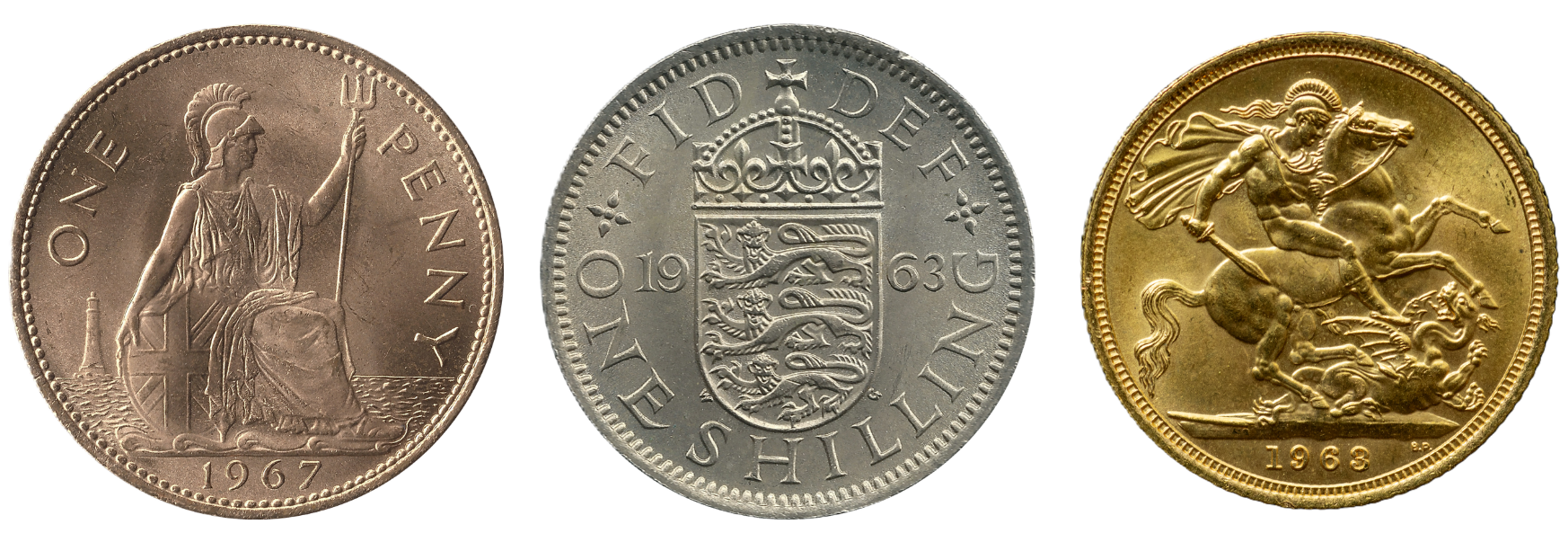
Until 1971, Britain did not use a decimal currency system. Now first, let’s understand what that means.
Currencies have basic units they work in. Some currencies have only a single unit, such as the Japanese yen: every note and coin in Japan is valued in yen. Most currencies, however, have two units: a main unit and a sub-unit, such as dollars and cents or pounds and pence. It’s also possible for currencies to have three or even more units, though none do today: the only limits are our imagination and level of faff we’re willing to put up with.
A decimal currency is one with two units where the difference between the two is expressed by a factor divisible by ten. Most commonly, the main unit is worth 100 times the sub-unit. This is the system used by most — though by no means all — currencies today. The American dollar, the euro, the British pound sterling, the Swiss franc, and so on and so forth.
The trend towards decimalisation began in the 18th century, really getting going when the American dollar was first issued in 1792 and when the French decimalised their currency (and their weights and their time and their mothers and everything else they could get their hands on) during the revolution.
And, of course, you can see the advantages. Thanks to our base ten counting system, having a base ten currency system makes certain kinds of maths just much easier. So yes, it makes a lot of sense to decimalise and, predictably, the rest of the world followed suit.
Except, of course, for Britain, which stubbornly kept its old system well into the second half of the 20th century. A system in which a scizzlepomp was worth seven-and-four-ninths of a gaggawack, and had even more arcane relationships to umpteen other coins. A system that wasn’t just old-fashioned, but ridiculous, absurd, and downright funny. And yet, if that was the truth, then whyever was such a system adopted and how did it stay around for so long?
In today’s rant, we’re going to go through the history of European currency and seek to explain the pre-decimal British system. And, by the end of that, we’ll have found that the system was fine, that it wasn’t that confusing, but that nonetheless decimalisation was long overdue by the time it happened.
Because, like so many systems in Europe, this all starts with the Romans, who used a silver coin called the denarius among various others. Its name derived from its original value: ten asses, (which we can all laugh about before moving on) with the as being both a coin and one of the basic currency units of Republican Roman coinage. The denarius is important. Remember the denarius.
In the late empire, debasement became a huge problem, causing inflation and lowering the value of the coinage in circulation, to the point that the denarius, as, and other lower valued coins fell out of use. At the same time, central authority crumbled and different regions started diverging in their practices. This was a problem.
And then along came the Carolingians, forging an empire across France, the low countries, Germany, and northern Italy. In particular under Charlemagne himself, this empire was able to impose standardised systems back onto these regions in a way not seen since the Roman Empire was at its height. One of those systems was currency.
Charlemagne made the silver denarius the core unit again. (See, told you it was important.) He also re-standardised the weight of a pound (libra, in Latin) and decreed that each of his new denarii would have 1/240 of that new pound’s weight of silver. Charlemagne’s pound weighed about 400 grams, meaning each of his denarii had a little under 1.7 grams of silver. Between the two was another unit, the solidus — originally introduced during the Roman inflationary period and literally named ‘solid’, as in ‘this is a coin you can trust’ — worth 1/20 of a pound, and therefore equal to 12 denarii.
In other words, Charlemagne’s system had three basic units. 12 denarii made one solidus and 20 solidi made one libra. In German, different names were used: pfennig for denarius, schilling for solidus, and pfund for libra. In English, where the exact same system was adopted, those terms were rendered as penny, shilling, and pound, and it was this system, without modification, which was kept for over a millennium until it was decimalised in 1971. France also used this system prior to its decimalisation, with deniers, sous, and libres1, though by the revolution inflation had rendered deniers obsolete.
Now, those numbers — 12 and 20 — seem very silly compared to a nice round 100. But they make more sense than you might think.
12 is a great number. I’d go so far as to call it the best number. At least, it’s the best number if you need to divide a lot, because 12 divides neatly into two, three, four, and six. The only integer less than half of itself that 12 doesn’t divide neatly into is five. By contrast, ten is an awful number for division. It only divides neatly into two and five, and dividing by two is a trait it shares in common with half of all numbers, which is frankly rubbish. 12 is more divisible than 10 while also being larger. Divisibility is a really useful thing for a currency to have for all the reasons I’m sure you can think of for yourself, and that’s the genius of the shilling.
But ten is a really good number for all the reasons that decimalisation is useful, so maybe we should use ten in our system. But, and here’s where we’ll get clever, we’ll combine the ease of dividing and multiplying by ten with the similar ease of doing the same with two, which just requires doubling and halving. And that’s the utility of having 20 shillings to the pound, as it only requires the additional step of doubling or halving after doing all your usual base ten maths. So, to convert 26 pounds into shillings, we just double it to 52 and add a zero, making 520. Easy. To convert back, we knock off the zero and halve.
That’s literally the entire system. Three units with a ratio of 240d:20s:1£. (As a Latin holdover, ‘d’ for denarius was used for penny and ‘L’ for libra was used for pound, stylised into ‘£’.) Not very confusing and actually quite sensical once you think about it, particularly when you realise that the shilling and pound weren’t originally supposed to be coins: they were merely units to make accounting easier. Coins worth one shilling and one pound weren’t issued until the late medieval and early modern periods respectively, after inflation had slowly eroded their value. In other words, doing maths with them was the only reason they existed and having to actually handle coins worth those amounts was a later addition to the system.
Because that’s what people tend to get hung up on: that there were lots of different coins that related to each other in confusing ways. Here’s how the system is often presented:
Two farthings make a ha’penny, two of which make a penny, two of which make a tuppence, one-and-a-half of which makes a thruppence, two of which make a sixpence, two of which make a shilling, two of which make a florin, one-and-one-quarter of which makes a half-crown, two of which make a crown, two of which make a half-sovereign, two of which make a sovereign.
But then, that’s how any currency looks when you stop looking at its coins in relation to the basic units and instead only look at them in relation to each other. If I was to say that five pennies make a nickel, two of which make a dime, two-and-a-half of which make a quarter, four of which make a dollar, that would also sound confusing. Except, of course, those are really just the names of different coins worth a certain number of cents, with their relationship to each other being of secondary importance.
So too with pre-decimal British currency. ‘Farthing’ is just the name of the coin worth 1/4 of a penny. ‘Crown’ is just the name of the coin worth 5 shillings. I’ll give it to you that some are slightly confusing amounts — like the half-crown being worth 2.5 shillings, AKA 30 pence — but even those are easy to wrap your head around. Fundamentally, this system just existed for a long time, over the course of which lots of different coins were issued, all of which developed their own names.
Except that I have to cede and rant about the genuinely confusing one: guineas, which were in circulation from the late-17th to the early-19th century and hence I have to read about them a lot because that’s precisely my period. Basically, the guinea — named after the origin of some of the gold used to make it — was supposed to be worth one pound, but because it was made of gold, while shillings were made of silver, its value relative to the more common shilling could shift due to fluctuations in the price gold and silver, and its value was eventually fixed at one pound and one shilling, AKA 21 shillings.
And, because they were the most valuable coin in circulation, and the one closest to one pound, guineas ended up being a really popular coin that were also used as a unit of accounting, and later coins were struck worth half, a third, and a quarter the guinea. So a guinea is 21 shillings, a half guinea is ten shillings and sixpence, the third guinea is seven shillings, and the quarter guinea is 5 shillings and thruppence. An absurd system, even for Britain, and so after being hugely popular in the 18th century, guineas were abolished in 1816, replaced by a coin worth exactly one pound called the sovereign, which after about a century was itself replaced by the one pound note. (So now we can forget about guineas and move on.)
Because no, I’m not leading up to a ‘bring back pre-decimal currency’ hot take. The advantage that the pre-decimal currency had is mostly in the ease of dividing up shillings evenly. That’s really important if your lowest unit — the penny, in this case — is worth enough that people actually care about it. Except, by the 20th century, that just wasn’t the case.
I mentioned earlier that Carolingian pennies were made of a little under 1.7 grams of silver. The price of that silver today is something like £3, or 300 modern pennies2. This is something I think most people don’t understand about pre-modern coinage: it was much less granular. I use as a rule of thumb that an average day-labourer in 18th century Britain could expect to earn about a shilling a day.3 That is, 12 pennies, in a system where the smallest coin was worth 1/4 of a penny. If they converted their wages into the smallest coins possible, they’d have 48 farthings. Today, working a full day at the British minimum wage would earn someone over £100. Converting that into the smallest coins possible, you get 10,000 pennies.
The penny today is effectively worthless, so no-one cares if you occasionally have to round up or down a bit. Already by 1900, the purchasing power of the penny had decreased hugely from just a century previously, as indeed it continued to decrease. With the penny increasingly worthless, being able to divide shillings equally became increasingly unimportant, meanwhile the advantages of a purely decimal system were ever present. So, by the 1970s, the change was long, long overdue and the only oddity is why it took us so long.
But we can recognise the advantage of making that switch while still understanding and appreciating the pre-decimal system with its own advantages and history and which, at the end of the day, was pretty straight forward once you understood it.
And, as a final aside, I do think we lost something in the decimalisation: all those fun names with all their history! Modern British coins are, frankly, very boring. Even the Americans have fun names for their coins, while we’re left saying things like ‘20 pence piece’. (This is also true of the euro, by the by, the currency I actually use in my day-to-day life.) So, I’m proposing that we bring back some cool names again, even if the values aren’t exactly the same as what they were. Here’s my proposal: we start calling the ten pence a shilling, the 20 pence a florin, and the 50 pence a crown. (Everything under ten pence is frankly useless and shouldn’t be minted anymore anyway.) Just start doing it in your day to day life, I’m sure it’ll catch on soon and absolutely no-one will look at you funny in the meantime.
This slot was supposed to go to an article about how to geopolitically analayse a fantasy world, and thereby how to craft a world with interesting political geography, but that had to be delayed due to time constraints, so look forward to it in three weeks.
In the meantime, next week we’ll be returning to some naval fiction with the story Strike the Colours! following a young officer unexpectedly left in command of a losing fight. If you’d like to check out something in a similar vein to tie you over, here’s my last foray onto the high seas:
Fortune's Favour
·
Apr 9
While he understood why he had been invited to the captains’ dinner – and it was certainly better fare than he was used to – Dimitrios would really rather have stayed away. It was just him with the three captains who made up their little convoy heading over hostile seas to the…
Don’t know where the continue with my writing? This might help:
The coin worth one libre was called a franc, so this was the name used for the post-decimalisation currency.
Which is only to compare the literal value of the silver, rather than their actual purchasing power, but it still gives you an idea.
Servants and soldiers typically earnt about half that, but their room, board, and some of their clothing (AKA the major expenses) were covered.
Comments
Nothing yet. Say the first thing.
Sign in to join the conversation.