
We were on a two-week trip to Oregon (the reason for a couple of missed posts), and I was all set to write about that but had seconds thoughts. Here’s why.
Because of the trip and recent knee surgery (update: I’m fine!), for more than a month I didn’t strolled the property or pursue my weed-fighting efforts as much as usual. This morning I undertook a walkabout to see the results of my neglect. Wow. Not great in the hinterlands. This got me thinking about, well, whether I’ve been indulging in wishful thinking.
Most ambitious gardeners know that garden beds left to their own devices will soon revert to chaos, which can come in the form of individual plant overgrowth, aggressive plants taking over, or weeds becoming dominant. Gardens need tending.
Yet I have seen recent advice from native gardening experts that promotes the idea of “leaving the weeds.” The argument goes that pulling weeds only activates more weed seeds already in the soil, which means even more weeds. Thankfully, this is one piece of bad advice I have never passed along.
Are the people giving this advice living in the same world as I am? Among our most aggressive weeds are invasive vines such as Japanese honeysuckle, porcelainberry, and Oriental bittersweet. Left to their own devices, these vines will overtop everything in their path in a single summer while also growing woody and more pernicious. Leaving these weeds is an invitation to utter disaster.
In addition, I’m sure I’m not the only one who sees many trees cropping up in his garden beds. In areas where I’m rewilding or at least reforesting, I welcome native volunteer trees. But we’d be crazy to leave them growing a single summer in the beds by the house, where they would soon send down tap roots that would make their removal that much more difficult. More than anything else, nature wants forests. Leave these tree weeds in your flower beds and a forest you soon will have—right on top of the house.
In fact, when we arrived home after a two-week hiatus, the patio garden looked plenty lush with the native perennials and shrubs we’ve planted, and the herbaceous weeds were manageable. But what I did notice were more than a few trees, mostly native black walnut, oak, and sweet gum, all welcome in the woods here but not in the patio garden. In addition, there were non-native and in some cases invasive trees such as Chinese chestnut, Bradford pear, and white mulberry. Mind you, this was after having pulled weed trees from those beds for two months prior. If I wait until fall to remove these trees, it will require a hefty shovel and maybe a pick mattock. And the effort would create large dead spaces. No, thank you.
That’s my dose of realism for planting beds near the house, but what about the meadows and woods?
A typical walk along the path finds me reaching down with pruners to cut multiflora rose or Japanese honeysuckle close to the ground and hand pulling what porcelainberry I can reach and break away (it’s brittle before it gets woody). But I rarely wade into the interior of meadows in mid-summer. The growth is too dense and the volume of work too great. So I mostly confine myself to the paths.
Yet, despite the fact that what I can reach amounts to a drop in the ocean, until now I’ve had the philosophy that no invasive plant I can see should be allowed to flower and fruit. Of course, I’m contradicting myself, because bad plants I can’t readily reach are equally bad, most of the invasive plants grow in areas I do not visit in summer, and therefore my philosophy of not allowing any invasive plants to blossom fails at first blush. Such is the nature of self-delusion.
Along the paths, however, I have until now persisted with the fight. The idea being that fruit means seeds, and seeds mean more invasives. But, again, this is precisely true while being broadly incorrect. Notwithstanding my own unreachable—or rarely visited—invasives in the midst of meadows, the reason it’s even more incorrect is because neighbors far and wide allow invasive plants to run rampant. Then birds eat the seeds, and birds fly across property lines. The seeds that might form along the path at my house represent an infinitesimal contribution to that sky-borne deluge. Even if I were willing to spot-weed beyond edges of meadows, the odds are grossly not in my favor.
As a backyard steward, I believe strongly that those whose practices do not support natural systems have detached themselves from reality itself. And this has and will continue to catch up to us in the form of fewer insects and therefore fewer birds and eventually complete ecosystem collapse that will not spare the quality of life to which most of us have grown accustomed, if not life itself.
But perhaps I am equally detached from reality if I believe I can hold back the tide merely by doing what I’m doing. The tell is in what I saw this morning: porcelainberry dominating patches of meadow, setting buds, grabbing onto tree branches where we did not string trim around the base, climbing our fence from mounds allowed to grow out of control in the neighboring community’s “open space.”
“Control” is the key word in my own delusion. Maybe even the best intentions are not enough to control natural systems tilted out of whack.
Maybe I need to accept that I cannot control all invasives that take root at Puddock Hill—or at least not defeat them. Maybe, at this stage, in this place, some invasive plants will go to seed before I can get to them, and I’ll simply have to pick off the worst offenders when they get too overgrown.
That doesn’t mean I’m giving up (or throwing in the trowel, as I once wrote). To wit, healed and well rested, I will soon be breaking out the brush cutter and the string trimmer and going after what I can—but no more. Realism is one thing. Defeatism is quite another.
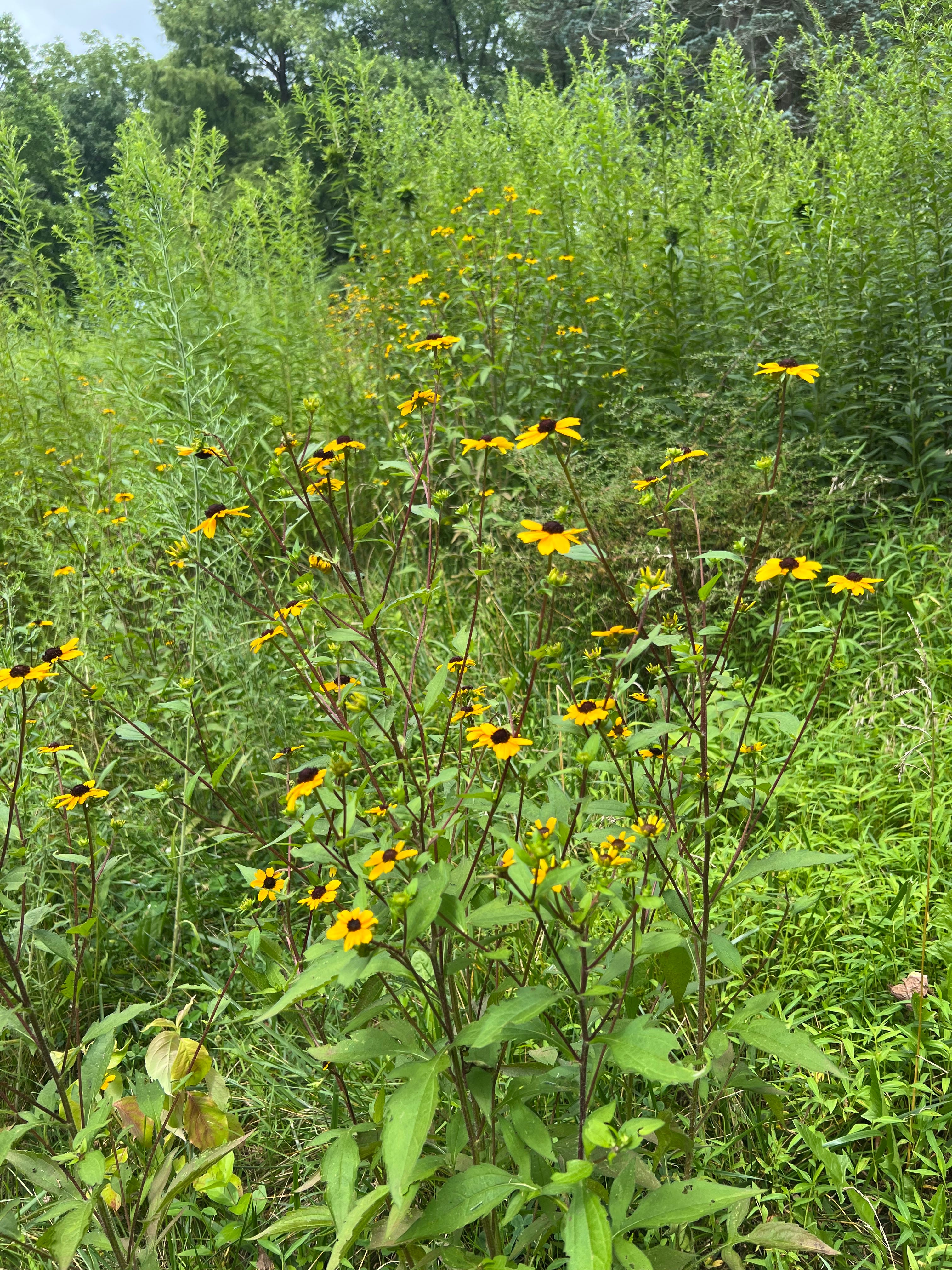
Native black-eyed Susan (Rudbeckia hirta) continues to spread in unmowed areas:
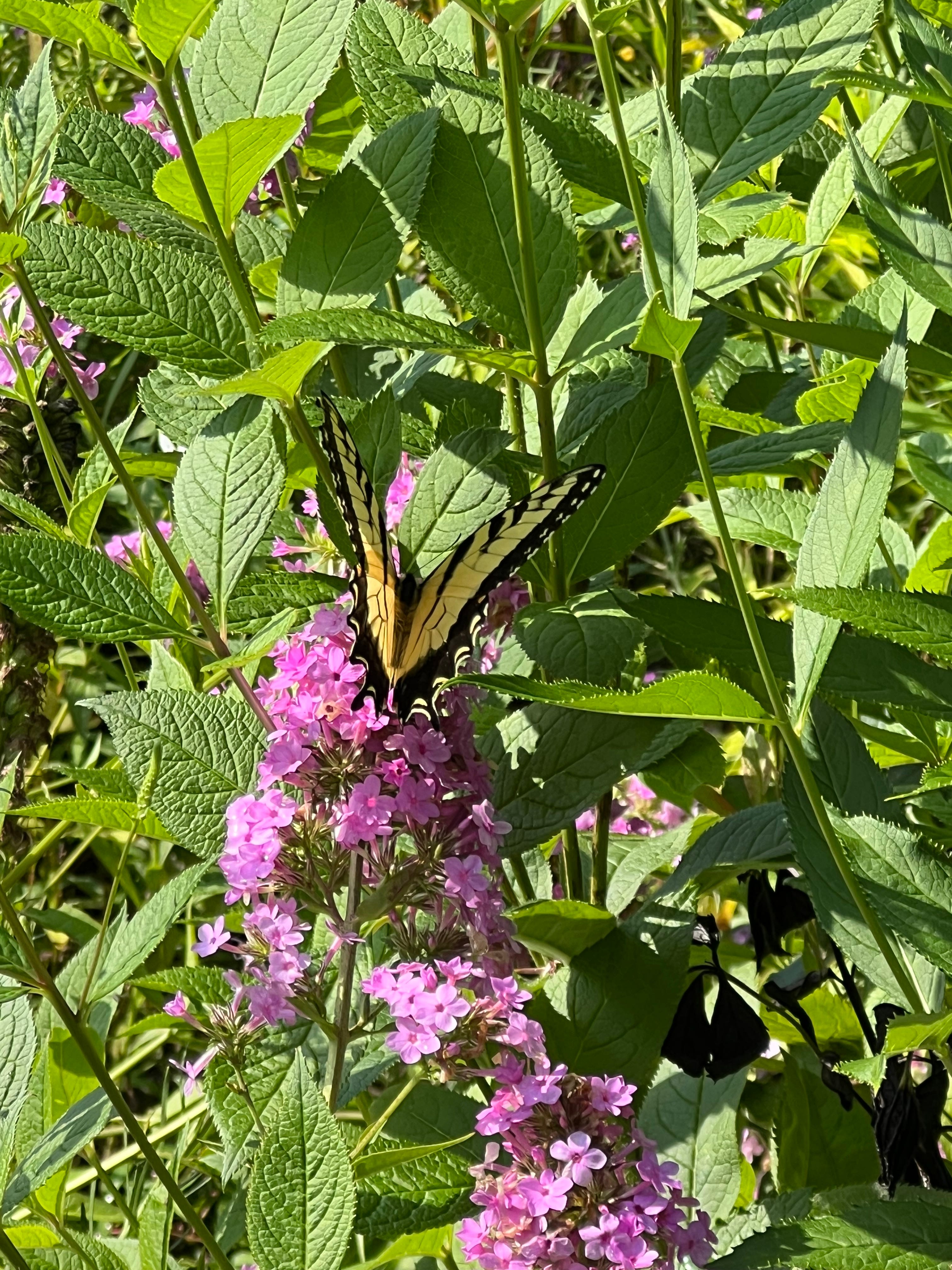
Native eastern tiger swallowtails (Papilio glaucus) love native garden phlox (Phlox paniculata), here in the patio garden:
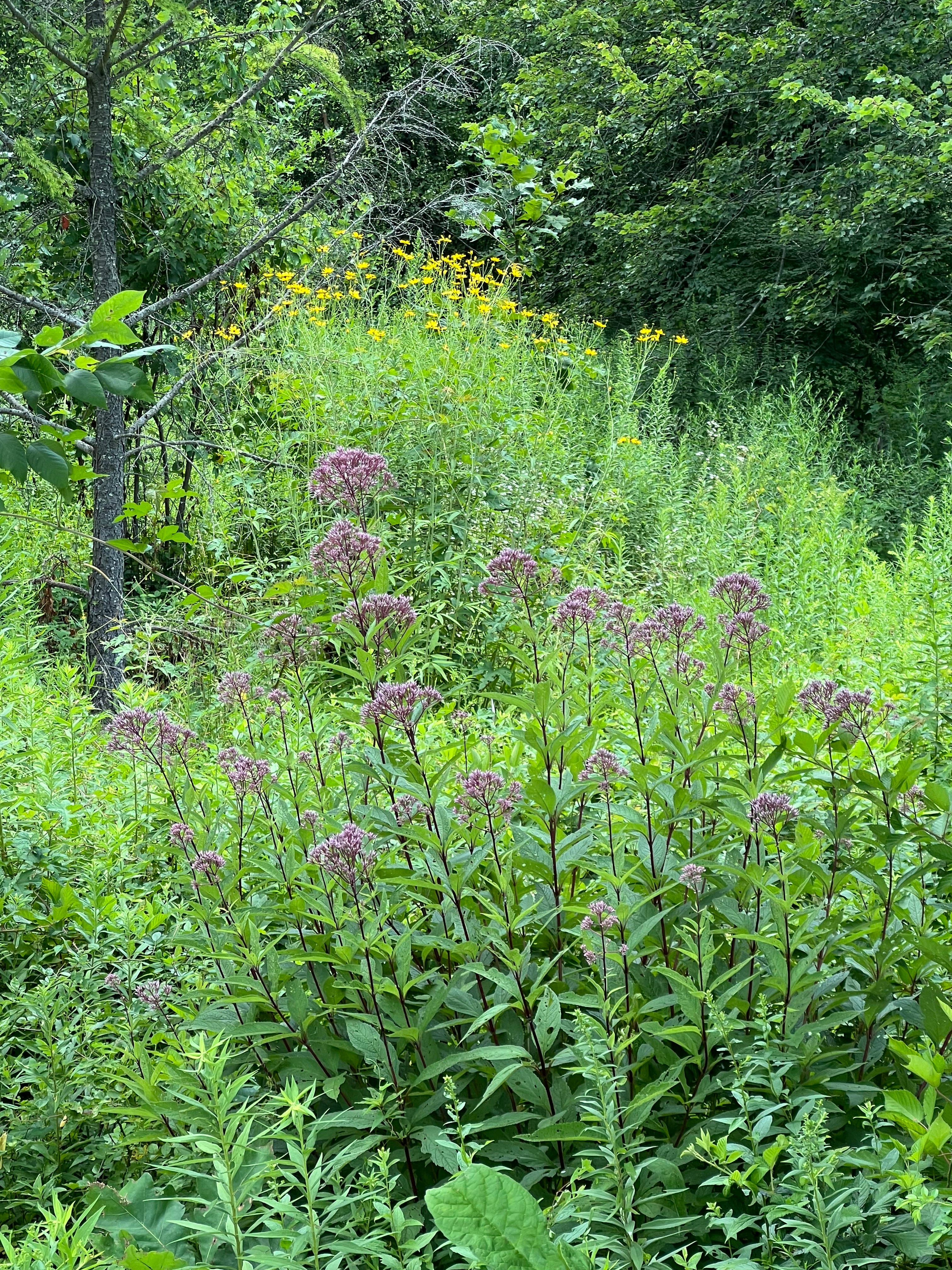
Native Joe Pye weed (Eutrochium purpureum) and tall tickseed (Coreopsis tripteris or Anacis tripteris) grow among goldenrod (which will flower in another month) in the barn meadow:
Backyard Stewardship is a reader-supported publication. To receive new posts and support my work, consider becoming a free or paid subscriber.
Comments
Nothing yet. Say the first thing.
Sign in to join the conversation.