
The Trump administration is collecting and consolidating reams of personal data, looking to create a big not-so-beautiful database about, at the very least, everyone who is present in the United States. So far, there has been little, if any transparency about how the data are being collected and what the federal government is doing with it.
Lauren Harper of the Freedom of the Press Foundation would like to know more. So would many others.

Here’s some background: President Trump issued an executive order calling for data pooling and consolidation among federal agencies more than a year ago - on March 20, 2025 – a few short months after he was sworn into his second term as president. The goal, according to his statement, was “eliminating bureaucratic duplication and inefficiency while enhancing the Government’s ability to detect overpayments and fraud.” The effort also gives the federal government unlimited access to databases maintained by the states when federal funds are involved. This includes databases maintained by third-parties, such as private contractors working on state and federally funded programs.
Who could be against marshalling government forces against overpayments and fraud? Seems reasonable.
Harper says the goal is far more nefarious. It is “every authoritarian’s dream.,” she wrote in the Intercept.
“This powerful tool would empower the government to conduct previously unimagined levels of surveillance and harassment against its own people.” And, she maintains, the database would contain “intimate details about every resident of this country, fully searchable by artificial intelligence.” It also would make the data an easy mark for bad actors inside and outside the United States to scoop up and use for who knows what.
So the Foundation set about trying to learn more. Since May 2025, the Foundation has filed open records requests with the Office of Management and Budget under the federal Freedom of Information Act for documents about this program. FOIA requires some type of response to requestors within 20 days of the government agency’s receipt of the request. The Foundation got that acknowledgement, but since then it has been crickets from, the Office of Management and Budget, the point agency for receiving reports from federal agencies about their data.
Traditionally, the millions of pieces of personal data that the federal government possesses have been separated by online firewalls that prevented much data sharing within the government. The idea is to protect personal privacy and ensure that the system protects the privacy of people who file their income tax returns, pay into the Social Security system, or in other ways interact with the federal government, without fear that the information would be disclosed.. This system has, among other benefits, ensured that people who are not legal residents but are required to file various forms and payments with the federal government, respond to the Census and answer other requests for information from the federal government, will do so. The system also shields health information, payroll and pension data of federal employees or others who may at times be the recipient of federal funds, such as contractors.
But it’s not a blanket exemption.
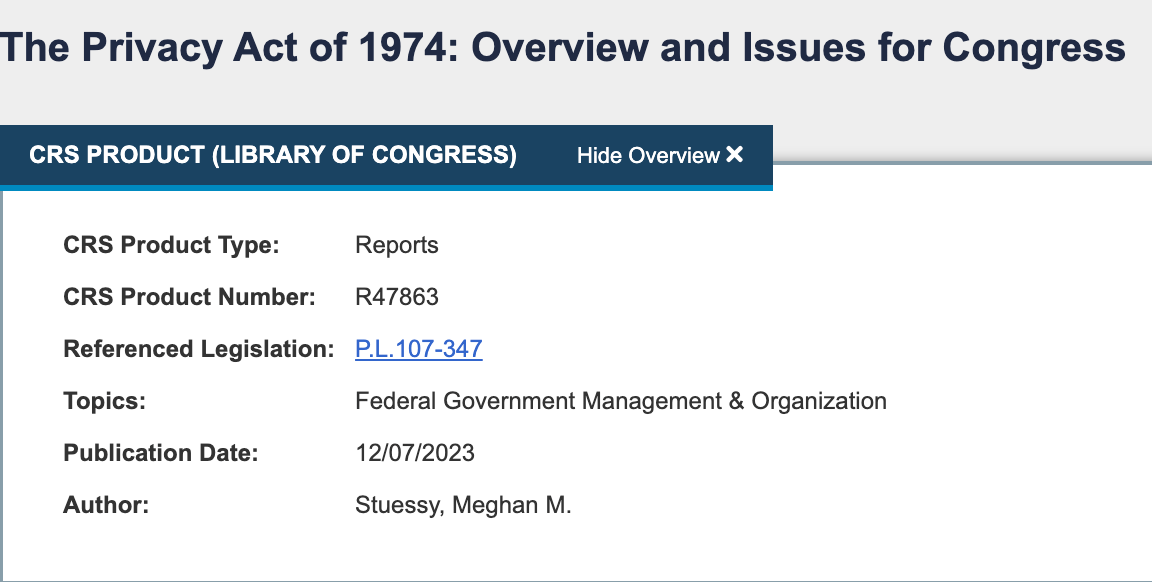
The 1974 federal Privacy Act already permits the federal government to get access to personal information held by its various agencies, including in the course of investigating waste, fraud and abuse, and other crimes.
Harper maintains that putting personal information into one big database, which she believes is the Trump administration’s goal, goes well beyond the exemptions already allowed in the Privacy Act. Having all the data in one place could make it much easier for the government to spy on any U.S. resident or citizen, she believes, and also makes the data easier to obtain by bad actors and hackers.
There are clear signs that the erosion of privacy that Harper fears is already occurring.
Immigration and Customs Enforcement obtained access to data about Medicaid recipients, and banking information.
The Transportation Security Administration is sharing biometric passenger information with ICE. Until the practice was quietly introduced by the Trump Administration, TSA had not usually been flagging people who travel domestically.
The Government Accountability Project, representing Charles Borges, who had served as the chief data officer at the Social Security Administration, filed a complaint in August 2025 claiming that there were major risks to the security of the agency’s data.
“In recent weeks Mr. Borges has become aware through reports to him of serious data security lapses, evidently orchestrated by DOGE [Elon Musk’s Department of Government Efficiency] officials, currently employed as SSA employees, that risk the security of over 300 million Americans’ Social Security data.”
They include “apparent systemic data security violations, uninhibited administrative access to highly sensitive” … environments, and potential violations of internal SSA security protocols and federal privacy laws by DOGE personnel…” Borges’s assertions, the complaint said, point to risks to the security of the data of 300 million people. This complaint is still being processed.
As the data consolidation and sharing continue to grow, the Freedom of the Press Foundation is suing to get the reports that federal agencies are now required to submit about their data practices and databases to the Office of Management and Budget.
Ginger Quintero-McCall, of the Free Information Group law firm, co-founded with Kevin Bell, is representing the Freedom of the Press Foundation. Quintero-McCall told me that getting a clearer understanding of how the new data mining system is set up is crucial. “The basic goal was to dismantle Privacy Act protections,” she said. But the Privacy Act’s key purpose was to create information silos and create safe methods to collect and store information. “That was a feature of the Act, not a bug.”
She put in this way in the lawsuit:
“The elimination of privacy guardrails…would create profound privacy problems for millions of Americans whose data is stored in government databases. Existing privacy laws, regulations and policies set strict standards about who can access what data, why, and what they can do with that data. Eliminating those guardrails would potentially allow unfettered, untracked access by anyone within government.”
Not only that, she wrote, the Privacy Act allows the public a clear understanding of what data are being collected about them and enables people to seek corrections of inaccurate information.
“Experts have noted that elimination of ‘information silos’ could also allow for the creation of increasingly detailed dossiers of Americans, which could then be used for any purpose the Trump Administration proposes,” she noted.
Talks are underway with OMB, but Quintero-McCall said she was unable to offer more information at this time.
The lawsuit highlights another major problem – an overall indifference if not outright defiance of open government laws by the Trump administration. No administration has been particularly proficient in responding to public records requests. My own FOIA to the Department of Agriculture took more than two years, and was only resolved when someone else sued for the same information – and that was during Trump 1 and then the Biden administration.
As Nate Jones noted recently in The Washington Post:
“As hundreds of thousands of federal employees were fired or chose to leave the government last year, FOIA requesters — myself included — wondered: Would these personnel reductions further undermine the federal government’s already strained ability to follow federal law and disclose public records when requested under FOIA?
“The answer, we now know, is a resounding yes. Attorneys for at least 13 agencies and departments have explicitly stated in 26 FOIA lawsuits that the downsizings were the reasons for failures to meet FOIA deadlines, according to a Washington Post review of 339 active FOIA lawsuits.”
And Jones believes that the actual number of requests that are overlooked, ignored, or simply stalled, is much higher.
Given that poor record, it will be illuminating to see if the Freedom of the Press Foundation lawsuit will make a dent in the information blockade that the Trump administration has erected across the federal government. I’ll be tracking this, so stay tuned here.
If you want to read more about state and local secrecy and the harm it inflicts on communities, my publisher The New Press is offering a 30 percent discount on my book Backroom Deals in Our Backyards: How Government Secrecy Harms Our Communities and the Local Heroes Fighting Back. You can order it here and use coupon code Backroom30
Checking in on FOIA compliance:
As I wrote in two previous Backroomdeals.substack.com articles, several federal agencies have yet to file their annual reports on FOIA compliance, which were due on Feb. 1.
Among the non-filers:
Health and Human Services
Homeland Security
Labor
Office of Management and Budget (the agency failing to respond to FOIA requests from the Freedom of the Press Foundation)
Veterans Affairs
Office of Special Counsel (where Borges filed his whistleblower complaint) U.S. Agency for International Development, which was gutted by Elon Musk’s DOGE team.
To its credit, the Department of Justice finally filed its own report.
You can read the list for yourself here.
No posts
Comments
Nothing yet. Say the first thing.
Sign in to join the conversation.