
The mainstream media, which I regard as a major source of news, has been closely following the nearly $1.8 billion self-dealing fund that President Trump’s compliant acting attorney general and former personal attorney Todd Blanche recently announced. But because there continues to be a firehose of other news pouring from the White House – the triumph/Trump arch, the war in the Middle East, gasoline prices, to name a few - some troubling developments at the state and local level have not yet attracted the national attention they richly deserve.
Take, for instance, Florida’s new anti-terrorist law.
You may recall – but not surprising if you don’t – that last September, President Trump signed National Security Presidential Memo 7, that broadened the definition of domestic terrorism. According to his memo, domestic terrorists are not only perpetrators of violent crimes, including hate crimes, but also are defined as those who reveal information about government agents, among others supposed crimes.
Here’s an excerpt from the White House announcement on Sept. 25, 2025 : “Common threads animating this violent conduct include anti-Americanism, anti-capitalism, and anti-Christianity; support for the overthrow of the United States Government; extremism on migration, race, and gender; and hostility towards those who hold traditional American views on family, religion, and morality.”
And this: “the goal of these campaigns can be to obstruct the operations of the Federal Government as well as aid and abet criminal activity the Federal Government is lawfully pursuing.”
Federal and state laws already view incitement of violence to be a crime. Free speech extends only so far, and First Amendment advocates are usually okay with that if shouting fire in a crowded theater when there is no fire leads to violence and injury – and prosecution. Before the White House expansion of the definition of domestic terrorism, it was legally defined under 18 U.S.C. Section 2331(5) as activities dangerous to human life, and was used in conjunction with criminal charges such as conspiring to deny someone their legal rights. It could also be a factor in sentencing,
“This seventh national security memorandum from the Trump White House pushes the limits of presidential authority by targeting individuals and groups as potential domestic terrorists based on their beliefs rather than their actions,” according to Melinda Haas, a professor at the University of Pittsburgh. Haas wrote about the presidential memo soon after it was released publicly.
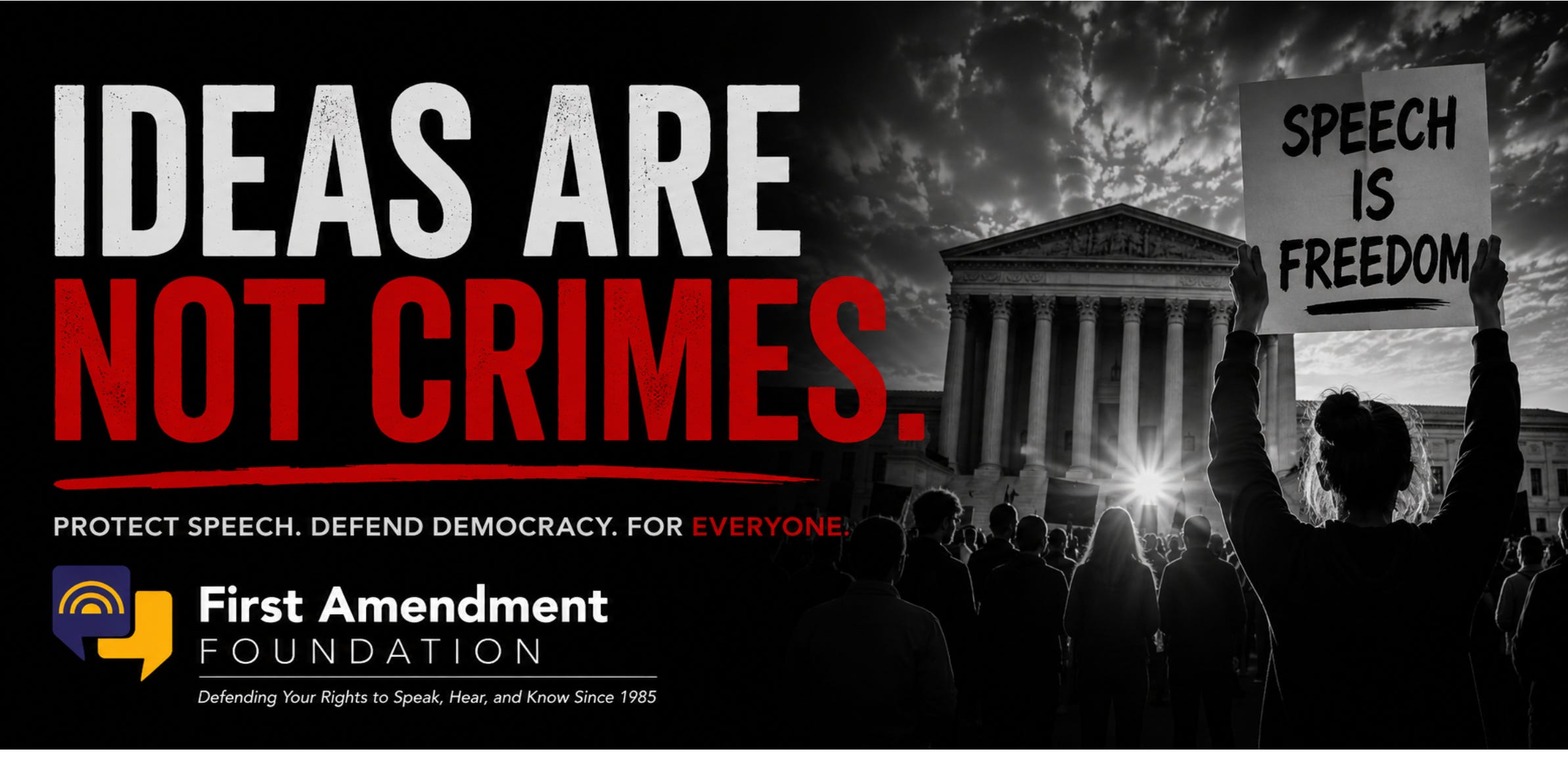
But merely criticizing the government or demonstrating peacefully in a public place is generally considered protected by the First Amendment – at least for the moment.
Not to be outdone by President Trump, Florida Gov. Ron DeSantis, a Republican, pushed for an anti-terrorism law of his own, giving him and a few others in Florida’s elected leadership the right to decide who’s a domestic terrorist and a foreign terrorist. This law is scheduled to take effect on July 1, a few days before the 250th anniversary of the Declaration of Independence on July 4. DeSantis is still thought to harbor presidential hopes, and is term-limited and cannot run for governor again this year. So getting this law on the books, even if it later fails to pass judicial scrutiny, may in some quarters help him with his political aspirations.
The Florida law seems to clearly threaten both the Constitution’s First Amendment’s guarantees of free speech and freedom of assembly and the Fifth Amendment’s guarantee of due process, as well as similar state guarantees. The terrorism law empowers the Florida Department of Law Enforcement to designate a group or individual as a domestic or foreign terrorist organization and then send the recommendation to the governor and the rest of his cabinet to reject or accept it. The governor, the state attorney general, the state’s chief financial officer, and the agriculture commissioner, all elected separately, make up the cabinet.
This group would then be able to require the expulsion of public university students who support the alleged terrorist. Anyone with the terrorist label would be banned from receiving state funds.
Once a decision is made, the name or names are to be listed in the state’s Administrative Register, informally known as the “gazette.” This is not a publication that anyone not closely watching state government or working for it is likely to read on a regular basis. There is also a requirement to notify the person or group if such notification can happen “safely.”
And if you find out that you are suddenly on the list and you want to fight the label, you will have to travel to Tallahassee where there is one court designated to review the terrorist label, according to Bobby Block, executive director of the First Amendment Foundation in Florida, which opposed the bill.
The law also includes an exemption to Florida public records laws and allows the decisionmakers to meet in secret to designate terrorists in Florida, and does not require an explanation to the person or group designated.
None of this is particularly surprising, given DeSantis’s penchant for ignoring or actively working to unravel Florida’s once strong open government laws, and his effort last year to label the Council on American-Islamic Relations a terrorist organization. The move, which followed a similar declaration in Texas, was halted at least temporarily by a federal judge on First Amendment grounds. DeSantis is appealing.
I spoke with Block of the First Amendment Foundation, who was part of a coalition that fought the Florida terrorism legislation. The foundation is planning a lawsuit to challenge it.
(images and video in this article from the First Amendment Foundation)
“It opens the door to punishing association, speech, and support in ways that raise serious First Amendment and due process concerns,” Block said.
”The goal is crushing dissent. Govern through power, and use power to limit dissent and public involvement,” he said.
“Where others fear to go, the Florida legislature has no problem doing this.”
The combination of secrecy, the power to designate and punish people without the ability to respond in real time, and the prospect of criminal prosecution to anyone who might support those
labeled as terrorists is a “perfect storm,” he said.
The Florida government, he said, “is not just chilling speech, it is freezing it.” And he is worried that other states will try to follow Florida’s lead.
Here’s a particularly interesting excerpt from the law, annotated by me in parentheses. You can read the entire measure here by clicking on the PDF version in the lower left of this link.
“The Chief of Domestic Security must provide written notice to the Governor and Cabinet of his or her intent to designate an organization as a domestic terrorist organization or a foreign terrorist organization, which notice must be accompanied by a summary of the basis for such designation. (So details are provided to the governor and cabinet, but as you will see below, not to the person or group now labeled a domestic or foreign terrorist organization - MS).
(b) If the organization has a readily discernable location or office and notice can be delivered or furnished to that organization safely: 1. The notice of intent must be delivered or furnished to the organization. The written findings regarding the basis for such designation need not be included with the notice. (So no rationale for the terrorist label is required for the recipient’s notice from the government, which can only be delivered under certain circumstances. Anyone heard of registered mail?-MS) 2. The notice must provide the date, time, and location of any public meeting regarding the designation. (Except the meetings are expected to be held in private. - MS). 3. The notice must provide information on how to object to the designation or appeal a designation. (c) If the Governor and Cabinet hold a meeting to consider the notice of intent, the meeting materials relating to the notice of intent, excluding information that is confidential, exempt, or otherwise protected from disclosure by state or federal law, must be published and made available to the public.“ (So what is releasable to the public and at what point in the process? Block believes very little is releasable. The wording here is very murky MS). - Miranda Spivack
If you want to read more about state and local secrecy and the harm it inflicts on communities, my publisher The New Press is offering a 30 percent discount on my book Backroom Deals in Our Backyards: How Government Secrecy Harms Our Communities and the Local Heroes Fighting Back. You can order it here and use coupon code Backroom30.
No posts
Comments
Nothing yet. Say the first thing.
Sign in to join the conversation.